The first thing to keep in mind about Blast Motion’s sensor is that it’s not just designed for baseball. Yes, like the Diamond Kinetics SwingTracker, you can attach the sensor to the end of a bat to track swing speed and direction. And like the Zepp sensor, the Blast sensor can also be used to track a golf swing. But Blast’s approach revolved around designing a high-quality, general purpose sensor, and then building specific applications for baseball, basketball, golf, action sports, and athletic performance around it.
“We didn’t approach this as trying to design a swing sensor or a specific sport product,” senior director of marketing Donovan Prostrollo said. “What we designed it to do was to be a natural motion capture product, and then we applied that to different sports, so it doesn’t pigeonhole our product.”
At the heart of the Blast sensor are inertial measurement units (IMUs), the combination of accelerometers, gyroscopes, and magnetometers that have become ubiquitous in devices like smartphones and tablets. But Blast has made two improvements to make the device more accurate. First, Blast Motion uses multiple IMU chips (although they wouldn’t disclose how many) to capture a wider range of movements. Second, the Blast sensor was also designed to use what founder Mike Bentley referred to as “tactical-grade” technology, a combination of more precise sensors, more processing power, and on-the-fly calibration that improves the device’s accuracy and consistency from one movement to the next.
But despite the intense technological focus, both Bentley and Prostrollo stressed the importance of keeping their outputs simple for the end user.
“You’ll find other solutions out there really overwhelm users with numbers, which is both good and bad, because if users don’t know which number to focus on, you’re not really helping them, you’re actually potentially making it worse,” Prostrollo said.
“At the end of the day, [the athletes] would love the technology to just completely disappear,” Bentley added. “And that’s one of the goals of Blast is how do we make the device disappear.”
When compared to other bat sensor apps, Blast lacks the three-dimensional rendering of the swing. Instead, the Blast app revolves around video, typically captured by setting the device on a tripod and automatically clipped so that only the events of interest are included. Prostrollo argued that the focus on video gave Blast an edge in capturing the entire movement, not just key metrics.
“We decided from the beginning to capture video and do it natively as part of the app so it’s really integrated into our DNA,” Prostrollo said. “And the cool thing about that is when you pair video and you compare the level of consistency out of our product it really does an amazing job.”
And Blast recently announced an adaptive slow-motion feature that adjusts the playback speed around the event.
“Basically, we know exactly when the impact occurred, when the swing started, and when the swing ended, and based on that we can speed up and slow down the video,” Prostrollo said. “We can also take the metrics and overlay them on top to get this dynamic fill, so it’s not just a metric in isolation.”
Blast verified the accuracy of its metrics using motion capture systems. As an example, Prostrollo said the system was within 1 mph of the motion capture system “85 percent of the time” and Bentley claimed that the Blast system “outperforms our optical system when you talk about rotational velocity” as verified by higher-end devices more commonly used to test aeronautical and military-grade IMUs.
Bentley and Prostrollo stressed not only the device’s accuracy but also the device’s consistency, so that identical swings or jumps would produce identical sensor readings. They attributed this consistency to improvements in their manufacturing process, and claimed it made a big difference to the professional athletes they collaborated with.
“The challenge is pro athletes absolutely can recognize that day one, the amateur athletes won’t necessarily realize that a product’s not as accurate as they want until it’s too late: they’ve purchased it, they’ve gone out, they’ve tried it, and they wonder why their swing speed varies by 6 mph when it’s all the same,” Prostrollo said.
Despite being a relatively new company, the founders of Blast Motion have been in the inertial sensor business for a quarter of a century. Before entering the sports world, their focus included military and medical products.
“This is not the first sensor we’ve ever manufactured,” Bentley said. “When we originally designed the sensors, it wasn’t for a single application. We wanted to be able to use the sensor and cross-pollinate across all applications.”
As Blast Motion began adapting its offerings for new markets, it worked with coaches, professionals, and other subject matter experts to design useful applications. But Bentley said there was a lot of overlap between the biomechanical elements underlying the different sports. Even more surprising, he said, was the overlap between social circles across different sports.
“What’s pretty unique about when you do get into the inertial world of working with different professional teams, how many baseball players work with professional golfers, and how many golfers play with hockey players,” Bentley said. “So the world is pretty small, and when you get a pretty exciting product, the word travels pretty fast in those worlds.”
The company currently works with a number of action sports ambassadors including Mike “Hucker” Clark and Greg Lutzka, as well as some NBA and MLB players they declined to name, citing confidentiality. And Blast Motion is working closely with bat manufacturer Easton as it gears up to release the Easton Power Sensor this summer. Little information is currently available about the project, but judging from the screenshots in the iTunes App Store, the interface at least will be very similar to Blast’s Baseball Replay app.
Looking to the future, Prostrollo said the biggest change would be not on the technological side but rather on the adoption side, as wearable sensors like Blast become more and more ubiquitous among both amateurs and pros.
“We’re at the point now where the average consumer has access to this technology, it’s no longer the pro athlete,” Prostrollo said. “What you’re going to see is a whole new generation of athletes leveraging the data and the technology, having a history to go back on, and really be able to do something very meaningful and different with that.”
It’s the return of the News Roundup. Here are some of the sports-tech stories we found interesting this week.
ESPN is issuing its first magazine cover featuring eSports. In fairness, it also features running back Marshawn Lynch, as he’s had his likeness added to the upcoming Call of Duty: Black Ops III. We’re not quite to the point where League of Legends players are gracing the front cover, but it’s a start.
The Wall Street Journal has a fascinating look into how the people of Cuba are watching their favorite American television. Basketball, baseball, even HBO — it’s all broadcast not by satellite, but by sneaker.
As a dedicated lazy person and as a golfer that spends a lot of his time criss-crossing the fairways, the GolfBoard might be right in my wheelhouse.
You know all that cool 3D/interactive/holographic stuff that teams and facilities are installing? Soon, all that tech might come from part incubator, part tax write-off known as the Mark Cuban Center for Sports Media and Technology. Say what you will about the man, but sports and technology seem to be two of his stronger suits.
This is technically from last week, but if you didn’t get a chance to see American Pharoah race Secretariat, you should. It’s amazing what a little archival footage and some video syncing can do.
For some reason, people think it’s fun to mock pitcher Alex Torres for wanting to protect his melon. Strides are being taken to maintain protection while making hats look a little less puffy, and perhaps a similar product being adopted by a prominent soccer player will help people wanting to avoid head injuries seem a little more commonplace.
That’s it for this week. Have a great weekend. Be excellent to each other.
It’s been a long road leading to this—if a prefatory article on Monday and the regular season on Wednesday can be said to qualify as long. The showdown has come: Venezuela and the Dominican Republic facing off, best of nine, for the championship of (non-American) all-time national baseball teams.
After Wednesday’s results, one could be forgiven for thinking this series a formality. The Dominican Saints ran rings around their seven opponents in the regular season to the tune of a 112-42 record. The Venezuela Oilers earned a wild-card berth, but finished 22 games back in doing so. What hopes did they have?
I spent a little time rummaging through the internals of the two teams, looking for some vulnerability in the Dominicans that Venezuela might be able to exploit. One brief hope was a fine Venezuelan record, 20-10, against southpaw starters. Too bad the entire Dominican pitching staff, starters and relievers, is right-handed.
This suggested the alternative of packing the Oilers’ lineup with lefties, but that doesn’t quite work either. Carlos Gonzalez was their only starter who bats left-handed, with main catcher Victor Martinez a switch-hitter. Backups Pablo Sandoval at third base (switch) and Bobby Abreu in right field (left) would help, but there could be no full-bore platoon assault on the Dominican arms.
Worse, Venezuela’s pitchers might be mismatched. The Oilers carried two southpaw starters in Johan Santana and Wilson Alvarez. They would face a Dominican lineup with just one left-handed regular, Robinson Cano.
The one weakness Venezuela could attack might be one they would scarcely see. Dominican starting pitchers led the league in ERA, but their bullpen came in last. Keep it close and get into the pen, and Venezuela could steal a few games. But with the Dominican starting five averaging almost 7 2/3 innings a start while posting 40 complete games, a bullpen strategy could be futile.
Anything can happen in a short series: that’s sabermetric gospel by now. Regardless, it felt like Venezuela would need something special on their side if they were to overcome a monster Dominican squad. I considered quitting my policy of computer control and managing the Venezuela Oilers myself.
Then I decided they had the odds stacked against them badly enough, and left it with the AI.
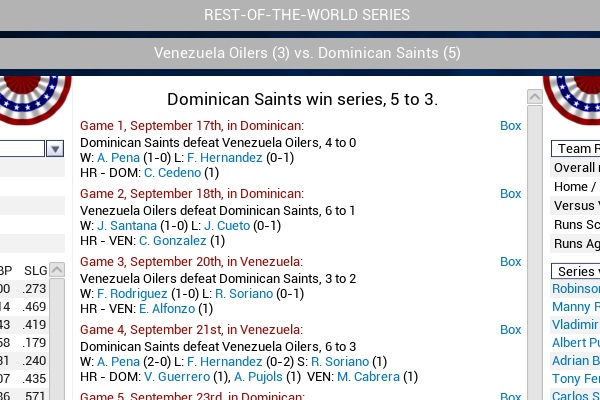
Thus began the Rest-of-the-World Series.
Game One
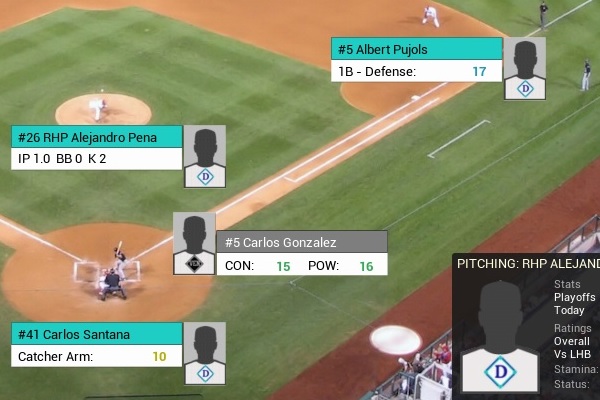
Alejandro Pena took the mound for the Dominicans, while the Venezuelans sent out Felix Hernandez. This looks like a mismatch to contemporary fans. It was, but the other way.
Yes, that’s a young Albert Pujols on defense. Thanks for noticing.
I watched this opening game using the broadcast option. Play-by-play was given for each pitch; offensive and defensive ratings were shown for each player on the field; ambient ballpark sounds provided atmosphere, including “Take Me Out to the Ball Game” after six and a half. (It was admittedly incongruous to hear fans chattering in recognizable English during a game theoretically being held in the Dominican Republic, but you can’t fault OOTP for playing the percentages.)
The Saints touched up Felix for two runs in the second, then let Cesar Cedeno finish the work. He homered off Hernandez in the third, and tripled in the fifth, coming home on Vladimir Guerrero’s sacrifice fly. Felix would leave after five, down 4-0.
Pena made that score hold up. He faced just one over the minimum for the first seven frames, and completed his shutout in a crisp 96 pitches. Anyone anticipating a Dominican rout got no contrary evidence from this 4-0 blanking.
Game Two
I went with the webcast option for this game. Anyone who has followed a game on the MLB At Bat app will be on familiar ground, the story coming in pitch by pitch. There’s a pitch-tracking box, showing locations. (I must report the harsh realism of OOTP: the tracker will show umpires missing balls-and-strikes calls.) For pure nerdish pleasure, there is even a rolling win probability measure for the teams.
Cueto really has his game face on. You can’t read him at all. (Actually, I just didn’t bother adding faces to players.)
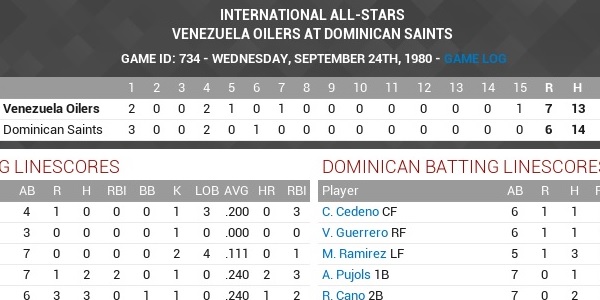
Johnny Cueto got the ball for the DR, while Johan Santana started for Venezuela. The Oilers broke their drought early, scoring three in the first on two triples, an error, and two productive outs. Manny Ramirez brought Tony Fernandez home in the Saints’ first, but Venezuela immediately got that tally back on Luis Aparicio’s RBI single. A Carlos Gonzalez homer opened a two-run fifth that salted away the game, 6-1 to the visiting Venezuelans.
Santana went eight, giving up just three hits and the lone run. He was pulled for Wilson Alvarez to pitch a garbage ninth despite having thrown just 84 pitches. Cueto took the loss, the first time all year he lost consecutive decisions. The Dominican bullpen belied its seeming weakness to pitch four scoreless innings. Oddly, Pedro Martinez was among the relievers, retiring a lone batter in the ninth. Didn’t they have other uses for him?
Regardless, Venezuela had managed to split the opening games held at the Dominican Republic. Their task was down to winning four of seven rather than five of nine, and they now had the home field advantage, for whatever that might be worth.
Game Three
I had to stop dallying with the snazzier methods of game-watching and strip down my viewing experience, lest I be running this replay well into the weekend. A pity for me, as this was the first game of the series that cried out to be savored.
Juan Marichal of the Saints and Kelvim Escobar of the Oilers got the call, and pitched a close-fought duel. Escobar got help from three double plays in the first four innings to keep posting zeroes, while Vladimir Guerrero’s muff of Richard Hidalgo’s fly ball hung Marichal with an unearned run in the second. Both pitchers held the line until the seventh, when Vladdy atoned with a RBI single to tie it, and Edgardo Alfonzo took Marichal deep to untie it.
Ugueth Urbina pitched a perfect eighth to set up the save for Francisco Rodriguez. Miguel Tejada greeted him with an infield hit, and one pop-out later, pinch-hitter Felipe Alou singled him to third. Cesar Cedeno tied the game 2-2 with a base hit, before K-Rod buckled down to strike out Guerrero and Manny Ramirez.
Venezuela weathered the disappointment of the blown save. Victor Martinez jumped on Rafael Soriano’s first pitch for a single. Bobby Abreu grounded out, but Edgardo Alfonzo worked a walk. Pinch-hitter Melvin Mora laced a single to right, so fast to Guerrero that Martinez was held up at third. This proved the sound play, as Luis Aparicio lined the walk-off hit over short to give Venezuela the 3-2 win.
Game Four
The starters for this game were close to a shock: Felix Hernandez and Alejandro Pena again. Three-man rotations for a playoff series being held in the 1980 era certainly weren’t strange, but the pitcher being excluded was. Would Pedro Martinez not take the mound to defend his 20-game winning streak? Would the Dominicans really try to win it all without starting him?
By purely analytical standards, this was no outrage. I observed myself that, by FIP, Pedro was the fourth-best starter on his team that season. yet it felt so wrong that I almost intervened with the AI.
Almost. But the game went on.
The Saints broke up a scoreless contest in the fourth, Carlos Santana driving Albert Pujols home. Venezuela tried to limit the damage with a two-out intentional walk to Tony Fernandez, bringing up the pitcher. Pena made them pay with a bases-clearing double.
That was effectively the ballgame. Both teams scored in the seventh and eighth without really altering the balance of power, and the Dominicans cruised to a 6-3 win to pull the series back even. Pena got his second straight win against King Felix, while Rafael Soriano pitched the ninth for the courtesy three-run save.
Despite the downbeat end, it was another split. The challenge was down to three out of five, as the series went back to Dominican turf for the next two.
Game Five
Cueto and Santana on the mound again. The three-man postulate seemed confirmed. I could only trust that the AI knew what it was doing in holding out Pedro.
This one got away from the Oilers quickly. Pujols rang up a three-run dinger in the first, and added a solo shot in the third that put the Dominican Republic ahead 5-0. Johnny Cueto recovered from his Game Two struggles to register a four-hit shutout, his sinker producing 19 ground-outs on the day. The 6-0 whitewashing gave the 3-2 series lead to the Saints.
Game Six
There is something about Game Six that, even more so than Game Seven, produces memorable baseball. Think back on the World Series of 1975, 1986, 1991, and 2011. Now this Game Six can, in its modest way, join that group.
(Yes, I know those were seven-game series and this one is nine. Leave me alone: I’m being poetic.)
This wonderfully crazy game was defined by its pitchers, but not the way you would expect. Marichal and Escobar both gave up first-inning homers, Miguel Cabrera with a two-run shot and Manny Ramirez with a three-run dinger. Bats cooled off for a couple innings, including a half-hour rain delay in the second, and then the fourth inning turned things upside-down.
Venezuela scored two in its half, capped by pitcher Kelvim Escobar’s RBI single. In the home half, Juan Marichal got his own run-scoring hit with two outs. He then advanced on an Escobar balk, and came home on Cesar Cedeno’s single that knocked Escobar out of the game. Both starters had driven in runs, and there was more to come.
The Oilers tied the game at five the next inning on a two-out rally, but lost a chance to go ahead the next inning when Dave Concepcion made the final out trying to go first-to-third on Cabrera’s single. The bottom of the sixth saw Marichal contribute again with the bat, another two-out RBI single that made it 6-5 Dominican.
Marichal got lifted in the seventh for Bartolo Colon, who promptly balked Carlos Gonzalez home to level things at 6-6. After the stretch, Oilers reliever Rafael Betancourt fought through a jam left to him by Anibal Sanchez, but with second and third and two gone, intentionally walked Carlos Santana to get to Adrian Beltre. The Dominicans countered by pinch-hitting David Ortiz, but he could only roll one over to third to snuff the threat.
Here the madness, or at least the scoring, subsided for a long while. The bullpens locked up the game in the eighth and ninth, and on, and on. Closers Francisco Rodriguez and Rafael Soriano came and went, and the deadlock remained. By the 11th inning, both teams had exhausted all their position players, meaning the long-relief pitchers now in the game—Carlos Zambrano for Venezuela and Ramon Martinez for the DR—had to bat for themselves.
Those who know something of Zambrano can guess how this ended. With two gone in the top of the 15th, Zambrano grounded a ball past Robinson Cano, bringing Carlos Gonzalez home from second. Then, in his sixth inning of relief work, he tottered from hits by Cano and Miguel Tejada, but hung on to secure the 7-6 victory.
Only thing missing was the threat of Mike Scott pitching the next day.
Having secured another split, this one very hard earned, the Venezuelans returned home. The five-of-nine mountain was down to a two-of-three crag, and as hosts of the next two games, they had a chance to win it all at home.
Game Seven
The sequel, as usual, could not top its predecessor. Robinson Cano’s two-run homer in the second gave Alejandro Pena an early lead, and a tack-on run plated on Dave Concepcion’s second error of the day seemed ample insurance for the Saints. But Pena began cracking in the ninth, surrendering his fourth and fifth hits of the day and bringing the tying run to the plate. Rafael Soriano came on to retire Magglio Ordonez for the final out. The Dominicans had their third shutout win, 3-0, and were now within one game of the title.
Game Eight
For the third time, Johan Santana faced Johnny Cueto. It looked like the bad Cueto of Game Two had arrived, with a pair of bases-loaded jams in the first two innings. He got double plays each time to emerge unscathed, and settled down to allow just one more Venezuelan baserunner the rest of his day.
Support came from Felipe Alou. He homered in the fourth to give the Saints the 1-0 lead, then in the sixth singled Manny Ramirez home as part of a two-run frame. It was still 3-0 when Cueto was pulled for a pinch-hitter in the top of the seventh. He had retired 11 straight Oilers at that point, but his pitch count was over 100 and the manager wanted a fresh bat to go for the kill. Julio Franco would strike out looking in Cueto’s place, on the way to a goose-egg seventh.
Venezuela would not capitalize on the opportunity offered. They would manager baserunners each inning against Bartolo Colon and Armando Benitez, but the closest they came to converting was getting Magglio Ordonez up in the eighth with two on and two outs. He would fly out to center, and an inning later pinch-hitter Andres Galarraga would fan at Benitez’s full-count heater to end the game and the series.
Champagne and instant-merchandising caps are not a DLC.
This series turned on pitching. The Dominicans hurled four shutouts, half the games played, without even using Pedro Martinez to start a game. Their bullpen beat expectations by yielding only two runs in 17 innings, though both runs were the decisive tallies in the pair of one-run games the Venezuelans pulled out. Alejandro Pena was the no-brainer series MVP, with three wins, a 1.05 ERA, and more strikeouts (15) than hits allowed (14). Among batters, Albert Pujols was the standout, going 12-for-31 with four walks. His three home runs and five runs batted in led all players for the series. For Venezuela, Miguel Cabrera with two homers and Edgardo Alfonso with a .407 on-base percentage were offensive achievers.
For the whole season, Carlos Gonzalez won the MVP Award, with Albert Pujols and Manny Ramirez 2-3 in the voting. The Cy Young went to Felix Hernandez, a bittersweet award given his nightmare 0-3 postseason pitching against Pena. (Cueto and Pedro were second and third.) Willie Hernandez of the Puerto Rico Sharks got the nod as the league’s top reliever.
There isn’t really much arguing with the result of the Rest-of-the-World Series. The Dominican Republic dominated the regular season in historic fashion, and brought superb pitching to bear to grind out the final triumph. But the Venezuelans need not hang their heads: they made the Dominicans play their best to earn that glory.
My thanks to David Temple, Grand Poobah of TechGraphs, for the opportunity to do something a little out of the usual TG wheelhouse. Signing out.
(Full disclosure: In order to conduct the simulation, I was given a complimentary copy of Out Of The Park 16. I gratefully acknowledge OOTP’s generosity. I even more gratefully acknowledge the assistance of Brad Cook, along with Lukas Berger and Chuck Hauser from OOTP for leading me through the nuances of some unusual roster creation. Had I been less boneheaded, you might have seen this series sooner, and I thank them for pulling me through.)
Major League Baseball gets a lot things right. Their Advanced Media department, the group in control of MLB.com and MLB.TV, have now updated their At-Bat app. In addition to watching games — which are still subject to local blackouts — the app now allows for constant viewing of the MLB Network’s round the clock channel. Unfortunately unlike Pinocchio, there remain strings attached to this deal.
A qualifying cable subscription is required to view the MLB Network live stream. The stream is available on iOS and Android phones or tablets as well as Mac and PCs. As noted by the crew over at Awful Announcing, the initial group of cable providers who have agreed to support the stream does not include Comcast. In addition to missing what Wikipedia calls the number one (by subscriber count) provider in the United States, those who use Charter Communications — number six by subscriber count — such as myself, are also left out.
After logging into my app, I was sad to see I was one of the million of baseball fans left out of the ability to stream the show.
The upshot is this means people on the go (or at work) have the option to view MLB Network shows, interviews and even out-of-market games while away from their televisions. Perhaps even more importantly is the inclusion of playoff and preseason games. Being able to catch a spring training game after a long winter or watching a potential series-defining game when not at home and without paying for any extra add-ons is a great move for baseball.
Last season MLB Network claimed two playoff games, Game 2 of the NLDS between the Dodgers and the Cardinals and Game 3 of the NLDS with the Nationals and Giants. In 2013 there were also two DS games shown, one from the NL and another from the AL. The same format of MLB Network getting two DS games stretches back to 2012. Given that MLB, ESPN, Fox and TBS came to an eight-year, $12.4 billion broadcast agreement that runs through 201, count on continuing to be able to see at least two playoff games per year via MLB Network’s online stream.
Even with the blackouts and the restrictions due to cable companies, this 24/7 streaming of a major sport offering represents a first in the world of sports. Yes, the NBA, NHL and NFL all have their own channels however none are simulcast in the same way MLB Network is. This move seems like a way to meet the old crowd and the new generation in the middle. More traditional TV subscribers may not find a ton of use for it and dedicated cord cutters will likely wish MLB Network didn’t require a cable package. Of course, with such a lukewarm offering, it’s hard to imagine this move generating a lasting effect. Perhaps as the NFL embraces the online streaming realm and as more and more people cut the cord, eventually a non-subscription version may arrive at some point.
General Reaction
A man, presumably speaking to his copy of Baseball Mogul, once wisely asked, “Why can’t I quit you?”
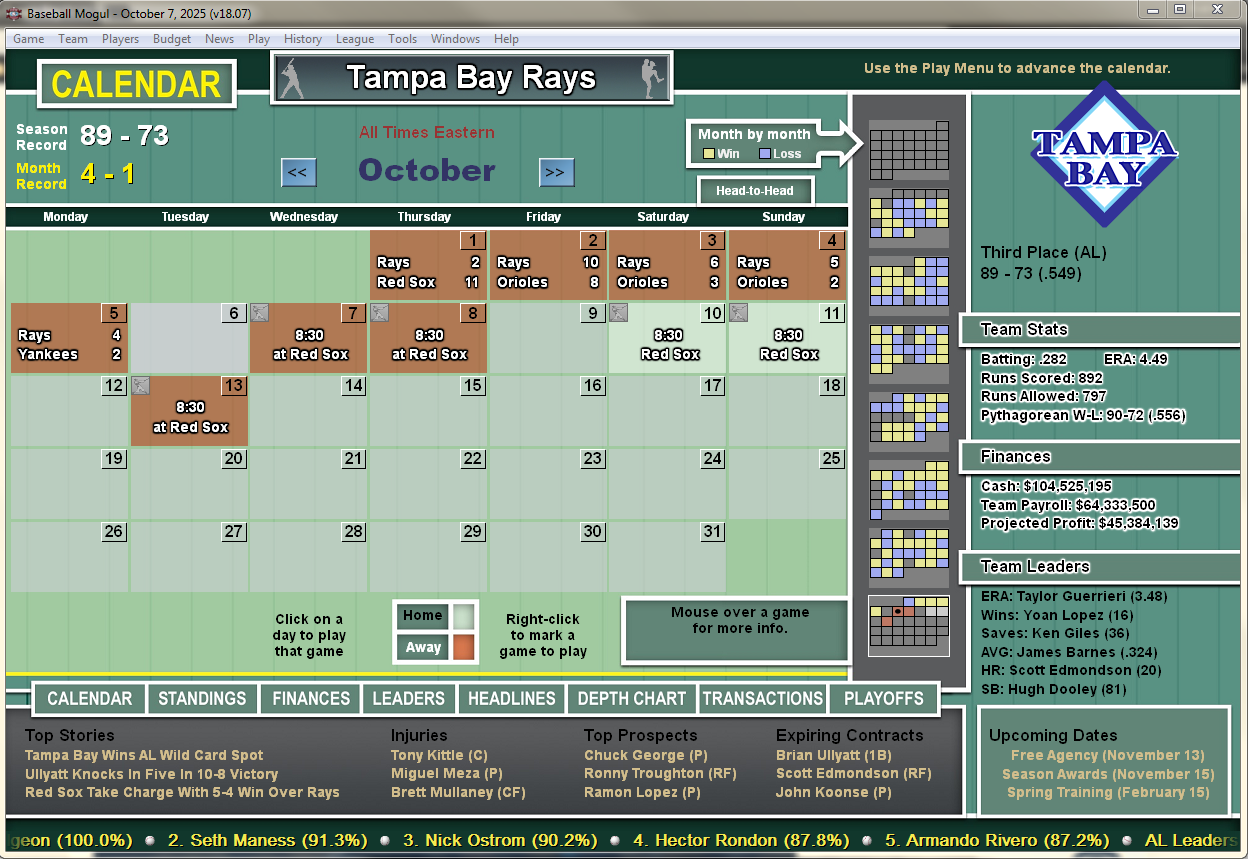
That question is as pertinent today as it was in seasons past. The Sport Moguls crew has dropped the annual naming convention (so no more Baseball Mogul 2014 or Baseball Mogul 2016 stuff). In its place, we have Baseball Mogul: Diamond Edition.
What’s different with the Diamond Edition? Well, not much, actually. I partly expected the name change would come with perhaps a major graphics or interface overhaul. Maybe they were going to simplify the game a little, or maybe add some complexities. Nope, not really. I spotted a few changes here and there from the previous version I played (that would be Baseball Mogul ’13, 96 A+)
This game is still, like, dumb levels of adddicting. If you like baseball simulation video games with large rosters and realistic aging curves, then Baseball Mogul is one great option in a field of just two choices.
Ratings
Graphics: 2.5 stars
I dinged the most recent version of OOTP on account of it’s graphics issues. That problem is more pronounced in Baseball Mogul. While neither this game nor OOTP try to entice users on graphics, it still matters that the interface looks very 1990s and the color scheme is pretty close to Eye Tuberculosis levels.
I guess the green is supposed to evoke thoughts of the Green Monster and other more classic ballparks, but it just feels like a Window 95 theme.
The in-game view is also a little weirder now. The picture of the field (at the top of the screen) is still like a photo of the field with a little computer-animated ball acting out each pitch.
But now the hitter in the middle of the screen is animated, as opposed to that ancient-looking GIF of a guy swinging a bat. The animated hitter doesn’t look bad or anything, it’s just one more example, though, of inconsistent aesthetics.
Concept & Game Modes: 4.5 stars
I’m addicted to this game without the need of online or multiplayer functionality. That said, these features seem like they should be standard in most modern games. Maybe there is a way to play online with Baseball Mogul? But it’s not very self-evident if there is.
I typically simulate my seasons a week at a time, checking my rosters each week to redistribute playing time, tweak the lineup order, check for injuries or healed players, and so on. But for users who want to see every game (which is occasionally me), you can play out every game as the manager or the player or the GM. And each of these modes is pretty fun.
Gameplay & Interface: 4.5 stars
The gameplay is really fun. It’s what makes the franchise not just viable, but delightful. One of the reasons I play it as much or more than OOTP is that I can get through seasons quickly and easily. Everything is just a few steps simplified, so I don’t have slog through a 30-round amateur draft (or feel guilty for changing it to a 10-round draft), or offer contracts to a dozen international amateur free agents every few days, or hire eight new pitching and hitting coaches for the minor leagues.
No, instead, I can build a strong farm system and sign a few major leaguers to relatively uncomplicated contracts and then simulate a whole season in under 30 minutes. Because, just as with real baseball, all I really care about is the stories of my players. Will this part-time scrub blossom into a starter this year? Will this prospect finally turn a corner and become an ace? Can this aging veteran make good for one more season?
In OOTP, we get less of this macro feel because the game offers so many micro elements to work on. In Baseball Mogul, we’re able to step back and look at the current/potential graphs of a 36-year-old Mike Trout and kind of bask in the story of his career.
The gameplay is pretty much 5 stars. The problem is that the interface is not 5 stars. I can customize my free agents screen, my draft screen, my sortable statistics screen (which I use frequently), but I still can’t tweak my lineup or pitching screens — the two screens I need more than any other. If I want to see wOBA, SB, and PA in the same screen as I set my lineup, tough beans. If I want to see IP, ERA, and DICE (which I guess is like the Walmart brand of FIP) on the same screen, tough beans.
There are some nifty new features, like being able to export a player’s stats as a CSV or tab-delimited file, but I’d trade that for a customizeable lineup/rotation screen any day.
Glitches: 4.0 stars
Does the game freeze or scramble your lineup or give the opponent four outs in an inning? No*. Not that I’ve seen. The game, from a debilitating-crash perspective, is bug free.
But there does appear to be a systematic problem with the latest version:
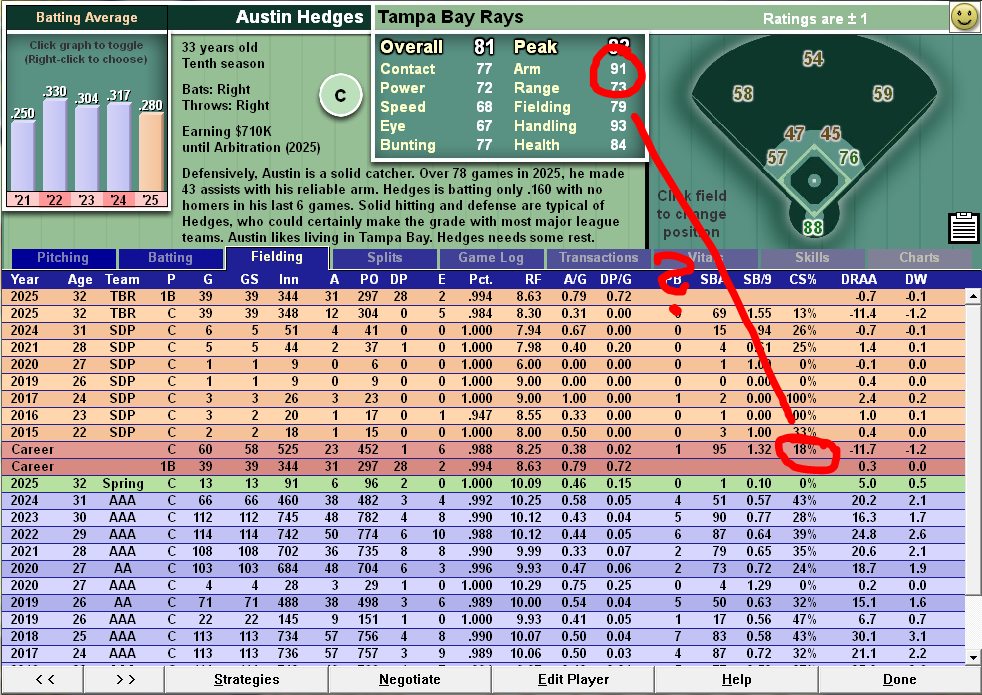
What good is a strong arm if it apparently has no correlation to stopping runners?
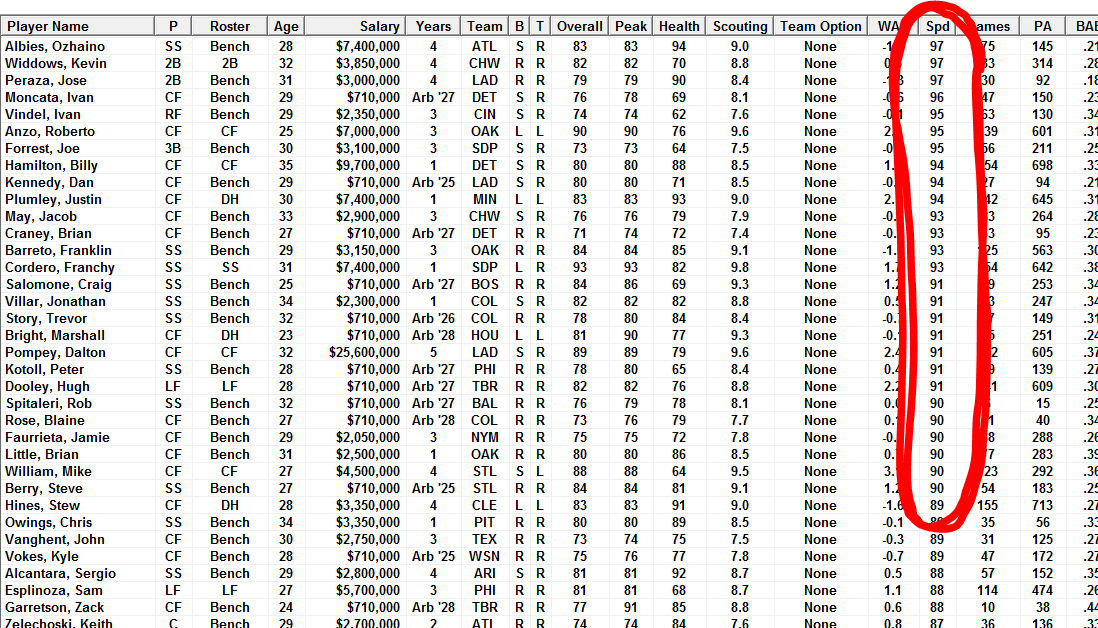
Not only does the catcher arm rating seem to be over inflated for most catchers, the arm ratings don’t seem to do a whole lot to defend against baserunners. And speaking of baserunners, why the heck are there so many fast guys now?
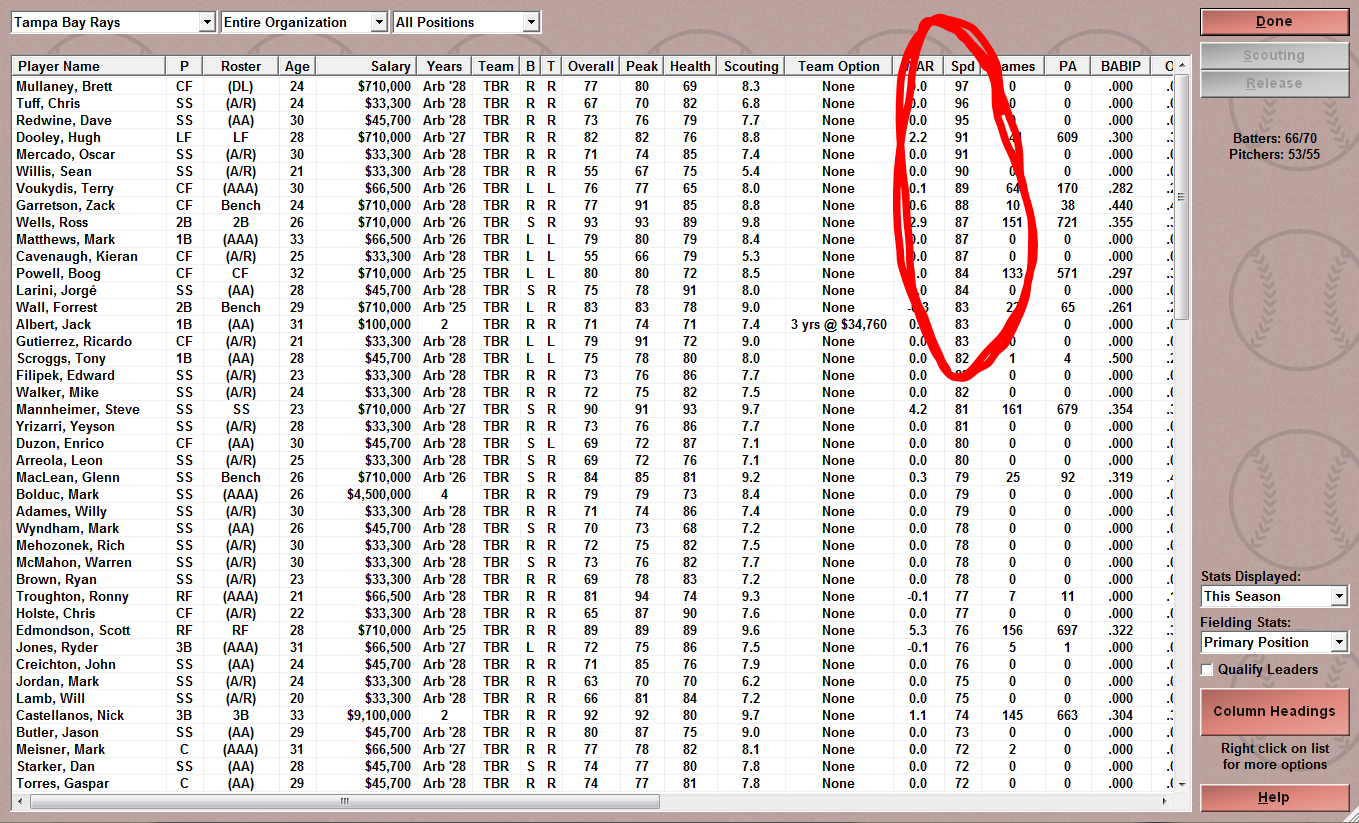
My first baseman stole 60+ bags in just 400 PA. I found a scrub third baseman, gave him 600 PA and he stole 116 bags.
Those are just the speed ratings within my own organization. I only specifically targeted two of those guys for acquisition based on their speed. The rest just kind of appeared in my system after just pursuing the best players available.
And looking at the whole league, we can see speed is in abundance in the majors. Why? I don’t know. Maybe they felt previous speed distributions were too pessimistic about the speed of MLB players; or perhaps guys like Billy Hamilton, when given a 90 speed, were disproportionately fast.
All I know is that it’s been a long time since my franchise had a catcher that could climb above the 20% caught stealing rate.
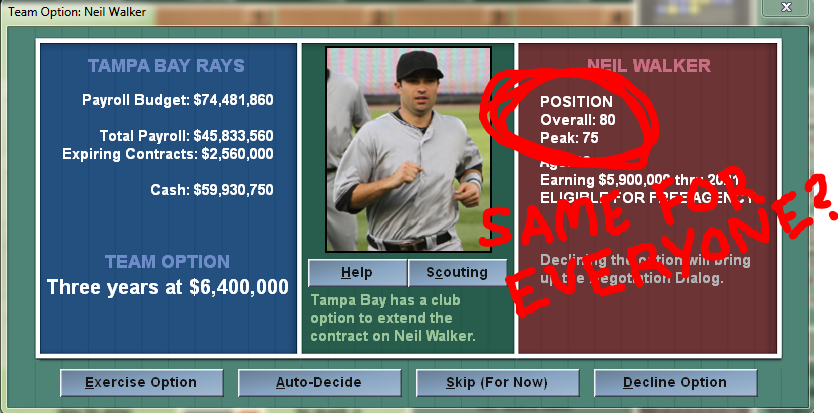
Another minor glitch: Sometimes, for whatever reason, the popups for arbitration offers show 80 current / 75 potential — which is like 99% not the case. Baseball Mogul rarely, if ever, gives a potential rating lower than a current rating.
Here’s an 82/82, late-career Neil Walker showing up as an 80/75:
Yeah, there’s something wrong when all of my arb-eligible guys are showing up as 80/75.
When I open his player card, the numbers look as expected. But in the arb popup, something is wrong. Not really a big deal though.
*A word to Linux users: Don’t try to build a new stadium. It’s a one-way ticket to Crashville. Unfortunately, running the game through Wine means some things just won’t work. 🙁
Rosters: 4.5 stars
On the spectrum of realistic rosters, it goes: Crappy Facebook games or whatever, MLB the Show-type games, Baseball Mogul, then OOTP. Nothing beats OOTP’s super, ultra complete rosters — which even include actual players for the next-soonest MLB draft. But Baseball Mogul is close. The 2015 opening day rosters have a robust, though not complete, minor league system rich with actual prospects and Quad-A fodder.
Also, the historical rosters — which stretch back pretty much to the time of Moses — give this game enormous replay value.
Monday, I introduced the International All-Star tournament, an OOTP 16 simulation involving national teams of the best major league players not born in the United States. Today, we get to the games themselves.
I gave the computer manager free rein to decide starting lineups, pitching rotations, and bullpen assignments. I did actually set up rotations for each team, but the AI, left to its devices, overruled my decisions. This did produce a few problems, such as with Panama, which the computer gave a five-man rotation despite having only four pitchers rated as starters.
This follows from my method of choosing representative seasons for the players. I did not cherry-pick years convenient for pigeon-holing them at particular positions. That means, for instance, Ramiro Mendoza ended up the reliever he was in 2001, rather than the part-time starter he might have been had I selected an earlier year for him.
This produced a few surprises in the field, too. I anticipated that Dave Concepcion would have to play second base for Venezuela, pushed off shortstop by Luis Aparicio. The computer, though, slid Aparicio over, despite his never having played a single game at that position in real life. It also chose some different starters than I did, such as Edgardo Alfonso over Pablo Sandoval at third for Venezuela and Pete Ward over Corey Koskie at third for Canada.
That’s okay. I’m not quite convinced enough of my expertise to insist on my decisions across the board. Besides which, I might unconsciously bias the simulation with my subjective selections. The OOTP AI does not have this problem. Or if it does, someone’s made a way bigger breakthrough than we realized.
Enough explanations. Time for baseball.
The 154-game season opened on April 1, running through to September 15. After the first month, there was the promise of a tight race, with some surprises popping up.
Enjoy it now. This is the last time there’ll be competition for the top spot.
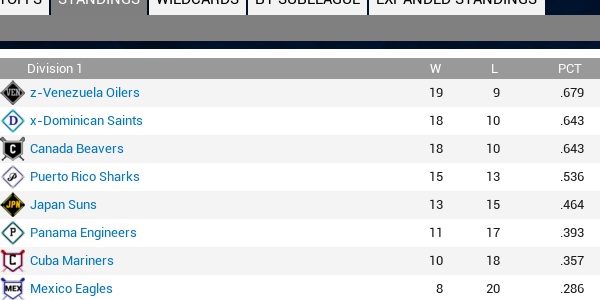
A stumbling Cuba was an early surprise, and a strong-running Canada maybe a bigger one. Having done a couple of dry-run sims, though, I knew these weren’t flukes. The Mariners were likely to remain a disappointment, while the Beavers might have the stuff to hang in the playoff chase.
Venezuela’s early lead was driven by a truly awesome April from Carlos Gonzalez. His batting line for the month was an insane .466/.530/.932, with a .596 wOBA and 3.0 WAR. He led the league in runs, RBI, homers, and triples. He would not maintain the supernova heat of his streak, though, a 0.3 WAR May pulling him back to the pack (though he still led the league in batting, slugging, homers, and runs scored at month’s end.)
The race took its true shape in May. The Dominican Republic compiled a 21-8 month (with just eight home games in that span) to take a 6 1/2-game lead. Venezuela and Canada were tied for second, with Puerto Rico half a game behind them. The rest of the league was effectively eliminated with 100 games to go: it was a four-horse race.
One result during that month I will note. On May 13, Pedro Martinez of the Dominican Saints lost a 3-2 decision to the Mexico Eagles when a ninth-inning rally fell short. This dropped Martinez’s record to 5-2. You will learn later why this is meaningful.
Truth be told, the league was still a horse race only in the sense that Secretariat at the Belmont was a horse race. A 22-4 June, including the last 16 wins of an 18-game winning streak, put the Dominicans 13 games clear of the field. The only race remaining was for the wild card postseason entry—but that was still very much a race.
Venezuela had the “lead” at the end of June, two games ahead of Canada and Puerto Rico. By the close of July, they had fallen to fourth, a game behind the again-tied Beavers and Sharks. Then it was the Oilers’ turn to hit the gas, a 21-8 August driving them three games clear for the wild card, with Puerto Rico third and Canada one more back in fourth.
By this time, the “Pennant Chase” function had kicked in, letting you preview at a glance upcoming games for playoff contenders. There I saw that Puerto Rico and Canada had an upcoming series together, starting the third of September. When it began, Venezuela was four games ahead of both. Whoever lost the series was all but sunk in the wild-card race.
The Sharks struck early, with a 10-7 win at Canada. Joey Votto’s perfect day—a homer, double, single, and three walks—won him the league’s Performance of the Day honors. It still wasn’t enough to overcome a seven-run PR sixth, sparked by a pair of errors.
But Canada stormed back. Rheal Cormier‘s four-hit shutout and Ryan Dempster’s eight innings of one-run, three-hit ball led the Beavers to 4-0 and 2-1 victories. They won the battle—but lost the war.
While those two were battering each other, Venezuela swept seventh-place Japan, adding a game to its wild-card lead. Worse, Canada’s next series was against the juggernaut Dominican Saints, while Venezuela drew last-place Panama. Venezuela would clinch the wild card with five games to play, though Canada ended the year on a six-game winning streak to make the final gap a respectable two games.
How it ended. Poor Panama: two months out of first.
The gap between second and first wasn’t nearly as respectable. The Dominicans clinched first place on August 24, with 21 games to play. They finished the season an awesome 112-42, 22 games up on Venezuela. For historical perspective, the Dominicans’ record was two games better than the 1927 Yankees, one better than the 1954 Indians, and trailed only the 116-36 campaign of the 1906 Chicago Cubs. But remember: those last two teams lost the World Series.
The Saints excelled on offense and defense, their 883-572 runs margin leading the league in both categories. Albert Pujols’s .308/.403/.569 with 35 homers paced the team, producing 6.7 WAR; five other batters produced at least 4.5 WAR. Of the 14 position players, all but two had an OPS+ of at least 106. The lineup had effectively no weakness.
Starting pitchers were, if anything, better. Against a league ERA of 3.89, the top four starters in the Dominican rotation all had ERAs below three. The bullpen was surprisingly weak, with five ERAs over five and closer Rafael Soriano at 3.86. The fault is probably disuse: the starters were such workhorses that four of them had more inning pitched than the 226.2 of the entire bullpen! Three of those starters won at least 20 games, including Juan Marichal at 20-7, 2.64 and Johnny Cueto at 21-6, 2.92.
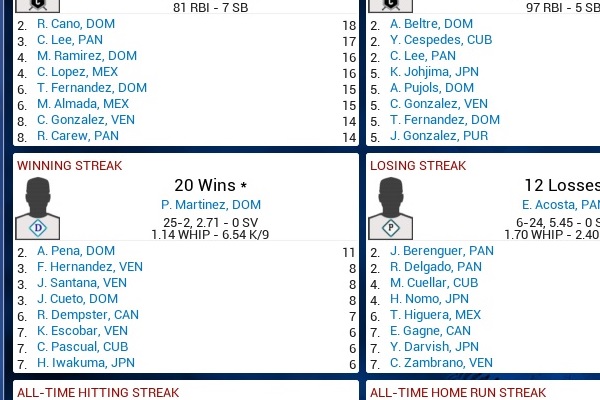
And then there’s Pedro Martinez. We last saw him in mid-May, dropping to 5-2 on the year. He finished at 25-2. For the last four months of the season, Martinez started 22 games. Two were no-decisions; the rest constituted a 20-game winning streak, active at season’s end.
Twenty. Games. Straight.
There are no words. Not at a “safe for work” site, anyway.
Okay, so it wasn’t pure skill. So he had the fourth-best FIP in the rotation; so he had the fourth-best WAR in the rotation. (Cueto led in both.) It’s still a 20-game winning streak. And counting.
Brian Kenny, we have just discovered the bitterest foe to your “Kill the Win” campaign.
Venezuela (90-64) had its own potent offense, aside from Luis Aparicio (51 OPS+) never getting comfortable shifted over to second. Carlos Gonzalez finished the year cold, but still piled up a .320/.395/.624 line, with his 35 homers tying Pujols for the league lead. He led outright in slugging, OPS, wOBA, and position player WAR at 7.1. (Cueto’s 7.7 led the league.) His batting average of .320 was good only for third on his team, behind Miguel Cabrera and league champ Victor Martinez.
Pitching was likewise a step behind the Dominicans, though not a long one. None of the starters managed 20 wins, but the 19-7 Felix Hernandez did take the ERA crown, his 2.42 besting Marichal’s 2.64. Johan Santana was right behind, with an 18-9 record and 2.66 ERA. Closer Francisco Rodriguez had a rough time (4.92 ERA), but setup men Ugueth Urbina and Rafael Betancourt picked him up with good work.
The also-rans in the league I will cover somewhat more briefly.
Canada (88-66) got offensive help from expected sources. Joey Votto led everyone in walks and on-base percentage, while Larry Walker and Russell Martin slugged very well. Martin posted the best catcher’s WAR in the tournament at 6.1. There was also an unexpected source in Pete Ward, selected as a utility infielder. Getting the starter’s role at third base, he hit an even .300 with 24 homers, just behind Walker and Martin.
Canada’s pitching was a bit peculiar. All five starters beat the league ERA average, but in a narrow 3.29 to 3.76 range. All five had winning records, but nothing overwhelming, led by Ryan Dempster’s 17-10 and Ferguson Jenkins’s 17-11. Likewise, Eric Gagne was an effective but not outstanding closer leading an effective but not outstanding pen. One real breakout performance among the pitchers might have driven the Beavers to the wild card, but they did not get it.
Puerto Rico (85-69) likewise had a strong team, just not quite strong enough. Four regulars batted over .300: Alomar, Clemente, Cepeda, and Ivan Rodriguez, though Clemente’s was an empty .310. (Bernie Williams batted .315, but Carlos Beltran was given center field ahead of him, so he got just 173 PAs.) Carlos Delgado put 30 over the wall, with Beltran adding 25.
Front-end pitching was very good. Juan Pizarro yielded a league-low .222 batting average against while posting a 17-11, 2.67 record. Even better by FIP were Javier Vazquez and Joel Piniero, though Piniero posted a lackluster 12-15 record. But the back-end starters were sketchy and the bullpen past Willie Hernandez’s 2.06 ERA was middling, and the Sharks came up short.
Cuba (67-87) wound up mediocre across the board. The only leader in a major category was hurler Camilo Pascual, who threw 263 innings while notching five shutouts, tying him with Juan Marichal. Best in the field were catcher Yasmani Grandal, knocking 24 homers, and Tony Oliva, more solid than spectacular while starting nearly every day. Constant play did much worse for Yoenis Cespedes, who started all but three games and staggered, exhausted, to a -1.3 WAR.
Mexico (66-88) was as punchless as predicted. No player hit double-digit home runs, and the top position player WAR was the 2.1 of Carlos Lopez. Any strength the team had came from its closer, Joakim Soria with a 2.12 ERA and 33 saves, and its starting pitchers, though none of them managed even a .500 record. Fernando Valenzuela scrabbled to a sub-three ERA and a fourth-best 166 whiffs, but it was no repeat of 1981 for him. The team was saved from a worse fate by massive overachievement, beating its Pythagorean projection by nine games.
Japan (59-95) had the weak offense I foresaw from lack of position players in MLB: Hideki Matsui was the only regular whose OPS+ beat the average. The lone offensive highlight was the league-leading 67 stolen bases by Dave Roberts (he was born on Okinawa: he counts), though his 64 percent success rate made it a hollow honor.
Starting pitching wasn’t the strength I anticipated, though Hiroki Kuroda and Hisashi Iwakuma held up well. Yu Darvish went a horrid 4-21, despite leading everyone in strikeouts (186) and K rate (7.9/9 IP). The bullpen was the tournament’s best, led by Takashi Saito’s 1.70 ERA, but it was too little, too late.
Panama (49-105) suffered the pitching “death spiral” I feared for them. Bruce Chen, at 12-17 and 4.24, was the “ace”. Juan Berenguer was hopeless at 1-13, 7.20, while Ed Acosta was the staff punching bag, absorbing a horrific 24 losses. Even Mariano Rivera suffered, with a 4.34 ERA and 24 saves, league worst for a closer. Presumptive batting superstar Rod Carew could only scrape together a .276 average and 90 OPS+, making Carlos Lee and Ben Oglivie the lone batters above league average.
Overall, the league had a notable tilt toward starting pitchers, with seven of the top 10 WAR scores going to hurlers. This is likely due to the managing AI playing to the “home era” of 1980, a time when 250 innings was a solid year’s work and complete games weren’t the rarity of today. It also severely curtailed relief innings, but since I generally gave the teams six-man bullpens rather than a modern seven or eight, this was somewhat mitigated.
So the regular season is over. History has been made—112 wins; Pedro’s 20 in a row—but there is more to come. See you back here Friday, for the Rest-of-the-World Series.
(Full disclosure: In order to conduct the simulation, I was given a complimentary copy of Out Of The Park 16. I gratefully acknowledge OOTP’s generosity. I even more gratefully acknowledge the assistance of Brad Cook, along with Lukas Berger and Chuck Hauser from OOTP for leading me through the nuances of some unusual roster creation. Had I been less boneheaded, you might have seen this series sooner, and I thank them for pulling me through.)
Early this year, I had a well-received article at The Hardball Times, a member of TechGraphs’ family of sports websites*. In it, I put together all-star teams of major league baseball players born in different countries from the United States, with speculation on which would be the strongest clubs if they faced each other.
(* If TechGraphs is a daughter site to FanGraphs, and FanGraphs is a sister site to The Hardball Times, it thus follows that TechGraphs is THT’s niece. So enjoy this visit from your Auntie Hardball.)
I wasn’t the only person who liked that speculation. I was contacted a while later by Brad Cook with Out of the Park Developments, the sports-sim folks. He suggested that I could use OOTP 16 (recently reviewed here by Bradley Woodrum) to pit those all-star teams against each other, and produce something more concrete than informed guesswork as to who would be best.
No spoiler tags necessary: I took him up on his idea. David Temple was himself kind enough to greenlight the idea of writing up the simulated season for TechGraphs, and here I am.
My series will be in three parts. Today I’m laying out the concept, the participating nations and players, and my handicapping of their chances. Later, I’ll play out a full season with the contending teams, seeing who totally confounds my predictions, and which players do best in this higher league. The final part will be the Rest-of-the-World Series, the top two finishers playing best-of-nine for the title.
For this project, I’ve chosen the eight countries I consider the best of the internationals to square off against each other. You may refer to my original article for how I chose them as the best. You’ll also need to refer to it for the team rosters, as space considerations don’t allow me to re-list all 200 players here.
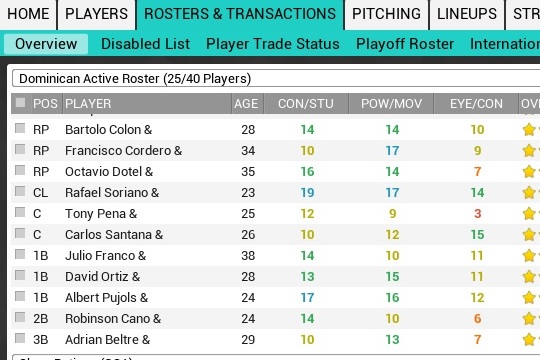
But here’s a tiny peek at the Dominicans. Ignore the ampersands. There are a few corrections I must make to those rosters. For Mexico’s team, I listed closer Joakim Soria twice; the second pitcher should instead be Luis Ayala. I also listed Tony Gonzalez twice for the Cubans; my substitution for the clone is Yoenis Cespedes. Also for Cuba, I managed to misspell Pedro Ramos’s name as “Predo.”
Yes, sometimes I can’t tell the players apart even with a scorecard.
Now for the teams themselves. I’ll give the countries, my personally chosen nicknames for the teams, plus the number of major-league players each nation has produced through 2014. (Only players who have played in MLB were eligible for my teams. Stinks if you’re Sadaharu Oh or Martin Dihigo, but I needed to compare apples-to-apples performance when making my selections.) I’ll also give capsule estimates of their strengths and failings.
In increasing order of my estimate of their team strength, here are the Elite Eight.
Panama Engineers (53):
For a small player pool, Panama has a solid front line of position players led by Rod Carew, and when they get a lead, Mariano Rivera’s there to slam the door. But the rest of their pitching is thin at best. If their rotation gets overwhelmed, they could go into a death spiral fast.
Japan Suns (61):
Japan is the reverse of Panama. Impressive starting pitching is their key strength, with capable pieces backing in the pen. However, few of their position players have crossed the Pacific, and this leaves them quite vulnerable on the infield and at catcher.
Mexico Eagles (114):
Mexico has pitching, though not with Japan’s depth, and a stronger infield. They are very lacking in power, though — their outfield being particularly punchless.
Canada Beavers (244):
An ace starter in Fergie Jenkins and ace relievers in Eric Gagne and John Axford anchor Canada’s pitching. The position players have real strengths in Joey Votto, Larry Walker, and Russell Martin, plus some holes, including a double-play combo out of the 19th century.
Cuba Mariners (186):
A deep rotation matches Japan’s, with Aroldis Chapman putting the bullpen ahead. Position players range from good to somewhere short of all-time great, with catcher maybe the only true weakness. This is the first team that feels like it could be dominant if dropped into today’s majors.
Puerto Rico Sharks (246):
The rotation is a step behind Cuba’s, the bullpen half a step back. The left half of the infield is not the strongest, but the other positions compensate amply with three Hall of Famers in Cepeda, Alomar, and Clemente. The Ivan Rodriguez/Jorge Posada duo behind the dish is easily the best in the tournament.
Venezuela Oilers (321):
Johan Santana and Felix Hernandez are a superb one-two punch, with a good back of the rotation and K-Rod closing. The infield is outstanding: Cabrera, Concepcion (moved over to second), Aparicio (which is why), and Sandoval. Outfield and catcher settle for being sneaky-good rather than shock-and-awe, but it’s still a great team.
Dominican Saints (618):
The rotation is stacked, from Pedro Martinez and Juan Marichal down to fifth starter Bartolo Colon, while the bullpen has so many good arms there is no clear closer. Three members of the infield (Pujols, Cano, and Beltre) could be going to Cooperstown, and the outfield is so stacked that Vladimir Guerrero is a sub. Leveraging its deep talent pool well, The Dominican Republic looks like the team to beat.
The tournament’s season structure will follow the style of the pre-expansion majors: eight teams in a single league, playing 154 games. I also chose to set the tournament in the year 1980, with the statistical underpinnings of that era. That year was reasonably balanced between offense and defense, without, for example, the smothered batting of the 1960s, the inflated home run figures of the turn of the millennium, or the extreme strikeout totals of today.
This means we shouldn’t expect any records from our players, with the tendencies of the league not biased toward producing 70 homers or 400 strikeouts in a year. Of course, we also shouldn’t expect such outlying numbers because this is effectively a higher league, a level of competition above what most or all of these players ever faced in real life.
The rosters are frozen with the 25 players for each team: no promotions from non-existent minors, and obviously no trades. I turned off injuries, along with suspensions and PED discipline. (Several players wipe their virtual foreheads in relief.) I want this tournament decided as much as possible by the players, not by chance.
As for the players … which versions of them will be playing? Do I go by career totals? Or do I select a specific season for each one, and which one? Will my tournament be populated by 200 guys all having their career years?
I chose a moderate course. I ordered each player’s seasons by WAR, then tallied their plate appearances (for hitters) or innings pitched (for pitchers), best-WAR season on down. The year in which he reached one-third of his career total is what I selected as his representative season. This was intended to produce a good season for each player, without overly rewarding anyone who had one freak breakout year towering over a lower baseline. As I tried to choose players for career achievement rather than lone standout years, it fits with the roster construction.
Of course, there’s always some loophole to mess with your intentions. For me it was the strike year of 1981, artificially reducing WAR by the one-third of games not played. This pulled Fernando Valenzuela’s WAR for his tremendous rookie season down below that of other seasons, enough so that ’81 got chosen as his year.
I could have omnisciently chosen some other year for him, along with similar adjustments for the smaller anomalies along those lines. However, intervening consciously against the algorithm felt like more of a distortion than letting it stand*. So Mexico will gain the full benefit of Fernando-mania for its national squad.
*Besides which, what the heck? It’s just a game.
So that’s your International All-Star league. Join us tomorrow, when they play ball.
(Full disclosure: In order to conduct the simulation, I was given a complimentary copy of Out Of The Park 16. I gratefully acknowledge OOTP’s generosity. I even more gratefully acknowledge the assistance of Brad Cook, along with Lukas Berger and Chuck Hauser from OOTP for leading me through the nuances of some unusual roster creation. Had I been less boneheaded, you might have seen this series sooner, and I thank them for pulling me through.)
Game:Out of the Park Baseball (OOTP) 2016 (website) Platform: PC, Mac, Linux, mobile Release Date: 2015 Metascore: n/a Techgraphs score: 4.3 or 86 B
General Reaction
OOTP is our most reviewed and highest reviewed game of all time. It takes all the high-level problem solving of a real baseball front office — salary management, roster management, owner expectations, and so on — and somehow condenses them all into a single game. The game is addictive. It’s fantastic.
That said, I’m trying to review this latest edition as critically as possible. And it’s hard to critique something you’re hooked on. But the game does have some flaws, and I will address those. But overall, it’s another excellent submission to the OOTP franchise.
Ratings
Graphics: 4.0 stars
Let’s face it; you’re not going to play OOTP for the graphics. The only 3D component of the game — an optional view for the in-game management — leaves a lot of a room for improvements. It’s not really a problem, per se — more of a “Where’d it go?” The old versions of OOTP had this realistic face generator. It was really impressive. But I can’t find it among the add-ons now. So we end up with this:
I had no idea Brett Gardner looks like a 45-year-old tax accountant from New Jersey!
Concept & Game Modes: 4.5 stars
OOTP does a nice job of not stretching itself thin with game modes. The database and formulas that serve as the foundation for this game would not be at their best in a “Path to the Majors” or a work-your-way-to-the-top game mode. So having a single player GM/coach mode and a multiplayer GM/coach mode is probably sufficient to please 90% of fans.
It would be interesting, however, so see an arcade mode — hear me out! The latest changes to OOTP have created a system where the player (you, sir or madam) are given a salary and contract based upon your reputation and recent success. What if the game took a page from the NBA 2K video game series and made those salaries worth something? Perhaps players could spend their salary on negotiation classes, improving insight and success rates during trade or salary negotiations. Perhaps players could spend on charitable enterprises and improve their reputation — thereby unlocking more prestigious managers and executives. Or perhaps players could spend money on special camps that have a chance to boost a few players’ rating in special areas (“Send [these three players] to the Barry Bonds Hitter Clinic? Grants 10% chance for increase in either Power or Eye rating. Cost is $100K per player.”).
This kind of stuff actually incentivizes earner a higher income. And it’s just kind of fun.
Gameplay & Interface: 5.0 stars
The interface hasn’t changed much in OOTP 16, but there have been a few minor tweaks that I think show the developers’ really care about user feedback. Lots of tiny things like:
This is a nifty little added feature. Saves a few clicks for all the top draft picks.
I’m giving gameplay and interface a perfect score, but a big part of me wishes I could experience it all over with rookie eyes. Of course the interface seems easy to me; I’ve been playing OOTP for a half decade.
Glitches: 3.0 stars
There’s a lot of little things that impede my enjoyment of the game — problems that didn’t exist before. Ratings filters don’t seem to work in the Find a Player section (a great new addition, if it actually worked for me…).
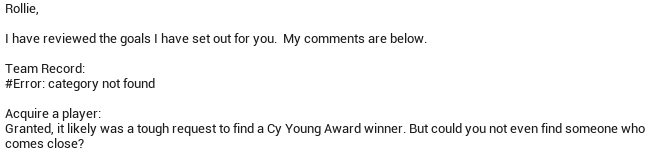
And more than that, the new owner goals feature had serious signs of inconsistency. Several times early in my franchise, the owner could not recognize the fact that I had completed an assigned task:
One of several glitches. The owner did not like my having acquired Jake Peavy, apparently, nor could it recognize the fact I improved the team record. :/
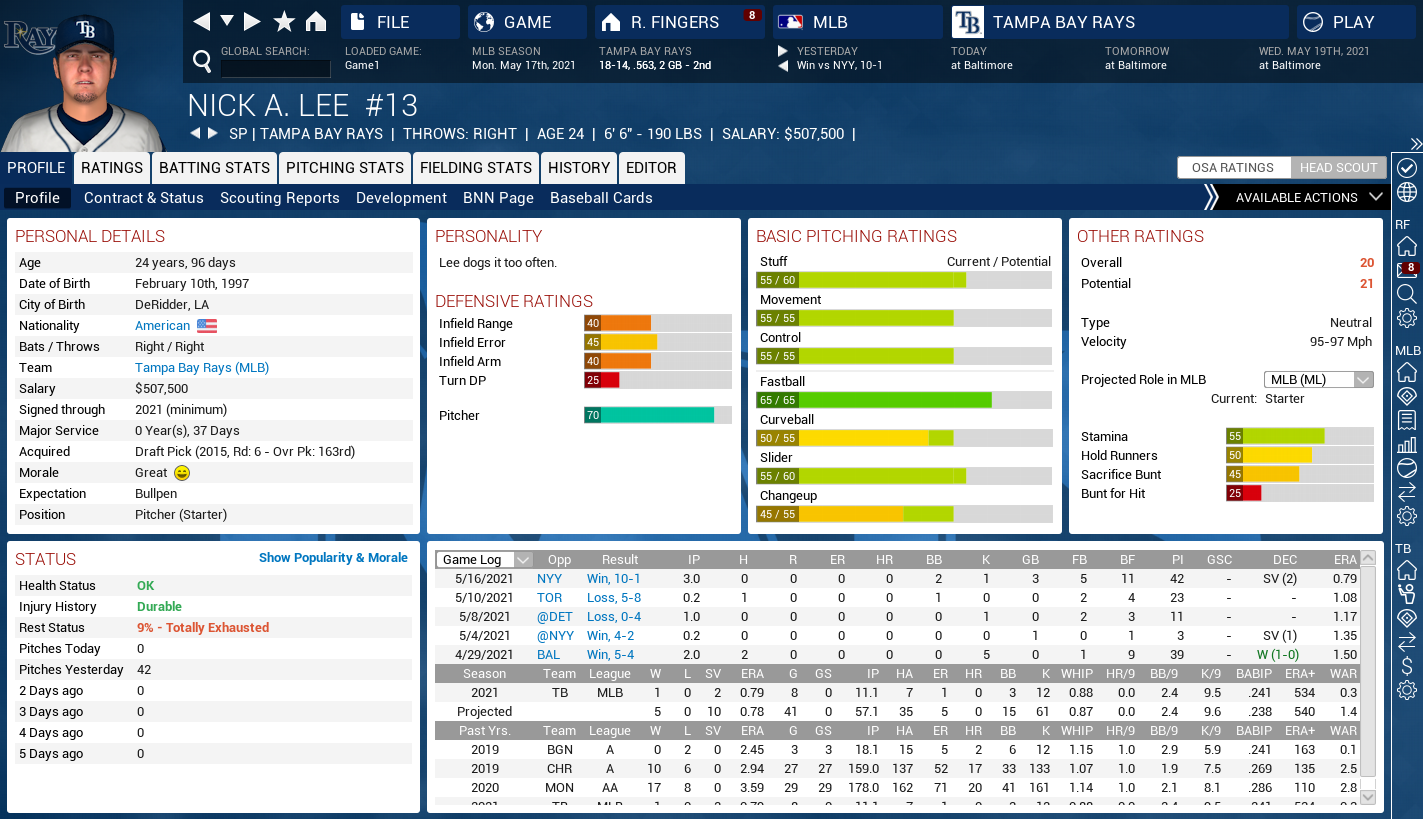
More troubling, though, is that there are numerous issues with player valuation. The AI does not seem to value pitchers correctly (a lot of trades that should go through, don’t), and seems to struggle to identify medium-quality talent. Either everyone is a five-star prospect or not a prospect at all. In general, scouts seem to have a bad grasp on pitcher value (a starting pitcher with three strong pitches and good makeup will still have a 21 potential on the 20-80 scale).
How is this not a good pitcher?
And then, after several years into my franchise, the talent pool disappeared. International free agents stopped being prospects all together (except for a few hidden gem pitchers who had great ratings everywhere except their potential ratings); the draft only had one or two premium prospects at most (normally the first round should land everyone a premium prospect); and since I had a world of difficulty convincing other GM that their pitchers had differentiating between a prospect and Quad-A filler, fair trades were hard to come by.
Say what I will about the relative simplicity of Baseball Mogul, at least the ratings are close (as close as a scouting system with variability should be).
Rosters: 5.0 stars
This is always the strength, nay, the stupid strength — so strong it’s dumb — of the OOTP franchise. You won’t find a more accurate system of minor league players and managers.
Few topics are so regularly discussed among my baseball circle of friends and colleagues as local blackout policies. While I am certainly biased in that I watch and talk baseball more than any other sport, I — among plenty of others — have found numerous flaws in MLB’s way of blocking local fans from their favorite teams. By no means is baseball’s governing body alone in limited television access for regional fans, as the NFL, NHL and MLS have a blackout policy of some sort in place, however given the sheer number of MLB games played each season, more baseball games are blacked out than the other sports combined.
To be fair, the NFL did lift local blackouts for the upcoming 2015 season, however as the linked article notes, zero games were blacked out in 2014. NFL games are only subject to local TV blackouts if the game isn’t sold out 72 hours before kickoff rather than the constantly blocked games in other sports. Professional hockey has seen its share of blackouts in TV, though a recent development for the Tampa Bay Lightning may be expanding the definition of “local blackout.”
Via CSN Chicago (warning: auto-playing video), Tampa is following in the footsteps of St. Louis and Nashville hockey teams in making it difficult for visiting (read: Chicago) fans to see the game in the stadium. The policy also affects actual Lightning fans living in other states. If fans have the time and the means to follow their favorite team from another state, tickets may not be available for them. A screenshot directly from the Lightning Ticketmaster describes the situation:
Building a home field advantage or looking for any competitive edge is all well and good, but at what point is a line drawn? How far will fans go to avoid the blackout issues, both on TV and in-person? Going back to baseball, there are massive numbers of people who can’t watch games based on their geographic location. One of my friends was recently accepted to graduate school at Iowa State University, located in Ames, Iowa. The sole downside for him thus far, other than the workload, has been being subjected to blackouts for his favorite team — the St. Louis Cardinals. According to Google Maps, Ames is nearly 370 miles away from Busch Stadium, yet he is still blocked off from their games. Running the Ames 50010 zip code through the MLB blackout finder, the Cardinals aren’t the only team subjected to broadcast issues. Both clubs in Chicago, the Twins, Brewers and Royals are blacked out for him. Even if he were a more broad baseball fan without ties to a specific team, his location alone blocks him off from 20 percent of MLB teams.
The lengths organized sports are going to block off fans from games has only been surpassed by those same fans looking for a way to circumvent the blackouts. Last week a free and popular virtual private network (VPN) came under criticism not from any league or association, but its own userbase. The Chrome and Firefox extension Hola! or Hola! Better Internet was denounced as a potential botnet to be used for malicious attacks on websites, to which they responded to Monday. Danger comes in the form of Hola! using other people’s idle bandwidth — and vice-versa — in order to circumvent geo-blocked content. By granting access to your Internet connection, it can be taken over and re-routed, potentially as part of a DDoS attack on a site or IP address. Be it accessing Canada’s or Australia’s Netflix or someone over there accessing the United States selection of TV and shows, Hola! provided a free and easy way to get around geographically-blocked content. Despite it no longer being available in the Chrome Store, the extension is still downloadable straight from the company’s site. I’d urge caution before a download of Hola! is considered, as the recent allegations have once again shown there is no such thing as a free lunch.
According to the Hola website over 47 million people have downloaded the extension to enhance their web browsing, despite the clear risks involved. That such a number of people would be willing to risk their idle connection in order to open the Internet for their browsing or entertainment needs shows the measure of their resolve. Whether companies like Netflix and HBO or leagues such as MLB or NHL open up their blackout restriction policies on their own accord may not matter. As long as people have a workaround — questionable or not — the market will find a way to access the desired content.
Sports analytics has moved on from the days when an ambitious amateur could fire up Excel or a relational database and make earth-shattering discoveries. Modern front offices must incorporate not only on-field performance but also medical histories, training results, biomechanics data, and a host of other sources into their decision making. To help teams better manage and access that mountain of data, Dublin-based Kitman Labs has developed the Profiler, a system that combines disparate data sources into analytics describing player health and injury risk.
Chief product officer Stephen Smith described Kitman Labs’ offering as “the operating system for sports teams.” The strength of the system is in its ability to combine data from multiple areas — including medical, biomechanical, and on-field sources — to produce more holistic analytics that can better inform team decision making regardingl athlete training and injury prevention. Smith said he was first inspired to create the system while working as an athletic trainer for Leinster, an Irish rugby team.
“One of the biggest challenges I had as a practitioner was that all the fitness data was held in one area, all the medical data was held in one area, and all the performance analytics were held in another area,” Smith said. “That just made it very hard to understand what any of the information actually meant.”
An example of the power of Profiler is demonstrated through a software application that allows users to collect markerless, three-dimensional biomechanical data from an off-the-shelf Microsoft Kinect. The software can calculate select joint angles from an athlete a few feet away — even during rapid dynamic movements, such as running, kicking, or throwing a pitch. And although Smith insisted that the Kinect software was “probably five percent of what we actually do,” he was enthusiastic about its ability to make motion-capture based analysis more accessible.
“Biomechanical information that you would garner in a normal professional sports environment would take you hours to actually get because the downtime is huge, and the cost of that is pretty difficult, and you just can’t access that day to day because it takes too long,” Smith said. “The software that we’ve created jumps professional sports teams into the next generation of real-time technology.”
When interviewed, Smith refused to name the specific organizations that have partnered with his companies.
“We definitely don’t like to speak about our clients because a lot of the information we’re housing, as you can imagine, is very sensitive data on very high-profile athletes,” he said.
But some of his clients have been less tight-lipped about their relationship. In March, The Los Angeles Dodgers announced that they would be partnering with Kitman Labs in their farm system, declaring themselves “the first American sports team” to sign with the company. Across the pond, Kitman Labs works with British Premier League squad Everton, along with a number of Irish rugby teams. Other organizations, including the San Francisco Giants, have also tested this system.
When Kitman Labs signs a new client, the two first collaborate to determine which data and which metrics are most important to the organization, and what sources of information the organization already collects. Kitman’s sports scientists then work with the coaches and training staff to demonstrate how to use the system and understand the analytics the system produces.
“We have a very experienced team of sport scientists who all understand the individual nature of each sporting discipline that we work with, and the uniqueness of each club, team, and athlete,” Smith said. “Those sports scientists will actually be on the ground with teams for a number of days actually helping them to get up to speed.”
Smith says he understands that his company offers an appealing solution to clubs looking to maximize the return on their sizable investments in player salaries, not to mention strength and conditioning, coaching, and other aspects.
“I presume that [general managers] want tools to ensure that they can get the best value from their athletes,” Smith said. “I think the clubs just love the idea of being able to try and maximize on that by being sure they can keep the athletes on the field.”
But the growth of biomechanics data has led to rumblings in some quarters. Some have expressed concerns that medical data which suggests an injury risk could be used against athletes during negotiations. (An example can be seen in the controversy surrounding the Houston Astros’ dealings with top overall pick Brady Aiken last summer.) Despite this, Smith said he hasn’t seen any pushback from athletes on teams using this product, and insists that the system was designed primarily with athlete wellbeing in mind.
“One of the largest driving forces for us in doing this is that we want to protect athlete welfare, we want to improve the standard of care that is given to athletes worldwide,” Smith said. “It’s there purely for the team to use that information to empower their decision making, and that way they can ensure the athlete makes it onto the field in the best possible shape.”
Kitman Labs was born out of Smith’s postgraduate research into injury risk factors, as well as his professional experience as an athletic trainer. The company was founded in October 2012, with its first product offering coming online in June 2013. By early 2014, Kitman Labs had signed their first partnerships with soccer and rugby teams, and were looking to expand into the American market.
“We kind of expected that the market over here would be pretty far ahead of what was going on in Europe,” Smith said. “But when we came over, we realized that it didn’t look like there was anybody else trying to do something like what we were doing.”
The company opened its first American office in Menlo Park, California, in September 2014. Since the MLB season was just wrapping up, Kitman Labs initially focused on expanding into baseball to coincide with teams’ buying cycles. Kitman Labs is now looking to expand into other sports, developing new applications in both professional and collegiate sports leagues.
“We’ve had early success with baseball in the U.S., but we’re actively working with NBA teams, NFL teams, and we’re actually now branching into the NHL as well,” Jeff Eckenhoff, a member of the Business Development team, said. “We’re pretty sport agnostic.”
And with the expansion into new sports comes an expansion of staff, as Kitman Labs looks to add sports scientists and engineers that can help them adapt their solutions for new clients. Smith said his company is actively looking to fill eight vacancies.
“We need industry experts from basketball, football, and baseball to come and be part our team, and to help us solve the largest problems for each of these sports so that we can truly help these teams to uncover the sources of injuries,” Smith said.
Still, Smith insisted that his company’s expansion would not come at the expense of Kitman’s current offerings.
“We don’t want to be a company that walks into a market and grabs a huge collection of customers and then walks away with their checks in our back pocket,” Smith said. “We want to change the face of sports science and sports medicine and we’re going to do that by incredible focus and by being extremely diligent.”