Archive for Wearable

Review: Motus Global’s mThrow

When Motus Global’s sleeve was announced last spring, it was supposed to save baseball, stemming the flood of Tommy John surgeries plaguing the majors. Now, the device that teams have been using to study their pitchers’ mechanics since last fall is available to the public. The mThrow has been on sale through the Motus website since March, and began shipping in early May. Eager to see what the device had to offer, I plunked down the $150 (plus $20 for an additional compression sleeve) and waited anxiously.

The box that the mThrow comes in is taken up mostly by the compression sleeve. The actual IMU — the sensor that actually tracks the arm’s motion — is a tiny blue thing, about the size and shape of a circus peanut*. The IMU charges by induction, so all the user has to do is plug in the charging station, place the sensor on top of the station, and wait about an hour.

* – But slightly better-tasting.

Pairing the sensor is simple, too, taking just a few taps of the smartphone app. The hardest part of setting the thing up is probably wedging the sensor into its little pocket in the compression sleeve, and then pulling the sleeve on so that the sensor rests over the infamous ulnar collateral ligament. In fact, the design might be overly simplified. In an effort to make the sensor more water-resistant, there are no lights on the sensor to tell the user of the charge level. The only way to check is to pair the sensor with the smartphone app; if the app doesn’t recognize the sensor, it probably needs to be re-charged.

The app is currently available only for the iPhone; an updated version was approved this week. The software now computes five metrics from the sensor data: pitch count; maximum arm speed, a rotational velocity measured in revolutions per minute; arm slot at release; maximum shoulder rotation relative to initial position; and, of course, torque on the UCL. These are then combined into three headline numbers: performance, a measure of mechanical consistency; workload, currently an additive function of elbow torque; and a “throw meter,” an energy bar that drains from blue to orange as the workload increases and consistency decreases.

I ran some preliminary testing of the mThrow, connecting it to an iPhone 4S and throwing 17 fastballs, 17 changeups, and 17 curveballs to the best of my extremely limited ability; all but six throws were recorded. Even if there’s no difference between their speeds and movement, you can still see a difference between my initial warmup tosses (the first dozen, with much lower arm speeds), fastballs (about 13-25), curveballs (26-43, with much lower torque values), and changeups (44 onward, with decreased arm speeds).
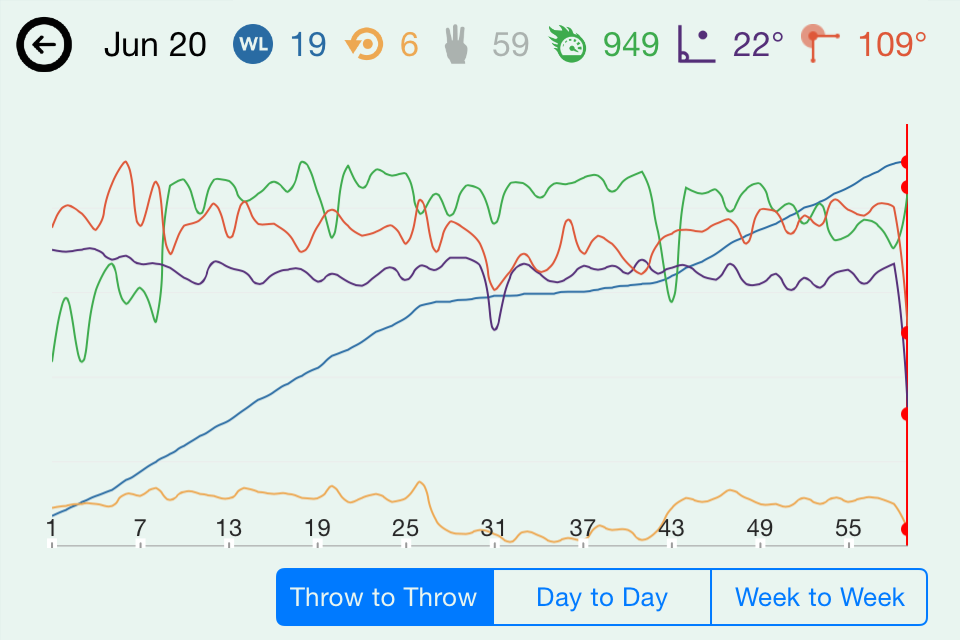
image2
This simple relationship was confirmed with a second test using a HitTrax system, which can track speed and late break of pitches as they cross the plate. My subject was a 45-year-old with some collegiate pitching experience who threw ten fastballs and ten curveballs. By comparing the HitTrax velocity report (right) to the mThrow statistics (left), we can see the correlation between the decrease in arm speed and the decrease in velocity as the subject switched from fastball to curves.

donfrancesco
Lastly, I brought the sleeve to a local high school (Blackstone Valley Tech, Upton, MA) to get some insights from active players. Assistant coach John Burke, pitcher Nick Laren, shortstop Joe Corsi, and catcher Jack Lynch took turns throwing an assortment of pitches from a number of release points, seeing how their throwing motions stacked up. The session supported some beliefs — for instance, that the quick motion Lynch uses to throw out would-be base stealers puts more torque on the elbow than a standard pitching delivery. But others were surprisingly contradicted: despite everyone’s belief that sidearm throws put less stress on the elbow than an over-the-top delivery, the app didn’t seem to report a relationship between arm slot and torque.

Chief technology officer Ben Hansen says the mThrow is still in its infancy, and says that the device’s official consumer launch is not scheduled until later this summer. The app currently relies on data compiled from Motus Global’s work with MLB prospects at last fall’s instructional league to generate its workload number, but Hansen and his team are working to produce more meaningful metrics from a more complete data set.

“We’re just capturing as much data as we can to see what’s normal,” Hansen said. “We also have controlled studies going on at every level. We have [NCAA] D1, D3, high school, and Little League players wearing it religiously.”

At this early stage, the app seems to be designed more for Motus’s professional clients than for public users. Maybe the best example of this is the tagging feature, which allows users to tag individual throws as belonging to bullpen sessions, long toss, or game action, and to further break throws down by pitch type. But at the moment, the tags are unavailable to the user after selection, getting passed on to Motus Global with the sensor data but not visible on any of the trend screens. Hansen confirmed that the tags were being used in the company’s research for their MLB clients, however.

“Every week we send reports broken down by tags where we compared each pitcher to the league averages for that pitch type,” Hansen said. “The teams love using the tags and breaking things down into the different pitch types.”

It’s a tantalizing view of an exciting feature that could still be a couple years away. And it’s not just super dorks like me who would find those analytics useful. The key to a good changeup is matching the same arm speed used to throw a fastball, so it’s easy to see coaches like Burke using the arm speed metric to give feedback to young pitchers just learning to throw the pitch. But without any way to divide pitches into different categories, this sort of feedback isn’t possible yet.

“We are looking into a web portal to give users more in-depth analytics,” Hansen said. “But right now we’re focused on getting the analytics right before we move on to other platforms.”

It’s probably still too early to judge the mThrow fairly, and I’m almost definitely not the right person to do it (sabermetrically-inclined tech geeks who can’t pitch are not Motus’s target market). And it’s true that more research could produce findings that actually help young pitchers stay on the field and off the operating table. But as currently constructed, the mThrow raises more questions than it answers, and left me wanting more. Like a top pitching prospect, the technology needs some time to mature before it can make a meaningful contribution.
Blast Motion Sensor Augments Metrics with Adaptive Video

The first thing to keep in mind about Blast Motion’s sensor is that it’s not just designed for baseball. Yes, like the Diamond Kinetics SwingTracker, you can attach the sensor to the end of a bat to track swing speed and direction. And like the Zepp sensor, the Blast sensor can also be used to track a golf swing. But Blast’s approach revolved around designing a high-quality, general purpose sensor, and then building specific applications for baseball, basketball, golf, action sports, and athletic performance around it.

“We didn’t approach this as trying to design a swing sensor or a specific sport product,” senior director of marketing Donovan Prostrollo said. “What we designed it to do was to be a natural motion capture product, and then we applied that to different sports, so it doesn’t pigeonhole our product.”

At the heart of the Blast sensor are inertial measurement units (IMUs), the combination of accelerometers, gyroscopes, and magnetometers that have become ubiquitous in devices like smartphones and tablets. But Blast has made two improvements to make the device more accurate. First, Blast Motion uses multiple IMU chips (although they wouldn’t disclose how many) to capture a wider range of movements. Second, the Blast sensor was also designed to use what founder Mike Bentley referred to as “tactical-grade” technology, a combination of more precise sensors, more processing power, and on-the-fly calibration that improves the device’s accuracy and consistency from one movement to the next.

But despite the intense technological focus, both Bentley and Prostrollo stressed the importance of keeping their outputs simple for the end user.

“You’ll find other solutions out there really overwhelm users with numbers, which is both good and bad, because if users don’t know which number to focus on, you’re not really helping them, you’re actually potentially making it worse,” Prostrollo said.

“At the end of the day, [the athletes] would love the technology to just completely disappear,” Bentley added. “And that’s one of the goals of Blast is how do we make the device disappear.”

When compared to other bat sensor apps, Blast lacks the three-dimensional rendering of the swing. Instead, the Blast app revolves around video, typically captured by setting the device on a tripod and automatically clipped so that only the events of interest are included. Prostrollo argued that the focus on video gave Blast an edge in capturing the entire movement, not just key metrics.

“We decided from the beginning to capture video and do it natively as part of the app so it’s really integrated into our DNA,” Prostrollo said. “And the cool thing about that is when you pair video and you compare the level of consistency out of our product it really does an amazing job.”

And Blast recently announced an adaptive slow-motion feature that adjusts the playback speed around the event.

“Basically, we know exactly when the impact occurred, when the swing started, and when the swing ended, and based on that we can speed up and slow down the video,” Prostrollo said. “We can also take the metrics and overlay them on top to get this dynamic fill, so it’s not just a metric in isolation.”

Blast verified the accuracy of its metrics using motion capture systems. As an example, Prostrollo said the system was within 1 mph of the motion capture system “85 percent of the time” and Bentley claimed that the Blast system “outperforms our optical system when you talk about rotational velocity” as verified by higher-end devices more commonly used to test aeronautical and military-grade IMUs.

Bentley and Prostrollo stressed not only the device’s accuracy but also the device’s consistency, so that identical swings or jumps would produce identical sensor readings. They attributed this consistency to improvements in their manufacturing process, and claimed it made a big difference to the professional athletes they collaborated with.

“The challenge is pro athletes absolutely can recognize that day one, the amateur athletes won’t necessarily realize that a product’s not as accurate as they want until it’s too late: they’ve purchased it, they’ve gone out, they’ve tried it, and they wonder why their swing speed varies by 6 mph when it’s all the same,” Prostrollo said.

Despite being a relatively new company, the founders of Blast Motion have been in the inertial sensor business for a quarter of a century. Before entering the sports world, their focus included military and medical products.

“This is not the first sensor we’ve ever manufactured,” Bentley said. “When we originally designed the sensors, it wasn’t for a single application. We wanted to be able to use the sensor and cross-pollinate across all applications.”

As Blast Motion began adapting its offerings for new markets, it worked with coaches, professionals, and other subject matter experts to design useful applications. But Bentley said there was a lot of overlap between the biomechanical elements underlying the different sports. Even more surprising, he said, was the overlap between social circles across different sports.

“What’s pretty unique about when you do get into the inertial world of working with different professional teams, how many baseball players work with professional golfers, and how many golfers play with hockey players,” Bentley said. “So the world is pretty small, and when you get a pretty exciting product, the word travels pretty fast in those worlds.”

The company currently works with a number of action sports ambassadors including Mike “Hucker” Clark and Greg Lutzka, as well as some NBA and MLB players they declined to name, citing confidentiality. And Blast Motion is working closely with bat manufacturer Easton as it gears up to release the Easton Power Sensor this summer. Little information is currently available about the project, but judging from the screenshots in the iTunes App Store, the interface at least will be very similar to Blast’s Baseball Replay app.

Looking to the future, Prostrollo said the biggest change would be not on the technological side but rather on the adoption side, as wearable sensors like Blast become more and more ubiquitous among both amateurs and pros.

“We’re at the point now where the average consumer has access to this technology, it’s no longer the pro athlete,” Prostrollo said. “What you’re going to see is a whole new generation of athletes leveraging the data and the technology, having a history to go back on, and really be able to do something very meaningful and different with that.”


Hydration Sensor Could Address Wrestlers’ Needs

I can still hear my high school wrestling coach talking to us about the dangers of “cutting weight.” That is to say, dropping large amounts of water weight in a short amount of time in order to make weight and be eligible to wrestle at a particular weight class. Sheer weight used to be the determining factor in how much water one has shed, but no longer. From a study conducted by University of Strathclyde a new wearable device could be able to provide real-time feedback on fluid loss and hydration levels to a computer or smartphone.

Similar to boxing, wrestling is divided up into various weight classes in the name of fairness. Of course, the weight can be very misleading as in just a few hours of intense workouts one can drop multiple pounds of water, allowing athletes to make weight, then rehydrate and technically be above the allowed weight class. Cutting weight is an old story, one that has been around for years despite numerous deaths in the high school and collegiate ranks. The NCAA enacted rules, specifically banning the use of saunas, rubber suits, and pills, but without a way to measure just how dehydrated an athlete is, it’s a fuzzy line between working up a significant sweat and being in real danger.

Dr. Stephen Milne of Strathclyde’s Department of Biomedical Engineering said of the new device:

On an individual level this would allow people to rehydrate during and after exercise. When it comes to team sports, fitness coaches would be able to monitor the data during matches and ensure athletes get what they need to maintain their performance. The sensor is small and wearing it on the skin does not cause any discomfort. During exercise the user would barely be aware of it, allowing them to focus on the activity without distraction.

Given the uniqueness of each person, the need for a personalized game plan for each individual’s workout plan and thus hydration plan is varied. The sensor itself has been designed in part by Professor Patricia Connolly of the Medical Diagnostics Research Group at the university who credited Dr. Milne, saying

Stephen has been able to take our work in medical sensors and transdermal sensing from the healthcare applications into the field of sport.

As someone who managed to stay at the 103 pound weight class all four years of high school, cutting weight was something I was all too familiar with. There were no doubt times I was dehydrated, but our coaches and managers were keen to notice fatigue and sloppiness in me, and would scale back workouts if need be. I would run laps in the pool room where the sweat would just pour out of me, but I never felt in any danger. If I did, I have no doubts the workout would have ceased as I was fortunate enough to have an excellent coaching staff. With this new sensor, the guesswork and “gut-feeling” of coaches is removed. While the context is focused on weight-class athletics, no doubt distance runners, weight trainers and athletes of any caliber should take careful note of their fluid levels. With issues of dehydration to hydrating at the wrong times or even over-hydrating abound, the sports world has been waiting for a wearable device like this for too long.

(Header image courtesy of and features the very dorky author)

Check Out MLBAM’s Ridiculous Launch Schedule for 2015

MLB Advanced Media, or the biggest media company you’ve never heard of, is about to embark on a video streaming expedition the likes of which the internet has never seen, supporting five launches in the next month alone, all while providing video streaming infrastructure for CBS Sports, ESPN, and WWE.

Take a look at this list put together by TechCrunch’s Matthew Panzarino:

  • 3/18 – Sony’s PlayStation Vue
  • 3/18 – March Madness streaming for Turner
  • 3/29 – Wrestlemania
  • 4/6 – MLB Opening Day
  • 4/12 – HBO Now debut with Game of Thrones

That launch calendar would be great if it occurred in a year’s time, but MLBAM is doing it in one month. If they nail it, MLBAM will be in prime position to do what has been speculated for months — spin off into their own digital entertainment company. As our esteemed managing editor, David Temple, noted, “Through some forward thinking, some early investments, and a little bit of luck, a sports league has ended up being a giant in one of the biggest tech industries around.”

As was previously reported by TechGraphs, HBO Now is being launched with an exclusive partnership with Apple TV, which created whispers that Apple is looking to start their own over the top streaming service like Sling.

In his interview with TechCrunch, Bowman responded to a question about the possibility of MLBAM supporting Apple in these efforts by saying, “I have no idea. We’d be honored to be part of anything, really… What people forget is how long they’ve been together, and how well they’ve been running the company. I think everybody would do a lot of things to be partners with Apple, but it’s hard to imagine there’s anything technologically we could bring to Apple.”

Continuing with the Apple theme, Bowman gave an update on the At Bat app launch for the Apple Watch, saying, “We obviously built a whole interface, when it launches in April and people sync their phones, [sic] obviously, the interface is different. Every piece of hardware has to look different… Hopefully, it looks cool and neat and — the watch itself, there’s ways to dig deeper. When you move it, you might just get an update, but when you punch it a couple times, it’ll dig a little deeper.”

Right now MLB.com is 85 percent of MLBAM’s business, but obviously that number is likely to fall given all off the business they’re taking on. When asked pick a competitor for MLBAM, Bowman responed, “I think the biggest competitors that we have are inertia.”

(Image via Ming-Yen Hsu)


Wilson, SportIQ Team Up to Produce “Pro-Quality” Smart Basketball

Look close at Wilson’s Wx “connected basketball,” and it’s hard to tell what’s so different about it until you spot the Bluetooth logo by the inflation valve.

“That is not something we usually deal with,” Wilson’s Vice President of Innovation Bob Thurman chuckled.

The ball was presented, along with an accompanying mobile app, at last month’s Sloan Sports Analytics Conference in Boston. Wilson developed the basketball in partnership with SportIQ, a Finnish company whose player tracking solution combines wearable sensors with synchronized video to help coaches analyze their teams’ performance.

When asked, SportIQ CEO Harri Hohteri (pictured above) was reluctant to talk about the “secret sauce” behind his company’s basketball. But he was quick to differentiate it from other smart sensor basketballs like 94Fifty’s.

“[The 94Fifty ball] was designed around shooting mechanics as a training tool,” Hohteri said. “But the first thing for us is the consumer side of things. We wanted to develop a professional-quality basketball.”

Hohteri, who played four professional seasons in Finland’s Korisliiga, insisted the feel of the basketball was of the utmost importance to players. “I can’t tell the difference between this and a game ball,” he said.

The quality of the basketball is further underscored by SportIQ’s partnership with the Korisliiga. For the third straight season, Finnish players are wearing the company’s sensors (and using its basketball) in league games. The data is used to automatically tag events in a synchronized video that Hohteri says coaches are using to track the efficiency of their offensive sets. And because it relies on sensors, the system doesn’t need the extensive camera setup used by STATS’ SportVU tracking system.

“It’s about doing things more efficiently,” Hohteri said. “That’s the whole idea. We can do the whole thing in real time with less manpower than teams are using now.”

But for those of us who aren’t running a professional basketball league, Wilson’s connected basketball is launching this year. The demo at the conference included a smartphone app (projected onto a television) that showed players their accuracy from various distances on the floor. A machine learning algorithm in the app detects makes and misses without the need for an additional sensor attached to the net, unique among smart basketball systems. Each distance stripe was color-coded, according to the percentage of shots made from anywhere in that arc.

SportIQ’s partnership with Wilson started in August 2012, when SportIQ first began its relationship with Finnish basketball. Because Wilson is the official basketball of the league, Hohteri approached Wilson’s innovations department about developing a smart basketball.

“At the same time, our business director was asking us for a way to measure makes and misses in the driveway to keep kids in the game,” Thurman said. “So we agreed that we would help engage them on tracking the basketball, and they would help us with this make/miss aspect.”

Thurman hopes the partnership between their companies will combine SportIQ’s intelligence with Wilson’s broad user base to “gamify” practice and inspire the next generation of basketball players.

“We want to activate 12-15 year old kids, to get them off the video games, and get them back in the park, to be more active,” Thurman said.


The Sports and Fitness Apps We Know Are Coming to Apple Watch

Apple once again took the tech news industry hostage today, as their Spring Forward event promised to bring new insights into a few of their current products as well as the much anticipated Apple Watch. They announced an HBO partnership with the (now cheaper) Apple TV, an incredibly thin new MacBook, and also previewed ResearchKit — a new way for health professionals to crowd source medical research. But the biggest buzz leading up to the event was Apple’s new wearable, and the folks from Cupertino certainly made that a highlight of the presentation. We don’t know all the specifics yet, but sports fans and fitness nerds should have at least a few things to look forward to.

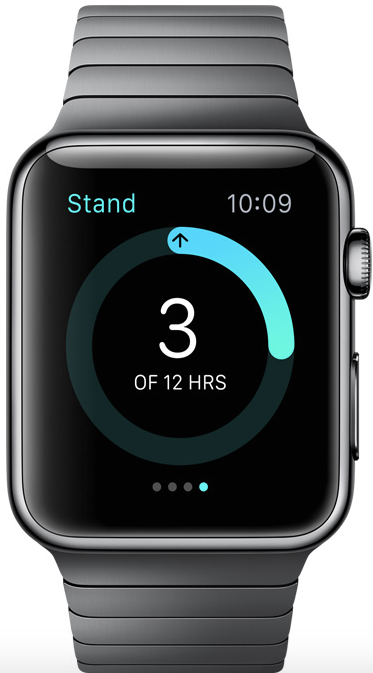
The biggest fitness app really isn’t an app at all, but a built-in feature to the watch. Apple Watch is chock full of fitness and activity tracking options including a workout app, basic step and burned-calorie counters, and will even feature reminders alerting you when it’s time to stand up and walk around a little.

applewatchstand

Third-party apps will also be available for tracking fitness. Offerings from Nike+ Running, Strava, and Runtastic are also being featured on Apple’s web site. Data from Watch will be synced with these services, allowing users more access to and control over their data.

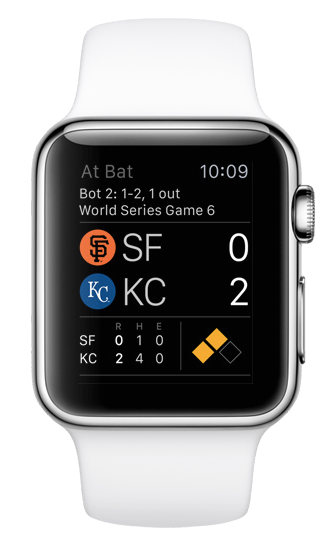
So far, only two apps for sports fans have been announced — MLB At Bat and ESPN. Both will feature team-/game-based notifications and general scoreboard functions, while the At Bat app promises player stats, news, and even highlights. I have to admit, watching highlights on a watch would be pretty cool.

applewatchmlbatbat

Apple has released the iOS update that features the Apple Watch app, but as of this writing access to the Watch App Store was not available. Nevertheless, the Watch API has been out for some time, so it’s easy to assume there will be plenty more offerings above what has been announced today. We’ll keep you updated as soon as we get any more info.

The Apple Watch will be available for preorder on April 10th, with units becoming available on April 24th.


ASMI’s Glenn Fleisig talks about Tommy John Surgeries, Wearable Sensors at Sloan Conference

For such a small piece of tissue, the ulnar collateral ligament can do a lot of damage when it tears. According to Jon Roegele, 90 professional baseball players underwent Tommy John surgery to repair a damaged UCL in the last calendar year, costing teams tens of millions of dollars and months of lost service time. Young prospects, grizzled veterans, pitchers, catchers, outfielders, flamethrowers and junkballers: all went under the knife and emerged with the infamous long, curved scar.

The high stakes go a long way to explain why Glenn Fleisig, Ph.D., research director at the American Sports Medicine Institute, was invited to speak on the epidemic at last weekend’s Sloan Sports Analytics Conference. Fleisig — who also serves as chairman of USA Baseball’s Medical and Safety Committee, an advisor for Little League Baseball, and on Major League Baseball’s Elbow Task Force — presented “Analytics of the Tommy John Injury Epidemic” Saturday morning to discuss the ASMI’s research, dispel some common myths, and talk about the “Pitch Smart” guidelines he helped develop.

Even in the few months since the Pitch Smart guidelines were released, Fleisig said he was “blown away” by the amount of positive feedback he’s received.

“For 20 years, Dr. [James] Andrews and myself have been giving guidelines that have been pretty well received in general by those in medicine,” he said in an interview. “Since the Pitch Smart guidelines came out, we’ve seen the same kind of response from coaches and parents across baseball.”

But Fleisig still devoted a significant amount of time to clearing up misconceptions about the surgery’s success rate (only two-thirds of MLB pitchers who underwent Tommy John surgery made it back to the majors and stayed there) and effect on pitchers (pitchers do not see a bump in performance immediately after the surgery).

The highlight of Fleisig’s talk was a discussion of the risk factors associated with UCL injuries. Fleisig reported the results of a recent study into the biomechanics of 80 minor league pitchers — 40 of whom had returned from Tommy John surgery, and 40 healthy controls. The paper looked at a number of potential risk factors (including amount of arm abduction, stride length, and the infamous “inverted W“), but found no difference between the mechanics of the previously injured and healthy pitchers. Fleisig admitted, however, that the study was not predictive: by looking at the biomechanics of only those pitchers who successfully returned to pitching, the study overlooked any mechanical flaws that had since been corrected, as well as any biomechanical issues in those pitchers who were unable to make a successful comeback.

A better predictor of UCL injuries, Fleisig said, was overuse. A recent ten-year study of 476 adolescent baseball pitchers found that pitchers who threw over 100 innings in a year were three times more likely to be injured; those who regularly threw over 80 pitches in a year more than four times; those who pitched for at least eight consecutive months five times; and those who regularly pitched fatigued 36 times more likely to suffer a UCL injury.

“I hear people say that throwing isn’t a natural motion,” Fleisig said during his presentation. “Throwing is natural. Pitching at max effort, 100 or more times in a game, that’s what’s not natural.”

Fleisig believes overuse of young pitchers is largely responsible for the rise in professional pitchers getting Tommy John surgery, even as organizations are placing increasingly strict limits on prized prospects like Dylan Bundy and Joba Chamberlain.

“A lot of the time, the damage has already been done by the time they get to pro ball,” Fleisig said. “When you pitch, you produce lots of microscopic tears that can heal with rest, but if you pitch too much, then [the UCL] is like a frayed rope, and there’s not much you can do.”

Fleisig’s group has calculated that a 90-mph fastball puts as much as 100 newton meters (N-m) of torque on the elbow. Fortunately, this force is instantaneous or UCLs would be tearing on virtually every pitch. But the ligament still absorbs a significant part of that force; as muscles tire, the amount absorbed by the UCL can increase, leading to the dramatic increase of UCL injuries in pitchers who regularly throw when fatigued. Fleisig said that strength and conditioning can help reduce the risk of injury, but stressed the importance of the entire kinetic chain, from legs to trunk to arm muscles.

“I wish I could say there was one key to avoiding injuries — and that would make a good article — but that’s not reality,” Fleisig said. “The secret isn’t the legs, the secret isn’t the arms, the secret isn’t the trunk, it’s the whole body.”

In addition to his work with ASMI and the sport’s governing bodies, Fleisig also serves as a consultant for Motus Global, a movement analysis company whose mThrow sleeve for pitchers will be available to the public this spring. The headline number produced by the system will be a measurement of workload, derived from the sum of the torque put on the elbow across all throws a player makes, including pitching in game situations, warmups, and drills such as long toss. The sleeve (and the metrics it provides) are still in the early stages, but Fleisig is confident that it represents an improvement in teams’ understanding of workload.

“We don’t know what the right exact formula [for workload] is,” Fleisig said. “For instance, if you throw two throws at 50 N-m, is that the same amount of danger to your elbow as one throw at 100 N-m? Probably not. But before the Motus sleeve, workload was just added up by people counting how many throws someone did.”

Fleisig admits, however, that users will rely too heavily on the system’s workload calculation, especially at the amateur level where coaches, trainers, and players may lack the rapport to establish when a pitcher is truly fatigued.

“The potential customers for the Motus sleeve are not only pro pitchers but also high school kids,” Fleisig said. “I would hope that the pro teams would click through to see the extra data the sleeve produces, whereas I think the summarized information might be the best for many of the amateurs.”

A number of companies aim to improve further on Motus Global’s innovation, and are working on systems that can automatically capture full-body kinematic data without markers. Fleisig does not consult on any of these projects, but has seen some of them in action. Most, including the system Sportvision presented at Saberseminar last summer, require manual digitization, where a human observer annotates the location of the pitcher’s joints at every frame. But despite the demand for automated systems, Fleisig stressed that these technologies are only a tool in the arsenal of coaches, trainers, and pitchers to prevent injuries and improve performance.

“Biomechanics experts and technology are not the keys to optimizing pitcher safety and performance,” he said. “The key will be the expertise of coaches to use this new information.”


Wearable Tech and Startups Highlight 9th Annual Sloan Sports Analytics Conference

The MIT Sloan School of Business will host its ninth annual sports analytics conference at the Boston Convention and Exhibition Center next weekend. The conference attracts a host of luminaries from the sports business world, including general managers, owners, players and journalists. But over the last few years, a number of technology companies have made their presence felt as well, giving attendees a glimpse of the present and future of technology in sports.

Last year’s conference featured a number of innovative products and big announcements. The highlight, of course, was Major League Baseball Advanced Media’s unveiling of its StatCast system. A number of wearable sensor companies also made presentations: Adidas demonstrated the miCoach system that the German national team used en route to their World Cup win last summer, Zebra showed off the RFID tags that made its NFL partnership possible, and Diamond Kinetics let attendees try its SwingTracker bat sensor before it hit the market. The multitude of hands-on experiences with the sensors made the hallway outside the panel discussions feel a bit like a carnival midway.

A number of this year’s panels will also revolve around new technology. The Wearable Technology panel on Saturday morning features Zebra’s general manager for sports Eric Petrosinelli and Catapult’s North American president Brian Kopp. These two, along with Cleveland Browns receiver Andrew Hawkins and Golden State Warriors assistant general manager Mark Lacob, will discuss the adoption of wearable technology, and discuss how teams are using data from wearable sensors to improve training and in-game decision making. No baseball devices are included in this panel, but the American Sports Medicine Institute’s Glenn Fleisig (who also consults for Motus Global) will be speaking on the Tommy John epidemic at the same time. Zebra’s general manager Jill Stelfox will also participate in a panel describing the “next-generation” statistics their sensors have brought to the NFL.

For those more interested in learning about technology’s impact on the fan experience, there is also a panel on “Designing the Stadium of the Future.” Some of the discussion will undoubtedly center on improving the fan experience, a familiar refrain for returning attendees. But stadium design company Populous is sending Jon Knight, a senior principal, to talk about design innovations and new technologies being incorporated into new stadiums. And YinzCam, a company dedicated to “the ultimate mobile fan experience,” will be on hand to silence any grousing about getting fans off their phones.

And there will be plenty of smaller companies making their debut on the big stage. The Startup Trade Show features 11 companies that run the gamut from fan experience apps to markerless motion capture systems to training managers and fitness guides. The companies will also compete in the Blitz Competition, where these startups pitch their business model to a panel of entrepreneurs for bragging rights and a small cash prize.

And there are a number of other interesting components, from the research papers to the conversation with new MLB Commissioner Rob Manfred (which is sure to touch on the new StatCast system slated to be rolled out this season). Tickets for the conference sold out months ago, but Sloan usually broadcasts the conference over YouTube. Those willing to pay for the subscription (or at least sign up for the 14-day free trial) can enjoy the videos without having to brave the frozen wastelands of South Boston.

(Photo by Matt Sullivan)

Startup deCervo Uses Brain Training to Boost Hitters’ Performance

There are four inches of fresh snow on the Brown University campus, but in a little office in the Pizzitola Center, junior Tim McKeithan is training to recognize sliders and curveballs.

McKeithan is tracking simulated trajectories on a computer screen while wearing an electroencephalograph (EEG) headset. It’s part of a new system developed by deCervo, a New York-based startup, to measure hitters’ decision-making process.

deCervo is led by Jordan Muraskin and Jason Sherwin, who met during their doctorate studies at Columbia University. Although the company is still in its infancy, the pair have been working on the underlying technology for several years, and have been featured in a number of prestigious publications. And teams are starting to take notice — Brown is the fourth NCAA Division I program to work with deCervo, joining Illinois, Bradley, and Ivy League rival Columbia. Sherwin also said the group was “in talks” with some Major League Baseball teams, and hopes to work with professional hitters during spring training.

The program relies on the Advanced Brain Monitoring B-Alert X10, a wireless EEG headset. The nine electrodes are attached to flexible plastic strips, and are evenly distributed around the subject’s scalp. The signals from the electrodes are sampled at 256 Hz and transmitted wirelessly via Bluetooth for storage on a personal computer.

Once the subject is wearing the headset and the signal quality has been checked, the training can begin using deCervo’s custom-designed software. Before each pitch, a pitch type — fastball, curveball, or slider — is displayed on a blank screen for a second or two. The label disappears, and a green “ball” moves according to one of the three trajectories. If the pitch trajectory matches the type displayed at the beginning, the subject presses a key, representing the decision to swing. The program stores the accuracy and response time for each trial, as well as the EEG signals recorded from the headset.

After McKeithan finishes his training and removes the headset, Muraskin processes the data and explains the results. His software allows them to break down the EEG signal into various components, with markers at the trial start, the moment the pitch first appears, and the time of key press. Muraskin also plots McKeithan’s accuracy as a function of reaction time.

“There’s usually a jump around 300 or 350 milliseconds where the player really starts recognizing the pitch,” Muraskin explained. But, to his surprise, McKeithan has improved, and is starting to recognize the pitches around 270 ms.

“That’s really good,” Muraskin said.

deCervo (whose name is from the French for “of the brain”) are not the only company training baseball players’ brains. Aaron Seitz from UC Riverside gave a talk at last August’s Saberseminar on the improvements the Highlanders’ baseball team saw after training with Ultimeyes, his vision training game. And Boston-based Neuroscouting also offers brain training solutions for elite baseball players. And although Sherwin did not claim to be an expert in Neuroscouting’s techniques, he had heard enough to draw a comparison between the two companies.

“In our research we’ve worked with musicians, with soldiers, with athletes,” Sherwin said. “We see that there are certain brain circuits that are tuned towards whatever context or expertise that person has. And we think that our tech is more efficiently tapping in to what those circuits are doing, and how well they’re doing.”

Support for this belief comes from the differences in performance deCervo sees between baseball players and non-baseball players, as well as the difference between players of different skill levels. Sherwin (who has no baseball playing background beyond high school) contrasted his performance while developing the program with that of McKeithan, who correctly determined whether or not to swing 86 percent of the time.

“It’s a very high number that we see consistently with our players,” Sherwin said. “Jordan and I made this experiment and we still haven’t been able to hit 86 percent accuracy, and what’s even more amazing is that their response time is significantly lower than ours.”

Sherwin also explained that better players produced both higher accuracies and lower response times, suggesting that the program could not only separate good from bad players but also identify the strengths and weaknesses of individual players. So Sherwin and Muraskin began developing profiles, based on each subject’s results, to suggest areas for potential improvement.

“Nobody wants to air their dirty laundry on the field,” Sherwin said. “You don’t want to look like a schmuck missing the slider low and away in the game, you’d rather practice that. Better to do it in the privacy of your own home, on an app or something.”

For now, though, deCervo isn’t suggesting specific practice plans for players, but instead are working with coaches to confirm their findings and discuss how coaches will work to fix each player’s agreed-upon weaknesses.

“The first step is having some kind of common ground,” Sherwin said, “Us showing that we’re measuring what we think is relevant for hitting a baseball, and them also recognizing that this is relevant for hitting a baseball.”

And so far, the coaches they’ve worked with have been receptive to the feedback deCervo is providing. Sherwin said he and Muraskin were excited by their early feedback, especially from Brown head coach Grant Achilles.

“Coach Achilles here, his line is emblazoned in my memory, he said, ‘You guys are showing on a statistical and empirical level what we’re seeing with our players.'”

Grant Achilles took over the head coaching job on an interim basis midway through last season, and is about to start his first full season in the top job. Achilles and his staff use a number of advanced metrics to measure his team’s performance, but doesn’t see himself as a sabermetric pioneer.

“Am I somebody that Bill James will be quoting in his book? Probably not,” Achilles said. “But it’s certainly something that’s growing in baseball, and if you don’t pay attention to it, you’re going to be left behind.”

Before coming to Brown, Achilles was an assistant coach at Wake Forest and Georgetown, big-time athletic programs with big-time athletic department budgets. But the comparatively smaller budget of Brown has forced Achilles to think more creatively about ways to improve his players. Achilles first heard about deCervo through an alumnus, who contacted the new coach after reading about the technology in a research journal. Achilles struck up a relationship with the company’s founders, and the Bears began a training program in December. Although it’s too early to see results in game situations, Achilles is already excited by what he’s seen.

“The actual data they’ve kicked back has given traction to stuff that we’ve seen as coaches but you really can’t explain,” Achilles said. “This data gives us a clearer understanding of why guys are either struggling with pitches or doing well in other situations, so it’s truly backed up the results we’ve seen on-field and in practice.”

The immediate future for deCervo, aside from branching into MLB, is developing a single piece of software that teams could use themselves (after some training) to train players and track their improvements over the course of a season. Sherwin and Muraskin also plan to develop a simpler mobile version of the software for players to use without the EEG headset.

“What’s interesting about the app is that given that we’ve done this [data collection] with a bunch of players and a bunch of non-players, we have a database now of what the neural predecessors look like on average in terms of the behavioral metrics,” Sherwin said. “So if we measure the behavioral metrics, we have an approximate measure of what the neural response looks like beforehand, give them an idea of what their most likely neural response is.”

deCervo is also starting to look outside baseball, working with an NHL team to measure how well goalies recognize puck trajectories and offensive formations. The company has also started to work with the Columbia football team, measuring how fast defensive linemen get off the line when the ball is snapped.

“All this stuff we’re doing right now, we’re starting pretty simplistic and building up,” Muraskin said. “There are things [teams] are doing that fit in well with what we’re doing but we would bring a more rigorous, scientific approach.”

Correction: A quote has been changed in the tenth paragraph from “towards whatever concept or expertise that person has” to “whatever context.”


MLS Joins NFL and NHL In Adopting Concussion Tracking Technology

Major League Soccer has announced they will begin implementing the concussion tracking device xPatch next season in order to further study the effects of head trauma on their players.

The xPatch was recently used in a rugby match by the London-based Saracens (no relation to Friday Night Lights character Matt Saracen, unfortunately). Some in London have dismissed the patches, calling them gimmicky, but Edward Griffith, the Saracens CEO, responded tersely saying, “It is the furthest thing from a gimmick. This is not something we just thought would be good to try out last weekend. This has been nine months in the planning. We have set aside a budget of £350,000 for it for next season funded by the Drake Foundation because we believe wholly in the significance of the research. I don’t want to be visiting these players in 20 or 25 years time in a hospital where they are suffering from dementia or some other neurological condition.”

The xPatch, made by Seattle-based X2 Biosystems, contains a gyroscope and accelerometer that are encased in plastic. They are 1” by 3” and placed on a bone behind the players ear and taped down for games. The xPatch records all of the head trauma a player experiences and sends the information to trainers via an app.

A device like the xPatch may have been able to better track the head trauma former MLS star Taylor Twellman experienced during his career (he retired after suffering his sixth concussion). Twellman has since committed to donating his brain after his death for concussion reasearch and has his own foundation, Think Taylor, to raise money and awareness for concussion prevention.

Further implementation of the device could also help prevent scenarios like the one that occurred during the NFL playoffs on January 3rd, when the Ravens Courtney Upshaw had a rare clean sack of Steelers quarterback Ben Roethlisberger, who’s helmet bounced off the turf when he went down.

Roethlisberger returned to the game five minutes later after having his neck and shoulders tested and going through the NFL concussion protocol. He looked shaky when he returned to the huddle and proceeded to throw an interception on his first snap, causing some to speculate that he returned to the game too soon.

Dr. Matt Matava of the NFL Physician Society explained to the Guardian previously that X2 Biosystems technology, “has allowed us to accurately diagnose concussions immediately following an injury [about six to eight minutes after a hit]. The software also allows us to compare the players’ injury date to their baseline in order to objectively assess changes in mental status.” All 32 NFL teams currently use X2’s concussion management software.

The hope is that the technology becomes unobtrusive enough for players of all contact sports to use during games to detect in-game head trauma and track the sub-concussive impacts a player experiences over the course of his career. Considering the tragic deaths of former NFL stars Junior Seau and Dave Duerson, and the nightmare that the NFL concussion settlement has become, it’s a breakthrough that can’t come soon enough.

(Image via Bay Area Bias)