Archive for Hockey

ESPN Secures Rights to 2016 World Cup of Hockey

Exclusive video broadcasting rights for the World Cup of Hockey 2016 has officially been awarded to ESPN. The Cup is to be held at the Air Canada Centre in Toronto from September 17 through October 1st, 2016 and will pit eight countries against each other in a round-robin format, followed by a semi-final bracket. The finals will be decided by a best-of-three series for the title of best hockey country in the world, at least until the 2018 Winter Olympics.

The press release specifically cites games will be shown on TV via ESPN and ESPN2. It also mentions live access available via the WatchESPN app, though of course that requires a cable subscription. ESPN nailing down major international sporting events is nothing new — see the 2014 World Cup and 2015 Women’s World Cup — but it is curious to them take hockey. The NHL Network and NBC own the US hockey rights as ESPN bowed out of bidding in 2004.

Last month word broke that unofficially ESPN beat out Fox and NBC for the World Cup, though it is doubtful NBC feels threatened. They probably feel secure in their 10-year broadcast deal running through the 2020-21 season. The Worldwide Leader has come under criticism for trending away from hockey, though President of ESPN, John Skipper disagreed:

Look, I don’t think it’s [the criticism] fair,” Skipper said. “I see SportsCenter every day and we cover hockey every day. We do not have a significant differential between highlights of hockey now and when we had it. The only difference is we are not there [as a rights holder]. If we were there for the playoffs, we’d be throwing to the guys calling the game. We can’t do that, but we are at hockey games. We are doing hockey highlights.

Apparently hockey highlights weren’t enough anymore.

(Header image via NHL)

NHL Announces Partnership with SAP to Redesign Stats Presentation

The NHL is slowly creating a new beat for sports journalists, announcing yet another technology partnership, this time with cloud software provider SAP, who will help the NHL.con introduce advanced statistics and redesign how they are presented.

Coming the heels of releasing 35 new advance statistics to NHL.com and partnerships with Go Pro and Sportsvision, the NHL is quickly storming to the forefront of sports technology.

NHL Chief Operating Officer John Collins said of the partnership, “Hockey is extremely fast-paced with very little stoppage in play, which results in many aspects of the game failing to show up in the box score. In partnering with SAP and using its best-in-class SAP HANA Enterprise Cloud service, we are now able to capture data points like never before and present existing and new statistics in a visually appealing way.”

SAP was already the NHL’s official cloud partner and this new partnership will further cement their relationship. It also helps that the majority owner owner of the San Jose Sharks is SAP co-founder Hasso Plattner.

The full extent of these initiatives will be released in phases, the first of which is the redesign of the NHL.com stats page and the introduction of new advanced statistics. For those looking for a proper introduction to the NHL’s new stats package head over to their enhanced stats introduction here.


NHL.com to Introduce 35 Advanced Statistics Today

The NHL will be introducing 35 new stats on their website today, ushering in a new era in the ways fans, media, and teams can measure the game. Adding to the puck and player tracking technology the NHL introduced at the 2015 All-Star Weekend, which TechGraphs chronicled, the 2014-2015 season may be remembered as the year the NHL left the analytics ice age and joined U.S. pro sports leagues in adopting advanced sports technology.

NHL COO John Collins said of the additions, “You’re going to see a big change in the way we present our stats, in terms of the depth and the utility of how to do it. And that’s before the puck tracking [system].” He later added, “We need to create a digital record of what happens on the ice. That’s standard across the league, and goes much deeper than the current real-time scoring system.”

The two most common advanced stats are Corsi and Fenwick, both of which estimate puck possession. For a primer on advanced NHL statistics check out this primer from Sports Illustrated, or for a deeper dive, take a look at Lighthouse Hockey’s introduction to hockey analytics.

In addition to being used by media and fans, the NHL will begin allowing teams and player agents to use these advanced statistics in arbitration hearings, which will change the criteria for how arbitration eligible players are compensated.

In fact, Jimmy Hascup of USA TODAY wrote an article today about player agent Allan Walsh, who brought up puck-possession metrics in a discussion about the value of one of his clients in a meeting with a general manager. After Walsh told  the officials they were missing an important part of his clients value, Walsh recounted,  “It was kind of like, ‘(expletive), he knows.’ It really brought discussion to a different level.”

But these new metrics aren’t being met with open arms by everyone associated with the NHL. Much like the scouts vs. quants stat wars chronicled in the Michael Lewis book, Moneyball, many in the NHL establishment have been resistant to these new metrics. Josh Gold-Smith from Awful Announcing covered this conflict recently, showing that one NHL columnist compared “analytics folks” to terrorists:

We’ve seen this story before in baseball and we know how it will end. Regardless of the opinions of stats-truthers, the NHL has already won by embracing advances in sports technology, which will bring dividends to the league and their fans for years to come.

(Image via Wikimedia)

Two Tech Partnerships Unveiled During NHL All-Star Weekend

The NHL has long been perceived as somewhat behind the times with their unique brand of legalized fisticuffs, but their latest partnerships with GoPro and Sportsvision could make the NHL the leader of the big four pro sports in player tracking technology.

First, the NHL announced they will broadcast live GoPro footage of its players during telecasts. Previously, GoPro has been relegated to partnerships with extreme sports. This is is their first foray with a major pro sports league. According to Techcrunch, GoPro will receive additional branding opportunities as part of their deal with the NHL as an “Official Partner.” The live broadcasts were a part of the 2015 NHL All-Star Weekend and you can see a clip of some previously shot footage below.

In another announcement, the NHL revealed they would be using player tracking technology in both the Skills Competition and the All-Star Game. The technology was created by Sportvision, which also provides real-time tracking technology for NASCAR and the NFL. To track the players and the puck in real time, Sportsvision has created a puck that contains a microchip and has infrared light tubes around the outside. As Sportsvision CEO Hank Adams explained to Yahoo Sports, “We have infrared cameras up in the catwalks, 10 of them. They see the flash of the puck, which is a unique frequency, and different than the flash of a player tag. And each player tag has a different frequency. We slip it into a pocket of the jersey, and it shines through brightly.”

The puck was the toughest nut to crack, something that took Sportsvision years to perfect. According to the Washington Post, Sportsvision partnered with the NHL’s puck manufacturer to recreate a puck that would play the same way as current game pucks. Adams says, “When you throw the puck on the ice, and the standard puck, they won’t be able to tell the difference,” Adams said. “It’s not livelier, deader, no extra rebound, heavier, it is basically the same puck from their standpoint.”

NHL Commissioner Gary Bettman praised the possibilities of the technology, saying, “This is, if I can coin a phrase, in the embryonic stages of a work in progress, but ultimately we are hoping to deliver the kind of data that will create insights and tell stories that avid and casual hockey fans will enjoy. In short, we are attempting to embark upon a journey that hopefully will enable us to create and then maintain a digital record of everything in our game and compile a complete digital history.”

For NHL fans, the technology will provide real-time times stats during broadcasts, including player speed, shot speed, and player ice time, among other information. Below is some footage of the tracking technology in use during the NHL Skills Competition.

The technology will also be used for viewers using a second screen, where fans can follow the game in real time similar to MLB’s At Bat app. Users will able to track in the puck, player position, and ice time in real-time. Below is the second screen software the NHL showed off during All-Star Weekend.

The are plenty more uses for this technology, including the ability to develop advanced analytics like the MLB and NBA, as well as new ways for fans to watch their favorite teams. For the naysayers who remember the glowing puck experiment by Fox Sports in the 1990s all too well, I can assure you this is not a repeat. On the contrary, these new partnerships could provide the NHL an advantage that it doesn’t have over more popular pro sports leagues for years to come.

(Image via gryphon1911)


MLS Joins NFL and NHL In Adopting Concussion Tracking Technology

Major League Soccer has announced they will begin implementing the concussion tracking device xPatch next season in order to further study the effects of head trauma on their players.

The xPatch was recently used in a rugby match by the London-based Saracens (no relation to Friday Night Lights character Matt Saracen, unfortunately). Some in London have dismissed the patches, calling them gimmicky, but Edward Griffith, the Saracens CEO, responded tersely saying, “It is the furthest thing from a gimmick. This is not something we just thought would be good to try out last weekend. This has been nine months in the planning. We have set aside a budget of £350,000 for it for next season funded by the Drake Foundation because we believe wholly in the significance of the research. I don’t want to be visiting these players in 20 or 25 years time in a hospital where they are suffering from dementia or some other neurological condition.”

The xPatch, made by Seattle-based X2 Biosystems, contains a gyroscope and accelerometer that are encased in plastic. They are 1” by 3” and placed on a bone behind the players ear and taped down for games. The xPatch records all of the head trauma a player experiences and sends the information to trainers via an app.

A device like the xPatch may have been able to better track the head trauma former MLS star Taylor Twellman experienced during his career (he retired after suffering his sixth concussion). Twellman has since committed to donating his brain after his death for concussion reasearch and has his own foundation, Think Taylor, to raise money and awareness for concussion prevention.

Further implementation of the device could also help prevent scenarios like the one that occurred during the NFL playoffs on January 3rd, when the Ravens Courtney Upshaw had a rare clean sack of Steelers quarterback Ben Roethlisberger, who’s helmet bounced off the turf when he went down.

Roethlisberger returned to the game five minutes later after having his neck and shoulders tested and going through the NFL concussion protocol. He looked shaky when he returned to the huddle and proceeded to throw an interception on his first snap, causing some to speculate that he returned to the game too soon.

Dr. Matt Matava of the NFL Physician Society explained to the Guardian previously that X2 Biosystems technology, “has allowed us to accurately diagnose concussions immediately following an injury [about six to eight minutes after a hit]. The software also allows us to compare the players’ injury date to their baseline in order to objectively assess changes in mental status.” All 32 NFL teams currently use X2’s concussion management software.

The hope is that the technology becomes unobtrusive enough for players of all contact sports to use during games to detect in-game head trauma and track the sub-concussive impacts a player experiences over the course of his career. Considering the tragic deaths of former NFL stars Junior Seau and Dave Duerson, and the nightmare that the NFL concussion settlement has become, it’s a breakthrough that can’t come soon enough.

(Image via Bay Area Bias)

It’s Time for VR in Sports Broadcasts

Word is the Google Cardboard toy — which started as a gimmick, is now a toy, and will soon be a tool, I suspect — now has over 500,000 users.

This got me thinking: We already have mini-cameras we can embed in the ground; we have 360° camera technology; and now we have cheap, accessible virtual reality (VR).

Isn’t it time for 360° MLB.tv? Perhaps a camera embedded neatly in front of home plate or the pitcher’s mound. Maybe on the back of the mound to watch closeup up as the shortstop flips a double-play ball to the second baseman.

Google Cardboard could rapidly democratize the world of VR customers.

Or what about mounting a 3D camera on the cable-tugged NFL sky view cameras? Allow fans to watch the play unfold while focusing on just their fantasy wide receiver, finally giving them the vindication to scream at the quarterback, “He’s wide open! Throw it to James Jones already!”

And doesn’t NASCAR already have cameras mounted on every vehicle? Would it be any more difficult to swap in a 360 model?

The technology is probably not a point just yet where a 360 camera can be safely embedded into a soccer pitch or — certainly not — a basketball court or hockey rink. But goal post cross bars, tops of basketball backboards and jumbotrons dangling from stadium roofs could all be reasonable and fun locations for VR watchers.

Think about it, sports execs. Because it would be awesome.


Hockey Teams Are Turning Ice Rinks Into Projection Screens

Hockey is seemingly always a fun event to watch live. Even if your favorite team isn’t performing so well, the speed of the game, the always-present chance of a fight, and the overall live experience of live NHL hockey is an enjoyable one. Fans seem to agree, as — at least in the short term — NHL attendance records are growing. Some teams are not resting on their laurels, however, and are instituting even more ways to engage fans that make it to the arena.

devilsice

That bit of visual mastery can be found at The Prudential Center, the home of the New Jersey Devils. It comes courtesy of a dozen high-powered 1080p projectors that are mounted to the rafters of the arena. The company behind it is Quince Imaging. They have set up similar systems for other NHL teams as well as a few NBA clubs. The company was profiled recently by Wired.

And according to Quince COO Scott Williams, it doesn’t have to stop at fancy pre-game theatrics. There are possible plans to integrate interactive games — even some controlled by fans’ mobile devices.

The detail of the graphics is impressive in both the GIF above, and the video below of the Calgary Flames’ intro. We are only a few years removed from HD scoreboards over center ice, and now arenas are tricking us into thinking people can freeze fire with their skates. I’m sure the addition of similar systems in other arenas would be a welcome change for fans.

(Header image and GIF via Quince Imaging Vimeo page)

The San Jose Sharks’ New “4D” Broadcasts

The San Jose Sharks has an entirely new experience for viewers at home. For games played at the SAP Center that are also broadcasted by Comcast SportsNet California, Sharks fans can now feel the game while watching and listening to it. The Sharks have partnered with the entertainment technology specialists at Guitammer and have allowed their product called “The Buttkicker” to feel the hits of the game in real time.

The Buttkicker attaches to the viewer’s couch and is essentially an over-sized rumble pack, harkening back to the days of the Nintendo-64. The Buttkicker utilizes sensors in the boards to directly send signal to the in-home sensor. Each hit will literally be felt at home as the rumble can be felt with every board collision. The system is trumpeted by Guitammer as “4D” sports. The partnership is ready to begin on November 20 with a game against the visiting Florida Panthers.

Per David Koppet, Senior Executive Producer, Live Events for Comcast SportsNet California:

“Our goal is always to bring fans closer to the action, and what better way than to allow them to actually feel what’s happening on the ice. Guitammer’s 4D technology helps us transmit the electric energy of a Sharks hockey game right into your living room.”

The Sharks utilization of the Guitammer system is being considered a pilot program, however in the quest to bring the stadium experience to at-home viewers, the system could become a league-wide option. Big partnerships is nothing new to Guitammer as last year the company teamed up with the National Hot Rod Association (NHRA) to give a similar feel of excitement to at-home ESPN2 viewers.

While the Buttkicker offers plenty of action of the sports angle, it can also be used with movies and video games as well. The unit isn’t cheap, $299.95, but for the home theatre enthusiast or Sharks fan, it isn’t unreasonable. If Guitammer can continue to expand their role in entertainment, expect more and more leagues and associations to jump on board.

(Photo via caguard)

DraftKings and the NHL Partner Up

The one-day fantasy site DraftKings already has a partnership with MLB, but now they are expanding out to pro hockey, as well. According to Boston.com, a new agreement has been reached making DraftKings the official one-day fantasy site of the National Hockey League.

NHL-based games were already offered through DraftKings and their ilk, so this amounts to little more than marketing and product placement. Still, it shows just how large of a grasp daily fantasy is beginning to have in the sports world. DraftKings, along with their main competitor FanDuel, have been gaining lots of traction. They have bought out smaller competitors, and their ads can be seen all over sports sites and blogs, as well as during televised games. Their new partnership with the NHL should expand DraftKing’s presence even more, as they are slated to be advertised heavily on NHL-branded online entities such as their official Twitter account, NHL Mobile, and video replay and preview segments, among others.

(Header image via John Biehler)

Review: Gametime’s Ticket Purchasing Via Mobile

Purchasing tickets online is nothing new, but Gametime has made the process even easier when buying from your mobile — Android or iOS only — device. The company has just update their free mobile app and now rather than refreshing a page again and again, the app now has a “pull to refresh” email style option. It’s a small change that goes a long way in terms of convenience.

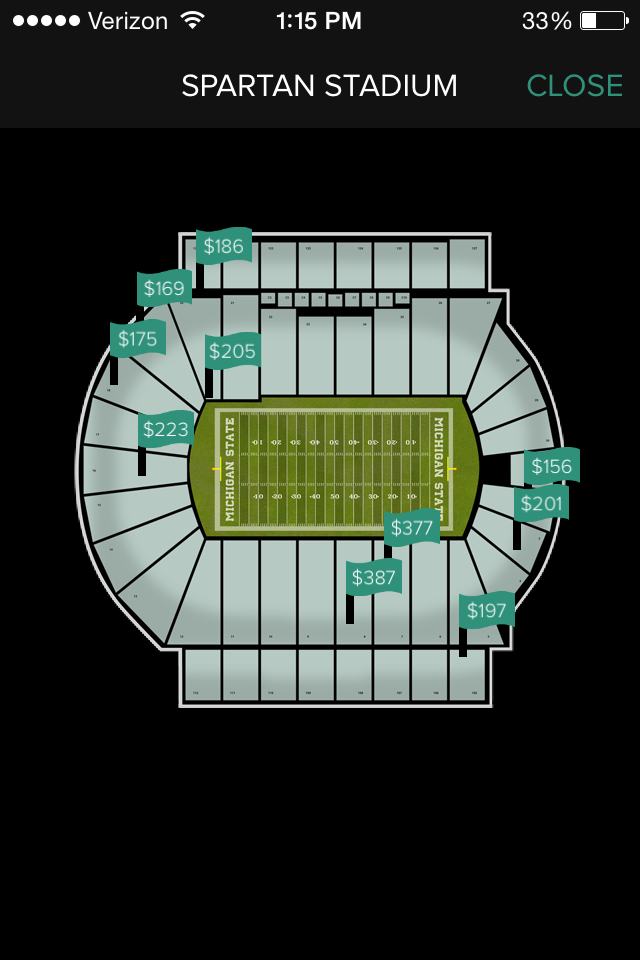
Not only is it easier to search for tickets with the pull to refresh option, Gametime now shows exactly where you’ll be sitting. With a birds eye view of the stadium or a field view, you know if you’ll be up in the nosebleeds or right on the sideline.

gametime5

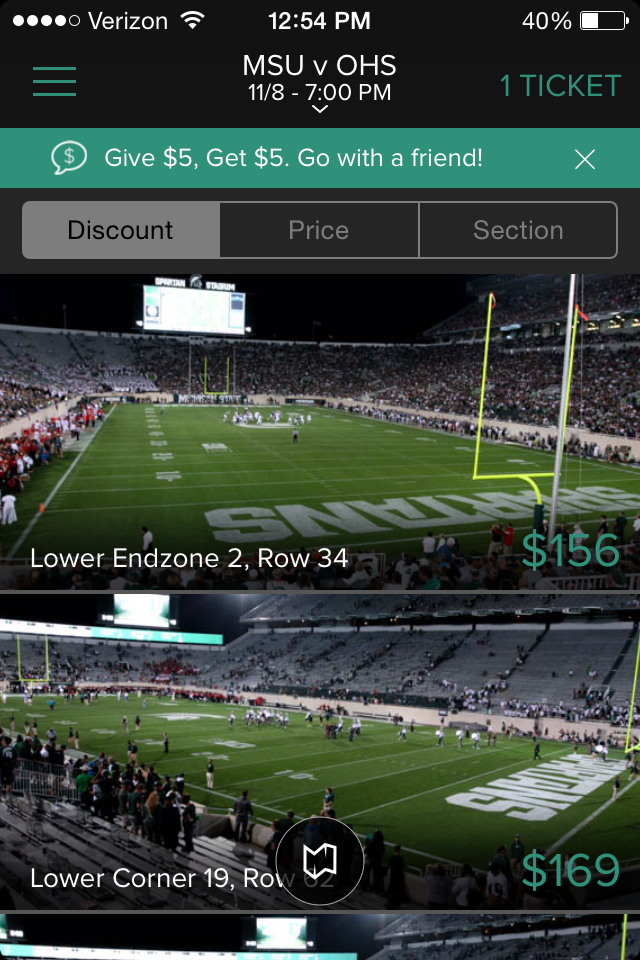
The field view gives the section, row and seat while showing what the field/court/rink will look like from the seats you’re interested in.

gametime4

The app allows purchasing up to 20 tickets per transaction and is within one second of real time availability. In an interview with VentureBeat, Chief Executive of Gametime Brad Griffith said of the updated ticket availability:

“We shifted to a video game style technology that can be immediately updated…It’s like playing a video game with another player. You have to keep it synchronized or it’s not a good experience.

Gametime currently works in 22 different cities and 60 venues. With app you can purchase tickets to NFL, MLB, NCAAF, MLS, NBA and NHL games. One downside is you’ll need a credit/debit card on file, as neither Paypal nor Venmo is currently a pay option.

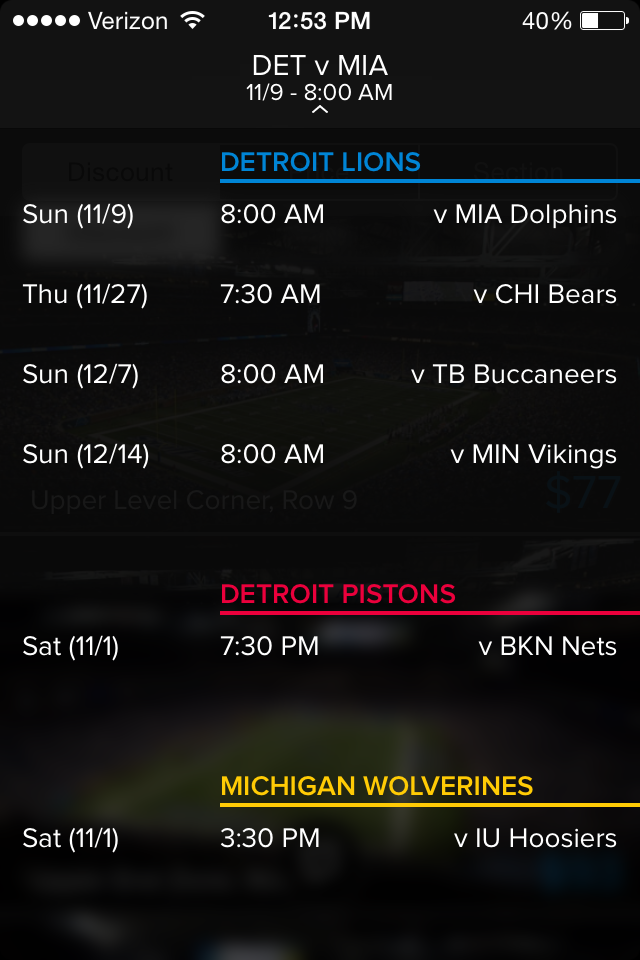
Another curious quirk was the start times of certain games is wrong. After selecting Detroit as my city, it showed the Lions are playing at 8 am on Sunday, November 9. The game actually kicks off at 1 pm.

gametime2Gametime did get the University of Michigan game and the Pistons start time correct, but they were an hour early on the Michigan State game. There wasn’t a way to change your timezone, so make sure to cross check the actual game times with what is listed. After checking more Lions games, it appears as though each game time for the Detroit football team is wrong.

gametime3

If you happen to find any other unusual goings on, reporting them to Gametime is as easy as shooting an email to their feedback email address or one could call or text them from 8am-11pm Pacific at their 1-800 number. Both help options are listed on their website FAQ, not in-app however.

Overall the app does exactly what it should: purchasing tickets from mobile quickly and easily, usually  without having to print them off. A small number of venues still require a paper PDF ticket but that is outside of Gametime’s control. It can certainly be a useful app for everything from a last-minute decision to go to a game or if you just need an extra ticket while on the way to the stadium.