Archive for Hockey

A Case for Open Source Concussion Research

The Case for Open Source Concussion Research

Not so long ago, the divide between hardware and software was fairly distinct. Certain companies made hardware and others made software. Or, to be more precise, companies made software and others scrambled like hell to make hardware that would run it. This was the time of the 80s and 90s PC market — Microsoft was king and others fought each other to build the machines that would run Microsoft’s software. But as time went by and the silicon got smaller and more diverse, it made sense for the manufacturers to also implement their own software. They knew how the hardware was supposed to function, after all. We see this now with smartphones and tablets. Apple makes their own hardware and software. Samsung makes the phones and and the heavily-modded Android OS that run them. And, of course, we see it with the wearable market. If you want to see the data from your FitBit, you need the FitBit app. The same goes for Misfit and Jawbone and the Microsoft Band. Truth be told, this is usually a perfectly workable system. But the boom of the wearable market has brought with it the proliferation of devices that do more than just track steps. Multiple companies now produce products that measure force and damage done to the head in efforts to try and reduce or at least understand concussions — a now-important issue in sports that we should have paid attention to years ago. But if individual companies are making their own hardware and software to collect this data, the collaboration disappears. Important sharing of knowledge goes by the wayside. Everything gets segmented and compartmentalized. With the threat of head injuries looming so large, should we not strive to pool our collective research? Can we not create products for both good and profit?

The term “open source” brings with it some confusion. Open source was spawned out of the Free Software movement, and in the name lies the first problem. When many people read the term “free software,” they think of those handy programs one can download for free off of SourceForge. It is true that many developers offer their products free of charge, but that’s not what free software or open source is about.

In the 1990s, Linus Torvalds — in either one of the most important acts in the history of computer science or one of the stupidest moves in the world of business, depending on who you ask — created his own variation on the Unix operating system and released it, for free, to anyone who wanted to try it out. It was released under the GNU Public License. The GPL basically* states that anything released under said license is free to be tested, used, and modified. Those who make modifications are even free to sell their product for profit, so long as they pay the GPL forward and release their code for the same testing and modification.

*I know I’m giving a very high overview of this. My apologies to the hardcore free software people out there.

Torvalds’ flavor of Unix was named Linux, and if you haven’t heard of it, your nerdiest friends sure have. It runs almost every web server, ATM, smart tv, and super computer, and can be found on around 50% of the world’s smartphones. This article is being written on a laptop running Linux. Company after company took Torvalds’ work and improved upon it, personalized it, and commoditized it. All they had to do was show their work.

This is how open source works. Google doesn’t technically make money off of Android, which is based on Linux. They do make money off the Android Store and the data the OS collects about users’ habits. Companies like Ubuntu and Red Hat make a killing selling their special flavor of Linux for servers, and/or by selling support for that software. Sure, some organizations do it just to do it — to work toward a common goal of creating something great and exciting — and for the mere challenge of it. But do not be fooled, there’s big money to be found in open source, in one way or another. Device manufacturers need not be afraid, especially when their work goes toward the greater good.

Imagine a company that makes sensors for football helmets. We have covered quite of few of them at this site. The sensors are meant to measure impacts and forces that could lead to brain injuries. The company packages their devices with their special software and sells it to professional, collegiate, and even high school teams. Meanwhile, another company is doing the exact same thing and selling their wares to other such teams. Who’s right? Who has the best data? Each system is self-contained so there’s no opportunity for this type of data to be compared, contrasted, and improved upon.

This is where innovation and collaboration stops. Sure, each company gets their share of the pie, but they’re not necessarily making athletes safer. This data is somewhat useful in the hands of coaches and parents, but imagine if it were open to research groups — if doctors and scientists could pick apart the code to find exactly what was being measured and submit improvements to the software. We might actually have a chance at learning something.

In a recent article about CTE, Deadspin’s Barry Petchesky wrote:

We don’t know a lot. We don’t know the rate at which CTE develops, or the mechanism. We don’t know the correlation with playing football as compared to other contact sports. We don’t know if some people are predisposed to developing it. We don’t know how its symptoms manifest in the living. (We don’t know if it has symptoms—correlation is not causation.) We don’t know if there’s treatment. Each announcement of another CTE-riddled NFL brain amounts to, basically, cataloguing.

Petchesky is exactly right. We’re at a stalemate with this issue. If a company were truly passionate about this, they would release their software under the GPL. They could still make and sell their hardware, but others would be able to sift through the mechanisms for measuring head injuries and submit advancements to make it better. Other companies could edit and enhance this code and implement it into their own sensors. Another company could come along and do the same. Meanwhile, everyone competing in this space would constantly be working to make better systems for tracking these types of things. Researchers, now armed with the code that powers these systems, could implement it into their own experiments and research. The conversation might still take a while, but at least everyone would be speaking the same language.

I understand that the point of all these systems is to make money. They give coaches and parents peace of mind knowing that steps are being taken to protect player safety. But there’s an untapped market here of contributing to the greater good. There’s still money to be made, it just comes with a little extra peace of mind that when a company uses this hypothetical open source system, they are putting their work out there for all to see. They are daring others to create a better system. These dares only lead to other dares, and sooner or later, people might actually learn something definitive about this subject. Players get better and companies still make money — imagine that.

GPS-Based Athlete Tracking Systems: A Primer

If you’re following the rise of player tracking technology, most of what’s being discussed are in-game systems. Whether the system is camera-based, like SportVu in the NBA or Statcast in MLB, or sensor-based, like Zebra’s RFID tracking of NFL players or the Sportvision’s partnership with the NHL, the goal is similar: track how pro athletes in the heat of competition, with the hope of gaining a competitive advantage by the shaving of a fraction of a second here or optimizing a route there.

But there’s another way for teams to use technology to gain an edge: by keeping their best players healthy and in those big games. This requires a separate system, especially on large squads like football teams where it would be impractical to collect and process the amount of optical data needed to capture everyone’s movements across all activities. As a result, systems based on global positioning system (GPS) technology are used in practices and rehab by a wide range of teams across all major sports.

Most of the designs center around a sports-bra looking harness worn by the athlete under his or her shirt. The harness holds a device containing a GPS chip, along with additional components like accelerometers, gyroscopes, and magnetometers, to track how and where an athlete moves. The GPS device is often paired with a heart rate monitor, allowing the system to estimate exertion.

Because the device relies on satellites to track the athletes, most companies that market a GPS system also market a complementary indoor system, typically based off a technology such as RFID that is better suited to the indoor environment. If a basketball or hockey team is working with one of these companies, chances are that they’re using indoor technology.

For now, these devices are predominantly used in practices, as none of the major leagues currently allow on-field wearable sensors for safety reasons. But FIFA just relaxed their ban, following successful runs at the Women’s World Cup and Under-23 World Cup over the summer. National federations are expected to follow suit shortly, and other sports leagues (such as MLB) are drawing up procedures to approve devices for in-game use.

Most readers are familiar with activity trackers like FitBit, which typically include a GPS component. But monitoring companies say that they aren’t designed to provide enough information to accurately track an athlete’s performance during competition or training.

“They offer very little insight into athlete’s performance,” said Richard Byrne, STATSports’s Business Administrator. “FitBit themselves are the first to admit they will show you patterns relating to your fitness levels as oppose to wholly accurate data.”

It might seem surprising to hear that teams are investing in GPS technology as camera-based systems proliferate across pro sports. STATS’ SportVu cameras are positioned in all 30 NBA arenas, and soccer teams have tracked distance traveled with systems like Matrics for years. But GPS companies argue their devices provide more in-depth information than camera-based systems.

“Camera systems essentially turn a match into moving dots on a screen,” said Catapult director of marketing Boden Westover. “You get speed and distance metrics, but they’re a tiny piece of the athlete tracking pie.”

There are a number of companies that offer similar GPS systems. For this introduction, I spoke with representatives from three — Catapult, STATSports, and VX Sport — but others (including GPSports and Zephyr) are also currently being used by pro organizations.

Catapult

With over 440 clients in 40 countries listed on their website, Catapult is the best-known and most prolific GPS company. Based in Australia, their OptimEye S5 (and the goalkeeper-specific G5) use GNSS, a combination of the American GPS system and the Russian GLONASS system. The result, according to Catapult, is a system accurate to within 50 cm; an older system that uses GPS only has a stated accuracy of 100 cm. The OptimEye devices include an inertial measurement analysis (IMA) chip, an accelerometer/gyroscope combination that measures an athlete’s finer movements. For indoor clients, Catapult produces ClearSky, an RFID-based system.

Westover said that Catapult’s distinguishing characteristic was independent validation of the technology published in peer-reviewed journals.

“There are around 100 such articles that have been published on Catapult, which prove that our technology measures what we say it does,” he said. “Other systems out there being used by teams have never been scientifically proven.”

STATSports

Headquartered in Ireland, STATSports’ offering is the Viper Pod, a combination GPS and MARG device with a stated accuracy of at least one meter. The inclusion of accelerometer, gyroscope, and magnetometer components allows the Viper Pod to track accelerations and decelerations, along with athlete direction and turning. The MARG components also contribute to the scrum analysis used by their rugby clients.

Although their current indoor solution works off accelerometry data, STATSports’ upcoming Viper 3 system (due out this year) will incorporate ultra-wideband technology for accuracy up to 10 cm. The new system will also use low-energy Bluetooth to connect to other devices like heart rate monitors.

Business administrator Richard Byrne said that STATSports prides itself on its software platform in addition to accuracy.

“Our customers tell us our software is light years ahead of anything else they have experienced,” Byrne said. “We have a host of innovative metrics which allow coaches who use our system an incredibly in-depth look at their athlete’s performance.”

VX Sport

VX Sport, a New Zealand-based company, is focusing its efforts on collegiate sports teams. VX Sport’s system combines three satellite systems — GPS, GLONASS, and an analogous Chinese system — but unlike other companies, doesn’t claim that the additional satellites produces increased accuracy. Instead, managing director Richard Snow claimed that the “dark art” of GPS accuracy relied more on high-quality components and intense post-processing.

“It’s a bit like talking about a pro digital camera vs. a consumer model,” Snow said. “If you picked up a pro Nikon from ten years ago, it’s always gonna be better than the 20 megapixel thing that you buy for $75 from an electronics store. And that’s the reality with GPS.”

VX Sport also offers an IMU-based indoor tracking system that caters to volleyball and basketball clients. Incorporating an accelerometer, gyroscope, and magnetometer, the device can track leg and hip biometrics based on the steps an athlete takes. The system includes software to summarize these biometrics into injury predictors.

Given the gameday motion capture systems currently in place, these GPS-based systems might seem superfluous. But Snow emphasized the importance of his system as a way to quantify players’ effort during the daily grind of training sessions.

“It used to be someone talking with the athletes in the morning, working out how are you feeling, what’s your readiness,” Snow said. “And then at the end of the training, how did you rate that? The only way they’re going to change that is with proper monitoring.”


How Playing Hockey Video Games Actually Taught Me How Hockey Works

It’s a bit of an odd dichotomy to be a sports fan living in Minnesota and not know anything about hockey. My excuse is that I grew up in Wisconsin, where football is king, and never even had a chance to play hockey in school. But I moved to Minnesota over 10 years ago. They air high school hockey games on the regional sports network here. I should have learned a little by osmosis at least.

I was too busy going to baseball games in the summer and pretending to care about the NFL in the winter to ever give hockey a try. It’s a shame really, because I found that the more of the sport I caught, the more I enjoyed it. So last year, when the NFL finally pulled enough BS to make me quit it pretty much entirely, I thought I’d give hockey a try. The only problem with that plan revolved around that fact that I didn’t really know anything about hockey. I’m not talking about not remembering what player played on what team. I barely knew the rules. So, like any enterprising 30-something with disposable income would do, I tried to solve my problems with video games.

Let’s preface this by saying, with the exception of simply knowing the name of some of the game’s biggest stars (Ovechkin, Crosby, Kane, etc.) essentially everything I knew about hockey came from whatever I ingested by watching The Mighty Ducks 50 times as a child. As it turns out, regular hockey is WAY LESS exciting than movie hockey, and movie hockey isn’t very good at explaining rules, strategy, or really even giving a general sense of the flow of the game. Needless to say, when I fired up NHL 15 last year, I had a steep hill to climb.

NHL 15 had its flaws, certainly, but the gameplay was always spot on for me. The graphics were great, the controls were responsive, and I had the ability to tailor the game in a myriad of ways. I could make my games easy or hard, fast or slow, and even get granular with how I wanted things like puck handling and passing accuracy to behave. I didn’t play much with these in the beginning, however, because I was too busy getting my butt handed to me.

Playing a video game based on sport you know nothing about is like driving a car in a country where the traffic laws are totally foreign. You have a good understanding of the mechanics of the whole thing, but not quite sure how to put it all together. Here’s how those first few days went:

1. Start game
2. Immediately get scored on
3. Check replay to see why
4. Glean nothing from replay
5. Get back into game
6. Get called for a penalty/violation
7. Pause game
8. Google said penalty/violation on my phone
9. Return to step 2.

I didn’t know what the blue lines were for. I didn’t understand offside or icing or interference of delays of game penalties. I didn’t know that if you shot the puck at the opponent’s net after an offside was called, the other team takes umbrage with it at a fairly aggressive level. I didn’t know that my goalie could be checked if he was out of the crease, because I mostly didn’t know what the crease was.

But soon enough, after enough failings and enough Googling, I understood the basic ins and outs of hockey. The hockey I watched on TV started to make more sense. When I watched the playoffs, I could understand a little more of what Doc Emrick was saying. It was some solid progress.

That was last winter, and I came into this season looking to understand a little more about strategy and basic fundamental gameplay. So instead of a general season playing as one team, I waded into the waters of creating my own player via the Be a Pro feature. I was about to go to school. NHL 15 taught me about how hockey was played. NHL 16 taught me how to play hockey.

OK, that last sentence may have been a bit of an overstatement. I’m not saying I’m ready to lace up and bang against some other out-of-shape dudes in a rec league or anything, but playing a season as a single player helped me better understand what everybody did and where they were supposed to go.

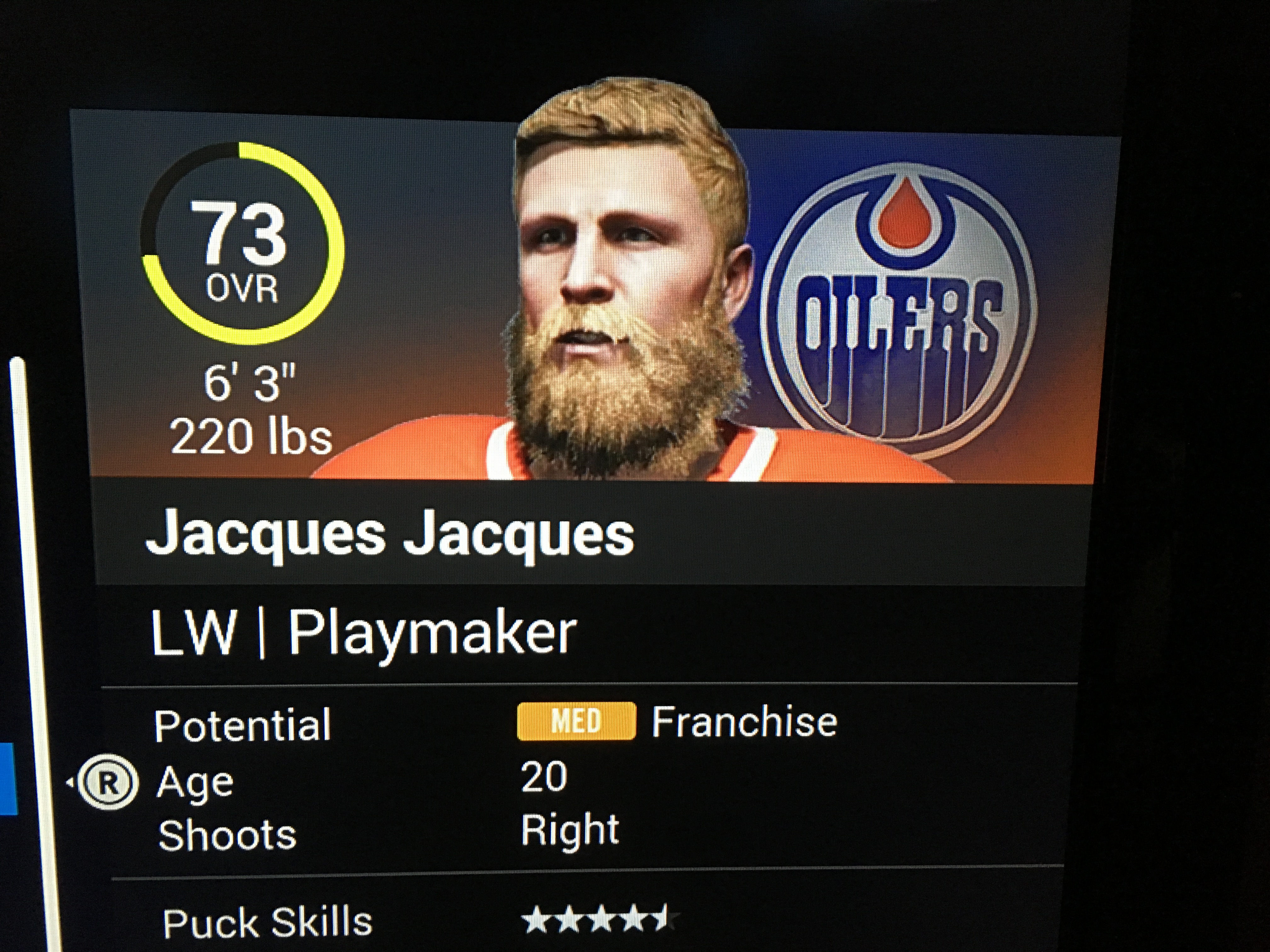
I think I’m on my seventh created player. The first six didn’t last very long. I tried playing as a center, but that didn’t do it for me. I tried a right winger but I made him right handed which isn’t the best idea because of the bad forehand angles (something I learned like three games in). I made some guys too big or too small for their position or juiced all the wrong attributes during creation, but finally I settled on a very solid player.

His name is Jacques Jacques. I wanted to make him have just one name like Pele or Cher, but the game wouldn’t let me. Regardless, Jacques was a last name prerecorded by the announcers, so it kind of sounds like they’re just using his one name. I even create a backstory for Jacques. Basically, he’s from somewhere outside Yellowknife, and he was discovered as a 17-year-old competing in unsanctioned MMA fights. He’d never played hockey because he was too busy logging or drilling for oil. But a scout found him and convinced him to learn hockey. It’s basically a mix between the plot of The Air Up There and Wolverine’s backstory from the first X-Men movie.

Jacques grows his playoff beard in November. That's how confident he is.
Jacques grows his playoff beard in November. That’s how confident he is.

Anyway, I played a whole minor league season with Jacques and ended up being the first overall pick. I was an Edmonton Oiler. The game, however, did not adjust the rest of the draft after that, so the Oilers still ended up with Connor McDavid. Needless to say, the Oilers are doing pretty well.

It’s kind of hard to explain everything I learned while trying to make my way through a digital hockey career, but the progress has been substantial.

I now understand things like general positioning — where the left winger should be in a given offensive formation. In the past, line changes always seemed so random to me, but now that I actually skate to the bench to rest, I’m starting to pick the best times to do so given where the puck, my teammates, and the opposing players are. I’m starting to decipher the fine lines surrounding what is and isn’t boarding and what is and isn’t interference. Whenever a goal is scored, I go to the replay to try and find out how. Where were the weaknesses in the defense? Who made a good play to get open? Was the goalie beat or was it a fluke deflection?

I see articles all the time about how schools are using games like Minecraft to teach kids things about teamwork and geometry and even basic computer programming. Educators have long used games as a teaching tool. And a silly as it sounds, NHL 15 and 16 honestly helped me learn about hockey. I now have a GameCenter subscription. I watch the Oilers and my hometown Wild or any other game that I find interesting. I’m understanding more and more why certain players or teams are really good.

I still have a lot of learning to do, but I can at least hold my own in a conversation with a hockey fan. I can detect a good play or a misstep when watching on live TV. I now have opinions that I yell at the TV.

Anyone can mindlessly play Madden or FIFA for hours on end. I’m not saying there isn’t value in that. But if one wants to really dig into the specifics and the minutiae of the sport, video games can actually be great for that too. I now know some stuff about hockey, which isn’t something I could have said two years ago. Now I just need to acquire a taste for lutefisk, and I’ll be a true Minnesotan.


CoachMePlus Completes Fundraising for Athlete Management System

CoachMePlus, a Buffalo-based company behind an eponymous athlete management system, recently completed a $600,000 round of venture capital fundraising, according to the company. The latest round followed a $1 million round of fundraising in October 2013.

The CoachMePlus software aggregates data from disparate sources into a single dashboard, making it easier for coaches and training staffs to combine the data from different wearable sensors, camera-based systems, and other sources. As such, they draw comparisons to Kinduct and Kitman Labs, which TechGraphs has recently covered. The difference, according to president and co-founder Kevin Dawidowicz, is that CoachMePlus was developed by “software guys,” rather than people with a physiology background. As a result, he argues, the company’s software is agnostic to a trainer’s methodology, which can mean a lot in a field as contentious as injury prevention.

“If I’m an industry expert, I’m going to shape my ideas and my software around my thought process,” Dawidowicz said. “But if you don’t believe in that methodology, then the software doesn’t work.”

This can be an advantage for teams with established sports science programs, who subscribe to their own theories on what keeps their athletes healthy. CoachMePlus also combines raw data with the outputs of algorithms produced by device companies to give front offices more options when working with data.

“We have universities that will use raw force plate data, put their own algorithms on top of it, and come up with their own indicators,” Dawidowicz said. “Nobody else is doing that.”

But not every organization is quite that advanced. For those cases, CoachMePlus has a network of consultants in place that teams can hire to help them analyze their data. The network, which Dawidowicz said was built entirely by word of mouth, keeps CoachMePlus from being influenced by a specific methodology.

“Everything that we’ve done is kind of through word of mouth, trade show attendance, and networking through different channels,” Dawidowicz said. “If you build these longstanding trust relationships, these coaching trees and these sport science trees open up because you’ve actually delivered for somebody.”

In addition to its data management tools, CoachMePlus also features workflow management tools, which Dawidowicz believes to be unique among his competitors. The tools allow coaches and training staffs to perform repetitive tasks like weigh-ins quickly and efficiently, even for large teams. The workflow tools also allow staffs to more effectively communicate with their athletes, so that athletes coming off the field can be quickly routed to the appropriate recovery therapy.

“We’ve created these workflows in our system that display this information throughout facilities and it lets people know ‘Something’s wrong,’ or ‘Go do something'” Dawidowicz said.

The origins of the company date back to the early 2000s, when Dawidowicz was running a software consulting company. The Buffalo Sabres’ strength and conditioning coach came to Dawidowicz to make an interactive version of the team’s workout book. But Dawidowicz, whose interest in strength and conditioning came out of his days as a self-described “bro-science gym rat,” saw the potential for something much more interesting.

“I get down to the locker room and I go, ‘You don’t want that, you want a calendar, and you want to put your periodiziation model on there, and you want to track your sets and reps, and you want to put your body fat percentages…’ and I’m just going on and on about all the stuff that it could be instead,” he said.

This relationship continued for a few years until the Sabres increased their budget, giving CoachMePlus the money to develop a prototype system. In 2011, CoachMePlus brought the prototype to the NHL combine in Toronto and signed deals with the Edmonton Oilers and Columbus Blue Jackets. The company still counts those organizations among their 48 customers.

“We’ve never lost a team, we’ve never gotten to the point where a team’s not going to renew with us,” Dawidowicz said.

In addition to their athlete management system, CoachMePlus has begun working with wearable device manufacturers to develop software that teams can use to take advantage of the new technologies.

“There are actual device companies right now that have given up on being software companies and instead pump their data into our system,” Dawidowicz said. “We’re finding more and more device companies looking to focus on just the hardware, and then we help them by focusing on the software.”

The additional venture capital funding will allow CoachMePlus to support the data management needs of even more organizations. Dawidowicz says the company will continue its focus on building software to the needs of its clients.

“It’s such a noisy market out there,” he said. “We’re playing the long game of, ‘Get the next customer, make them happy, continue.'”


Kinduct Sports Offering Featured in Dodgers Accelerator Program

Kinduct Technologies made waves in the sports tech world when they were selected as one of ten companies in the Dodgers Accelerator program. But CEO Travis McDonough admits that his company is more mature than many of his fellow participants.

“We have 40 employees, we’ve got many many different clients, we’re across different industries, we have a mature operating system,” he said. “We have now 50 professional sporting organizations that are using our tool and it changes every day.”

The tool, which is known as the Athlete Management System, aggregates data from wearable, camera-based, and even more subjective systems into a single environment. The system includes visualization tools so teams can search for correlations between the data themselves, and a machine learning component to further guide organization training plans. The system gives vital help to organizations trying to understand the massive amounts of data they collect from games and practices.

“There’s been an explosion of ancillary tracking tools on the market today, everything from camera systems to GPS trackers to heart rate monitors to smart phones,” McDonough said. “And all those data sources, as valuable as they are, reside in siloed pockets.”

In addition to the Athlete Management System, Kinduct offers similar services in the health care, wellness, and human performance market (which covers military and law enforcement applications). Their experience in these other fields informs the algorithms behind their athletic products.

“Because we have had the opportunity to start to figure the machine learning side out on the health side, we’re able to cross-pollinate and apply it to the sports market,” McDonough said.

But the operating system and machine learning tools are only as effective as the data they can handle. McDonough said Kinduct works with their clients to incorporate both new and existing sources of data. Their web page lists relationships with camera-based systems including the NBA’s SportVu system, as well as wearable trackers like Polar Global and Catapult, among others.

“We’re very agnostic, and we love to pull in data from as many sources as possible,” he said. “So we are absolutely delighted at the new technologies that are coming out, and all these emerging data sources are exactly what make us more powerful.”

Kinduct counts dozens of sports organizations among its clients — including “more than half the NBA,” according to McDonough — and is working with a few unnamed leagues to manage data across all teams. The obvious differences are there, of course: basketball teams have different expectations for their relationship with Kinduct than hockey teams or baseball clubs. But the varying levels of sophistication across organizations provides an additional challenge, and Kinduct has to ramp up or scale back their offerings according to the client’s experience and comfort level.

“The NBA teams, they put their arms right around technology so we adopt what they use,” McDonough said. “When it comes to other organizations … they’re looking for recommendations by us to suggest ancillary technologies that can do the best job of tracking their players.

From a researcher’s perspective, the fact that Kinduct works with such a large percentage of the NBA is exciting. Deep in their databases is tracking and data, across games and practices, on dozens of elite athletes. McDonough estimated that the average NBA team spent $10 million on players sidelined with “preventable” injuries, repetitive stress injuries arising from flawed biomechanics that he likened to a stone cutter chipping away at a rock. And while McDonough was more than happy to describe how an individual team could combine their various data sources to find potential injury markers, he also stressed his company’s respect for the “firewall” that protects not only each team’s raw data, but also any metrics they build on top to analyze those data.

“It’s almost like we provide a technological apartment building, but each and every team moves their specific furniture and wallpaper in it, and the keys to the front door are locked down so no one can go in it but that organization,” he said.

Still, he agreed that a league-wide approach would be more effective, allowing coaches and staff to spot trends in a wider sample of data that could keep players off the trainer’s table.

“The right thing in the future is for leagues to be able to analyze the data and intervene to make sure the players are playing at their best and reducing injury as best as they can,” McDonough said.

Nevertheless, Kinduct is still dealing with health care data, which is subject to a wide range of safeguards to protect patient confidentiality. On top of that, athletes and the players associations that represent them remain leery about biomechanical data being used against them during contract negotiations. Players associations also objected to earlier iterations of the system that tracked athlete workouts during the off-season as excessive. As a result, Kinduct has worked to produce a system that provides the data front offices are after while remaining as unobtrusive as possible to players.

“For a player, they just want to win games, they want to win a championship,” McDonough said. “And a level of surveillance [during the season] seems to be acceptable by both the players’ association, the players, and of course management and ownership.”

It was announced in August that Kinduct was one of the ten companies selected for the Dodgers’ first annual accelerator program, which will run through a “demo day” November 15. The Dodgers are running the accelerator in conjunction with advertising agency R/GA, who has successfully run a number of similar programs in the past. Described by McDonough as “almost like a business boot camp,” the program offers Kinduct mentoring from a who’s who of sports executives and a chance to get more exposure.

“What we have is a Ferrari in a garage,” he said. “This allows us to open the garage door and have more people see our Ferrari. And people want to drive it, and it’s exciting.”

For now, McDonough and his staff have moved to Los Angeles to participate in the accelerator, and plan to open an office in the U.S. after the program to expand into the American market, especially in the health care, fitness, and military areas that fall under the same “human performance” umbrella as the company’s Athlete Management System. Still, McDonough said the company would remain true to its Canadian roots regardless of its excursions south of the border.

“We’ll always have a home base in Halifax,” McDonough said. “But we need to have a bigger presence in the United States.”


Behind the Code: Sports-Reference Founder Sean Forman

Behind the Code is an interview series centered around the sports-related web sites we use every day. The first installment features Sports-Reference founder Sean Forman.

For the first century of sports, newspapers, almanacs, and baseball cards were the medium of choice for communicating statistics. But the world of sports statistics has gone from paper to electric in less than two decades — and the Sports-Reference family of websites has been a key component in that transition.

We caught up with Sean Forman, founder of the Sports-Reference network — which includes Baseball-Reference.com, Pro-Football-Reference.com, and Basketball-Reference.com — and talked about the genesis and future of his family of stats sites.

Bradley Woodrum: What inspired you to start the site back in 2000? I know David Appelman started FanGraphs to help his fantasy team. Did B-Ref have equally humble beginnings? Or was the expectation to become, essentially, the modern almanac for sports statistics?

Sean Forman: I had a similar creation story. There was really nobody doing an online encyclopedia and I thought it would be a great medium for that work. You could hyperlink between pages. So rather than leafing through a book (sounds crazy now) to hunt down Joe DiMaggio’s teammates you could just click a link and see them all. I didn’t expect it to do much. I worked hard on it for two months (while I was in grad school and should have been working on my dissertation) and got the basic site done.

BW: What was the online sports statistics scene back in 2000? What were your go-to resources for stats before Sports-Reference and before the Lahman database?

SF: The Lahman DB was the first bones of the site. It wouldn’t have happened without Lahman’s DB and the work of Pete Palmer that the Lahman DB is based upon. There was no historical content really online in 2000. TotalBaseball.com had a site, but it was barely usable. I was a disciple of Jakob Nielsen at that time, so my focus on usability and ease of use really paid off initially as there was so much cruft out there in web design. Splash pages, flash sites, image maps, blink and marquees.

While TotalBaseball.com had a pretty nifty biography section for major players back in 2000, it lacked the meat of a more statistically rigorous site.

BW: I understand you were previously a teacher before working on Sports-Reference full time. What was that transition like? And how did you finally make the decision to go full time?

SF: I was a full-time math/CS professor for six years. I actually completed the site before taking that job. During that time, I did B-R in my free time. One mitigating factor is that we weren’t updating in-season at that time, so the stress was a lot lower and we didn’t need to be as on top of things. I could leave it for a week and not worry about it.

BW: The Sports-Ref family is famous for its Spartan design — outside of the player pictures on B-Ref, there’s, what, a single PNG on the whole site, and that’s the logo. Even the interactive charts and graphs have a minimalist design. Has this aesthetic lasted the test of time for its functionality, or is it more just the site’s personality at this point?

SF: [It has a] few more [pictures] than that, but not many. We are trying to reduce them further.

It’s both our personality and for functionality reasons. I’ve heard some people call it the Craigslist of baseball stats. I like to think one of our strengths is that we can view the site from the user perspective better than most. That is really hard to do. We have 250 MB internet connections and gigantic phones and use the latest chrome browser and know internally how the site is put together, but a new user has none of that. They may be on an old windows machine with a 1200×800 resolution with a slow internet connection. Basically you’ve got to make things more obvious than you can even imagine being necessary.

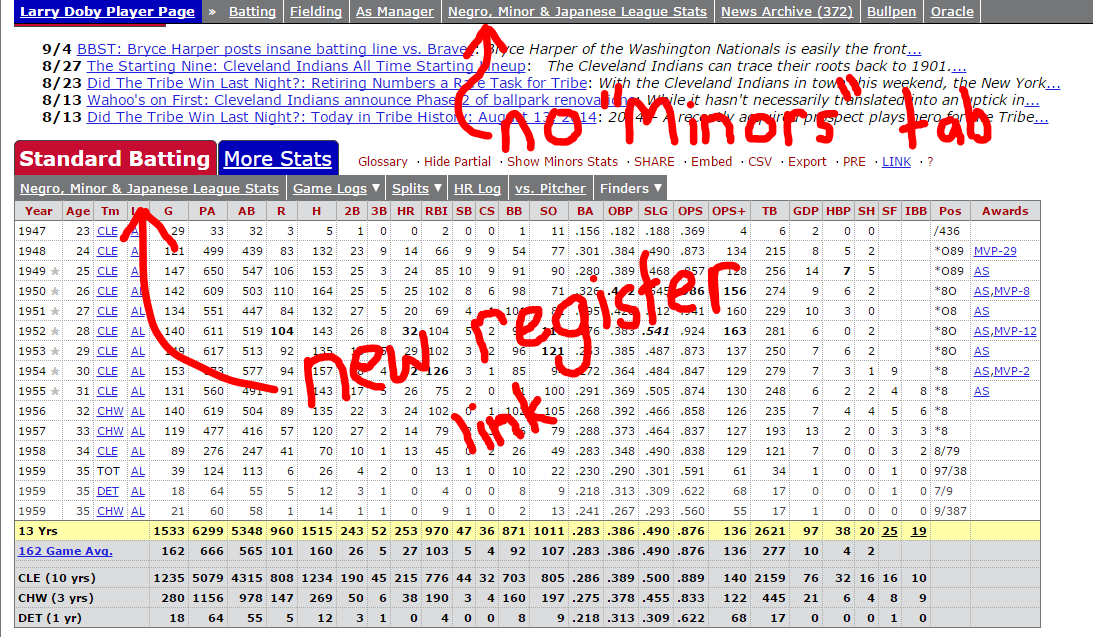
We had a good example of this last week. We launched a new “register” section to combine the minors, Japan, NLB, Cuba and KBO stats into one area. Larry Doby is our test case for this. We called it register because we’ve got 70+ Sporting News Baseball Registers on our shelves and those showed the stats pretty much in the way we are doing it now. Within 20 minutes of launching, we got complaints that we’d taken away the minor league stats, asking are were expecting people to “sign-up” (read register) for the site. We should have caught that on our end, but we were able to fix it quickly and improve the clarity in the process.

Larry Doby's page shows the new layout and links for the stats register. Even small changes like this can cause big waves with users.
Larry Doby’s page shows the new layout and links for the stats register. Even small changes like this can cause big waves with users.

BW: Speaking of the lesser known stats, the B-Ref Bullpen has developed into a go-to resource for baseball fans and writers, oftentimes trumping player’s actual Wikipedia pages. What inspired you to add this feature? Do you expect the basketball and football sites will eventually get their own wiki’s too?

SF: I started it because 1) I love Wikipedia. Wikipedia may be the greatest human accomplishment of all time. I’m not joking. Think about how valuable having all of that knowledge in one place is. (DONATE!). 2) For good reason Wikipedia starts their baseball articles with info like “Ty Cobb is an American baseball player…” and I thought that it would be interesting to put together pages for players that were more in depth and baseball oriented than wiki would want. The funny thing is that the star players get almost no treatment on our site, but we have 1000’s of words on Japanese players, Negro Leaguers and early players. It makes sense as there is a need to know about those players.

As for the other sites, we probably should have just done it by now. I’ve been skeptical we’d get any traction with them, but it would have been a good idea to start them.

BW: Baseball, basketball, football, hockey, and Olympics. Is there any area remaining that you might want to add? Maybe prep / high school stats?

SF: The great frontier is soccer (fbref.com). It makes the history of professional baseball look like child’s play. We have a great dataset and hope to get something launched this winter. My favorite stat I’ve discovered is that the English Wikipedia has more pro soccer clubs listed than there have been players in Major League Baseball history.

BW: Oh wow. I can’t even conceptualize that many teams. I’m looking forward to see how you handle that!

A big thanks to Sean for taking the time to talk with us! Be sure to give him a follow on Twitter at @Sean_Forman.


MLB Fan Lawsuit Seeks Technological Remedy

Last month, Oakland A’s fan Gail Payne filed a class-action lawsuit against Major League Baseball in an effort to compel the league to provide more protective netting at all ballparks, including minor-league parks:

The Plaintiff and the Class are entitled to injunctive relief requiring Defendants, among other things, to adopt corrective measures regarding the implementation of: (1) a rule requiring all existing major league and minor league indoor and outdoor ballparks to be retrofitted to extend protective netting from foul pole to foul pole by the beginning of the 2016-2017 MLB season; (2) a rule requiring any newly constructed ballpark intended to house major or minor league baseball games, to include at a minimum this amount of netting; and (3) a program to study injuries and the rates of injuries amongst spectators, including the type and manner of injury and at what locations in ballparks they occur, in an effort to continually reevaluate whether additional measures should be taken, so that precautionary measures can continue to evolve as the sport continues to evolve.

As Nathaniel Grow wrote for FanGraphs, Payne’s lawsuit has a relatively low likelihood for success, due to the “several strong legal defenses” available to MLB and the possible applicability of “the so-called ‘Baseball Rule,’ a doctrine historically shielding MLB teams from legal liability for injuries incurred by fans from foul balls or broken bats.” (Payne attached to her complaint a “sample list of injuries suffered to spectators located in the unprotected areas along first and third base between the foul poles, during official play” that identifies about eighty-five such injuries since the early 1900s.)

If the case does go forward, though, it could present a few interesting questions. One is whether the U.S. District Court for the Northern District of California, where Payne’s case is pending, will apply the Baseball Rule. Last summer, the Georgia Court of Appeals refused to do so, affirming a trial judge’s rejection of a request by the Atlanta Braves (joined by the office of then-MLB Commissioner Bud Selig) to apply the rule and dismiss a lawsuit brought on behalf of a child whose skull was shattered by a foul ball at a Braves game.

A second question arises out of the procedural nature of Payne’s complaint, which seeks class-action treatment, and involves the means available to dissenters in the proposed class for challenging Payne’s position. Unlike the more popularly familiar “opt-out” class-action lawsuits, for which you may have received a coupon because you purchased overpriced energy drinks or music CDs, Payne’s proposed class action will proceed, if at all, under a different rule as a “mandatory” class action. Practically, this means that, if the court certifies Payne’s case as a class action, the final result of the case will bind every member of the class, which Payne broadly defines as all MLB season-ticket holders with seats “in any unnetted/uncovered area between home plate and the foul plates [sic] located at the end of the right and left field lines . . . .” As Grow suggested in his FanGraphs post, if the court grants her request for class certification, Payne could find herself with some unhappy fellow class members, as it seems likely that many MLB season-ticket holders with seats in what Payne’s complaint dubs “the Danger Zone” prefer their completely unobstructed views of the action and do not agree with Payne that the league should extend netting all the way to each foul pole. Because the proposed class is of the mandatory variety, though, dissenting class members could not simply opt out and control their own legal destinies. While yet another rule may allow those season-ticket holders who don’t want additional netting requested to intervene in the case and make their objections known, they must take affirmative steps to do so, and they must act in a timely fashion. A possible alternative, which Grow mentioned, is that MLB itself may point to this probable intra-class division in the course of its anticipated argument that the court should not allow the class action to proceed, thus relieving the dissenting class members from the need to do so. (On this point note that, on Monday, MLB filed a routine Disclosure of Interested Entities, which listed only the league’s thirty teams and their owners as among those entities having “a financial interest in the subject matter in controversy [or] having a non-financial interest in that subject matter . . . that could be substantially affected by the outcome of this proceeding.”) MLB’s answer to Payne’s complaint is due on October 2, 2015.

Third, and the reason for taking a look at this case over here at TechGraphs, Payne’s complaint raises a question of practical technology: How can we keep baseball fans safe while affording them the best available opportunity to enjoy baseball games? While the response from Payne’s legal and ideological opponents is that the fans themselves (and alone) bear the burden of ensuring their safety, an increase in fan-protection measures of some sort seems likely. MLB teams, including the aforementioned Braves, already employ extended netting during pregame activities, and further severe fan injuries could mobilize popular sentiment and personal injury lawyers to target MLB’s pockets, rather than merely its conscience.

To some, the pushback against increased safety netting should sound as a cry for technological innovation. As attitudes about netting change, a manufacturer who could produce stadium nets with reduced visual obtrusiveness seemingly would find himself or herself well-positioned to enter the market. (I contacted representatives for multiple MLB teams and netting manufacturers in connection with this story. None offered substantive comment, although one, Tex-Net, Inc. owner John Scarperia, indicated that he thought that the nets in use today already were as unobtrusive as possible while still providing the requisite degree of protection.)

And attitudes are likely to change. In 2002, thirteen-year-old Brittanie Cecil died as a result of injuries sustained when a deflected hockey puck struck her in the head during the course of an NHL game between the Calgary Flames and Columbus Blue Jackets. Three months later, the league, having completed a study of the issue, decided to significantly expand fan safety measures in its arenas by installing large safety nets at each end of the ice.

Image via Wikipedia
Image via Wikipedia

As Yahoo! hockey blogger Greg Wyshynski recalled in a post marking the tenth anniversary of Cecil’s death, negative fan reaction to the netting in 2002 was substantial and precisely in line with the remarks from 2015’s opponents to increased baseball netting. From the article announcing the new nets: “Some Blackhawks season ticket-holders said during the season that they would oppose having netting installed because it would interfere with their view of the game.” From a (oddly illuminated) contemporary editorial:

If spectators paid attention to the game, safety wouldn’t be a concern.

At the MCI Center in Washington, D.C., 122 fans were injured in 127 games, most of them weren’t serious, according to a report by two emergency room doctors. Meaning spectators were trying to be heroes by catching the puck and cutting their hand or something minor.

Don’t try to be heroes when the puck is traveling at 100 miles per hour; just duck.

The nets are good news to some people, such as the architects that build new arenas and stadiums. Now, with the nets, spectators will be able to see ice rinks where there are only 15-20 rows of seats behind the end zones and the rest near center ice. Taller and wider stadiums will be built as soon as the word gets out that no one can see through the nets.

Even Doug MacLean, then the general manager for– of all teams, the Blue Jackets– received angry mail: “It was shocking to me. When we put the nets up in Columbus [where Cecil was killed], I had some unbelievably nasty letters from season ticket-holders asking me how I could do that to their sight-lines.”

Wyshynski, who admitted he too was an early opponent of the netting, revisited the story ten years later not so much to chide or mock those early opponents but to observe just how much of an afterthought the netting had become since the initial outcry over its installation: “The purists bristled at the end of a tradition. Debates raged … and then a decade later, yesterday’s hot-button debate is today’s societal norm.” Should MLB ultimately follow the NHL in mandating new safety netting, it isn’t too difficult to imagine that, ten years down the road, your favorite baseball writer on whatever future version of TechGraphs exists at that time will have something similar to note.

(Header image via Rob Bixby)

Could MLBAM Be Making a Push to Become the Next Sling TV?

By now, you may have heard that the NHL has partnered up with MLB Advanced Media (MLBAM) in a new distribution deal. It’s a bold move for both leagues, and one that shows that the NHL is serious about increasing their online presence and offerings. But hidden in the details are even bigger revelations about the future of MLBAM. From the CBS article:

NHL COO John Collins would not confirm these figures, but word is the league valued the deal at $200 million per year.

The annual breakdown: a $100M rights fee to the NHL, $20M in savings from the league not having to invest in the capital resources/expertise it would take to go on its own, and $80M in equity in MLBAM’s technology business.

The equity portion may not figure in revenue calculations for the purposes of the salary cap. “We were told to expect $120M per year in added revenue… $4M per team,” one governor said.

This new deal is indicative of a fairly serious pivot. MLBAM made a name for itself as a content partner — a company that provided the infrastructure for those who wished to offer online content streaming. The massive system that they built to host their MLB.tv service was essentially leased out to the likes of ESPN, HBO, and WWE.

But with the NHL deal, MLBAM is no longer serving as the back end. They aren’t the ones being paid for hosting, they are paying for distribution rights. And they are buying everything lock, stock, and barrel. Besides being in charge of streaming NHL Center Ice, MLBAM is taking over NHL Network, NHL.com, and individual team web sites. Basically, if you want to view NHL content online, you have to go through MLBAM.

And there’s more. According to Forbes:

Along with the deal, the NHL would have equity in what is now called BAM Tech, a wholly new digital company that will be spun-off of MLB Advanced Media.

There’s the other shoe. What once started as a distribution channel for baseball games has become a lucrative technology business.

But I doubt this is the end for BAM Tech. They could certainly take their subscription fees from baseball and hockey fans along with their licensing fees from HBO and be content being a very profitable company for some time. But if that was the plan, they would have just taken the NHL’s money for distribution rather than paying them for the rights. Sure, they’ll make money from Center Ice and the NHL Network, but it could be indicative of a bigger move.

The “problem” with MLBAM’s business model is that it’s easily repeatable. Any company with enough capital and infrastructure can get in on the action. What MLBAM has that others don’t is partnerships. Right now, it works with two major sports leagues, *edit: I originally neglected to mention that MLBPA also hosts streaming for the PGA*, the biggest name in professional wrestling, the largest sports media company in the world, and the most popular premium cable channel. If one were inclined to, say, start their own over-the-top online TV provider, this would be a pretty good start.

It’s speculation at this point, but it wouldn’t be surprising to see a BAM app available on smartphones and set-top boxes in the near future. While they’d be competing against the likes of Sling TV and PlayStation Vue, the already-formed partnerships along with their world-class technology platform would certainly make them a formidable opponent. And don’t forget that HBO owns Cinemax and is a subsidiary of Time Warner (which just merged with Charter)*, while ESPN happens to be owned by Disney. There are a lot of fingers in a lot of pies here.

* – a studious commenter pointed out my mistake here.

Say you want to pay $120 for MLB.tv. What if BAM Tech could offer that plus HBO, NHL games, the Disney channel, and ESPN offerings for an extra $40 a month? Would the availability of live sports be enough to convince you to cut the cord?

MLBAM already built the gun, and now they’re starting to buy the bullets. There isn’t much stopping the once-quaint sports video service from becoming one of the biggest players in TV.


Blackout Policies and Their Consequences

Few topics are so regularly discussed among my baseball circle of friends and colleagues as local blackout policies. While I am certainly biased in that I watch and talk baseball more than any other sport, I — among plenty of others — have found numerous flaws in MLB’s way of blocking local fans from their favorite teams. By no means is baseball’s governing body alone in limited television access for regional fans, as the NFL, NHL and MLS have a blackout policy of some sort in place, however given the sheer number of MLB games played each season, more baseball games are blacked out than the other sports combined.

To be fair, the NFL did lift local blackouts for the upcoming 2015 season, however as the linked article notes, zero games were blacked out in 2014. NFL games are only subject to local TV blackouts if the game isn’t sold out 72 hours before kickoff rather than the constantly blocked games in other sports. Professional hockey has seen its share of blackouts in TV, though a recent development for the Tampa Bay Lightning may be expanding the definition of “local blackout.”

Via CSN Chicago (warning: auto-playing video), Tampa is following in the footsteps of St. Louis and Nashville hockey teams in making it difficult for visiting (read: Chicago) fans to see the game in the stadium. The policy also affects actual Lightning fans living in other states. If fans have the time and the means to follow their favorite team from another state, tickets may not be available for them. A screenshot directly from the Lightning Ticketmaster describes the situation:

lightningBuilding a home field advantage or looking for any competitive edge is all well and good, but at what point is a line drawn? How far will fans go to avoid the blackout issues, both on TV and in-person? Going back to baseball, there are massive numbers of people who can’t watch games based on their geographic location. One of my friends was recently accepted to graduate school at Iowa State University, located in Ames, Iowa. The sole downside for him thus far, other than the workload, has been being subjected to blackouts for his favorite team — the St. Louis Cardinals. According to Google Maps, Ames is nearly 370 miles away from Busch Stadium, yet he is still blocked off from their games. Running the Ames 50010 zip code through the MLB blackout finder, the Cardinals aren’t the only team subjected to broadcast issues. Both clubs in Chicago, the Twins, Brewers and Royals are blacked out for him. Even if he were a more broad baseball fan without ties to a specific team, his location alone blocks him off from 20 percent of MLB teams.

The lengths organized sports are going to block off fans from games has only been surpassed by those same fans looking for a way to circumvent the blackouts. Last week a free and popular virtual private network (VPN) came under criticism not from any league or association, but its own userbase. The Chrome and Firefox extension Hola! or Hola! Better Internet was denounced as a potential botnet to be used for malicious attacks on websites, to which they responded to Monday. Danger comes in the form of Hola! using other people’s idle bandwidth — and vice-versa — in order to circumvent geo-blocked content. By granting access to your Internet connection, it can be taken over and re-routed, potentially as part of a DDoS attack on a site or IP address. Be it accessing Canada’s or Australia’s Netflix or someone over there accessing the United States selection of TV and shows, Hola! provided a free and easy way to get around geographically-blocked content. Despite it no longer being available in the Chrome Store, the extension is still downloadable straight from the company’s site. I’d urge caution before a download of Hola! is considered, as the recent allegations have once again shown there is no such thing as a free lunch.

According to the Hola website over 47 million people have downloaded the extension to enhance their web browsing, despite the clear risks involved. That such a number of people would be willing to risk their idle connection in order to open the Internet for their browsing or entertainment needs shows the measure of their resolve. Whether companies like Netflix and HBO or leagues such as MLB or NHL open up their blackout restriction policies on their own accord may not matter. As long as people have a workaround — questionable or not — the market will find a way to access the desired content.

(Header image via BizOfBaseball)

The Sports and Fitness Apps We Know Are Coming to Apple Watch

Apple once again took the tech news industry hostage today, as their Spring Forward event promised to bring new insights into a few of their current products as well as the much anticipated Apple Watch. They announced an HBO partnership with the (now cheaper) Apple TV, an incredibly thin new MacBook, and also previewed ResearchKit — a new way for health professionals to crowd source medical research. But the biggest buzz leading up to the event was Apple’s new wearable, and the folks from Cupertino certainly made that a highlight of the presentation. We don’t know all the specifics yet, but sports fans and fitness nerds should have at least a few things to look forward to.

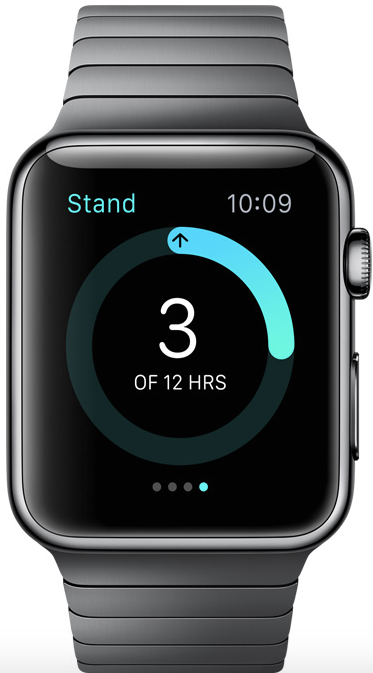
The biggest fitness app really isn’t an app at all, but a built-in feature to the watch. Apple Watch is chock full of fitness and activity tracking options including a workout app, basic step and burned-calorie counters, and will even feature reminders alerting you when it’s time to stand up and walk around a little.

applewatchstand

Third-party apps will also be available for tracking fitness. Offerings from Nike+ Running, Strava, and Runtastic are also being featured on Apple’s web site. Data from Watch will be synced with these services, allowing users more access to and control over their data.

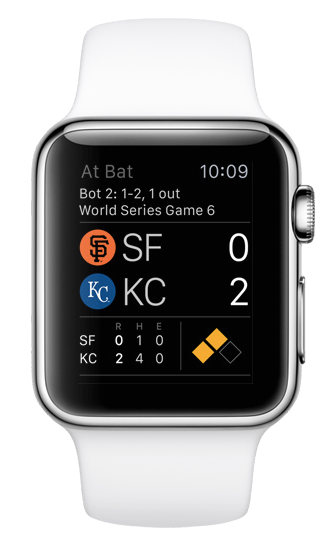
So far, only two apps for sports fans have been announced — MLB At Bat and ESPN. Both will feature team-/game-based notifications and general scoreboard functions, while the At Bat app promises player stats, news, and even highlights. I have to admit, watching highlights on a watch would be pretty cool.

applewatchmlbatbat

Apple has released the iOS update that features the Apple Watch app, but as of this writing access to the Watch App Store was not available. Nevertheless, the Watch API has been out for some time, so it’s easy to assume there will be plenty more offerings above what has been announced today. We’ll keep you updated as soon as we get any more info.

The Apple Watch will be available for preorder on April 10th, with units becoming available on April 24th.