Archive for Health

Kinduct Sports Offering Featured in Dodgers Accelerator Program

Kinduct Technologies made waves in the sports tech world when they were selected as one of ten companies in the Dodgers Accelerator program. But CEO Travis McDonough admits that his company is more mature than many of his fellow participants.

“We have 40 employees, we’ve got many many different clients, we’re across different industries, we have a mature operating system,” he said. “We have now 50 professional sporting organizations that are using our tool and it changes every day.”

The tool, which is known as the Athlete Management System, aggregates data from wearable, camera-based, and even more subjective systems into a single environment. The system includes visualization tools so teams can search for correlations between the data themselves, and a machine learning component to further guide organization training plans. The system gives vital help to organizations trying to understand the massive amounts of data they collect from games and practices.

“There’s been an explosion of ancillary tracking tools on the market today, everything from camera systems to GPS trackers to heart rate monitors to smart phones,” McDonough said. “And all those data sources, as valuable as they are, reside in siloed pockets.”

In addition to the Athlete Management System, Kinduct offers similar services in the health care, wellness, and human performance market (which covers military and law enforcement applications). Their experience in these other fields informs the algorithms behind their athletic products.

“Because we have had the opportunity to start to figure the machine learning side out on the health side, we’re able to cross-pollinate and apply it to the sports market,” McDonough said.

But the operating system and machine learning tools are only as effective as the data they can handle. McDonough said Kinduct works with their clients to incorporate both new and existing sources of data. Their web page lists relationships with camera-based systems including the NBA’s SportVu system, as well as wearable trackers like Polar Global and Catapult, among others.

“We’re very agnostic, and we love to pull in data from as many sources as possible,” he said. “So we are absolutely delighted at the new technologies that are coming out, and all these emerging data sources are exactly what make us more powerful.”

Kinduct counts dozens of sports organizations among its clients — including “more than half the NBA,” according to McDonough — and is working with a few unnamed leagues to manage data across all teams. The obvious differences are there, of course: basketball teams have different expectations for their relationship with Kinduct than hockey teams or baseball clubs. But the varying levels of sophistication across organizations provides an additional challenge, and Kinduct has to ramp up or scale back their offerings according to the client’s experience and comfort level.

“The NBA teams, they put their arms right around technology so we adopt what they use,” McDonough said. “When it comes to other organizations … they’re looking for recommendations by us to suggest ancillary technologies that can do the best job of tracking their players.

From a researcher’s perspective, the fact that Kinduct works with such a large percentage of the NBA is exciting. Deep in their databases is tracking and data, across games and practices, on dozens of elite athletes. McDonough estimated that the average NBA team spent $10 million on players sidelined with “preventable” injuries, repetitive stress injuries arising from flawed biomechanics that he likened to a stone cutter chipping away at a rock. And while McDonough was more than happy to describe how an individual team could combine their various data sources to find potential injury markers, he also stressed his company’s respect for the “firewall” that protects not only each team’s raw data, but also any metrics they build on top to analyze those data.

“It’s almost like we provide a technological apartment building, but each and every team moves their specific furniture and wallpaper in it, and the keys to the front door are locked down so no one can go in it but that organization,” he said.

Still, he agreed that a league-wide approach would be more effective, allowing coaches and staff to spot trends in a wider sample of data that could keep players off the trainer’s table.

“The right thing in the future is for leagues to be able to analyze the data and intervene to make sure the players are playing at their best and reducing injury as best as they can,” McDonough said.

Nevertheless, Kinduct is still dealing with health care data, which is subject to a wide range of safeguards to protect patient confidentiality. On top of that, athletes and the players associations that represent them remain leery about biomechanical data being used against them during contract negotiations. Players associations also objected to earlier iterations of the system that tracked athlete workouts during the off-season as excessive. As a result, Kinduct has worked to produce a system that provides the data front offices are after while remaining as unobtrusive as possible to players.

“For a player, they just want to win games, they want to win a championship,” McDonough said. “And a level of surveillance [during the season] seems to be acceptable by both the players’ association, the players, and of course management and ownership.”

It was announced in August that Kinduct was one of the ten companies selected for the Dodgers’ first annual accelerator program, which will run through a “demo day” November 15. The Dodgers are running the accelerator in conjunction with advertising agency R/GA, who has successfully run a number of similar programs in the past. Described by McDonough as “almost like a business boot camp,” the program offers Kinduct mentoring from a who’s who of sports executives and a chance to get more exposure.

“What we have is a Ferrari in a garage,” he said. “This allows us to open the garage door and have more people see our Ferrari. And people want to drive it, and it’s exciting.”

For now, McDonough and his staff have moved to Los Angeles to participate in the accelerator, and plan to open an office in the U.S. after the program to expand into the American market, especially in the health care, fitness, and military areas that fall under the same “human performance” umbrella as the company’s Athlete Management System. Still, McDonough said the company would remain true to its Canadian roots regardless of its excursions south of the border.

“We’ll always have a home base in Halifax,” McDonough said. “But we need to have a bigger presence in the United States.”
Preventing Concussions in the Next Generation of Football Players

Concussions are bad.

Nobody has ever really disputed this, but over the last decade, it has become increasingly apparent that repetitive head injuries, seen particularly often in football, can lead to significant long-term medical effects.

The “concussion debate” has largely taken place on the professional stage, from the controversies generated by League of Denial to Will Smith’s forthcoming feature film Concussion and beyond. Yet the true impact is being felt across the nation, as schools and innovators work to protect the more than 1,000,000 young adults who play college and high school football each season.

This fall, new devices large and small are being tested to reduce the frequency and effect of football-related concussions.

The Dartmouth Dummy

Five years ago, the Dartmouth Big Green football program eliminated athlete-on-athlete tackling during practices. Cutting out these collisions in favor of tackle sleds and dummies cuts down on injuries and concussions–which makes sense–but made it harder to actually practice tackling against a moving target–which also makes sense.

Enter the MVP–the “Mobile Virtual Player”.

Designed by two Dartmouth engineering students, the MVP is a remote-controlled, human-sized dummy that resembles a cross between the Headless Horseman and a Weeble. Less bone-crushing than an actual human, the MVP allows for relatively realistic tackling simulations while significantly decreasing the risk of head and neck injuries.

Two MVPs were deployed in August, with a third on the way, and the experiment has received the attention of major media, tech blogs–and, reportedly, a few NFL teams.

New Helmets InSite

This doesn’t do much to prevent contact during games–and, as long as there’s tackling in football, there’s only so much you can do–but some new tools are being developed to limit the effects of major hits when they do happen.

The sporting company Riddell is in the process of bringing a new line of helmets to high schools around the country. The SpeedFlex helmets, equipped with Riddell’s InSite Impact Response System, use six built-in accelerometers to measure the individual and combined force of every impact a player receives. This data is sent live to a laptop on the sidelines, where trainers and staff can monitor players for potential danger signs.

As programs continue to adopt the system, one trainer says, this data will itself be useful for better understanding what leads to football brain injuries.

Watch Your Mouth

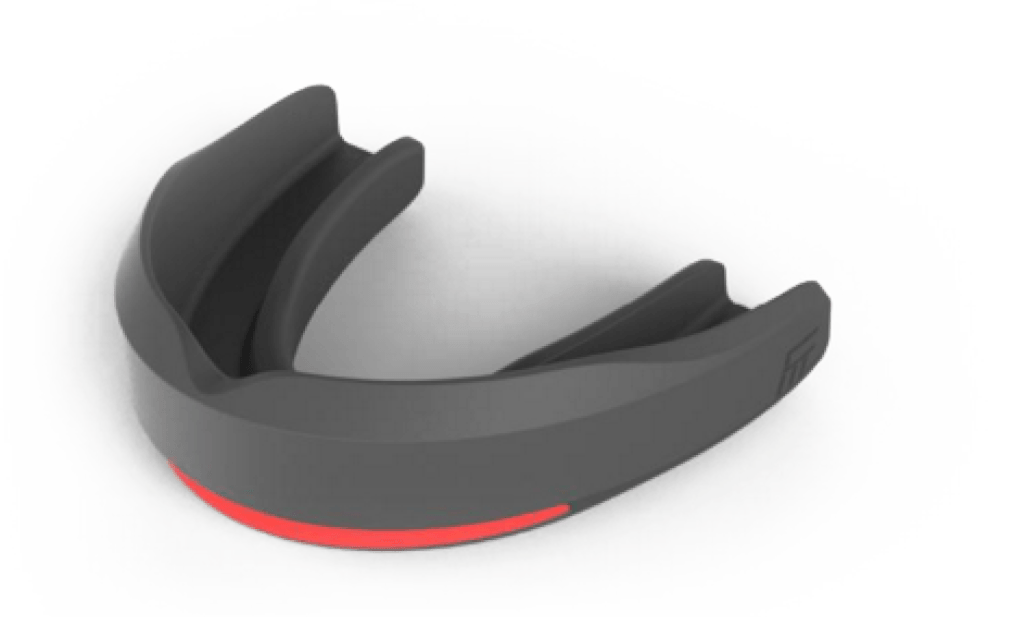
In fact, before long it might not even take a special helmet to easily detect potential concussions. Smithsonian reports on FITGuard, a mouth guard co-created by two Arizona State grads–one a veteran of the rugby team.

Like InSite, FITGuard uses sensors to measure hits to the head and can transfer data to a nearby computer. If FITGuard sees any signs of danger, though, it simply lights up the player’s mouth using LEDs. FITGuard is scheduled for release in early 2016.

Image courtesy of fitguard.me

These tools aren’t without their caveats. A recent Stanford study, for example, found that some currently existing concussion-measuring devices (particularly helmets) can significantly mismeasure the actual force of impact.

Nevertheless, with room for improvement and no end to the concussion crisis in sight, technology like this can still have great potential to help protect our next generation of football players.

(Featured Image via Dartmouth)


Jason Pierre-Paul Didn’t Start the Fire: How Athletes Could Lose Control Over Their Health Data

Like many of us, NFL defensive end Jason Pierre-Paul spent last weekend launching fireworks in the course of celebrating America’s birthday. Unlike most of us, hopefully, Pierre-Paul injured himself in the course of his combustible activities. While the extent of his injury, reported to be to one of his hands, initially was unknown, that quickly changed on Wednesday afternoon, when ESPN’s Adam Schefter posted a photograph purporting to be of a Pierre-Paul medical record, which indicated, among other things, that doctors had amputated one of the football player’s fingers.

The news of Pierre-Paul’s digital truncation would have come out before long– it’s difficult for linemen to hide severe hand injuries– even if Schefter’s source didn’t leak it, but in an era of ostensible medical privacy, Schefter’s tweet still was a bit stunning to see. Though laws such as the Health Insurance Portability and Accountability Act do not apply to journalists, Schefter’s actions still cross a line of decency and ethics.

One of the central concepts here is authorization, and as we move away from a time in which the bulk of athlete health information exists in conventional medical records and into a reality in which people, including those involved with sports teams, are embracing wearable athletic technology with the capability of pervasively gathering vast amounts of biometric data, authorization may become a moot issue for the monitored athletes. Seeing Pierre-Paul’s records pop up on Twitter struck some as “creepy” and “invasive,” but we may not be far from a situation in which athletes are indirectly pressured or directly asked to authorize broad disclosure of their health information.

In examining the “explosion of data and data collection” in the NBA for an ESPN The Magazine last fall, Pablo S. Torre and Tom Haberstroh wrote that

The boom officially began during work hours. Before last season, all 30 arenas installed sets of six military-grade cameras, built by a firm called SportVU, to record the x- and y-coordinates of every person on the court at a rate of 25 times a second . . . .

But to follow this logic to its conclusion is to understand why the scope of this monitoring is expanding, and faster than the public knows. Teams have always intuited that on-court productivity could be undermined by off-court choices — how a player exhausts himself after hours, for instance, or what he eats and drinks. Now the race is on to comprehensively surveil and quantify that behavior. NBA executives have discovered how to leverage new, ever-shrinking technologies to supervise a player’s sleeping habits, record his physical movements, appraise his diet and test his blood. . . .

“We need to be able to have impact on these players in their private time,” says Kings general manager Pete D’Alessandro. “It doesn’t have to be us vs. you. It can be a partnership.”

A lovely sentiment, at least in theory. But how long will it be until biometric details impact contract negotiations? How long until graphs of off-court behavior are leaked to other teams or the press? How long until employment hinges on embracing technology that some find invasive?

Baseball fans benefit from the deepening analysis of the sport by writers at places like FanGraphs, who can easily query in-game data troves like PITCH/fx and Statcast to support their work, and recent work on this site highlights the leading edge of wearable technology designed for baseball applications. Will data from players’ heart-rate monitors and FitBits ever be publicly searchable on BaseballSavant? Probably not. Will they be leaked when the player is in the midst of contract negotiations, as Pierre-Paul is, like drug test results and Wonderlic scores already are? The mere existence of the data certainly allows for that possibility.

Reports indicate that Pierre-Paul still plans to play football this season, although it’s unclear whether he will do so as a New York Giant. Even a strong season, wherever he winds up playing, is unlikely to make him the most accomplished nine-fingered performer in recent memory. As we sit on the cusp of the “explosion of data and data collection” in sports, though, we nevertheless may remember the leak of Pierre-Paul’s medical records as marking an important transition point on the path toward the more all-encompassing biometric-data-gathering world. And also the part about blowing off his finger with fireworks.

(Header image via maf04)

Review: Motus Global’s mThrow

When Motus Global’s sleeve was announced last spring, it was supposed to save baseball, stemming the flood of Tommy John surgeries plaguing the majors. Now, the device that teams have been using to study their pitchers’ mechanics since last fall is available to the public. The mThrow has been on sale through the Motus website since March, and began shipping in early May. Eager to see what the device had to offer, I plunked down the $150 (plus $20 for an additional compression sleeve) and waited anxiously.

The box that the mThrow comes in is taken up mostly by the compression sleeve. The actual IMU — the sensor that actually tracks the arm’s motion — is a tiny blue thing, about the size and shape of a circus peanut*. The IMU charges by induction, so all the user has to do is plug in the charging station, place the sensor on top of the station, and wait about an hour.

* – But slightly better-tasting.

Pairing the sensor is simple, too, taking just a few taps of the smartphone app. The hardest part of setting the thing up is probably wedging the sensor into its little pocket in the compression sleeve, and then pulling the sleeve on so that the sensor rests over the infamous ulnar collateral ligament. In fact, the design might be overly simplified. In an effort to make the sensor more water-resistant, there are no lights on the sensor to tell the user of the charge level. The only way to check is to pair the sensor with the smartphone app; if the app doesn’t recognize the sensor, it probably needs to be re-charged.

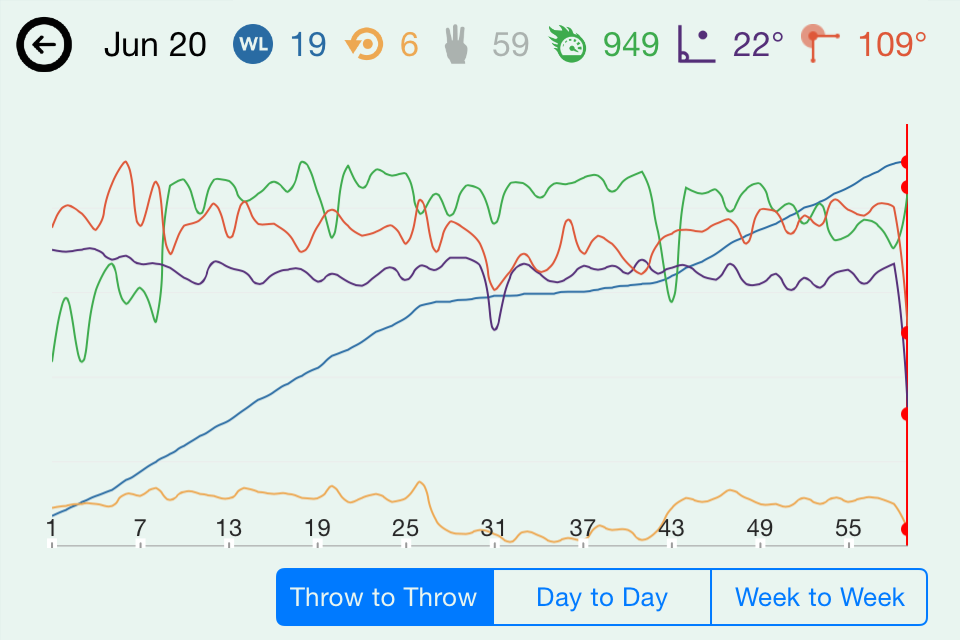
The app is currently available only for the iPhone; an updated version was approved this week. The software now computes five metrics from the sensor data: pitch count; maximum arm speed, a rotational velocity measured in revolutions per minute; arm slot at release; maximum shoulder rotation relative to initial position; and, of course, torque on the UCL. These are then combined into three headline numbers: performance, a measure of mechanical consistency; workload, currently an additive function of elbow torque; and a “throw meter,” an energy bar that drains from blue to orange as the workload increases and consistency decreases.

I ran some preliminary testing of the mThrow, connecting it to an iPhone 4S and throwing 17 fastballs, 17 changeups, and 17 curveballs to the best of my extremely limited ability; all but six throws were recorded. Even if there’s no difference between their speeds and movement, you can still see a difference between my initial warmup tosses (the first dozen, with much lower arm speeds), fastballs (about 13-25), curveballs (26-43, with much lower torque values), and changeups (44 onward, with decreased arm speeds).

image2
This simple relationship was confirmed with a second test using a HitTrax system, which can track speed and late break of pitches as they cross the plate. My subject was a 45-year-old with some collegiate pitching experience who threw ten fastballs and ten curveballs. By comparing the HitTrax velocity report (right) to the mThrow statistics (left), we can see the correlation between the decrease in arm speed and the decrease in velocity as the subject switched from fastball to curves.

donfrancesco
Lastly, I brought the sleeve to a local high school (Blackstone Valley Tech, Upton, MA) to get some insights from active players. Assistant coach John Burke, pitcher Nick Laren, shortstop Joe Corsi, and catcher Jack Lynch took turns throwing an assortment of pitches from a number of release points, seeing how their throwing motions stacked up. The session supported some beliefs — for instance, that the quick motion Lynch uses to throw out would-be base stealers puts more torque on the elbow than a standard pitching delivery. But others were surprisingly contradicted: despite everyone’s belief that sidearm throws put less stress on the elbow than an over-the-top delivery, the app didn’t seem to report a relationship between arm slot and torque.

Chief technology officer Ben Hansen says the mThrow is still in its infancy, and says that the device’s official consumer launch is not scheduled until later this summer. The app currently relies on data compiled from Motus Global’s work with MLB prospects at last fall’s instructional league to generate its workload number, but Hansen and his team are working to produce more meaningful metrics from a more complete data set.

“We’re just capturing as much data as we can to see what’s normal,” Hansen said. “We also have controlled studies going on at every level. We have [NCAA] D1, D3, high school, and Little League players wearing it religiously.”

At this early stage, the app seems to be designed more for Motus’s professional clients than for public users. Maybe the best example of this is the tagging feature, which allows users to tag individual throws as belonging to bullpen sessions, long toss, or game action, and to further break throws down by pitch type. But at the moment, the tags are unavailable to the user after selection, getting passed on to Motus Global with the sensor data but not visible on any of the trend screens. Hansen confirmed that the tags were being used in the company’s research for their MLB clients, however.

“Every week we send reports broken down by tags where we compared each pitcher to the league averages for that pitch type,” Hansen said. “The teams love using the tags and breaking things down into the different pitch types.”

It’s a tantalizing view of an exciting feature that could still be a couple years away. And it’s not just super dorks like me who would find those analytics useful. The key to a good changeup is matching the same arm speed used to throw a fastball, so it’s easy to see coaches like Burke using the arm speed metric to give feedback to young pitchers just learning to throw the pitch. But without any way to divide pitches into different categories, this sort of feedback isn’t possible yet.

“We are looking into a web portal to give users more in-depth analytics,” Hansen said. “But right now we’re focused on getting the analytics right before we move on to other platforms.”

It’s probably still too early to judge the mThrow fairly, and I’m almost definitely not the right person to do it (sabermetrically-inclined tech geeks who can’t pitch are not Motus’s target market). And it’s true that more research could produce findings that actually help young pitchers stay on the field and off the operating table. But as currently constructed, the mThrow raises more questions than it answers, and left me wanting more. Like a top pitching prospect, the technology needs some time to mature before it can make a meaningful contribution.


EA Games Announces Updates to Its Sports Franchises

E3 – the gaming industry’s biggest yearly conference, kicked off today, and as usual, a lot of big announcements were made. While sports games weren’t at the forefront of the biggest proclamations today, they are most certainly being worked on and updated. EA was kind enough to spill the beans on how the [INSERT SPORTS LEAGUE] 16 games would look and feel.

EA’s biggest franchise, Madden, gets updates every year — some more impressive than others. For Madden 16, elements of fantasy football have been brought into the fold. Gamers will have an option to tweak their chosen team using rounds of fantasy-based drafts. These super teams can then be used to compete against each other or an AI opponent.

As senior EA producer Sean Graddy told Polygon:

“We limit the number of picks that you have so that those decisions are hard […] You’re not going to fill every position on your team. How do we create this draft experience, but take it one step further? With fantasy football you pick a team and you passively watch it. In our game you pick a team and you can play with it on the field. It makes it a bit more special.”

Changes to passing and receiving are also coming, with quarterbacks getting options regarding speed and height of passes, and receivers will be given options to attempt fancy, stylish catches or more traditional ones. These should be nice updates to a game that everyone is going to buy anyway. It comes out August 25th.

Making the logical segue from football to golf, the return of an EA golf video game is imminent. Due to a mixture of personal issues and general ineffectiveness on the course, Tiger Woods has become a persona non grata at EA. Rory McIlroy is the new face of the series, and with him come some other major changes. EA didn’t release a golf game last year, as they worked on revamping the series.

Rory McIlroy PGA Tour is EA’s first sports game that will utilize its Frostbite engine — the same engine that powers games like Battlefield and Dragon Inquisition. The inclusion of the engine allows the game to load an entire course at startup, rather than just one hole at a time. This should drastically cut down on total game time, a welcome addition. I mean, do they really expect us to take a whole hour to play a round of golf?!

Tour will include three different modes of play — Arcade, Classic, and Tour — which each offer their own set of advantages. A new course map feature seems pretty slick, as it gives the player multiple distances to different spots of the course, much like those little booklets you see caddies carrying around. The game drops July 14th.

NHL 16  is not only bringing back many of the online features it cut from this year’s version, but is also making a small change that could make a huge difference. In the past, any time a player wanted to accept a pass, the skater glided until he had possession of the puck. This isn’t how hockey works however. Players take passes while skating the other way, in a complete stop, or in a full sprint. NHL 16 is reportedly adding the ability to accept passes this way. This should enhance the gameplay, which is already very smooth.

Updates to the Be a Pro and Be a GM features are also coming, with wannabe GMs having to deal with things like player morale and clubhouse chemistry. If you play the Be a Pro mode, expect to get more and better feedback from coaches as you sweat and bleed your way to Lord Stanley’s Cup. Look for this game in September.

Soccer is also a sport and FIFA 16 is also a video game. One of the more important updates — the addition of women’s soccer — was already announced. But EA is also mentioning smarter AI defense, more realistic slide tackling, and some more dribbling fanciness.

Passing is also getting an overhaul. Per Polygon:

Perhaps of even more significance is that players are given more control over the pace of their passes. Previously, long passes (hold down the button) were a matter of telling the game to move the ball a long way. Now, they simply say, “kick it hard.” This means that players can ping short, hard passes to one another, a useful antidote to the defense’s greater alertness. Or they can drift long passes across the park with a greater degree of control.

For a long time, sports games have relied on graphics to try and make them seem more realistic. Now, with more advanced hardware and software at their disposal, developers are working to make the games look and play more like the real thing. This is a welcome change and will ensure the line between real and digital will become more imperceptible each year. Where some sports series seem to be a little stagnate (cough, MLB the Show, cough), EA is making strides keep their offerings fresh. Whether it pans out or not remains to be seen. We’ll have to hang our hope on promises for now.

(Header image via Pop Culture Geek)

REVIEW: Schmoylent, Bags of Powder from the Internet

FUN FACT ALERT: The day I started putting this review into actual writing, I got this letter from the makers of Schmoylent — the very product I had been consuming for the purpose of reviewing.

Here’s the skinny: This is not for everyone. In fact, I’m specifically asking, “Is this right for athletes?” I spent a good many years as a collegiate athlete who struggled with nutrition and calories. For college students tight on money and limited on time, though, this could be a good fit. I was a scholarship athlete who could never get calories under control because I was too exhausted and too poor to eat anywhere but the cafeteria, and too poor to afford healthy, but quick groceries.

Liquid meals, therefore, could offer the necessary solution for the under- and overfed athlete on the budget. And that is the purpose of this investigation. It is to find the possibility of the Soylent Athlete.

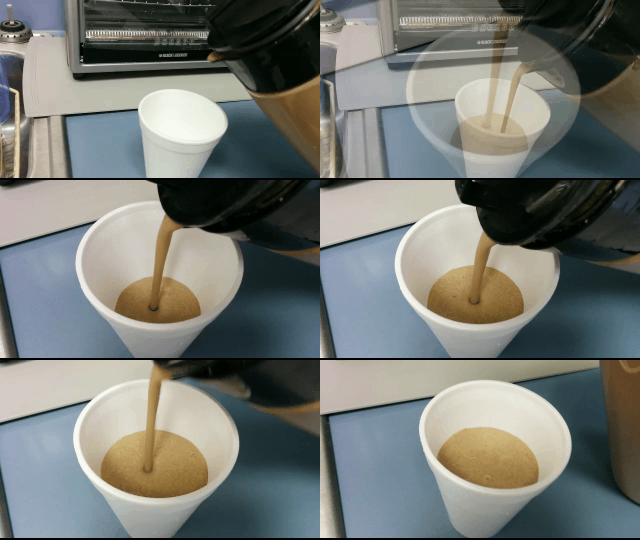
Here's a look at the pouring consistency of Schmoylent.
Here’s a look at the pouring consistency of Schmoylent. NOTE: There’s a loose chunk of unmixed powder in there, but that tends to be user error. I usually can get it mixed well enough.

Grades

Taste: 8
Texture: 7
Nutrients: 10
Packaging: 3
Ego Depletion: 6
Price: 6 ($4.04 per meal)

Rating: 6.7

Taste

I gave name brand Soylent a 5-out-of-10 rating in taste and basically said no thanks. I’m giving Schmoylent an 8-out-of-10 rating and saying I hardly knew thee. The difference in taste? So far as I can tell, the only difference is the inclusion of chocolate powder in Schmoylent. Could that have made the powder-drink that much more likeable? Or maybe it was the fact that Schmoylent is based off an earlier version of Soylent, one which required the user to add a few bits of oil during the mixing process?

Not that I could taste the coconut oil I was adding per se, but I do recall wondering often how my Soylent would taste with some sort of smoothing agent like oil added to it. Was it better tasting than my so-far favorite 100% Food? Boy, it’s hard for me to believe it, but for some reason I just really like the taste of Schmoylent. I looked forward to my Schmoylent meals.

Texture

Much like Soylent, it tastes dusty. Maybe my having tried Soylent first prepared me in ways that 100% Food failed to prepare me for Soylent. But all I know for certain is that the texture, while not enjoyable, was not a deal-breaker this time.

Nutrients

A nice 2100 calorie supply of food with:

Carbohydrate: 252g
Protein: 114g
Fat: 70g
Fiber: 27g

That’s essentially the aim of this whole project — get sufficient nutrients and do so in a sustainable way. The latter half is still pending, but the nutrients of these liquid meals have typically left me feeling as or more awake and ready than ever.

Packaging

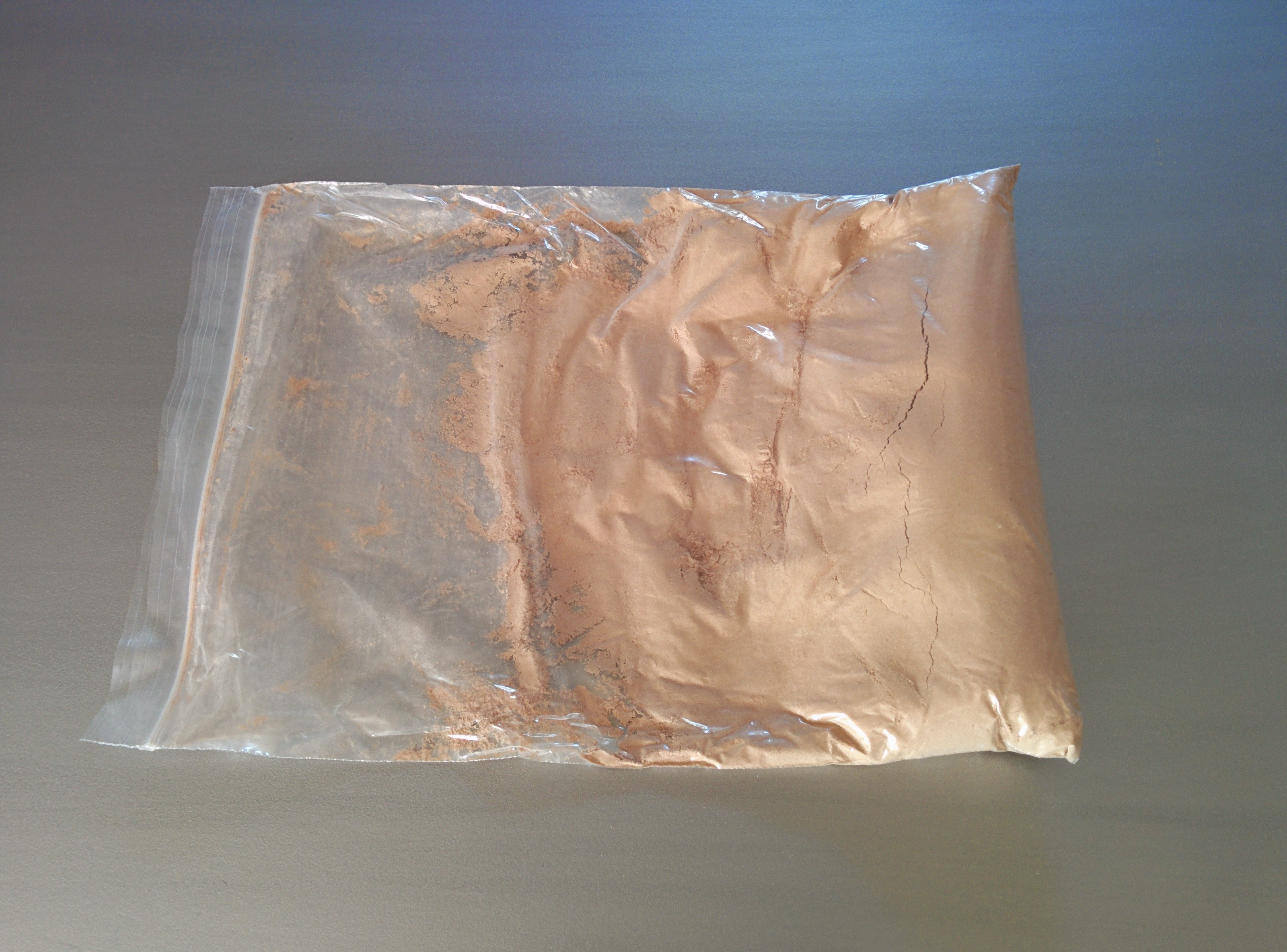
Here’s the problem with Schmoylent: It arrived in unmarked zipper bags.

This isn't at all suspicious.
This isn’t at all suspicious.

Soylent and 100% Food are both clearly young companies, but at least they had unique, professional-looking packaging. Schmoylent felt like some sort of terrifying Internet dare. And while I ultimately loved the product, the packaging would be such a tough sell that I imagine many users would never even taste the product upon seeing it’s floppy, suspicious transmission device.

And besides being a PR problem, the bags also constitute a practicality problem. Whereas 100% Food had self-contained bottles and Soylent had a free pitcher with the first order, Schmoylent lacked any storage accommodations. I was lucky my Soylent order arrived before Schmoylent, otherwise I wouldn’t have had a pitcher appropriate to render my Schmoylent portable (and thereby practical).

Thank goodness for the Soylent pitcher!

Ego Depletion

I honestly think I could eat Schmoylent long term. Had it not ceased its deliveries already. Oh well.

Price

While $4.04 is still better than Taco Bell, but not as good as Soylent’s grocery-level $3.06 price point — especially considering that Soylent also sends a pitcher with the first order.

Conclusions

My final say on Schmoylent:

  1. So far, Schmoylent tasted the best. Still dusty though, so maybe my tastes have begun to change.
  2. That means I should probably give Soylent another go.
  3. I shall miss you Schmoylent, you and your terrifying mystery bags of health powder.

Until the next one, eat well, my friends!

Other Reviews

Check out the Soylent subreddit for some great resources on liquid meal-replacements.


Kitman Labs’ Profiler Helps Keep Athletes on the Field

Sports analytics has moved on from the days when an ambitious amateur could fire up Excel or a relational database and make earth-shattering discoveries. Modern front offices must incorporate not only on-field performance but also medical histories, training results, biomechanics data, and a host of other sources into their decision making. To help teams better manage and access that mountain of data, Dublin-based Kitman Labs has developed the Profiler, a system that combines disparate data sources into analytics describing player health and injury risk.

Chief product officer Stephen Smith described Kitman Labs’ offering as “the operating system for sports teams.” The strength of the system is in its ability to combine data from multiple areas — including medical, biomechanical, and on-field sources — to produce more holistic analytics that can better inform team decision making regardingl athlete training and injury prevention. Smith said he was first inspired to create the system while working as an athletic trainer for Leinster, an Irish rugby team.

“One of the biggest challenges I had as a practitioner was that all the fitness data was held in one area, all the medical data was held in one area, and all the performance analytics were held in another area,” Smith said. “That just made it very hard to understand what any of the information actually meant.”

An example of the power of Profiler is demonstrated through a software application that allows users to collect markerless, three-dimensional biomechanical data from an off-the-shelf Microsoft Kinect. The software can calculate select joint angles from an athlete a few feet away — even during rapid dynamic movements, such as running, kicking, or throwing a pitch. And although Smith insisted that the Kinect software was “probably five percent of what we actually do,” he was enthusiastic about its ability to make motion-capture based analysis more accessible.

“Biomechanical information that you would garner in a normal professional sports environment would take you hours to actually get because the downtime is huge, and the cost of that is pretty difficult, and you just can’t access that day to day because it takes too long,” Smith said. “The software that we’ve created jumps professional sports teams into the next generation of real-time technology.”

When interviewed, Smith refused to name the specific organizations that have partnered with his companies.

“We definitely don’t like to speak about our clients because a lot of the information we’re housing, as you can imagine, is very sensitive data on very high-profile athletes,” he said.

But some of his clients have been less tight-lipped about their relationship. In March, The Los Angeles Dodgers announced that they would be partnering with Kitman Labs in their farm system, declaring themselves “the first American sports team” to sign with the company. Across the pond, Kitman Labs works with British Premier League squad Everton, along with a number of Irish rugby teams. Other organizations, including the San Francisco Giants, have also tested this system.

When Kitman Labs signs a new client, the two first collaborate to determine which data and which metrics are most important to the organization, and what sources of information the organization already collects. Kitman’s sports scientists then work with the coaches and training staff to demonstrate how to use the system and understand the analytics the system produces.

“We have a very experienced team of sport scientists who all understand the individual nature of each sporting discipline that we work with, and the uniqueness of each club, team, and athlete,” Smith said. “Those sports scientists will actually be on the ground with teams for a number of days actually helping them to get up to speed.”

Smith says he understands that his company offers an appealing solution to clubs looking to maximize the return on their sizable investments in player salaries, not to mention strength and conditioning, coaching, and other aspects.

“I presume that [general managers] want tools to ensure that they can get the best value from their athletes,” Smith said. “I think the clubs just love the idea of being able to try and maximize on that by being sure they can keep the athletes on the field.”

But the growth of biomechanics data has led to rumblings in some quarters. Some have expressed concerns that medical data which suggests an injury risk could be used against athletes during negotiations. (An example can be seen in the controversy surrounding the Houston Astros’ dealings with top overall pick Brady Aiken last summer.) Despite this, Smith said he hasn’t seen any pushback from athletes on teams using this product, and insists that the system was designed primarily with athlete wellbeing in mind.

“One of the largest driving forces for us in doing this is that we want to protect athlete welfare, we want to improve the standard of care that is given to athletes worldwide,” Smith said. “It’s there purely for the team to use that information to empower their decision making, and that way they can ensure the athlete makes it onto the field in the best possible shape.”

Kitman Labs was born out of Smith’s postgraduate research into injury risk factors, as well as his professional experience as an athletic trainer. The company was founded in October 2012, with its first product offering coming online in June 2013. By early 2014, Kitman Labs had signed their first partnerships with soccer and rugby teams, and were looking to expand into the American market.

“We kind of expected that the market over here would be pretty far ahead of what was going on in Europe,” Smith said. “But when we came over, we realized that it didn’t look like there was anybody else trying to do something like what we were doing.”

The company opened its first American office in Menlo Park, California, in September 2014. Since the MLB season was just wrapping up, Kitman Labs initially focused on expanding into baseball to coincide with teams’ buying cycles. Kitman Labs is now looking to expand into other sports, developing new applications in both professional and collegiate sports leagues.

“We’ve had early success with baseball in the U.S., but we’re actively working with NBA teams, NFL teams, and we’re actually now branching into the NHL as well,” Jeff Eckenhoff, a member of the Business Development team, said. “We’re pretty sport agnostic.”

And with the expansion into new sports comes an expansion of staff, as Kitman Labs looks to add sports scientists and engineers that can help them adapt their solutions for new clients. Smith said his company is actively looking to fill eight vacancies.

“We need industry experts from basketball, football, and baseball to come and be part our team, and to help us solve the largest problems for each of these sports so that we can truly help these teams to uncover the sources of injuries,” Smith said.

Still, Smith insisted that his company’s expansion would not come at the expense of Kitman’s current offerings.

“We don’t want to be a company that walks into a market and grabs a huge collection of customers and then walks away with their checks in our back pocket,” Smith said. “We want to change the face of sports science and sports medicine and we’re going to do that by incredible focus and by being extremely diligent.”


REVIEW: Soylent Tastes Like Dusty Cardboard

This journey begins with the Soylent Athlete, an article in which I muse about the possibilities of an athlete benefitting from a liquid-meal diet. Specifically, we ask: Can an athlete better meet his or her fitness goals by using powder meal replacements?

After months of waiting, my first shipment of Soylent finally arrived. I have already reviewed 100% Food, which proved rather tasty. In fact, I continued to purchase it well after my review published.

Will Soylent fare as well? I’m guessing you’re one of those “headline reader” types, so I doubt this is a spoiler, but the answer is probably no.

Grades

Taste: 5
Texture: 6
Nutrients: 10
Packaging: 5
Ego Depletion: 5
Price: 7 ($3.06 per meal)

Rating: 6.3

Taste

Woof. I did not like Soylent. Imagine that dusty box on your back porch, the one holding your fake Christmas tree. Imagine ripping that weirdly crispy, tired cardboard into little pieces, adding water, and then blending it into a smooth, pleasing-looking but oddly tacky liquid. Now eat it.

While I complained about 100% Food’s lack of spicy options, I realize now that having great sweet options is a huge accomplishment. In order to eat Soylent — not necessarily enjoy, but just simply eat it — I had to add cocoa powder and sweeteners. Sometimes I just poured a hearty dose of chocolate sauce into the blend. All of this, obviously, eats away at the nutritional value of Soylent — y’know, the core reason for wanting to go on Soylent.

I do think the neutral, cardboardy taste might lend itself to spicy creations, but I was so worried about making a nasty batch, that I never tempted fate and added hot sauce. Why was I worried? Because I already had to throw out one big batch.

I added some fruit as per a suggestion in the neat-looking instruction manual. I took a helping of frozen mixed berries, blended them with some water, and then used the water fruit mix as the base for the Soylent powder. They blended well — which is to say, they chemically combined well — but tasted so awful and turned so ominously gray after 12 hours in the fridge that I couldn’t stomach a second meal of the now-gritty and still-not-sweet-enough Soylent/fruit mix.

I cannot imagine many standard customers, much less food-craving college athletes, satisfying themselves on a batch of Soylent. And that’s just with regards to the taste.

NOTE: Someone on the Soylent reddit page suggested adding powdered fruits to Soylent to help with the flavoring. Because new flavoring ideas are constantly appearing, and because I certainly didn’t try all possibilities, I completely reserve the right to at any time change my opinion and pretend like I always held this new opinion.

Texture

So if 100% Food was like a milkshake in its thickness, Soylent is like chocolate milk. It’s not totally watery, but it’s smooth and thick. Problem is: It’s very tacky. And maybe I’m not using that word correctly, but it’s the closest description I can find for something that feels kind of like how I imagine paint would feel in my mouth.

It’s dry, yet somehow still a liquid. It’s sticks to my mouth, but not in a good way. It’s really not great, but it’s not horrible either.

Nutrients

Fellow redditor Alex Clifford has been on Soylent for some time now. I suggest reading through his Soylent experiences at his beautifully designed blog, Red Dog Tales. He shared some of his data with me, and the results — while much more comprehensive — mirror what I was seeing from my top-down analysis of 100% Food. Basically this: The liquid diet resulted in better health.

Here’s the gist of his changes:

Soylent proved a wise choice for blogger Alex Clifford.

So the only two categories that changed significantly for Alex while on Soylent were Alanine Aminotransferase and Triglyceride, both of which moved from unhealthy to healthy ranges. His Lipemia Index went from 11 to 4, but anything in the 0 to 50 range is okay.

I personally never had any GI issues with soylent, and I hear this latest edition has improved that kind of stuff. So I can’t but give Soylent perfect marks on the nutrition side of things.

Packaging

At first, I thought the big plastic pouring container doodad was pretty awesome. It warned me to not over-tighten it, and I did my best to gently turn it shut. But sure enough, Soylent is everywhere. I got Soylent on my car seats. I go Soylent on my clothes. There’s a Soylent ring on the fridge shelf. I got Soylent all over my hands. I tried tightening the lid more, and I got more Soylent everywhere. And that doesn’t even include the powder form.

Basically, this is how the Powder Problem works: You fill the canister half with water, then add the powder (and good lord, add something with flavor). Shake. Then add more water (to fill the canister), and then shake again. By then of this process, the raw Soylent powder should have arrived at every level location in your immediate area. And no matter how carefully I poured the powder into the canister … poof!, powder everywhere.

I’m betting I’m just super spoiled having started with 100% Food, with its neat, self-contained single meal packaging. By just the process of making Soylent — the whole five minutes necessary to make all three of my day’s meals — felt like a drag.

It’s also worth mentioning here that Soylent took almost a half year to reach me. I believe they are getting more staff and upping production paces, but basically it’s not feasible if you’re looking for an immediate, short-term order.

Ego Depletion

It was very hard to eat Soylent for every meal. But that is almost certainly because the texture was unpleasant and, more importantly, I couldn’t find a flavor (or flavors) that I really liked. Because of it’s neutral base, though, the possibility for more flavor combos exist than with, say, 100% Food. So I’m totally open to changing this section.

Price

Since 100% Food raised its price, Soylent remains among the cheapest tiers. It’s around $3. That’s pretty dang close to grocery prices. A nice midpoint, perhaps, between McDonald’s and homemade — but sans the time cost for either those two alternatives.

Conclusions

Here’s what I think I’ve decided:

  1. It’s not bad enough for me to say no to Soylent forever. I’ll keep trying Soylent.
  2. Generally, I don’t like Soylent.
  3. And I cannot imagine this being the liquid meal that enables healthier, easier student-athlete diets.

Until the next one, eat well, my friends!

Check out the Soylent subreddit for some great resources on liquid meal-replacements.


Skulpt Aim: A New Workout Measurement Tool

A wrist band there, a smartwatch here, maybe a sensor in your shoe. Connected health devices have an evolving — and growing —  place in our world, and as unique as they are, they tend to measure the same things. Heart rate, distances, sleep and such things are all incredibly helpful, however with the Skulpt Aim device, that is all left behind. Aim is a device that measures muscle quality (MQ) in specific muscle groups, up to 24, and by measuring biceps, triceps, abs and quads it gives a total body fat percentage as well as MQ score.

skulpt1

To quantify the muscle gains, Skulpt Aim utilizes 12 sensors and a technology called Electrical Impedance Myography (EIM), developed by Seth Rutkove, MD, Professor of Neurology at Harvard Medical School. EIM applies a small current of electricity through the muscle to accurately quantify muscle and fat, as each reacts differently when a current is sent through it.

The MQ is measured on an index, the higher the score, the better the muscle quality. With each measurement you can track your fat percentage going down while the MQ goes up, ideal for focusing on specific areas where you think you’re lacking.

skulpt2

With Skulpt, quantifying your training is far beyond simply looking in the mirror or even stepping on a bio-impedance scale. Each measurement with the Aim takes less than one second and the results are displayed on the device itself, no need to pair it with a wireless device for immediate feedback. It is currently compatible with iOS devices (iPhone 5 and later) and will be available for Android (4.3 and later) soon in order to keep a running total of measurements.

Skulpt’s website boasts comparable muscle measurements to hydrostatic weighing, the most accurate and expensive method. The Aim device also claims to be three times more accurate than caliper based measurements. It is available for pre-order at $199 USD and is also available for varying prices in Canada, U.K. and Australia. With a battery that lasts two months a single charge and is splash proof, the Skulpt Aim appears to be a must-have device for any serious trainer, regardless of  the sport. Skulpt’s intro video can be found below and a number of how-to measure videos are available on their website.


CES 2015 Final Thoughts : The Imitation Game

CES has come and gone, and I’m looking over my pages and pages of notes trying to figure out how I took it all in. There was a lot of ground to cover, and I’m not embarrassed to say that we didn’t see everything. It was a question of numbers really, and there were simply too many booths spread over too much real estate to catch it all. While we couldn’t see all of the prototype TVs or every piece of home automation tech that’s been put out there, we worked hard to focus in on our “beat,” what we cover at this site. And CES has shown me two distinct things about the sports tech world — everybody is getting into it, and very few have any idea what they’re doing.

The sports tech/wearable tech exhibitors at CES took up much of the second floor of the Sands Expo. Big hitters like FitBit were there showing off their latest tracking wrist wear, but so were many other smaller companies trying desperately to show their new or conceptual product to anyone who would listen. We went around talking to people and looking at literature, and to be honest, after a while everything just sort of blended together into some sort of silicon pastiche. Seemingly every new fitness product did the same six or seven things — tracked heart rate, steps taken, distance travelled, calories burned, etc. They were all slight variations of each other.

In this rapidly-expanding arena of fitness tracking, nobody is doing anything truly new. Much of the industry seems stuck in neutral. They are all just doing a lot of the same. Sure, some companies had better-looking apps or more stylish hardware, but these minor differences are the only ways manufacturers can set themselves apart. Until someone can break through that next technological barrier — and I’m not sure what that is yet — this trend is just going to continue.

I’m not saying that this type of product is a fad because I think devices like these will be around for some time. But the market is clearly oversaturated. Far too many companies are jumping into this pool either looking to gain a presence for their already-established brand in this new space, or to try and be the next big Kickstarter phenom. Did you know that there is a fitness tracker for dogs? Because there is a fitness tracker for dogs. Many of the booths we passed reeked of desperation.

The products that jumped out at us were those that were hyper-focused on something, and usually something the other guys didn’t do. I think VERT is a good example. Is everyone going to want a device to track their jumping? Of course not. But VERT is attempting to find their niche rather than being one of a thousand faces in a crowd. They have a specific market, a market they are growing, and focusing their time and resources on that is their best chance at success.

This is not to say that everything we encountered at CES was dreck. We found many interesting products on the showroom floor. Some we have already profiled here, others will be featured in the near future. There is great innovation out there to be found, you just have to separate a little wheat from a little chaff.

Over my four days at CES I logged over 80,000 steps, cultivated one grape-sized blister on my foot, had to recharge my phone about 100 times, and ended up learning a lot about where to world of sports technology is, but less about where it’s going. There were some clear cut trends in other markets — virtual reality, 4K, home/life automation, and even consumer drones were the talk of the conference. But the sports/fitness world didn’t have that. There was no next big thing. And that’s OK. It’s a young world that needs some time to grow. But until that thing is found I fear many companies will still be pushing all their chips into the rapidly-growing pot of wearable tech and smart watches. I’m just not sure who will have the winning hand.

If you’re wondering what a reporter might bring to a show like this, below is a picture I snapped quick of what I brought to the show every day in my bag.

ces2

The gear includes but is not limited to:

  • A MacBook Air donning a custom NotGraphs (RIP) skin
  • An iPad Air with stylus (I used Penultimate for all my note taking)
  • A mirror-less camera on loan from my boss, David Appelman
  • A Grid-It organizer packed with essentials such as
    • USB wall chargers and cables
    • Two USB battery packs
    • Bluetooth mouse
    • Lightning to USB adapter for iPad
    • Earbuds w/ Bluetooth adapter
    • Pens

I have no doubt that the overall feel of this showroom section will be much different at CES 2016. A year is a long time for things to shake out in such a new market. Hopefully more companies will be looking to innovate rather than imitate. Some are already trying to do so, and it’s leading to some really interesting products. I hope that trend continues in 2015, and the sports tech section of CES 2016 will be stage for some big-time changes in this space.

(Header image via Michael Koukoullis)