Archive for Esports

Major Changes For Valve’s Major

On Tuesday we will see a major sporting event kick off in Ohio, with hundreds of thousands (if not millions) of people watching online. No, it’s not MLB opening day or the Columbus Crew (but has a soccer fan, I would love to see a crowd of that size for a domestic game). No, I’m talking about the first ever Valve-sponsored Major for Counter-Strike:Global Offensive here in the United States, Major League Gaming’s Championship: Columbus.

While not the first Major, it’s the first one held in the States — all previous Majors have been held in Europe. The location isn’t the only notable change to the Major, as this also represents a record of four teams from the North American region qualifying, though a team from Europe — in particular, Fnatic — seem likely to take the championship. In addition to the solid North American representation in Columbus, Brazil is represented in team Luminosity Gaming, and if any team could challenge the EU region heavyweights, it might be LG. On top of the diverse lineup, the prize pool has been quadrupled from a notable $250,000 in previous Majors to an impressive $1,000,000 up for grabs, with $500,000 going to the first place team. Beyond the massive increase in the cash, Valve has also made changes to the gameplay, specifically the clock, and it is something that could play a role — for better or worse — in the upcoming matches.

While the nature of CS:GO is quite different than any traditional sport, the teams of five simultaneously playing offense and defense lend at least a quick comparison to basketball. Rather than outscoring the enemy team when the game clock reads 0:00, CS:GO instead is a race to be the first side to win 16 rounds. A maximum of 15 rounds per half will be played, so one could consider it a best of 30, in a manner of speaking. The first half consists of the Counter-Terrorists (CT) side defending two bomb sites while the Terrorists (T) attacks and attempts to plant a bomb. CTs can win by

A. Holding both sites for the full 1:55 each round (an uncommon way to win)
B. Eliminating the T’s before they can plant the bomb at one of the sites
C. Defusing the bomb once it has been planted

While that’s the quick and dirty comparison, Valve — developers and sponsors of this Major — have decided to toy with what effectively is the “shot clock” in CS:GO. For years and years, heck, even since I played Counter-Strike 1.5 and 1.6, the universal standard* for each individual round was 1:45, or if the bomb was planted, a 35 second timer would begin. Last December, Valve implemented a significant change, shifting to the longer, previously mentioned 1:55 round and increasing the bomb detonation timer from 35 to 40 seconds. The key thing is that neither planting the bomb nor defusing is instantaneous. It takes approximately three seconds for the T side to plant the bomb, and for the CT side, defusing it varies based on whether or not the CT purchases a defuse kit. Without the kit, it’s a full 10-second defuse but with the kit it’s cut in half to five seconds.

*Valve had a 45-second bomb timer in their official matchmaking until the December change, however this article is aiming to address competitive play.

While leagues such as ESL/ESEA Pro League have adopted the longer round time and 40-second bomb detonation time as have DreamHack tournaments, the change could absolutely affect rounds and thus matches. For example, imagine if the NBA changed a similar 10-percent increase in the shot clock, rather than 24 seconds it would get bumped to 26.4 seconds. Or overall game length from four 12-minute quarters to four 13:15 quarters. It isn’t hard to see just how drastically this would change things like player substitutions, shot selection, timeout usage and team fouls. Just like basketball, CS:GO is heavily reliant on the clock to force action. By changing what forces the action, I would argue the game has been changed as well.

Rather than worry about player substitutions or shot selection like in basketball, the thing being juggled — especially on the CT side of things — in CS:GO is the in-game economy. Instead of needing to purchase a defuse kit, now the CTs can opt to spend that cash elsewhere, be it an upgraded weapon, grenade, body armor etc., and still have what almost equals the same amount of time. By choosing to not purchase a kit, there is no real difference between a full 10-second defuse on the 40-second bomb timer versus buying a kit to cut the time in half to five seconds on a 35-second timer. The kit itself a relatively small price to pay, just $400 in-game dollars, yet that same amount of currency is the same as two flash bangs, one smoke or one high explosive grenade (with $100 left over). As one would suspect, this type of equipment can absolutely have a huge affect on how a round plays out as the longer bomb time opens up the CT arsenal considerably.

On top of the in-game currency falling under scrutiny, the million dollar prize pool is something to cover in detail as well. To be honest, the $1 million is technically correct for the tournament itself, but it fails to account for one thing: stickers. No, not actual, real life stickers, instead these stickers allow the purchaser to place the stickers on weapons if they so desire. The stickers cost just $0.99 with the money being split 50/50, half going to Valve and the other half to the teams.

teamstickers

For a glimpse of an older Cloud9 sticker, here is a screenshot of C9’s Jordan “n0thing” Gilbert in action in the MLG Columbus Qualifiers. The full highlight video can be found on Cloud9’s YouTube page.

nothingstickers

Count on yours truly among those watching the streams as 16 teams representing 18 countries decide who will take home the title.

(Header image via MLG)

Learn from a Nerd: David Wiers Explains esports (Part 2)

Editor’s note: The esports landscape has really expanded over the past year or so, and, for the longest time, we’ve given all the esports stories to David Wiers (an avid gamer and former esports competitor himself) since nobody else here really understands it. Contributor Patrick Dubuque looked to remedy this by digging deep with Wiers to get a better understanding of how this whole world works. Part 1 can be found here. Part 2 is below.)

Patrick: Player movement in itself doesn’t seem like a big deal – it happens in every sport, and it gives fans a metasport to talk about during the offseason. But that’s another point, and one of the reasons I have a hard time getting into, say, soccer, let alone the tourney-based sports: is there even an offseason? Sure, seasons are techinically arbitrary endpoints, but having a standings page that automatically resets gives fans a chance to reset expectations, but also gives new fans a convenient entry point. Do esports have such a thing, or do we all have to just jump into it in media res?

David: This about the perfect time to pick an esport, actually. The Dota 2 Star Ladder Series is just now starting the playoffs, League of Legends North America, European and Korean Spring Split is yet to begin or is only one week in and in CS:GO, a number of leagues and tournaments are set to kick off in the coming weeks. Given the number of titles that have reached or attempting to reach esports status, there really isn’t an offseason if you wanted to follow every single one. Even if you just picked LoL, Dota, or CS:GO (again, arguably the three biggest esports titles) then following all three would still leave you very little time to do watch any other esport or any traditional sport. For me, my level of dedication is pretty split between soccer, baseball and select esports titles.

One thing esports does have going for it is near constant action. As you mentioned earlier from your time in Korea, they had (and now have multiple) channels dedicated to esports. Where I have to wake up early to watch Tottenham play, I can probably tune into Twitch/Azubu/MLB/etc. at anytime and get some solid esports viewing in. In that regard, a lack of a formal, unified season (for titles other than the mostly rigid LoL schedule) is great.

P: Near-constant action is great, but I really feel like there’s something to be said for an offseason, especially after the culmination of a single championship. With different games and different tournaments competing for attention, especially with wildly different gameplay and viewing experiences, it seems like there’s a real danger of fracturing the market, if it hasn’t been fractured already. Other sports like chess (it’s a sport, damn it) and even football during the USFL era suffer when there’s no one real champion to hold up at the end of the day.

Do you think that the future of esports is a general unification, some level of organization above the corporate/tournament level? I envision something where a “season” requires mastery of five or so different games, each requiring different skillsets and thus requiring different skilled team members (almost requiring the specialization of position players) to attain the best overall record. Is this possible? Or will the unique reality of shifting games and cultures prevent anything that codified from ever taking place?

D: I worry about oversaturation and players being exhausted and overstretched, absolutely. I think we saw that this year in CS:GO. There were times where domestic league games were played at a level I think most would call subpar, possibly because both teams just finished traveling to Europe.

As for different cups, leagues, and tournament organizations, I have mixed feelings. On the one hand, I love Dota 2’s main event, The International, which has broken the prize pool records for an esports tournament I think three years running. On the other hand, teams focus almost entirely on qualifying and seeding for that one tournament, with not much else top level competition happening throughout the year. It’s a topic that clearly cuts both ways, and while both LoL and Dota 2 crown World Champions, as does StarCraft II, CS:GO doesn’t. I’d like to see a World Champion of Counter-Strike like back in the days of WCG, but even then the WCG winner had to contend with the summer and winter CPL winters. Personally, I’m all for the leagues uniting to offer a world series of CS:GO, but due to sponsorship needs and contracts, I don’t know if we’ll see that for awhile, at least until the developer steps in.

And my concerns aren’t just about gameplay quality either, but content delivery. With MLG being sold to Activision Blizzard recently and ESL purchasing ESEA late last year, and now the SSL being live casted only on Dingit I’m concerned about esports fans consumption, and no, not just the stereotypical Mountain Dew and Doritos. Twitch.tv is the undisputed king of streaming platforms, but it’s gotten to the point where the numerous flaws in Twitch are being recognized and then quickly forgotten, almost as if esports fan don’t want to give MLG TV, YouTube, or any other competitor a real chance. That said, some Twitch competitors such as Dingit is pretty awful, as is Azubu and Afreeca, but I’ve personally had the exact same problems on Twitch as I have with MLG. Heck, if more people used YouTube to live-stream, I think that could be the best among them given the Google backing it has.

I guess my dream scenario, at least for CS:GO (as they lack a World Champ) would be for a World Series-type event, probably in the form of the top eight teams in terms of tournament and league placings (not fan vote) meet in a December showdown to crown a champ. The event could be broadcasted by CS:GO itself (Spectating in-game rather than in-browser) that way no tournament or league could complain about ad revenue, viewership, sponsors and subscriptions…basically, like almost all things, esports is about the bottom line.

P: So the question that will have to be asked over and over: are esports a sport? What makes a sport a sport?

D: I can’t get there and call it a sport. It can be physically demanding, mentally exhausting and injuries (RSI, carpal tunnel etc.) but I still can’t call it a sport,. To me, and I could be way off base here as I equate professional sports with pro-gamers, a professional athlete has some sort of natural athletic gift. It could be throwing a fastball, running a route, kicking a ball, whatever, but some physical aspect shines through. While there is aiming, reflexes hand-eye coordination and the other physical things a part of esports to be sure, it is not on the same plane as soccer, baseball or even golf.

Again, not to minimize the physical aspects of esports, but they’re light compared to any other sport. I’d liken esports to that of darts or pool There is skill that separates the top from the average Joes, as well as a certain physical demand, but the physical side is secondary to the mental. As for your mention of chess earlier, well, I’m not sure that’s a sport…

P: I’m finding that in my old age, I’m growing increasingly indifferent to the physical aspect of all sports. As a participant, sure, physical exertion and execution if a major part of playing a sport; as an observer, staring at the action on a television screen, the images are already devoid of physicality. Whether those images represent actual people sweating, or are representations of people sweating controlled by people in office chairs with gamepads, has no real effect on my experience.

Execution is great and all, but I don’t watch basketball for the free throws or football for the extra points. It’s the strategy, either on the larger scale or the split-second reactionary one, that makes sports interesting to me, and that translates perfectly to esports, or chess, or even an episode of Jeopardy!. At some point, maybe it’s no longer sports, but I don’t know where that line is and I can’t really make myself care.

Let’s take a hypothetical situation where two people are playing RBI Baseball against each other on Twitch. How is that different, to a viewer, from a recording of a high school baseball game?

D: It probably goes back to reaction times and then level of play. An 16-year-old center fielder might take a bad route or a hitter could be late to a fastball. Sure, those types of issues or errors can be coded into a game as well, but that difference — at least to me — is very huge.  As for the level of play, I wouldn’t want to watch low level baseball just like I wouldn’t want to watch low level esports. Watching a Bronze StarCraft II player or Silver CS:GO player is similar to coach-pitch baseball and softball. It’s the same game as the pros are playing, but the difference in skill is the impressive part.

Maybe that’s one of the things still holding eports back: an inability to convert the level of difficulty to the general public. When someone gets a pentakill in LoL or Dota 2 or a clutch ace in CS:GO, it’s usually an extremely rare and difficult feat to accomplish. Without a basis of comparison, the average non-esports enthusiast might interpret nothing but a bunch of characters, colors and effects on the screen. Just about everyone can recognize the brilliance of a walk-off home run versus very few people recognizing the brilliance and game sense in a 1v5 clutch situation.

P: That’s true. But from the perspective of the person watching on the couch, what’s the difference between watching athletes on a television screen and watching digital representations of athletes on a television screen? What makes one sports and the other not quite sports?

D: As far as spectating goes, it’s an increasingly small difference, but I’d wager the difference is the element of, I guess for lack of a better word, risk. Reaction times are critical in both sports and esports, but when I’m playing MLB 2K16, the fastball aren’t actually humming by me, etc. Not to understate the injuries in esports, but the risk and danger to the players is very different. I highly doubt anyone watches baseball for the beanings or football for the helmet-to-helmet hits, but with physical stakes considerably higher on the field than on the screen, I suppose that would be the difference to the viewer.

P: Is the physical risk to the athlete actually exciting to you? I honestly never even consider it.

D: I don’t think “exciting” is the word, but it’s certainly something I’m aware of. Here’s a video of me facing 50 mph and 70 mph in the batting cage. The highway speed pitches aren’t even close to a major league fastball and I was flailing helplessly. Of course, batting cages aren’t consistent, no seams, etc., but really, I was never going to stand a chance against 70 mph. On the other hand, I’ve played against top tier talent in CS (Hell, Stuard Holden, former Bolton Wanderer and USMNT player and his team steamrolled my team and me several times) back in the 1.5 and 1.6 days, and while we didn’t fare well, my team and I certainly did better against them than I would against an MLB pitcher. Sure, this is just one example and perhaps time has colored my memory a rosy tint — I wish I still had the demos, sadly that computer is long gone — but even semi-pro CS teams can take a map off of pro teams. I can’t see an Indy ball team winning a game against an MLB squad.

To come back to your question, I’m more impressed with the physical ability of pro athletes than I am of the reaction time/aim of esports. The risk involved is secondary, maybe tertiary to what I’m watching, but it is a factor for me. If tension equals compelling story lines (and reality TV would make it seem so), then the physical stakes of sports is much higher than esports, and thus I’m more impressed with sports over esports, and I’m a massive esports fan. I mean, I’m watching DreamHack Leipzig (SCII and CS:GO) as I’m writing this!

P: College baseball teams win occasionally against major league teams! That’s one of the great things about baseball, I think.

Okay, so let’s move on. We’ve talked about how difficult it is to become a sport, all the logistics that go into creating the sport itself and what can make people a fan of it. People quote the viewership and the dollars that go into the industry, and these are all very important things.

But esports have a strange cousin that receives next to no money or attention, except for a couple charities a year. The scene is also nearly completely opposite: individual-focused rather than team, supportive, almost non-competitive. While tournaments take place in giant arenas, speed running takes place in people’s homes, or at most in hotel banquet rooms. And yet the product, the actual gaming, is at least to me as compelling, if not more, to the head-to-head gaming scene.

Is speed running a sport, in your mind, and what makes it fall into such a different realm than the DOTA/LoL sphere?

D: I don’t think speed running is an esport. I adore guys like siglemic et al who do the N64 speed runs of Super Mario 64, but I can’t get there as an esport. The level of competition is certainly there, yet so many speed runs depend on glitches, bugs, etc. that would never fly in a league or organized format. For example, Halo 2 speed running is actually done an older patch of the game, because Bungie opted to remove the sword flying/rocket canceling exploit. It’s a high level of competition, but I can’t get there as an esport.

I guess the counter-point to glitches is things like bunny hopping. It’s used in just about every Half-Life or Half-Life 2 game to speed run, and it is allowed in competitive formats, though the old CAL system did ban bhopping for a spell. Now that I think of it, I think either CEVO or CAL had a limit on crouch-hopping (continuously and rhythmically tapping the crouch button while running to change the sound of the footsteps as well as the player’s hitbox) in CS 1.6 to two consecutive “crouch hops.”

I’m torn now. I don’t see speed running as an esport right now, but I reserve the right to change my answer. If that’s flip flopping, well, so be it.

P:  I just find it compelling as a viewing experience. GDQ just wrapped up their winter charity marathon, and while I missed most of it, there’s just so much spectacle: two players playing Super Metroid on a single controller, a guy getting all the way to Tyson on Punch-Out! while wearing a blindfold, listening to audio cues and timing dodges. It’s really fun to watch, and it’s fun to watch in exactly the way that sports are to a lot of people: seeing the same games played by average people, done to an incredible degree. There’s just so much joy to the experience, a level of sportsmanship and collective pleasure in Beating a Thing, that you don’t see in directly competitive sports that often. It’s Bautista’s bat flip without a pitcher to embarrass. It’s great.

What do you see as the immediate future of the sport? What does it need to do to gain popularity/acceptance with the potential fan?

D: I’m going to sound like a candidate running for office here, but I have a three point plan on how I think it will happen. We’ll soon find out, given the first, big step, is already all but wrapped up.

  1. Television Deal
    1. The Turner Esports League will hopefully bring a boon to CS:GO, and thus esports as a whole. It’s set to kick off this summer and I’m optimistic it will catch enough positive attention to really gain traction in the general population.
  2. Higher accountability
    1. I’m taking for both teams and organizations as well as players. It’s a mix of maturity, penalties, restrictions and binding contracts is something desperately needed. Teams drop rosters, churn or cut players, while different players quit on their teams, leave games while a match is live, etc. I know some organizations do have legal contracts, but other orgs appear shady at best.
  3. Corporate sponsorship
    1. Already various esports related companies sponsor teams. For example. Intel, Hyper X, Razor, Nvidia and many others are involved, but few non-esports related sponsors are involved. There is Samsung, Korea Telecom, CJ Group, but most are in South Korea. I remember Stride Gum had a personal sponsorship with Tyler “Nony” Wasieleski, but those types of deals are far too infrequent. I like to imagine a day where it’s like soccer, with various airline companies or banks sponsoring teams.

P: So this is how the sport will become successful as a business model. But how will it become loved? How will it reach out to people who hate millenials or think blood is a necessary part of entertainment? How will it win my heart, Wiers?

D: I’d argue that it is already loved, haha, but I get your larger point. The on-screen action is still the primary form of entertainment, but to circle back to an earlier point, the interviews, ceremonies, celebrations, basically the *style* in which the esport is played will help capture people’s hearts rather than just their fleeting attention. Without sounding too much like Office Space, it’s about the flair and the drama. I’m generalizing here, but for me, a compelling story in esports is infinitely more interesting than in the traditional sporting world. I didn’t particularly care when Jon Lester pitched against the Red Sox as an Oakland A, but please believe I was glued to my screen when Spencer “Hiko” Martin played his first match for Team Liquid against Cloud9 after he left C9. Esports drama is basically a reality TV show for me: it’s a never ending source of entertainment, though still secondary to the in-game action.

I could be off here, but given how much esports figures interact with the general public (meaning, via Twitter, vlogs, blogs, etc.) versus traditional athletes, the big difference seems to be just how unfiltered the esports competitors are. There is no HR department to screen bad tweets, and few repercussions for them in the first place. I wouldn’t call the esports world transparent in the least bit, but definitely unfiltered. Some esports figures, not just the competitors, but commentators, writers and hosts as well, often jump in with the banter. Sometimes it feels like they’re just baiting the fans to post reactions on Reddit or Twitter, but the interaction, at least to me specifically, is at least refreshing. Imagine David Price jumping into a random thread on r/baseball. Now shrink that down about 1000 times and you’ll have a close comparison to when an esports figure pops up in a thread on r/dota2 or r/globaloffensive and the like.

I feel like fans of anything desire interaction with the stars in their respective fields. The level of interaction in the esports realm far outpaces — for better or worse — that of traditional sports. Get people to pay attention to your esport for a game, have a sharp interview, be personable on social media and bam, you have a likeable (and marketable) esports figure. That’s how people will get drawn in.

P: I hope so. It’s interesting to watch any sport in its relative infancy, creating the foundations for its own future heritage. I’m not sure that this iteration of esports is for me, or even meant to be for me; I prefer a more methodical, chess-match style of battle, one where the audience can scheme along with the participants. I guess what I prefer is actual chess, which is just never going to happen. Or a blend of poker and esport in which two players sit across a table and play Twilight Struggle with their cards exposed to the camera.

D: Instead of Chess or esports, what about streaming a game of Risk or Settlers on Twitch? I think I would watch a streamed Euchre tournament, but that could be my inner Michigander coming out.

As far as watching esports grow from a nerd niche to a wider audience (and hopefully mainstream in the coming years), it is amazing to view the progression. Will I one day say I watched Olof “Olofmeister” Kajbjer in a similar way I’ll talk about Mike Trout? Maybe, maybe not, but we’re certainly closer to that happening than we were even two years ago. And that’s enough progress for me.

P: Me, too. Thanks for answering all these questions, David. It was fun.

D: Thank you, Patrick! Hopefully my rambling words (that may have flirted with a rant from time to time) can help bring a wider audience to the outstanding realm of esports.

Also, I’m not sure exactly where this would fit, but this link (posted today) has some awesome charts/graphics on the rising money in the esports industry, with a projection for it to reach over $1 billion in 2019.


Learn from a Nerd: David Wiers Explains esports (Part 1)

Editor’s note: The esports landscape has really expanded over the past year or so, and, for the longest time, we’ve given all the esports stories to David Wiers (an avid gamer and former esports competitor himself) since nobody else here really understands it. Contributor Patrick Dubuque looked to remedy this by digging deep with Wiers to get a better understanding of how this whole world works. Part 1 of that chat is below.)

Patrick: So [recently] ESPN announced its esports section, which seems like a major step toward legitimizing the phenomenon. As someone who enjoys video games but was born in a different era, I find myself attracted to the idea of esports but entirely outside the realm where it takes place.

The first thing that struck me when I went to ESPN’s site is the header: where the usual categories like standings and schedule go, the basic elements of a sport, there are three games: League of Legends, Dota2, and Hearthstone. Are these it? I know there are other games which are played competitively, if not at that level (Rocket League springs to mind), so what differentiates these three? Are they the “major leagues” right now, and what changes that, if anything?

David: Similar to how the MLB is different from the NFL, is different from the MLS, each individual game can carry multiple esports leagues. On one side, League of Legends is ran from a very rigid — some would say concrete sequential — manner from the game’s developer, Riot. On the other side of things is Dota 2, ran by their developer, Valve. With different leagues, formats, qualifiers, and simultaneously running events, the esports schedule can get hectic in a hurry.

As for different games, I’m a bit surprised to see Counter-Strike: Global Offensive not a part of the specifically named esports titles. After LoL and Dota, CS:GO is almost universally acknowledged as the No. 3 in esports, and some would argue at times, the No. 1 title. In CS:GO alone, there is FaceIt, ESEA, and CEVO for league play, plus weekend style tournaments like Major League Gaming, DreamHacks, Intel Extreme Masters, and more.

I personally find it very curious that ESPN pushed out this launch at this time, just days after TNT had a cross-promotion with their NBA guys for the new CS:GO league. If you ever wanted to see Shaq get banter’d by some esports nerds, well, here you go.

As for changes, I have to envision a player union of some sort in the near future. Whether or not it will be for individual games or across all of esports is in the air.

Have you had a chance to check out Twitch.TV, MLG, Azubu or any of the streaming options that has really allowed esports to take off? They’re driving a huge amount of innovation and change to almost all digital media, not just esports.

P: I watch Twitch occasionally when I’m pacing in circles with my two-month-old, but not enough to be able to track the competitive stuff. It’s always hard when you don’t have the time to immerse yourself in a sport, give it the time it deserves to appreciate it. As a newer sport, I guess that’s an issue esports has on the bigger scale.

So what makes a game “good” for competitive gaming? Is it the interests of the players, the interests of the game publishers, the interests of the viewers? I personally find FPS shooters far more difficult to watch, as a theoretical sports fan, than other styles of games, and even the endless multitasking of the RTS makes my head hurt a little (I was an awful, awful Starcraft player). Does that factor in?

D: Oh man, the list of things that make a game good for competitive play is long and varied. My unconsidered answer off the top of my head would be game balance above all. If one particular strategy, weapon, character etc. is overpowered or underpowered, the game will suffer from it, people will leave the game and any esports hope and hype for it dies out. That said, there are a number of games I would think make for great entertainment, Team Fortress 2 to name one, but a mix of gameplay balance and a stale meta-game in the competitive scene have hurt various titles.

Rather than address the gameplay side of things, the production side can absolutely make or break a tournament or league. Sound, camera work, good conditions and times for the players and the casters/hosts all play a huge role in how an event is perceived. I remember back when StarCraft II was *the* esport around, the North American Star League held a major tournament and their sound was an absolute disaster. Despite being the biggest esport title on the block at the time as well as featuring great gameplay, the most referenced thing about that is still a running joke in the SC community. If ever an event has sound trouble, there is no shortage of “NASL sound guy must be here!” type jokes. I mean, even a quick Google search almost four years after the event brings a ton of memes, joke videos and an announcement about the guy getting fired.

To circle back to my previous mention of meta-games within esports titles, they are to me, one of the most fascinating parts about games. The “mind games” so to speak can play a huge role, especially if someone does something unexpected and against the “normal gameplay.” It’s like when the NFL mixed in the Wildcat formation, the rise of the cut fastball in baseball, or better yet defensive shifts in baseball. Small things that may go against the tradition of the sport, but when executed correctly, can have a huge effect. I may be talking against a straw man at this point, but I still bristle a bit when people shrug off esports and simply “nerds playing video games.” There is nuance to each esport, and heck, to each tournament and league as well as calculations to exploit the other team or other player’s nuance.

P: I guess that takes me to the next aspect of esports I don’t really understand: the player and team structure. My first intro to the sport was when I lived in South Korea in 2002, and found a 24-hour StarCraft channel. Without being able to understand the announcers, and not being good enough at the game to appreciate the subtlety onscreen, the image I was left with was the players: two guys sitting across each other, clouds of dry ice tumbling over their feet, utterly motionless and expressionless. I loved it.

Given the structure of gaming, the amount of attention it requires during play and the fact that the focus of the viewer is on an avatar on a separate screen, can the gamer reach the same level of stardom and identity as other sports? Or are they doomed to be a secondary part of the action for reasons of logistics alone?

D: I think some esports figures are already stars, at least in their niches. If the issue of recognizability is at hand, then we’ve already seen that happen to traditional sports stars. I mean, Kris Bryant just wore sunglasses and people didn’t recognize him as their Lyft driver. Sure, we can be overly reductive and say esports players are just guys sitting in chairs, but we can be equally reductive with other sports. Basketball, hockey and soccer are just teams of people trying to put an object in a net.

There has been, I don’t want to say issues, but concerns and some bemoaning of a player’s real life persona not matching their in-game flair or style. The crude term “faceless Korean” in the StarCraft scene was one where it attempted to describe a potentially great Korean player, but someone who lacked a significant persona in the post or pre-game interviews.

I’m hesitant to call a lack of perceived persona racially based, but I absolutely think it is culturally based. The Dota 2 and LoL scene is largely dominated by Koreans, Chinese, and Europeans, specifically the Nordic countries. None of these countries are known for their outgoing or boisterous personalities, however that is changing with time. Korean SCII pro gamer Jan Min-Chul, better known as MC (aka The Boss Toss for his incredible Protoss playing abilities) recently sang Frozen’s Let It Go at a StarCraft tournament. If you told me 10 years ago a Korean would be singing in front of thousands of people, I would never have believed it. That said, there have been some, umm, enthusiastic and wild characters in esports. Look no further than Lee Sung Eun, aka FireBatHero for possibly the only time an esports player will take off his clothes, throw out ice cream to the crowd and then jump into a body of water. Although I will say Won Lee Sak, aka Parting, did two of those three things back in the fall of 2014.

While it isn’t an ideal proxy for popularity, esports some esports organizations rival that of traditional sports. For example, Fnatic is at 475K Twitter followers, Team SoloMid is at 540K and then my beloved Oakland A’s are at 291K and your Mariners are at 325K followers. If we aren’t already at the time of huge esport organizational as well as individual player popularity, we’re damn close.

P: One thing that might affect the visibility of particular players in esports is the lack of visibility of teams. From an outsider perspective, teams seem to be composed in a similar fashion to NASCAR: loose allegiances of players assembled like corporate executives, with no tie to local region. Because of this, it’s harder for the introductory fan to grasp onto a particular team or a even a particular star who feels, even artificially, “theirs.” Is this true? Or because of the sport’s international underpinnings, does rooting take on more of a nationalistic bent, like the Olympics or FIFA? Or is it not so much the lack of cohesive teams that lend to a lack of observable standings to track, and more a product of a more golf/poker-like tournament format that prevents a fan from appreciating the greatness of a team?

D: Unfortunately, allegiances and even signed agreements are often not enough to keep players — and organizations — from breaking promises and breaching contracts. Players get cut, teams get cut, teams leave organizations, orgs buyout other player to replace their own, etc. Mostly things take a regional pride, such as North America against Europe against Asia, etc.

That said, players shift and move regions as well for most esports, though the World Championship Series for StarCraft is region locked to citizenship and other legal paperwork in an encouragement to get the local players some competition. I have pretty mixed feelings about that, as fostering the local scene is of course important, but region locking any competition makes it less of a meritocracy. Of course there is also pride for each nation, and it was huge upset when France beat South Korea in Nation Wars recently. For some genuine esports passion, here is the French broadcast of final moments.

On the topic of observable standings, the crew at Team Liquid, plus the various Smash Bros boards as well as the group that runs Esports Earnings all do incredible work. TL in particular has been a massive influence on just about every esports fan, really whether those fans know it or not.

Anecdotally, I’m not sure all of the esports fans really recognized the level of team-play and coordination it takes to play at a high level. From my days of being an active esports competitor, it isn’t just aim and reaction times, but it’s working as a cohesive unit and breaking down previous demos of yourselves and opposition. Recognizing your strengths and the opponent’s weaknesses in real-time as well as conveying that to your team is what separates the top teams from the also-rans. I remember breaking down opposing team’s demos as if we were football coaches going over game film. Being at the top of the esports world really is a full time job, and then some. Unlike blogging, it isn’t just sitting in mom’s basement, amirite?!

(Stay tuned for Part 2, coming soon.)


TechGraphs News Roundup: 10/23/2015

As the World Series approaches– quick question: does StatCast display in metric for Blue Jays fans?– and sports dreams become reality, the tech beat, in which robot dreams become reality, marches on. What follows are some of the sports-tech stories from the past week that we found interesting.

First Gatorade, now head safety. The University of Florida football program has its priorities in chronological order, announcing this week that it is the first (collegiate, we suspect) team to test HITS sensors in its helmets. HITS stands for Head Impact Telemetry System, and the idea is to develop a better picture of the cranial contact football players receive during games for the purpose of improving safety.

Speaking of robot hats, IBM is turning the attention of its Watson computer to a number of sports-related applications, including player safety, through wearable technology monitoring; golf, though a “personal caddy” app that provides swing feedback; and hockey, through a program being used by the Pittsburgh Penguins to analyze fan data to improve the fan experience at home games. Still no word on that song Watson and Dylan are supposed to write together, though.

Feeling overwhelmed by all of these new wearable sports tech products? We’re only on the third story of this roundup! The NFL Players Association understands, though. Yesterday, the union filed a grievance against the NFL, claiming that use of sleep-monitoring sensors on players by “several” teams– including the Seahawks and Eagles– violates the collective bargaining agreement, because the technology is used outside of practices and games. This grievance is but the latest chapter in what is likely to be an ongoing battle over the scope of wearable biometric technology in professional sports.

In good news for the environment and most smartphone users, a significant segment of the secondary sports ticket market is going paperless. SeatGeek has introduced a mobile app through which the site will deliver a barcode for scanning when you enter the venue. Unfortunately, it does not have a ticket-sharing feature, but the company says that’s in the works.

It has been a somewhat contentious week in the world of online sports media. First, Deadspin and SB Nation resumed sports-GIF tweeting following account suspensions in response to Digital Millenium Copyright Act claims against them by the NFL (and not the MLB, as some initially suspected, based on a recently announced GIF-sharing crackdown by that league). The media entities appear to be preparing for a more combative approach in the future, arguing that their GIFs and Vines constitute constitutionally-protected speech. Meanwhile, ESPN and YouTube seem to be squabbling over YouTube’s new premium service, YouTube Red, which allows users to watch videos advertisement-free, in exchange for a ten-dollar monthly payment. ESPN shut down many of its YouTube channels, but it is too early to tell with certainty whether that decision was the result of a disagreement with YouTube policies or concerns over the legal rights to the sports footage often incorporated in ESPN videos.

Finally, still more drama in the e-sports world, where the coach and two members of a South Korea-based professional StarCraft2 team have been arrested on match-fixing charges. Authorities believe those involved manipulated the results of five matches this year, for which they received between $4,400 and $17,600. (If you want an even smaller amount to ogle, a professional League of Legends player was fined $556 for flipping the bird at one of his competitors. (Also, if you haven’t checked lately, take a look at that dollar-Euro exchange rate.)) Here, the magnitude of the government’s response, rather than the sum at stake, speaks to the growing global interest in competitive video game competitions.

That’s it for this week. Shake it off this weekend, and be excellent to each other.


DraftKings Joins The Esports Betting Ranks

DraftKings, the daily fantasy site that has saturated the TV airwaves with commercials lately, has just launched their newest wing: esports. As of right now their esports division consists solely of League of Legends matches, however I wouldn’t be surprised to see Counter-Strike: Global Offensive, Dota 2 and more titles added. It should come as no surprise to see those three games be the most watched of August for Twitch.tv.

DraftKings isn’t considered gambling, but more of a skill game  — though Arizona, Iowa, Louisiana, Montana and Washington consider it online gambling and prevent their residents from playing it — and esports, the same as in in the traditional athletic world is unfortunately no stranger to gambling and match fixing. From bans in CS:GO due to match fixing last year to StarCraft banning numerous player in 2010 due to a network of match throwers, sadly once money gets involved, people tend to have their morals become a bit more flexible.

While DK may or may not be considered gambling, they are just the latest website to offer payouts based on investments. Ranging from websites such as CSGO Lounge to CSGO Loot, Gosu Gamers and plenty more, there is money to be made — or lost — by wagering your weapon or player “skins” depending on the game. They’re nothing more than digital pixels, but they carry real world monetary value, sometimes in excess of the tens of thousands of dollars.

In the Counter-Strike realm, the sponsoring of so-called gambling sites — not DraftKings, but the others — has been banned in ESEA, a top competitive league. Citing a conflict of interest, insider knowledge and general professionalism, ESEA is making a stand against gambling. Of all the leagues to take the moral high ground on an issue, it’s interesting that ESEA does it, given their shady history. Regardless of previous transgressions, it is likely for the best to see gambling sites being barred from team sponsorship.

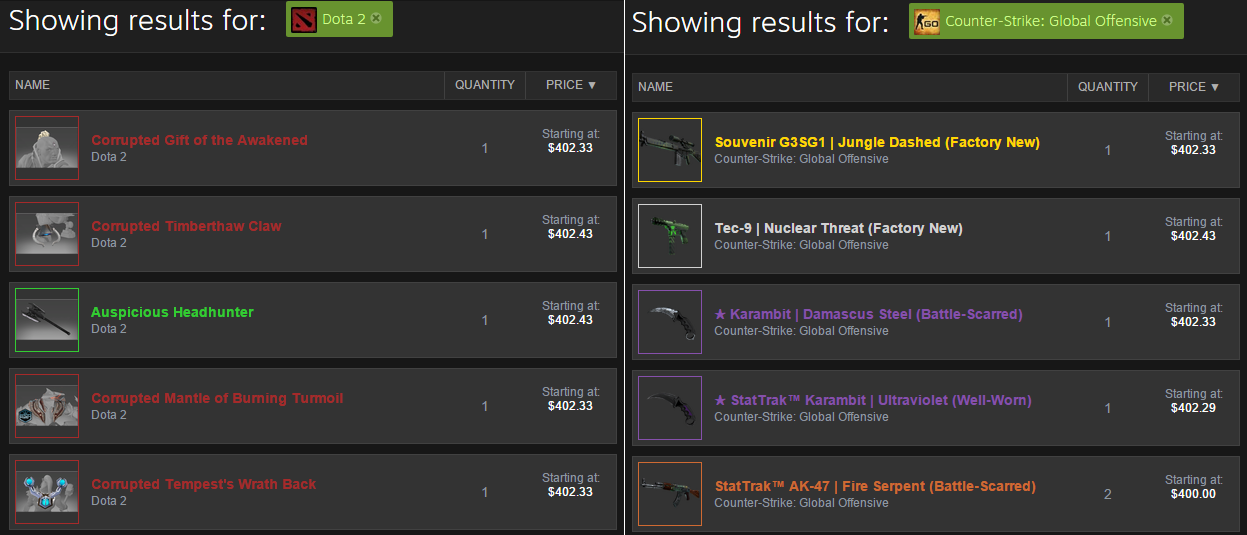
An entirely different issue is when people under age-21 wager their skins. These items are worth lots of money, just look at some screencaps from Steam’s Community Market page. Steam is the software distribution portion of Valve, creators of CS:GO and Dota 2. Some of the items for sale on the Valve Community Market are going for $400 dollars, while other third party marketplaces are trading and betting items worth much more money than that.

dota2
While this is certainly an exciting time to be an esports fan — the prize pools have never been bigger, corporate sponsorships are flowing in and possibly a major television league and broadcast deal in the works — seeing as DraftKings sees League of Legends on par with traditional sports, we can’t get too far ahead of ourselves. We’ve already seen entire organizations get taken down for throwing matches, some for cheating and with yet another website now offering to exchange cash (not just weapon skins with value tied to them) based on esports results, the cynic in me fears the worst.


Player Two Has Entered The Esports Streaming Game

YouTube Gaming launched last Wednesday and after nearly a week of observations, the Google powered streaming service has left several big impressions. Before fully diving into the details, it should be noted that YTG represents the first real challenger (sorry, Major League Gaming TV) to the currently undisputed streaming service of Twitch.TV. Last year Amazon purchased Twitch after Google reportedly backed out despite tentatively agreeing to a price tag upwards of $1 billion. Amazon ended up paying approximately $970 million to acquire Twitch, representing an investment — and presumably a belief — in the continued success of streaming esports and video games.

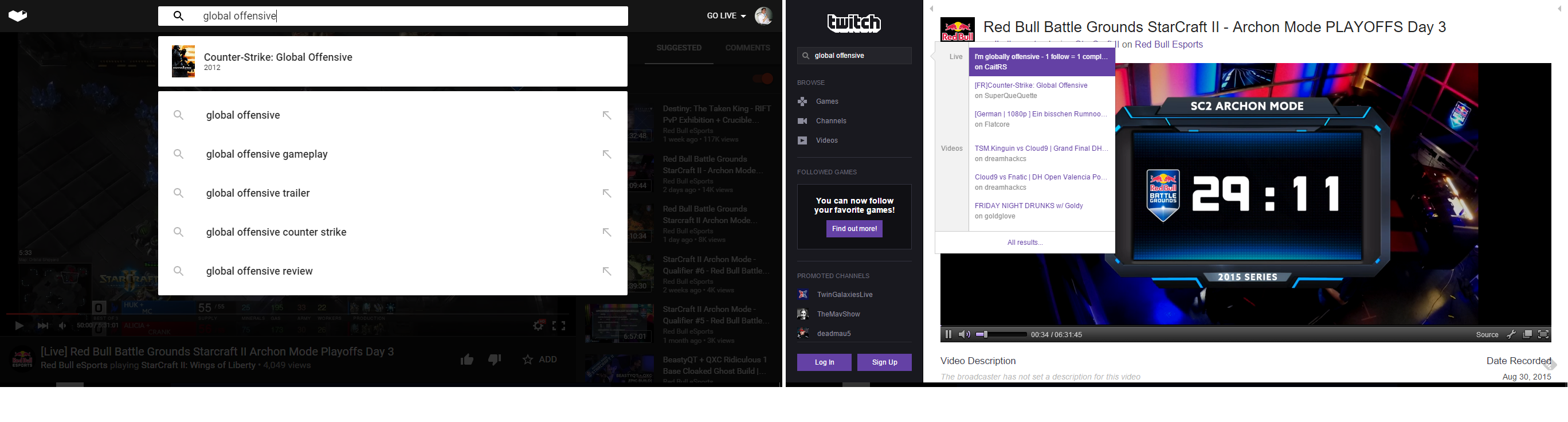
Other than huge difference in viewership numbers, something not particularly unexpected given YTG is still in its infancy, there are some differences in the layout and execution of the two platforms. For the duration of this look-in, YTG will be on the left-hand side with Twitch being on the right. Pictured below is the same moment (as close as I could get) in a StarCraft II: Legacy of the Void beta game between two pairs of professional players that has been paused. The screenshot was a VOD (Video On Demand) rather than live as I couldn’t quite grab the right timing during each live broadcast. The match up took place at Red Bull Battlegrounds, something YTG labels in the upper left whereas Twitch does not during a full screen pause.

comparison1It isn’t a deal making feature for YouTube, however it is a nice feature that normal YouTube videos have that has carried over to the streaming side of things. Another big chip in YTG’s favor is their pausing the VODs. YouTube grants the ability to navigate away from a specific spot in a video and being able to hit the back button and go right to where the video was paused. Twitch on the other will send you back to the beginning of the VOD rather than save a spot. For anyone who’s ever played a video game for more than a few minutes, misclicks or the wrong hotkey being hit are bound to happen, so this pause-and-return feature is another great feature from standard YouTube.

The game search options for both options each leave much to be desired as both sport autocomplete options, but neither are particularly great.

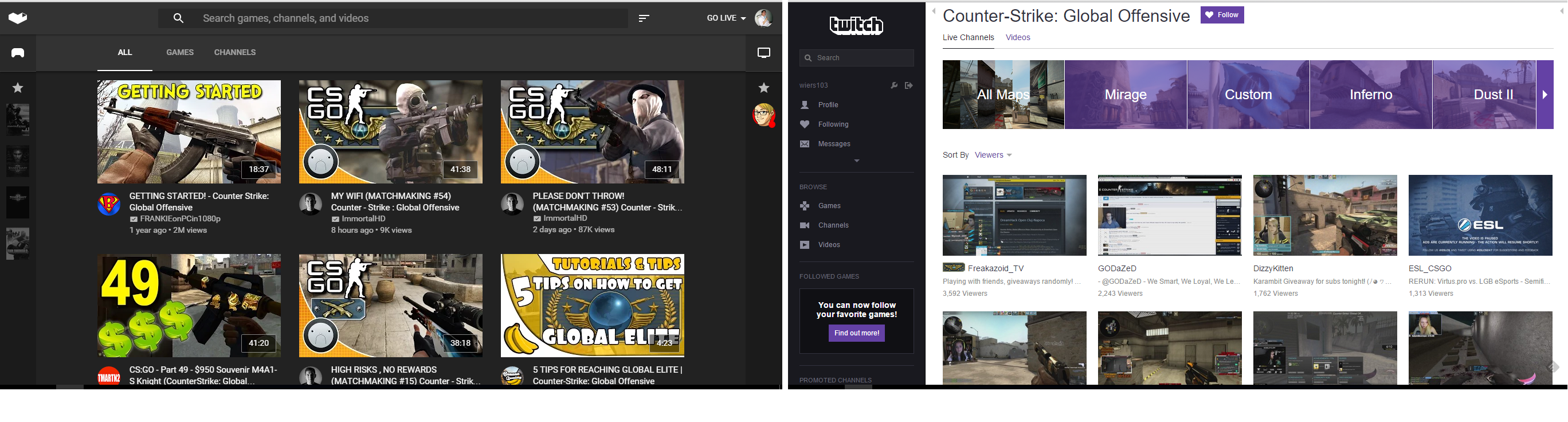
comparison2After clicking the game, in this case Counter-Strike: Global Offensive, Twitch welcomes you to a page featuring the top streams rated by current viewership sortable by specific maps. This is a big contrast from the generic YouTube landing page where it shows a video from a year ago as its top result and zero live streams. After browsing the various YTG videos, most turned out to be previously uploaded videos rather than live stream VODs. As it gains a more extensive VOD library I expect this to change, but it’s somewhat surprising to see two of the top six YTG search results be from more than four months ago.

comparison3Another issue I routinely saw with YouTube that I’m willing to chalk up to it still being new is the lack of moderators for the stream chats. Of the two dozen or so YTG streams I was in, the chat was running rampant with a mix of memes, ASCII characters and the like. Obviously Twitch chat is nothing to brag about, but at least a majority of the ridiculous fluff was removed by mods in the Twitch channels I frequent. To be honest, my friends have nicknamed Twitch chat — and by extension most stream chats — as YouTube comments in real time, something that is not a compliment to anyone who has delved into the depths of said comments.

Despite the flaws, I remain optimistic YouTube Gaming will get up to speed and soon give Twitch a real live streaming threat in the esports realm. As someone who has dealt with streaming issues since Justin.TV and an esports fan who grows weary of Twitch issues — specifically video stuttering or freezing and frame-rate drops despite a strong internet connection and computer — hopefully the competition YTG brings to the table will bring out the best in themselves and in Twitch, resulting in the best possible outcomes for the users. While I remain unimpressed with YouTube Gaming at the moment, I’m eager to see what the coming months brings for their viewer options. I can’t see this becoming Google Glass or Google+; this is one project that seems incredibly likely to succeed if for no other reason than that the market and demand is already in place.


Recent esports Tournaments Show Promising Attendance Numbers

Over the past weekend we saw two titans of esports, League of Legends and Counter-Strike: Global Offensive, hold major tournaments. On Sunday the European and North American League of Legends Championship Series summer finals concluded with the Counter-Logic Gaming team taking first place for North America, $50,000 in prize money, and a ticket directly into the 2015 World Championship, and Fnatic taking home the trophy for Europe. Fans of CS:GO were entertained from Thursday to Sunday with the ESL One: Cologne tournament, a tournament partially sponsored by CS:GO developer Valve, with $100,000 going to the winning team and $250,000 overall up for grabs. The weekend was filled with teams from all over the world aiming to take the top prize.

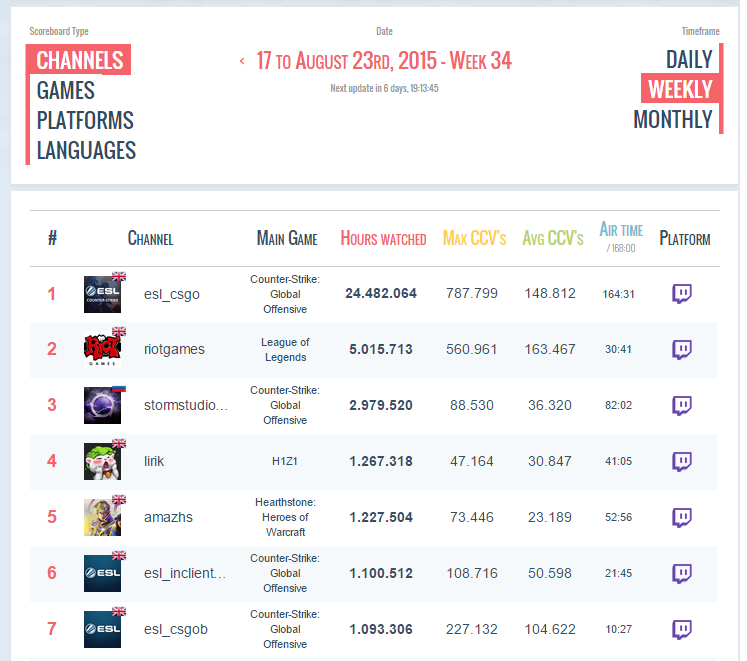
Both esports events captured a huge number of fans, and CS:GO set a sixth month high for Twitch.tv view hours in a single day. Via Gamoloco, CS:GO averaged more than seven million hours per day across the for the four day event, peaking at 8.9 million view hours on Saturday. It should be noted the number of hours is likely skewed by users logging in with multiple CS:GO accounts in order to raise their chances to receive a free in-game item drop, so these numbers should be taken with a grain of salt. The infographic below displays the game itself rather than the specific ESL One Twitch channel, which is to say there were other streams being watched for CS:GO and League of Legends beyond just the official ESL One and LCS streams.

gamoloco

By specific channels with each game, Gamoloco rates ESL One compiling 24.4 million hours (with another one million hours on the official “B Stream”) compared to Riot Games, developer of LoL, totaling just over five million hours over the past week. These numbers represent the English speaking channels only, with the Russian channel covering ESL One accumulating nearly three million hours, plus Polish and German broadcasts for each game.

gamoloco2The crowds at both live venues were impressive as well, with the League of Legends NA Summer tournament filling up Madison Square Garden with a reported 11,000 fans. Europe was no slouch either as ESL looking as though the Lanxess Arena drew a fair crowd as the header image would indicate, along with a large crowd at the EU LCS at Stockholm’s Hovet Arena. While it’s hard to compare a single tournament to the long grind of a sports season, the NA Summer event pulled a crowd comparable to the NHL’s Florida Panthers and more than the MLS’ Chivas USA, though both the Panthers and Chiva rank last in attendance for their respective leagues.

These impressive numbers aren’t even counting Dota 2’s yearly tournament, The International that was held from July 27 to August 8 to decide the world’s champion where we saw the single largest prize pool for an esports tournament. With the growing prize pool, interest level and time commitments being dedicated to esports — not to mention push notifications the ESPN app and score tickers (cap tip to HeyCJay from Reddit) and streams on ESPN 3 — it may be time to pick your favorite esports organization just the same as a football or baseball team. 

(Header image via ESL Twitter)

YouTube’s Live-Streaming Potential for Sports is Growing

After representing Middle Earth in the Lord of the Rings films, New Zealand is once again the epicenter for fantasy and hopes sprung to life. Yesterday, YouTube secured broadcasting rights to the Bundesliga and will begin showing its soccer matches on Friday in real time from Germany. Time zone differences will be awfully tough on the Kiwis as a 2:30 Friday afternoon game goes live at 12:30 am in New Zealand. Ruined sleep patterns aside, merely seeing Google take live streaming so seriously could open up a new competition for sports broadcasting rights.

The Latest_Bundesliga Twitter account was among the first to break the cord cutter friendly news:

Sports Business Daily (subscription required) noted YouTube — and by extension Google — is also allowed to show additional games and highlights from the league, but as replays and not live.

YouTube previously streamed the opening match of Bundesliga season here in the United States, a matchup between three-time reigning champ Bayern Munich and Hamburg last Friday. With Fox Soccer owning the broadcast rights here, the game was streamed via their soccer page.

It’s hard to imagine YouTube not being interesting in the broadcast world, as they’ve been in the live streaming business for some time now, really kicking things off with their stream of the 2012 London Olympics. With events ranging from traditional sports to extreme and esports, as well as general content creators also getting in on the live broadcast game, YouTube already has a massive user base, huge infrastructure behind it, as well as name recognition and familiarity.

Further emphasis has been placed on YT’s trend of embracing esports as they streamed Dota 2’s largest yearly tournament, The International 5. At TI5, 16 qualified teams from around the world competed for a prize pool of over $18.4 million, with more than $6.6 million going to the winning team. Factor in the soon to be released YouTube Gaming platform, an aptly named area specifically for the broadcast of esports, speed runs, Let’s plays and more, clearly Google has taken a keen interest in bringing live content to people. Google securing the rights in New Zealand with their ~5 million residents could be a guinea pig or stepping stone of sorts for bigger things on the horizon here in the US. According to their second quarter 2015 report, Google increased revenue to $17.7 billion and revenue growth of 11 percent year-over-year. Ruth Porat, Google CFO commented on the revenue, specifically noting YouTube, said:

Our strong Q2 results reflect continued growth across the breadth of our products, most notably core search, where mobile stood out, as well as YouTube and programmatic advertising. We are focused every day on developing big new opportunities across a wide range of businesses. We will do so with great care regarding resource allocation.

Unfortunately it’s impossible to distinctly separate YouTube’s revenue stream from Google’s numerous other ventures, however it isn’t hard to imagine YouTube comparing similarly to traditional networks. Given that other broadcasting network reports don’t separate their revenue streams channel by channel, these numbers for sports networks should be taken with a grain of salt. CBS’s Q2 2015 report disclosed a $3.2 billion, increasing 1 percent compared to last year. Disney, owners of sports giants ESPN and ABC amongst other channels, reported Q2 earnings at $2.1 billion this season. Time Warner, controllers of TNT, and TBS et al. posted $7.3 billion, up 8 percent compared to 2014.

With plenty of money, a desired market for more streamed sports and clear goals moving towards streaming live broadcasts, Google and YouTube could once again transform the way the every person consumes their favorite sports, news and other media.


Esports Players turn to Adderall for Competitive Edge

Over the previous weekend the 2015 Electronic Sports World Cup Counter-Strike: Global Offensive finals took place in Montreal. Multiple countries were represented and competed for the $75,000 prize pool, with $30,000 going the champions. Aside from technical setbacks, other controversy arose due usage of Adderall as well as in-game communication advantages. In a bit of a surprise, North American team Cloud9 won their group and advanced to the finals, though former Cloud9 member Kory “Semphis” Friesen gave a candid interview with Mohan “Launders” Govindasamy where Friesen said how common it is to find Adderall usage. In a separate interview, current Cloud9 member Ryan “fREAKAZOiD” Abadir had strong comments regarding other teams listening in to the Cloud9 in-game strategies.

Transcribing and editing the interview, Friesen said the following:

Friesen: Ha, I don’t even care. We were all on Adderall. Like, I don’t give a [expletive]. Like, it was pretty obvious if you listen to the comms. People can hate it or whatever, but.

Govindasamy: So everyone does Adderall on ESEA LAN, right?

Friesen: Yeah.

Govindasamy: Just throwing that out there, so you’re good.

As someone who has played Counter-Strike (and other games) in a relatively high level for a number of years — as well as someone who has taken their fair share of Adderall, this topic hits pretty close to certain times back in my younger days. While dealing with working part-time or going to school, plus a practice schedule that took up at least two hours per day, it was clear that time was in short supply. A teammate at the time suggested I go for an Adderall subscription. However, living in a college town I soon found out that it wasn’t that easy to get my hands on the pills without my own prescription.

The effects of being on Adderall didn’t seem big like much at first, but then about four hours passed and I hadn’t really noticed. It really did help me focus — almost to the point of tunnel vision — and in the context of esports, managing your tasks and focusing on the matters at hand is critical. For example, at big LAN event or venue, it’s a really loud atmosphere. With your in-game sounds turned up to hear every footstep, your teammates calling strategies, the announcers shouting and the crowd going bonkers, it’s incredibly easy to get distracted. In fact, recent controversy arose over communication. In somewhat recent events, more and more tournaments have been tapping into team’s in-game communications with so called Point-of-View streams, showing gameplay alongside the team’s comms.

Ryan “fREAKAZOiD” Abadir said in an interview how it’s unfair to English speaking teams. To quote Abadir:

Interviewer: What are your thoughts on it [POVs]?

Abadir: I think it’s great honestly. I love POVs, but, if you’re releasing it [live] and we can’t speak their language, then, how can we use it to our advantage when they [opposing teams] can use it [POVs] to their advantage? So release it after we’re done playing.

ESWC had teams from Ukraine, Sweden, Germany, France, China, Brazil, South Africa and Australia, along with Canada and the United States, so a multitude of languages could be found. Abadir’s interview was actually in regards to the previous weekend’s Electronic Sports League tournament, but that also boasted an international lineup where French, Swedish, Polish, Finnish, Portuguese and of course English were spoken. League of Legends releases post-match communication highlights, and tends to be careful to limit the amount of strategy given away at any time.

Is the ability to listen in on other teams’ communications cheating? Is it unfair for players to be taking Adderall? There are some fuzzy lines being skirted by major esports brands. Without pressure from sponsors or an overarching governing body, it doesn’t seem like any significant policy change will be in place for Adderall usage or POV streams. Despite the rapidly rising popularity, esports still have a long way to go when it comes to rules and regulations.

(Header image via ESWC)

TechGraphs News Roundup: 6/12/2015

It’s the return of the News Roundup. Here are some of the sports-tech stories we found interesting this week.

ESPN is issuing its first magazine cover featuring eSports. In fairness, it also features running back Marshawn Lynch, as he’s had his likeness added to the upcoming Call of Duty: Black Ops III. We’re not quite to the point where League of Legends players are gracing the front cover, but it’s a start.

The Wall Street Journal has a fascinating look into how the people of Cuba are watching their favorite American television. Basketball, baseball, even HBO — it’s all broadcast not by satellite, but by sneaker.

As a dedicated lazy person and as a golfer that spends a lot of his time criss-crossing the fairways, the GolfBoard might be right in my wheelhouse.

You know all that cool 3D/interactive/holographic stuff that teams and facilities are installing? Soon, all that tech might come from part incubator, part tax write-off known as the Mark Cuban Center for Sports Media and Technology. Say what you will about the man, but sports and technology seem to be two of his stronger suits.

This is technically from last week, but if you didn’t get a chance to see American Pharoah race Secretariat, you should. It’s amazing what a little archival footage and some video syncing can do.

For some reason, people think it’s fun to mock pitcher Alex Torres for wanting to protect his melon. Strides are being taken to maintain protection while making hats look a little less puffy, and perhaps a similar product being adopted by a prominent soccer player will help people wanting to avoid head injuries seem a little more commonplace.

That’s it for this week. Have a great weekend. Be excellent to each other.