Archive for Esports

Esports Injuries Are Piling Up

A torn knee ligament, shoulder surgery and now wrist injuries can be added to the list of career threatening injuries to those making a living playing video games. In the wake of the sudden retirement of League of Legends pro Hai “Hai” Lam where he specifically cites an ongoing wrist injury, it may be time to re-examine our thoughts on esports competitors as athletes. Repetitive strain injuries from tennis elbow to carpal tunnel effect athletes and esports competitors alike.

The United State government already formally recognizes some esports competitors as athletes by granting multiple P-1A visas, given specifically to athletes. While certainly not a normal athletic workload, esports at the highest level has nonetheless produced a long list of injuries, most notably in the wrist and neck, for years.

In StarCraft II, injuries have forced out arguably the best player in the five year history of the game, Jung “Mvp” Jong Hyun. The four time champion of the Global Star League is the third highest earner in prize money with over $400,000 in the bank for his tournament showings. Mvp’s career was derailed when pains in his neck caused numbness in his shoulders and arms.

Canadian player and at one point arguably the best non-Korean player in the world Sasha “Scarlett” Hostyn was temporarily forced away from the game to allow her wrists to recover.

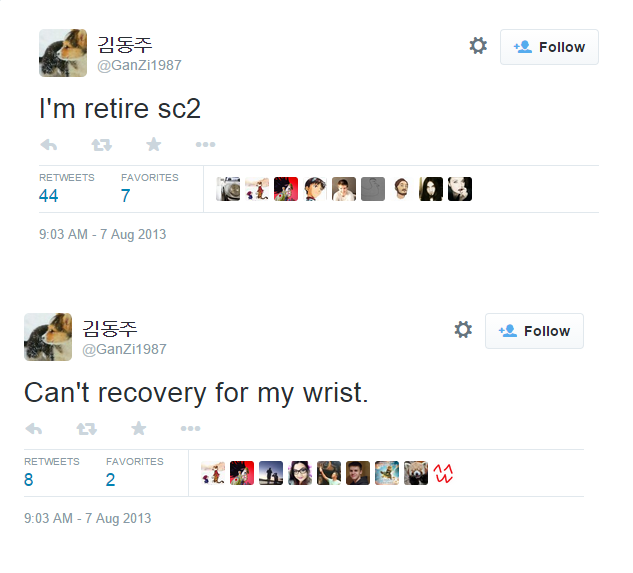
Former competitor Kim “Ganzi” Dong Ju is another victim of wrist injuries, tweeting his retirement announcement and the reason for it.
ganzi

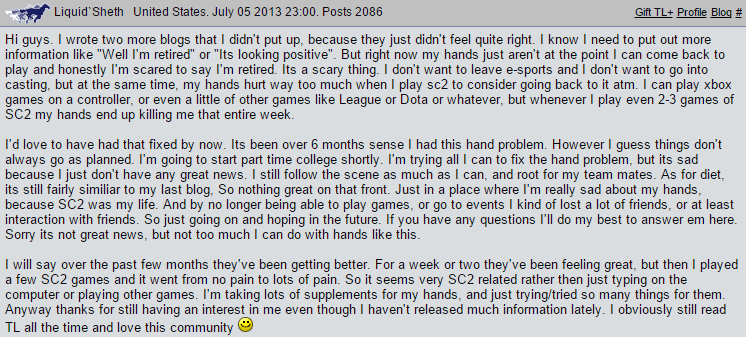
Popular player Shawn “Sheth” Simon was also felled by injuries, citing in a forum post that pain in his hands have prevented him from playing anything more than a handful of matches per week.
sheth

The world of esports is in an awkward position. While getting ESPN2 airtime on a Sunday evening with a Heroes of the Storm collegiate aptly named “Heroes of the Dorm” match is a welcome sight to esports fans as is the emerging scenes across various games, the lack of team infrastructure is alarming. Without any sort of players union or dedicated medical staff, the players lack protection from injuries that have already ended or shortened multiple careers.

(Header image via Wikipedia)

You Probably Play A Computer Game

It is no longer a question of “do you like computer games and esports” but now “which game is your favorite?” The latest Global Web Index report shows 48% of internet users in the United States play a game on their computer (in this context Macs and Linux devices are included with Windows).

pcnumbers
One of the more encouraging signs of growth isn’t in the sheer numbers, but the demographic of the players. It should come as no surprise to see the 25 to 34 and 16 to 24 age groups leading the way at 54% and 52% respectively, however even the more middle aged 35 to 44 bracket plays games at a high frequency of 48%. Across the age boundaries there is a nearly even money chance that both men, 48%, or women, 47%, play a game online or competitively at least once per month as well.

The surveyed group did not need to specify which specific games were played, but Twitch.TV released their January streaming info and serves well as a best-guess proxy on the GWI group. The top three most played — and viewed — games are titans of the esports realm, with League of Legends, Dota 2 and Counter-Strike: Global Offensive standing in order atop the podium. Five of the top 10 highest viewed titles are exclusive to PC’s. When a CS:GO tournament can draw over 1 million simultaneous viewers, big entertainment money follows big entertainment numbers.

csgomillion
(Image credit to Qctopz via r/globaloffensive)


With the biggest prize pools, sponsorship and biggest infrastructure involvement, it isn’t just the nerds taking note. Other entertainment mediums have been sponsoring esports related events. From the StarCraft II Ender’s Game on Blu-Ray tournament last year to the Chappie Challenge tournament playing Evolve this earlier month, to the million dollar perfect game MLB 2k11, the intersection of esports — in particular PC games — and entertainment is at a level never before seen.

(Header image via GWI)

South Korea Announces Esports Investments

The fact that you have to spend money to make money is true for all business models, including esports. South Korea, arguably the world leader in esports, is seeking to build on their strong history of supporting video gaming professionals at the player and developer level. According to The Korea Times, President Park Geun-hye promised 100 billion won — around $90 million — from the government for startup companies in the gaming community, the internet of things and financial technology.

According to Esports Earnings, South Korea has been particularly dominant in StarCraft: Brood War and StarCraft II. Players hailing from South Korea have collected over $5.9 million in tournament winnings from SC:BW compared to China’s second place of almost $87,000.

scbwearnings

The gap in SCII is Korea dominating the scene to the tune of over $11 million versus Sweden’s coming in at a tick above $530,000.

sc2earnings

In addition to being the top earnings in both iterations of StarCraft — so much so the gaming community calls it the “Korean scene” versus the “foreign scene” with foreign meaning every single country that isn’t South Korea — League of Legends has also been largely dominated by Koreans. China is relatively close in winnings, though it is still barely half of what Korean teams and players have raked in.

leaguewinnings

With so much money coming in and going out in Korean esports, it should come as no surprise there is a governing body, the Korean e-Sports Association, better known as KeSPA. From proposing a minimum salary for players, ensuring travel for Korean citizens to foreign events and vice versa, as well as partnering with game developers for feedback, KeSPA’s is an organization looking out for sponsors and players alike. While not perfect, KeSPA — and South Korea as a whole — has inarguably played a major role in bringing esports to its current level of popularity.

(Header image via Blizzard)

Is YouTube Creating a New Rival to Twitch?

For all of the various competitions getting streamed via TwitchTV, it is unfortunate to see the platform itself does not have any major competition. Yes, ESPN3 has shown esports in the past, Major League Gaming TV is making strides, and Azubu is still a thing, but without another titan to battle, TwitchTV holds all the cards as streaming’s primary go-to website. Cue the whispers of YouTube preparing to re-launch a gaming centered live-streaming platform in this Daily Dot piece.

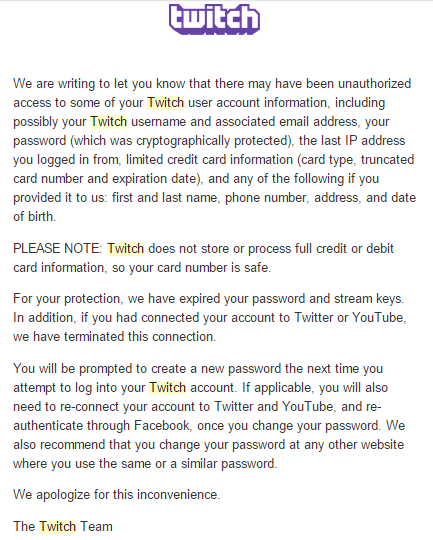
The rumor mill has an acute sense of things given the recent Twitch password issues. While it isn’t on the same scale as Sony storing user passwords in plain text, on Tuesday certain TwitchTV users were hit with the a concerning email. A subject line of “Important Notice about Your Twitch Account” immediately caught the eye of channel owners as the body of the email revealed that unauthorized access within accounts may have taken place:

twitchpolicy

As a relatively long-time Twitch user — my account registration is dated January 1, 2012 and the company officially split from JustinTV in June of 2011 — I can even remember the JustinTV days and the issues that have hampered the streaming platform back then. From out of sync audio and video to levels of lag that turned videos into slideshows, Twitch seems to take one step forward and two steps back in terms of being the best available. Now offering the ability to at least report issues on hand with a few simple clicks, Twitch has nonetheless introduced other problems.

twitchstream

From a sub-par VOD catalogue that lacks a basic search function to their music policy that causes large areas of previous VOD’s getting muted (as indicated by the warning and large red bars), many — myself included — have expressed frustration with the platform.

twitchmusic

Hopes are high that a rival service will end with the companies bringing out the best in each other for the consumers. Google previously showed interest in purchasing the Twitch platform before backing out, but if you can’t join em, beat em.

(Special thanks to the GSL and TakeTV channels)

The US Digital Gaming Market

It’s starting to become less and less crazy to call the United States digital games market a billion dollar industry. Thankfully, according to SuperData Research, it is estimated at $995 million, a 2% increase over last year. That number represents money going to the developers, and does not account for in-game trading and betting.

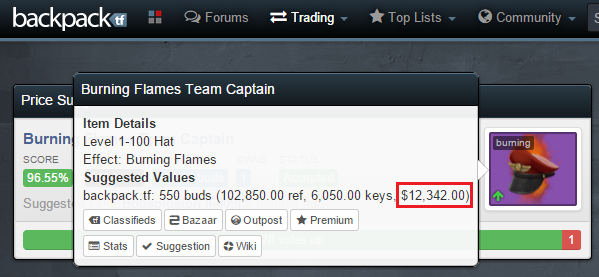
For a taste of how much money trading and in-game economy represents; Yanis Varoufakis, formerly Valve’s chief Team Fortress 2 economist is now the Finance Minister for Greece. Yes, from valuing digital items and pixels to a helping run a country, the economic factor of modern games is not to be understated. A single hat in TF2, the Burning Team Captain, is famous for being a ridiculously priced item, namely about $12,000.

tf2price

Of the $995 million mentioned, some of that is gathered from monthly subscriptions, mostly from massive multiple games. SuperData Research shows five of the most popular MMO subscription games in the US in the table below.

GRAPH-SuperData_EastWestRevenueSplitTopP2PMMOsThese subscription-based numbers are missing free-to-play League of Legends and Dota 2, arguably the two biggest multiplayer games in the esports scene. LoL is known for its massive following and Dota 2 is famous for its huge userbase and even bigger prize pool at the yearly tournament known as The International. Esports have become mainstream when the dollars being thrown around rival that of not only major sports franchises, but entire leagues.
(Header image via Shawn Carpenter Photography)

Competitive Minecraft Has a New Option

Minecraft, the open sandbox style game Microsoft purchased — along with the entire Mojang company —  for a staggering $2.5 billion could be entering a new competitive phase. Given the recent attention towards esports from ESPN, theScore et al, it should be no surprise that Minecraft, the best selling PC game of all time, is getting some love. Over at Kickback.gg (though the site is still just an open Beta) Minecraft players have an option of going against each other either for free or with money on the line.

Between the 34 million player base on computers and consoles plus an additional 30 million mobile users, Minecraft could be on the eve of new multiplayer day. The registration at Kickback is free, though in order to win money you’ll have to deposit some cash in order to wager it. If you’re not quite ready to put your money where your mouth is, there are free games as well. For just $1 per game, any confident player will probably take a crack at it.

The player vs player matches (PvP) will take place on pre-made servers in order to prevent cheating or any suspected tampering. In a world where bets at CSGO Lounge reach millions of dollars per day on Counter-Strike matches, it was only a matter of time before competitive Minecraft cashed in. Unlike other games like ESEA, CEVO and FACEIT, there is no league entry fee  — the the latter two companies do offer free competitive ladders and leagues. It seems as though Kickback is looking to fill the cravings of a competitor on the short-term. Rather than be obligated to compete in official matches, it is a simple as joining the site and jumping in-game.

Think of it in terms of fantasy sports — rather than signing up for six months of a fantasy baseball league, Kickback is a daily sort of thing with minimal commitment. If the success of DraftKings and FanDuel is any indicator in terms of short-term entertainment, Kickback could be something big.

(Image via postapocalyptic)

Gaming Communities Are The New Sports Fans

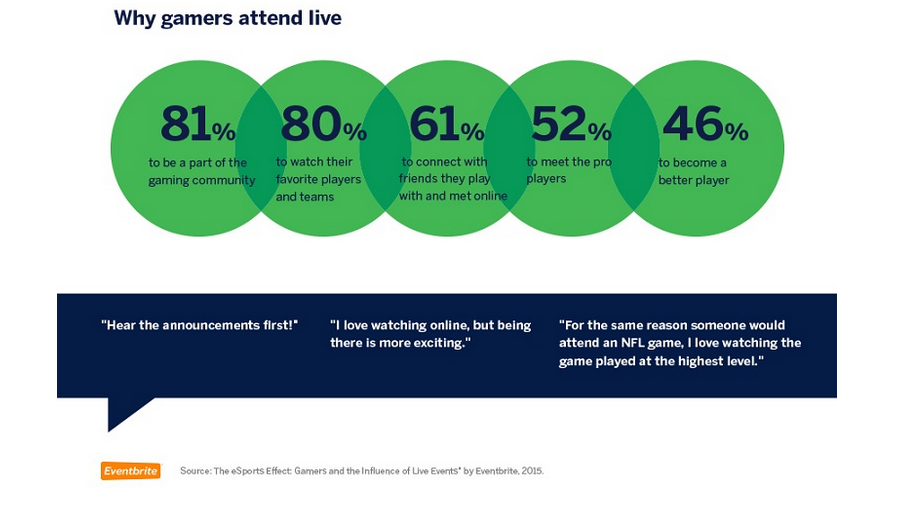
Earlier today Venture Beat posted an article with polling data on esports fans who have attended live events — not only attended, but as spectators and specifically not as participants. Much like professional sports, the pro scene in esports has a strong following, arguably a stronger (though not necessarily better) social media presence due to the more unfiltered and less politically correct realm of the internet community.

VB (in conjunction with Evenbrite) see over 80% of fans attending live events to be a part of the community and to watch their favorite players and teams live. Many fans, 61%, also go to connect with friends they play with online.

gamerpoll

As a former player — not at the highest level, but relatively close — in both first-person shooters (specifically Counter-Strike 1.5 and 1.6) and real-time strategy games such as StarCraft II, the connecting with friends part is huge. From old LAN centers such as Warfactory in St. Louis, Missouri to CygamZ in Ypsilanti, Michigan, my team(s) and I enjoyed the travel and the live events in a way online couldn’t match.

Back in the day my teams used voice programs such as Ventrilo mostly, though originally we used the even older Roger Wilco to communicate in-game. When we weren’t scrimmaging (aka scrimming) or working on timing strategies, we would often hang out in our mIRC channels and just shoot the breeze. Similar to coaches going over post-game film, our team would often watch demos of ourselves together, take notes, make recommendations and adjustments. We would even scout opposing teams in upcoming matches or swap tactics with other teams in our divisions, and basically have a scouting report. For example, if we knew one particularly member on the opposing team was hyper-aggressive or overly passive, we would adjust our strategies to exploit that.

Living or rooming together to develop strategies and bonds between teammates even has a specific term in the gaming industry: bootcamping. North American CS:GO team Cloud9 often does bootcamps and recorded two last year prior to a major LANs. Other teams live together in literal team houses, mostly in South Korea and throughout Europe.

While my experiences are of course subjective and anecdotal, seeing the vast majority of fellow gamers agree doesn’t surprise. From literally playing games in my parent’s basement to traveling to compete with the best North America had to offer, I wouldn’t change a thing about my gaming career. To see esports take off to such a level that ESPN shows games, media outlets conducting interviews with pro players and the sheer size of prize pools, I may have to get the band back together.

(Header image via ESL)

New Esports Program Debuts in Norway

Norway’s largest commercial television network, TV2, announced a trio of esports leagues to be aired on their programming. The three leagues will consist of League of Legends, StarCraft II and Counter-Strike: Global Offensive. TV2 is partnering with House of Nerds, a large Local Area Network (LAN) center with over 100 computer stations, in order to accommodate the new leagues. The House of Nerds arena is over 1,000 square meters and while the infrastructure is there, no announcements of prize pools, distribution or commentators have yet been made.

Norway isn’t a stranger to the esports scene, particularly with the success of Jens “Snute” Aasgaard, currently ties for #21 in the world according to World Championship Series points. Aasgaard finished 2014 as the #17 ranked player and the highest non-South Korean player in StarCraft II. He just qualified for round of 16, sweeping his group without losing a map and winning 4-0.

The country also owns a solid history of competitive Counter-Strike, going back to the days before CS:GO. In Counter-Strike 1.4/1.5/1.6, Norway boasted a strong collection of talent with multiple world champions in players such as Jørgen ‘XeqtR’ Johannessen and Ola ‘elemeNt’ Moum.

The competitions are set to play a 10 week season, though whether the leagues will be decided by an open qualifier, invites or a mix hasn’t been released yet. Matches will be aired on TV2 Sumo, the entertainment network, though TV2 Sport will also feature the games. Corporate sponsorships are nothing new, but a full partnership to broadcast esports matches — similar to the X Games and Major League Gaming agreement in Aspen — to an entire nation grows the popularity and acceptance of esports.

(Header image via eSports Norway’s Facebook Page)

Sports Site theScore Releases New Esports App

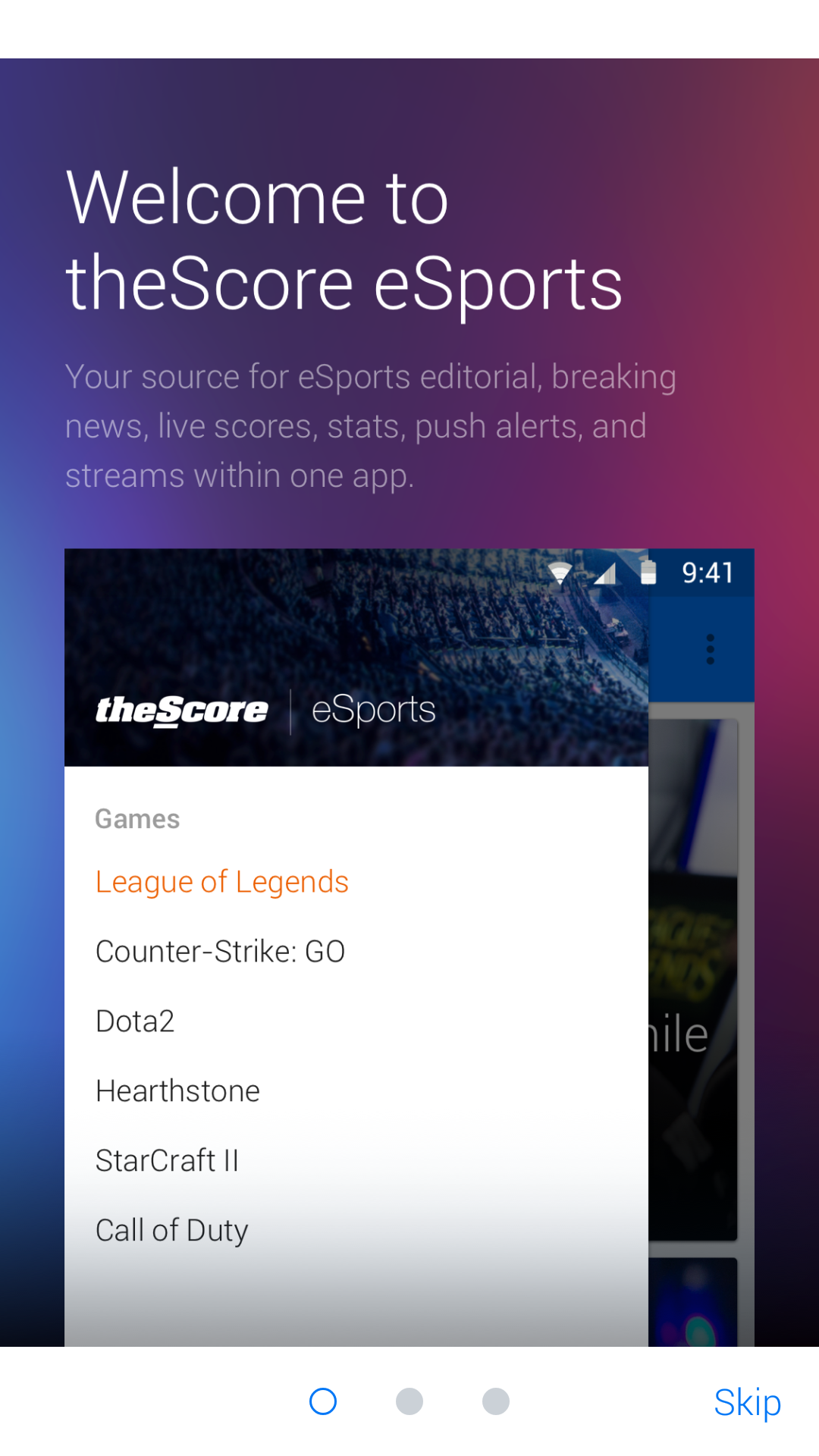
Popular sports website theScore has made the leap into esports with the launch of their “theScore eSports” app for Android today. An iOS version is in the works already. The company, which just set a new record for their site traffic at 10.2 million active monthly users, now features a specific app focused on the happenings in six of the biggest esports titles.

thescore

Featured within the app are options to follow League of Legends, Dota 2, Hearthstone, StarCraft II, Counter-Strike: Global Offensive and Call of Duty. Within those games listed there are specific regions covered as well, currently consisting of North America, Europe, Korea and China. TheScore has promised more games and more regional coverage as the app continues to grow.

Right now some aspects of the app work are fully operational. The North American League of Legends Championship Series currently shows upcoming matches and scores. The StarCraft section isn’t fully complete yet, as neither scores nor regions were available at the time of the app launch.


thescore3

There is a catch-all hub that doubles as the Top News section, where tournament announcements, player acquisitions, sponsorship news and more can all be found. Within the Top News section there is the option to sort by specific game as well, making things very convenient if a person only follows one or two esports scenes.


Bans Handed Down From Valve For Match Fixing

In the wake of the allegations and subsequent investigation formed from The Daily Dot’s Richard Lewis in regards to match fixing, Valve — creators and developers of Counter-Strike: Global Offensive — has acted quickly by banning all parties involved announced in a blog post. Most of the former team iBUYPOWER as well as others involved have received bans from Valve. The ban list which includes professional players and community figures is as follows:

Duc “cud” Pham
Derek “dboorn” Boorn
Casey Foster
Sam “Dazed” Marine
Braxton “swag” Pierce
Keven “AZK” Larivière
Joshua “Steel” Nissan

Of particular note is Braxton Pierce, recently named HLTV’s 18th best CS:GO player of 2014. While there is no sole governing body in esports, let alone CS:GO, Valve did not act alone in their ban of the players from Valve-sponsored events. Competitive leagues ESEA, FACEIT and CEVO have all banned the guilty players for a minimum of one year.

Valve notes they were able to confirm the guilt after tracking the items (or skins) by looking at the historical activity of the accused accounts. Though the players apparently did not wager any money, there was thousands of dollars worth of bets in the form of skins the iBUYPOWER team wagered on the opposing underdog team NetCodeGuides.com. By throwing the match for what equated to a monetary gain, the CS:GO community cried out for justice, and it was served.

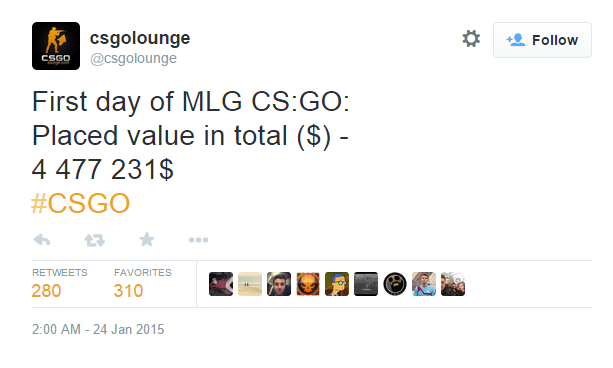
While thousands of dollars worth of in-game items may seem like a lot of money, it pales in comparison to formal bets on the games. Recently the 2015 Aspen X Games hosted a Major League Gaming CS:GO portion and popular betting site CSGO Lounge tweeted out a rather staggering figure for bets they handled on day one:

csgo

If Valve continues to step in and clean up the professional ranks of CS:GO — they and ESEA banned several professional players such as Hovik “KQLY” Tovmassian in November and ESEA more recently banned Andre “flex” Francisty  live on stream — then it betters esports as a whole. With money from sponsorships, advertising revenue and the integrity of the game on the line, Valve acted quickly. It isn’t the first time a governing body has handed down bans for wagering on games, from sAviOr and StarCraft to the much more famous Pete Rose and MLB, gambling on games where you directly affect the outcome hurts the image of the sport.