Archive for wearables

Motus, Zepp Unveil New Wearable Baseball Tech at CES 2016

Motus Global and Zepp announced new additions to their existing lineup of baseball-specific wearable devices at this week’s Consumer Electronics Show in Las Vegas.

Motus Global’s system, called motusBASEBALL, is driven by a single IMU sensor. The new system can be used in a compression sleeve to track pitching, comparable to the mThrow, their existing offering. But the motusBASEBALL system can also be clipped on to a batting glove, providing feedback on a player’s swing.

“Our unique approach to the space, rooted in years of biomechanics services for MLB teams, along with the most powerful sports sensor on the market, gives our users the best chance at improving their mechanics and monitoring workloads on their joints,” said vice president for application development Ryan Holstad.

Preliminary information about the system is available on Motus Global’s website. The pitching metrics offered are very similar to the mThrow: both include throw limits based on workload, elbow and shoulder kinematics based on the single IMU worn over the ulnar collateral ligament, and a “bullpen mode” to help pitchers train.

The webpage also suggests that six metrics will be tracked for hitters: bat speed, hand speed, swing time, swing length (in inches), attack angle, and vertical angle. Metrics will be calculated separately for each region of the strike zone, to help hitters identify “hot” and “cold” regions. (Pitch locations will presumably be entered manually.)

To this point, not much has been revealed about the sensor driving the new system, other than that it has been “upgraded” over the current mThrow sensor. We can say for sure that the new sensor is less rounded than the current one. There is also a micro USB port for charging the sensor, a change from the induction charging previously used. More details will be revealed in the weeks leading up to the device launch (currently scheduled for February).

The company emphasized that motusBASEBALL was a consumer system, contrasting it with the motusPRO system unveiled during last month’s Winter Meetings. A full-body, five-sensor system, the motusPRO also transmits data via Bluetooth to a mobile phone or tablet for analysis. The system describes hitting and pitching motions through a wide range of angles, forces, rotations, and timing parameters. The motusPRO is currently available only to professional organizations, but Motus Global plans to roll the device out to select training facilities in the future.

Also this week, Zepp announced the next evolution of their bat sensor: an as yet unnamed offering embedded directly into the handle of the bat. As seen in the image above, the sensor will lock into a retention sleeve, which in turn will be fitted into the hollowed-out knob of a bat. Current offerings, which fit into flexible sleeves that slide over the knob, can move around or be knocked off by especially violent swings. Moving the sensor inside the bat should mitigate this problem.

The new design is still in the prototype phase, and no price point or release date have yet been announced. But Zepp claims to be in talks with a number of bat manufacturers to make a commercial version. In addition, Zepp announced a partnernship with New Balance, who unveiled a new digital sport division at CES.

Meanwhile, Zepp also has representatives at the annual convention of the American Baseball Coaches Association in Nashville. The goal there is to advance Zepp’s new design as an “open-source” industry standard for wearable sensors. To that end, the company will be hosting a roundtable discussion on this topic Friday.

Currently, devices like Motus Global’s and Zepp’s are not approved by MLB for in-game use. But MLB has said they are updating their wearables policy before the 2016 season. Until then, these devices can be used in practices and specific events: Zepp’s existing sensor has been used during game action at Perfect Game showcases, and an early version of the mThrow was used during 2014 fall instructs.

GPS-Based Athlete Tracking Systems: A Primer

If you’re following the rise of player tracking technology, most of what’s being discussed are in-game systems. Whether the system is camera-based, like SportVu in the NBA or Statcast in MLB, or sensor-based, like Zebra’s RFID tracking of NFL players or the Sportvision’s partnership with the NHL, the goal is similar: track how pro athletes in the heat of competition, with the hope of gaining a competitive advantage by the shaving of a fraction of a second here or optimizing a route there.

But there’s another way for teams to use technology to gain an edge: by keeping their best players healthy and in those big games. This requires a separate system, especially on large squads like football teams where it would be impractical to collect and process the amount of optical data needed to capture everyone’s movements across all activities. As a result, systems based on global positioning system (GPS) technology are used in practices and rehab by a wide range of teams across all major sports.

Most of the designs center around a sports-bra looking harness worn by the athlete under his or her shirt. The harness holds a device containing a GPS chip, along with additional components like accelerometers, gyroscopes, and magnetometers, to track how and where an athlete moves. The GPS device is often paired with a heart rate monitor, allowing the system to estimate exertion.

Because the device relies on satellites to track the athletes, most companies that market a GPS system also market a complementary indoor system, typically based off a technology such as RFID that is better suited to the indoor environment. If a basketball or hockey team is working with one of these companies, chances are that they’re using indoor technology.

For now, these devices are predominantly used in practices, as none of the major leagues currently allow on-field wearable sensors for safety reasons. But FIFA just relaxed their ban, following successful runs at the Women’s World Cup and Under-23 World Cup over the summer. National federations are expected to follow suit shortly, and other sports leagues (such as MLB) are drawing up procedures to approve devices for in-game use.

Most readers are familiar with activity trackers like FitBit, which typically include a GPS component. But monitoring companies say that they aren’t designed to provide enough information to accurately track an athlete’s performance during competition or training.

“They offer very little insight into athlete’s performance,” said Richard Byrne, STATSports’s Business Administrator. “FitBit themselves are the first to admit they will show you patterns relating to your fitness levels as oppose to wholly accurate data.”

It might seem surprising to hear that teams are investing in GPS technology as camera-based systems proliferate across pro sports. STATS’ SportVu cameras are positioned in all 30 NBA arenas, and soccer teams have tracked distance traveled with systems like Matrics for years. But GPS companies argue their devices provide more in-depth information than camera-based systems.

“Camera systems essentially turn a match into moving dots on a screen,” said Catapult director of marketing Boden Westover. “You get speed and distance metrics, but they’re a tiny piece of the athlete tracking pie.”

There are a number of companies that offer similar GPS systems. For this introduction, I spoke with representatives from three — Catapult, STATSports, and VX Sport — but others (including GPSports and Zephyr) are also currently being used by pro organizations.

Catapult

With over 440 clients in 40 countries listed on their website, Catapult is the best-known and most prolific GPS company. Based in Australia, their OptimEye S5 (and the goalkeeper-specific G5) use GNSS, a combination of the American GPS system and the Russian GLONASS system. The result, according to Catapult, is a system accurate to within 50 cm; an older system that uses GPS only has a stated accuracy of 100 cm. The OptimEye devices include an inertial measurement analysis (IMA) chip, an accelerometer/gyroscope combination that measures an athlete’s finer movements. For indoor clients, Catapult produces ClearSky, an RFID-based system.

Westover said that Catapult’s distinguishing characteristic was independent validation of the technology published in peer-reviewed journals.

“There are around 100 such articles that have been published on Catapult, which prove that our technology measures what we say it does,” he said. “Other systems out there being used by teams have never been scientifically proven.”

STATSports

Headquartered in Ireland, STATSports’ offering is the Viper Pod, a combination GPS and MARG device with a stated accuracy of at least one meter. The inclusion of accelerometer, gyroscope, and magnetometer components allows the Viper Pod to track accelerations and decelerations, along with athlete direction and turning. The MARG components also contribute to the scrum analysis used by their rugby clients.

Although their current indoor solution works off accelerometry data, STATSports’ upcoming Viper 3 system (due out this year) will incorporate ultra-wideband technology for accuracy up to 10 cm. The new system will also use low-energy Bluetooth to connect to other devices like heart rate monitors.

Business administrator Richard Byrne said that STATSports prides itself on its software platform in addition to accuracy.

“Our customers tell us our software is light years ahead of anything else they have experienced,” Byrne said. “We have a host of innovative metrics which allow coaches who use our system an incredibly in-depth look at their athlete’s performance.”

VX Sport

VX Sport, a New Zealand-based company, is focusing its efforts on collegiate sports teams. VX Sport’s system combines three satellite systems — GPS, GLONASS, and an analogous Chinese system — but unlike other companies, doesn’t claim that the additional satellites produces increased accuracy. Instead, managing director Richard Snow claimed that the “dark art” of GPS accuracy relied more on high-quality components and intense post-processing.

“It’s a bit like talking about a pro digital camera vs. a consumer model,” Snow said. “If you picked up a pro Nikon from ten years ago, it’s always gonna be better than the 20 megapixel thing that you buy for $75 from an electronics store. And that’s the reality with GPS.”

VX Sport also offers an IMU-based indoor tracking system that caters to volleyball and basketball clients. Incorporating an accelerometer, gyroscope, and magnetometer, the device can track leg and hip biometrics based on the steps an athlete takes. The system includes software to summarize these biometrics into injury predictors.

Given the gameday motion capture systems currently in place, these GPS-based systems might seem superfluous. But Snow emphasized the importance of his system as a way to quantify players’ effort during the daily grind of training sessions.

“It used to be someone talking with the athletes in the morning, working out how are you feeling, what’s your readiness,” Snow said. “And then at the end of the training, how did you rate that? The only way they’re going to change that is with proper monitoring.”


How David Ortiz Keeps Hitting Homers

On September 12, David Ortiz led off the top of the fifth inning by turning on a Matt Moore curveball, depositing it into the Tropicana Field bleachers for his second home run of the day and the 500th of his career. Ortiz became the 27th MLB hitter to reach the 500-homer milestone, and (at 39 years and 298 days) the fifth-oldest.

Ortiz didn’t get regular at bats until his age 24 season with Minnesota, and when he first came to the Red Sox, he shared the DH role with the immortal Jeremy Giambi. Contrast that with fellow Dominican and 500-homer man Albert Pujols, who had already played three full seasons by that age and collected 114 home runs as the Cardinals’ everyday left fielder. How has Ortiz managed to overcome this late start and defy the aging curve to hit dingers long after other sluggers have seen their power decline?

We can glean some extra insights from Ortiz’s relationship with Zepp’s baseball sensor. Because Ortiz is one of nine MLB players who endorse the Zepp baseball sensor, Zepp includes data and video from a couple of his swings with their app. And even when compared to the other professionals they’ve worked with, Ortiz’s swing impresses the Zepp scientists.

“Most of the athletes we work with are 25 years old, in the prime of their career,” Trevor Stocking, Zepp’s product manager for baseball and softball, said. “For him to have the kind of bat speed he does at age 38, 39, 40, it’s really special.”

David Ortiz Data - Total

Looking at his swing data (pictured above), we see Ortiz’s swing speed is in line with other Zepp athletes like Giancarlo Stanton, Mike Trout, and Hunter Pence. Ortiz’s time to impact (how early before contact the hitter starts his swing) is just above league-average. According to Zepp, most professional hitters’ time to impact is between .14 and .18 seconds; Ortiz was clocked at .138 seconds.

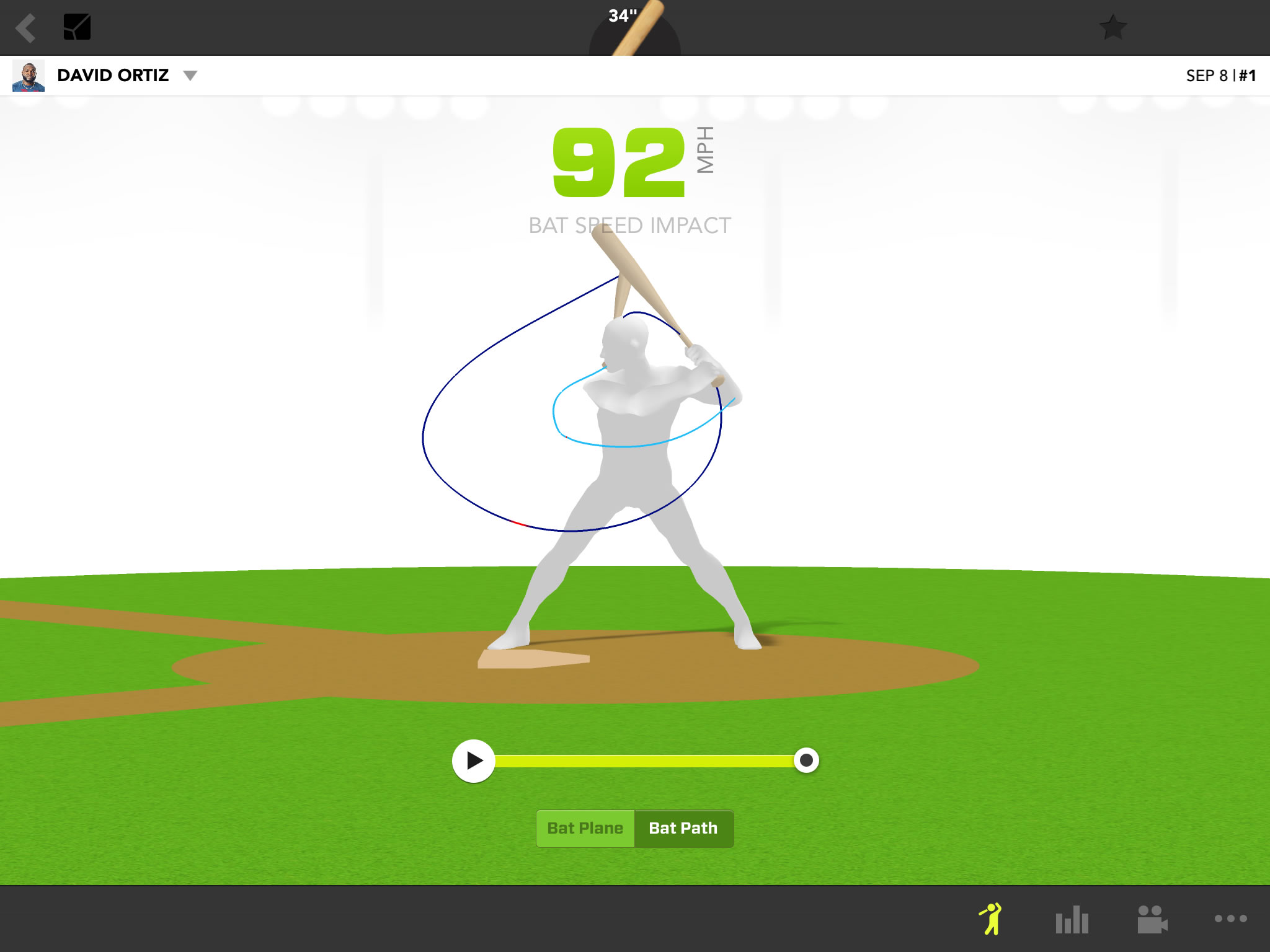
David Ortiz Bat Speed Impact

Viewing his swing path in the three-dimensional representation above, we see that Ortiz focuses on keeping his hands close to his body, ensuring the bat stays on a direct path to the ball with a minimal amount of wasted energy. This helps keep his bat fast and his swing quick.

But Ortiz is a giant of a man, listed at 6’4″ and 230 pounds. For younger players who use this technology to compare their swings to that of their heroes, it might not be a great idea (or even possible) to mimic his strategy without his strength. But Stocking says there are still lessons to be learned from his data.

“What you come away with each time you work with David Ortiz is a respect for how hard he works,” Stocking said. “He understands his swing and has a plan when he gets in the batter’s box. That’s something we can all strive to do.”

Apart from Ortiz’s successes, Zepp has had a few accomplishments of their own this summer. The company inked deals with the Angels, Diamondbacks, Padres, and Rays to provide sensors and data to hitters throughout those organizations. CEO Jason Fass said the four teams are additions to Zepp’s existing stable of MLB organizations, but declined to divulge how many or which teams, citing non-disclosure agreements.

Zepp also strengthened their existing relationship with Perfect Game, providing sensors for in-game use at this summer’s showcase events like the PG All-American Classic. The in-game data from such high-level talent provided a novel database for Zepp’s research.

“It’s the first time ever this kind of data has been recorded with pro-level talent,” Stocking said.

The Perfect Game data also hinted at a relationship between attack angle (or swing plane) and success. In the admittedly small sample gathered at the showcase, the average hit was associated with a slight uppercut, an attack angle of 12 degrees. Most outs, on the other hand, were produced by a nearly flat or slightly downward swing, having an average attack angle of -2 degrees.

“This would back up a lot of our MLB data that tells us most line drives occur when the attack angle is between five and 20 degrees,” Stocking said.

The Zepp sensor is a square, neon green device held in place by a flexible strap that goes over the knob of the bat. The sensor contains two accelerometers and one gyroscope, allowing Zepp to track the bat’s path through six degrees of freedom. Having two accelerometers allows the sensor to track the large, high-frequency accelerations that happen around impact while still accurately tracking the lower-frequency accelerations as the bat moves through the zone. The sensor connects via Bluetooth to an Android or iOS phone or tablet, where swing data (and simultaneous video) can be captured, stored, and compared to friends and professionals like Ortiz, Stanton, Trout, and others.


Blast Motion, Easton Collaborate to Produce Easton Power Sensor

The Easton Power Sensor, produced through the partnership between wearable sensor manufacturer Blast Motion and baseball equipment manufacturer Easton, was recently released. The sensor was the result of a collaboration first announced in January 2014, and has been in the works since before the official launch of the Blast Baseball Replay.

The product, which will go on the market this fall, is largely a re-branding of the existing Blast Baseball Replay sensor. For the first time, however, Blast will expand its offerings to support Android devices. Donovan Prostrollo, Blast Motion’s senior director of marketing, says that current users will also benefit from future software changes that will come out of this partnership.

“There has been a lot of infrastructure work that has gone on behind the scenes,” Prostrollo said. “We will be providing a free software upgrade to Blast Baseball Replay customers, allowing them to gain all the benefits of the Easton Power Sensor and the new features that are on the way.”

Now that the sensor has been officially released, Easton plans to incorporate it into its traveling Hit Lab, which combines video capture and Trackman radar systems to help players learn more about their swings.

“[The Hit Lab] offers an unmatched opportunity for players to experience the science of hitting,” said Henry Fitzgerald, a member of Easton’s performance sports group. “The Easton Power Sensor will have a central role in this.”

Plans to further improve sensor performance are currently being discussed, but Fitzgerald was understandably reluctant to divulge specific improvements.

“Our R&D department is always searching for ways to improve our bats and any relevant technology,” Fitzgerald said.

The announcement coincided with the start of the 2015 Little League World Series, which ended this past Sunday. As the official equipment sponsor of the event, Easton brought the Power Sensor to Williamsport (shown above) to demonstrate its capabilities for the second straight year.

“It’s exciting to see the kids when they get their hands on the sensor and see their metrics,” Prostrollo said. “By combining the science of hitting with innovative technology, we’re able to give players of all ages and skill levels the insights they need to improve their swing.”

Like Major League Baseball, Little League Baseball currently does not allow wearable senors like the Easton Power Sensor on the field during competitions. But Fitzpatrick says Easton has been lobbying for these groups to lift this ban.

“The sensor as it is today does not offer any sort of performance advantage,” he said. “It’s simply an attachment.”

Like the Blast Baseball Replay, the Easton Power sensor is driven by a “tactical-grade” inertial measurement unit (IMU), which combines more precise sensors, more processing power, and on-the-fly calibration to improves the device’s accuracy and consistency. Both the Blast and Easton apps revolve around video, typically captured by setting the device on a tripod and automatically clipped so that only the events of interest are included. Users can view their swings in adaptive slow-motion, which automatically adjusts the playback speed around key moments in the swing. In an earlier interview, Prostrollo said Blast Motion’s focus on video allows Blast’s Baseball Replay — now re-branded as the Easton Power Sensor — to give users insights into more than just bat path alone.

“Because we approached it from the natural motion capture side, we knew that it was going to be a lot more about what is your entire body doing,” Prostrollo said. “The metrics are really only half the story. You really need to put that in context, you need to make it personal.”


Preventing Concussions in the Next Generation of Football Players

Concussions are bad.

Nobody has ever really disputed this, but over the last decade, it has become increasingly apparent that repetitive head injuries, seen particularly often in football, can lead to significant long-term medical effects.

The “concussion debate” has largely taken place on the professional stage, from the controversies generated by League of Denial to Will Smith’s forthcoming feature film Concussion and beyond. Yet the true impact is being felt across the nation, as schools and innovators work to protect the more than 1,000,000 young adults who play college and high school football each season.

This fall, new devices large and small are being tested to reduce the frequency and effect of football-related concussions.

The Dartmouth Dummy

Five years ago, the Dartmouth Big Green football program eliminated athlete-on-athlete tackling during practices. Cutting out these collisions in favor of tackle sleds and dummies cuts down on injuries and concussions–which makes sense–but made it harder to actually practice tackling against a moving target–which also makes sense.

Enter the MVP–the “Mobile Virtual Player”.

Designed by two Dartmouth engineering students, the MVP is a remote-controlled, human-sized dummy that resembles a cross between the Headless Horseman and a Weeble. Less bone-crushing than an actual human, the MVP allows for relatively realistic tackling simulations while significantly decreasing the risk of head and neck injuries.

Two MVPs were deployed in August, with a third on the way, and the experiment has received the attention of major media, tech blogs–and, reportedly, a few NFL teams.

New Helmets InSite

This doesn’t do much to prevent contact during games–and, as long as there’s tackling in football, there’s only so much you can do–but some new tools are being developed to limit the effects of major hits when they do happen.

The sporting company Riddell is in the process of bringing a new line of helmets to high schools around the country. The SpeedFlex helmets, equipped with Riddell’s InSite Impact Response System, use six built-in accelerometers to measure the individual and combined force of every impact a player receives. This data is sent live to a laptop on the sidelines, where trainers and staff can monitor players for potential danger signs.

As programs continue to adopt the system, one trainer says, this data will itself be useful for better understanding what leads to football brain injuries.

Watch Your Mouth

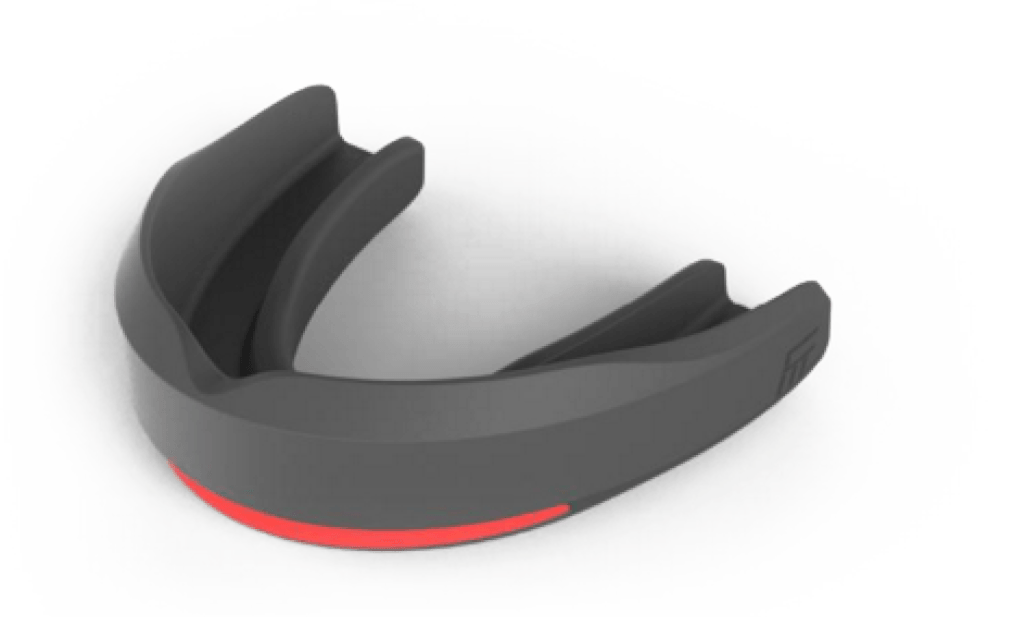
In fact, before long it might not even take a special helmet to easily detect potential concussions. Smithsonian reports on FITGuard, a mouth guard co-created by two Arizona State grads–one a veteran of the rugby team.

Like InSite, FITGuard uses sensors to measure hits to the head and can transfer data to a nearby computer. If FITGuard sees any signs of danger, though, it simply lights up the player’s mouth using LEDs. FITGuard is scheduled for release in early 2016.

Image courtesy of fitguard.me

These tools aren’t without their caveats. A recent Stanford study, for example, found that some currently existing concussion-measuring devices (particularly helmets) can significantly mismeasure the actual force of impact.

Nevertheless, with room for improvement and no end to the concussion crisis in sight, technology like this can still have great potential to help protect our next generation of football players.

(Featured Image via Dartmouth)


Heart Rate Sensor Assists U.S. Women’s National Team

The United States women’s national team won their third World Cup title this summer in Canada. That same Women’s World Cup, along with this summer’s Under 20 World Cup in New Zealand, marked the first time FIFA allowed players to wear tracking devices during game action. The success of the devices during these events led FIFA to greenlight the use of wearables in future competitions, subject to the approval of individual leagues.

Part of the team’s success was the players’ dedication to the training plans developed by strength and fitness coach Dawn Scott.

“I think it’s a testament to the players that they trusted us and stuck to the program, and did what they needed to even when they had their commitments with their [club] teams,” Scott said in a previous interview.

An earlier Wired article discussed the USWNT’s relationship with Polar Global devices. When reached for comment, Polar Global’s Josh Simonsen confirmed that the players were wearing the H7 heart rate monitor on the pitch, and using M400 GPS watches in training sessions. Simonsen, the company’s national training resource specialist for the U.S., said the Finnish company had worked with Scott and the USWNT since 2010.

“What that gave Dawn was the ability to track speed, distance, and activity of the athlete while they’re away,” Simonsen said. “And they were able to send it her in a much easier environment than the previous models.”

The H7, the heart rate monitor worn during the games, consists of a strap worn across the chest and a small transmitter a few inches wide. The strap contains an electrode that collects the ECG signal from the athlete; after some basic processing, the transmitter then sends out a Bluetooth signal. The system reports heart rate on a per-second basis, using only basic peak-to-peak measurements, which are less susceptible to the kind of movement artifacts you would expect with an athlete wearing the device during competitions.

Polar’s top-of-the-line system, the Team Pro, also includes a GPS and IMU sensor. Switching to Bluetooth Smart also allows the transmitters to communicate directly with a tablet. But Simonsen said the USWNT was still using the older Team2 solution this summer.

“They didn’t want to transition prior to the World Cup,” he said.

The company has a long history with heart rate sensors, having built the first monitor for an athlete in 1977. But it was not until the early 2000s that Polar began developing systems for whole teams, rather than for individuals.

“Essentially the coach would log into the software and each player would have their own page, but they really weren’t able to compare the team as a whole,” Simonsen said. “We couldn’t look at the big picture.”

This functionality would not become available until Polar’s Team2 system was introduced in 2009. Unlike their previous offerings, Team2 allowed coaches to collect and analyze data in much less time. The addition of Bluetooth transmitters also allowed coaches to monitor their players in real time.

“[Team2] was like a 50 percent cut in time that it took to do everything,” Simonsen said. “Everything was exponentially faster.”

The Team2 system is currently used by “about 450 teams” in the U.S., and Simonsen said new coaches are typically surprised by the feedback provided by the data.

“A lot of the time they’re just blown away at how long things were or how hard things truly are,” he said. “Or that their easy day really wasn’t that easy, or that their hard day was a lot harder than they really thought it was.”

Simonsen argues that this experience in the field is what separates Polar Global from the plethora of other companies offering heart rate monitors.

“We created heart rate,” Simonsen said. “And with us using HR from the beginning, accuracy is always our number one thing.”


The Technology Behind the U.S. Women’s National Team’s World Cup Victory

The United States women’s national team went into the 2015 FIFA Women’s World Cup with a chip on their shoulder, trying to avenge a heartbreaking finals loss in 2011. But eagle-eyed viewers might have also noticed the chips the women wore under their shirts as well, as Will Carroll pointed out on Twitter.

The objects were Polar Global’s H7 heart rate sensors as suggested by this Wired article and confirmed by Polar Global. The USWNT is also listed as a client of Catapult, an Australian-based company that combines GPS and inertial measurement units (IMU) into a single sensor.

Strength and fitness coach Dawn Scott confirmed that her team uses heart rate sensors and GPS systems to monitor player performance. However, because the team does not have a formal relationship with either company, she could not discuss the specific devices she uses in detail. Nevertheless, she was still happy to answer general questions about how she and the rest of the American coaching staff used the devices.

The GPS system and heart rate monitor produce a wide range of metrics. Head coach Jill Ellis and her staff were mostly interested in measures of intensity, rather than total distance covered. Scott specifically discussed the percentage of high-speed running (running faster than 11 mph) and distance covered during high-speed running.

“For me they’re the main factors that then show how much a player’s involved in the high-intensity activities,” Scott said. “[That means] overlapping for your midfield player, making high-intensity runs into the box. For defenders, [it means] having to recover.”

But not every position calls for such high-intensity bursts. For those players, the coaching staff relies on meterage — a player’s average speed in meters per minute.

“So say a Lauren Holiday, who isn’t necessarily doing a lot of sprints when she’s in a holding midfield position, but she’s one of the ones who does the highest meterage, so for her, that is more of a marker of her work rate,” Scott said. “In one of the games where she was pushed into the attacking midfield role, she suddenly had a lot of max sprints.”

The games presented an additional set of challenges. Although this tournament marked the first time FIFA allowed players to wear monitoring devices on the pitch, FIFA retained the regulations prohibiting the use of technology on the sidelines. This prevented the coaching staff from using these systems to guide their in-game decision making.

“I don’t always see the purpose of real time [monitoring],” Scott said. “Sometimes in training we’ll take out the real time system, but for me that’s only if we want to get a certain physical output from a fitness point of view.”

Making matters more difficult, several of the stadiums in this summer’s World Cup were domed (like Montreal’s Olympic Stadium) or had large roofs overhanging the field (like Vancouver’s BC Place). This meant the team’s GPS-based systems were much less accurate during games.

“The interpretation of that data is crucial, especially when you’re giving that back to players and the coaches who are interested in that feedback,” Scott said.

Scott doesn’t rely on a single number to judge player performance, instead adjusting her expectations and the numbers she looks at based on the game plan for that particular match.

“It’s knowing your team, your opposition, it’s knowing your own players, and what their physical capabilities are as well,” Scott said. “Carli Lloyd’s numbers were very different in the first three games from the final three games when her role was very different.”

But unlike a coach for a club team, who can monitor their players’ workouts year round, Scott had the added challenge of making things as simple as possible for her players after their training session ended. That meant shelving the more complicated GPS monitors and giving each player a wrist-worn heart rate sensor to wear during training. To their credit, though, the players diligently stuck to the team’s training plan — and just as diligently sent the data back to Scott.

“The players were very good at giving us updates in terms of their heart rate loads,” Scott said. “And they also logged into an online training diary or physical monitoring system, where every single day they would log in, answer five questions about how they feel physically, and so I can then log in and see where a player’s physical state is.”

Scott traveled across the country, working with coaches for every National Women’s Soccer League (NWSL) team to come up with a plan that kept the national squad healthy without hindering their club’s chances of winning. Scott was quick to praise her NWSL counterparts for their cooperation.

“The clubs were given guidelines in terms of when we want to train, when we want the players to have a day off, and also ideally how long the training session should be with the player,” Scott said “And to be fair to the clubs, in that crucial period in the leadup to the World Cup, they stuck to the programs we sent.”

Off the field, Scott is working towards a doctorate from the University of Western Sydney. Unsurprisingly, Scott’s research focuses on the physical demands and training loads of elite female athletes, with a focus on soccer players. Scott’s research relies on the hundreds of hours of game data she has collected from USWNT athletes since 2012.

“The main focus is going to be to develop a training model, so looking at what are the physical demands of women’s football,” Scott said. “And then with that, we look at what is the training intervention is to prepare the players physically for those demands,” Scott said.

But not all Scott’s methods are quite so high-tech. During March’s Algarve Cup in Portugal, players complained about stiff necks and poor sleep. So before this summer’s Women’s World Cup, each player was given an allowance to buy their own pillow to take on the road with them. The result, Scott said, the team was better rest and improved performance.

“When I first suggested it, people looked at me like I’d gone mad,” Scott said. “But the players appreciated it, because it just meant something they had at every single hotel.”

(Header image via GoToVan)

Blast Motion Sensor Augments Metrics with Adaptive Video

The first thing to keep in mind about Blast Motion’s sensor is that it’s not just designed for baseball. Yes, like the Diamond Kinetics SwingTracker, you can attach the sensor to the end of a bat to track swing speed and direction. And like the Zepp sensor, the Blast sensor can also be used to track a golf swing. But Blast’s approach revolved around designing a high-quality, general purpose sensor, and then building specific applications for baseball, basketball, golf, action sports, and athletic performance around it.

“We didn’t approach this as trying to design a swing sensor or a specific sport product,” senior director of marketing Donovan Prostrollo said. “What we designed it to do was to be a natural motion capture product, and then we applied that to different sports, so it doesn’t pigeonhole our product.”

At the heart of the Blast sensor are inertial measurement units (IMUs), the combination of accelerometers, gyroscopes, and magnetometers that have become ubiquitous in devices like smartphones and tablets. But Blast has made two improvements to make the device more accurate. First, Blast Motion uses multiple IMU chips (although they wouldn’t disclose how many) to capture a wider range of movements. Second, the Blast sensor was also designed to use what founder Mike Bentley referred to as “tactical-grade” technology, a combination of more precise sensors, more processing power, and on-the-fly calibration that improves the device’s accuracy and consistency from one movement to the next.

But despite the intense technological focus, both Bentley and Prostrollo stressed the importance of keeping their outputs simple for the end user.

“You’ll find other solutions out there really overwhelm users with numbers, which is both good and bad, because if users don’t know which number to focus on, you’re not really helping them, you’re actually potentially making it worse,” Prostrollo said.

“At the end of the day, [the athletes] would love the technology to just completely disappear,” Bentley added. “And that’s one of the goals of Blast is how do we make the device disappear.”

When compared to other bat sensor apps, Blast lacks the three-dimensional rendering of the swing. Instead, the Blast app revolves around video, typically captured by setting the device on a tripod and automatically clipped so that only the events of interest are included. Prostrollo argued that the focus on video gave Blast an edge in capturing the entire movement, not just key metrics.

“We decided from the beginning to capture video and do it natively as part of the app so it’s really integrated into our DNA,” Prostrollo said. “And the cool thing about that is when you pair video and you compare the level of consistency out of our product it really does an amazing job.”

And Blast recently announced an adaptive slow-motion feature that adjusts the playback speed around the event.

“Basically, we know exactly when the impact occurred, when the swing started, and when the swing ended, and based on that we can speed up and slow down the video,” Prostrollo said. “We can also take the metrics and overlay them on top to get this dynamic fill, so it’s not just a metric in isolation.”

Blast verified the accuracy of its metrics using motion capture systems. As an example, Prostrollo said the system was within 1 mph of the motion capture system “85 percent of the time” and Bentley claimed that the Blast system “outperforms our optical system when you talk about rotational velocity” as verified by higher-end devices more commonly used to test aeronautical and military-grade IMUs.

Bentley and Prostrollo stressed not only the device’s accuracy but also the device’s consistency, so that identical swings or jumps would produce identical sensor readings. They attributed this consistency to improvements in their manufacturing process, and claimed it made a big difference to the professional athletes they collaborated with.

“The challenge is pro athletes absolutely can recognize that day one, the amateur athletes won’t necessarily realize that a product’s not as accurate as they want until it’s too late: they’ve purchased it, they’ve gone out, they’ve tried it, and they wonder why their swing speed varies by 6 mph when it’s all the same,” Prostrollo said.

Despite being a relatively new company, the founders of Blast Motion have been in the inertial sensor business for a quarter of a century. Before entering the sports world, their focus included military and medical products.

“This is not the first sensor we’ve ever manufactured,” Bentley said. “When we originally designed the sensors, it wasn’t for a single application. We wanted to be able to use the sensor and cross-pollinate across all applications.”

As Blast Motion began adapting its offerings for new markets, it worked with coaches, professionals, and other subject matter experts to design useful applications. But Bentley said there was a lot of overlap between the biomechanical elements underlying the different sports. Even more surprising, he said, was the overlap between social circles across different sports.

“What’s pretty unique about when you do get into the inertial world of working with different professional teams, how many baseball players work with professional golfers, and how many golfers play with hockey players,” Bentley said. “So the world is pretty small, and when you get a pretty exciting product, the word travels pretty fast in those worlds.”

The company currently works with a number of action sports ambassadors including Mike “Hucker” Clark and Greg Lutzka, as well as some NBA and MLB players they declined to name, citing confidentiality. And Blast Motion is working closely with bat manufacturer Easton as it gears up to release the Easton Power Sensor this summer. Little information is currently available about the project, but judging from the screenshots in the iTunes App Store, the interface at least will be very similar to Blast’s Baseball Replay app.

Looking to the future, Prostrollo said the biggest change would be not on the technological side but rather on the adoption side, as wearable sensors like Blast become more and more ubiquitous among both amateurs and pros.

“We’re at the point now where the average consumer has access to this technology, it’s no longer the pro athlete,” Prostrollo said. “What you’re going to see is a whole new generation of athletes leveraging the data and the technology, having a history to go back on, and really be able to do something very meaningful and different with that.”


Wilson, SportIQ Team Up to Produce “Pro-Quality” Smart Basketball

Look close at Wilson’s Wx “connected basketball,” and it’s hard to tell what’s so different about it until you spot the Bluetooth logo by the inflation valve.

“That is not something we usually deal with,” Wilson’s Vice President of Innovation Bob Thurman chuckled.

The ball was presented, along with an accompanying mobile app, at last month’s Sloan Sports Analytics Conference in Boston. Wilson developed the basketball in partnership with SportIQ, a Finnish company whose player tracking solution combines wearable sensors with synchronized video to help coaches analyze their teams’ performance.

When asked, SportIQ CEO Harri Hohteri (pictured above) was reluctant to talk about the “secret sauce” behind his company’s basketball. But he was quick to differentiate it from other smart sensor basketballs like 94Fifty’s.

“[The 94Fifty ball] was designed around shooting mechanics as a training tool,” Hohteri said. “But the first thing for us is the consumer side of things. We wanted to develop a professional-quality basketball.”

Hohteri, who played four professional seasons in Finland’s Korisliiga, insisted the feel of the basketball was of the utmost importance to players. “I can’t tell the difference between this and a game ball,” he said.

The quality of the basketball is further underscored by SportIQ’s partnership with the Korisliiga. For the third straight season, Finnish players are wearing the company’s sensors (and using its basketball) in league games. The data is used to automatically tag events in a synchronized video that Hohteri says coaches are using to track the efficiency of their offensive sets. And because it relies on sensors, the system doesn’t need the extensive camera setup used by STATS’ SportVU tracking system.

“It’s about doing things more efficiently,” Hohteri said. “That’s the whole idea. We can do the whole thing in real time with less manpower than teams are using now.”

But for those of us who aren’t running a professional basketball league, Wilson’s connected basketball is launching this year. The demo at the conference included a smartphone app (projected onto a television) that showed players their accuracy from various distances on the floor. A machine learning algorithm in the app detects makes and misses without the need for an additional sensor attached to the net, unique among smart basketball systems. Each distance stripe was color-coded, according to the percentage of shots made from anywhere in that arc.

SportIQ’s partnership with Wilson started in August 2012, when SportIQ first began its relationship with Finnish basketball. Because Wilson is the official basketball of the league, Hohteri approached Wilson’s innovations department about developing a smart basketball.

“At the same time, our business director was asking us for a way to measure makes and misses in the driveway to keep kids in the game,” Thurman said. “So we agreed that we would help engage them on tracking the basketball, and they would help us with this make/miss aspect.”

Thurman hopes the partnership between their companies will combine SportIQ’s intelligence with Wilson’s broad user base to “gamify” practice and inspire the next generation of basketball players.

“We want to activate 12-15 year old kids, to get them off the video games, and get them back in the park, to be more active,” Thurman said.


Sony Looking to Prove Durability with Tough Mudder Partnership

Various devices boast about toughness, water resistance and qualities of similar ilk. As Amazon’s most recent Fire commercial demonstrates, a device’s overall ability to work under circumstances — extreme and every day — remain important bullet points. Sony is willing to put its money where its mouth is, as they partnered up with the Tough Mudder (TM) organization to record and track various events this year. The devices being used will be Sony’s Xperia Z3, Z3 tablet compact and Smartwatch 3.

From the Samsung S4 and S4 Active in 2013 and their S5 last year to the Kyocera Brigadier and HTC Desire Eye, water resistance in mobile devices is nothing new. HTC offers Uh-Oh Protection, where events such as cracked screens and water damage are covered up to one year after purchase. Similarly there is no shortage of water and sweat resistant smartwatches or fitness trackers, though again, few have been put through the paces of an event like the Tough Mudder. In addition to various participants utilizing the Sony gear, a sponsored team will also be running the course while being subject to all manners of dirt, water, dust and any combination of the three.

According to the Tough Mudder website, 1.3 million people have participated in various events over the years and each race averages between 10 and 15 thousand people. The advertising reach for Sony shouldn’t be understated, but that is presuming their devices work as advertised. Sony claims each of the three are IP 68 certified, meaning they can submerged in nearly five feet of fresh — not salt — water for up to 30 minutes without any negative effects. With multiple TM events involving water, such as the Mud Mile and the Underwater Tunnels, Sony is betting that this publicity and their sponsorship paint the company in good light. Samsung faced public backlash when it was discovered in 2013 that the S4 and S4 Active did not have moisture damage covered in the one-year limited warranty despite being so famously advertised by having a camera mode specifically for taking pictures underwater. The next Tough Mudder event is scheduled for this coming weekend in Los Angeles with five more races throughout the year. It’s only a matter of time before Sony’s products get put through the wringer, just like the people who run in the events.

(Header image via Facebook)