Archive for wearable

Heart Rate Sensor Assists U.S. Women’s National Team

The United States women’s national team won their third World Cup title this summer in Canada. That same Women’s World Cup, along with this summer’s Under 20 World Cup in New Zealand, marked the first time FIFA allowed players to wear tracking devices during game action. The success of the devices during these events led FIFA to greenlight the use of wearables in future competitions, subject to the approval of individual leagues.

Part of the team’s success was the players’ dedication to the training plans developed by strength and fitness coach Dawn Scott.

“I think it’s a testament to the players that they trusted us and stuck to the program, and did what they needed to even when they had their commitments with their [club] teams,” Scott said in a previous interview.

An earlier Wired article discussed the USWNT’s relationship with Polar Global devices. When reached for comment, Polar Global’s Josh Simonsen confirmed that the players were wearing the H7 heart rate monitor on the pitch, and using M400 GPS watches in training sessions. Simonsen, the company’s national training resource specialist for the U.S., said the Finnish company had worked with Scott and the USWNT since 2010.

“What that gave Dawn was the ability to track speed, distance, and activity of the athlete while they’re away,” Simonsen said. “And they were able to send it her in a much easier environment than the previous models.”

The H7, the heart rate monitor worn during the games, consists of a strap worn across the chest and a small transmitter a few inches wide. The strap contains an electrode that collects the ECG signal from the athlete; after some basic processing, the transmitter then sends out a Bluetooth signal. The system reports heart rate on a per-second basis, using only basic peak-to-peak measurements, which are less susceptible to the kind of movement artifacts you would expect with an athlete wearing the device during competitions.

Polar’s top-of-the-line system, the Team Pro, also includes a GPS and IMU sensor. Switching to Bluetooth Smart also allows the transmitters to communicate directly with a tablet. But Simonsen said the USWNT was still using the older Team2 solution this summer.

“They didn’t want to transition prior to the World Cup,” he said.

The company has a long history with heart rate sensors, having built the first monitor for an athlete in 1977. But it was not until the early 2000s that Polar began developing systems for whole teams, rather than for individuals.

“Essentially the coach would log into the software and each player would have their own page, but they really weren’t able to compare the team as a whole,” Simonsen said. “We couldn’t look at the big picture.”

This functionality would not become available until Polar’s Team2 system was introduced in 2009. Unlike their previous offerings, Team2 allowed coaches to collect and analyze data in much less time. The addition of Bluetooth transmitters also allowed coaches to monitor their players in real time.

“[Team2] was like a 50 percent cut in time that it took to do everything,” Simonsen said. “Everything was exponentially faster.”

The Team2 system is currently used by “about 450 teams” in the U.S., and Simonsen said new coaches are typically surprised by the feedback provided by the data.

“A lot of the time they’re just blown away at how long things were or how hard things truly are,” he said. “Or that their easy day really wasn’t that easy, or that their hard day was a lot harder than they really thought it was.”

Simonsen argues that this experience in the field is what separates Polar Global from the plethora of other companies offering heart rate monitors.

“We created heart rate,” Simonsen said. “And with us using HR from the beginning, accuracy is always our number one thing.”

Review: Motus Global’s mThrow

When Motus Global’s sleeve was announced last spring, it was supposed to save baseball, stemming the flood of Tommy John surgeries plaguing the majors. Now, the device that teams have been using to study their pitchers’ mechanics since last fall is available to the public. The mThrow has been on sale through the Motus website since March, and began shipping in early May. Eager to see what the device had to offer, I plunked down the $150 (plus $20 for an additional compression sleeve) and waited anxiously.

The box that the mThrow comes in is taken up mostly by the compression sleeve. The actual IMU — the sensor that actually tracks the arm’s motion — is a tiny blue thing, about the size and shape of a circus peanut*. The IMU charges by induction, so all the user has to do is plug in the charging station, place the sensor on top of the station, and wait about an hour.

* – But slightly better-tasting.

Pairing the sensor is simple, too, taking just a few taps of the smartphone app. The hardest part of setting the thing up is probably wedging the sensor into its little pocket in the compression sleeve, and then pulling the sleeve on so that the sensor rests over the infamous ulnar collateral ligament. In fact, the design might be overly simplified. In an effort to make the sensor more water-resistant, there are no lights on the sensor to tell the user of the charge level. The only way to check is to pair the sensor with the smartphone app; if the app doesn’t recognize the sensor, it probably needs to be re-charged.

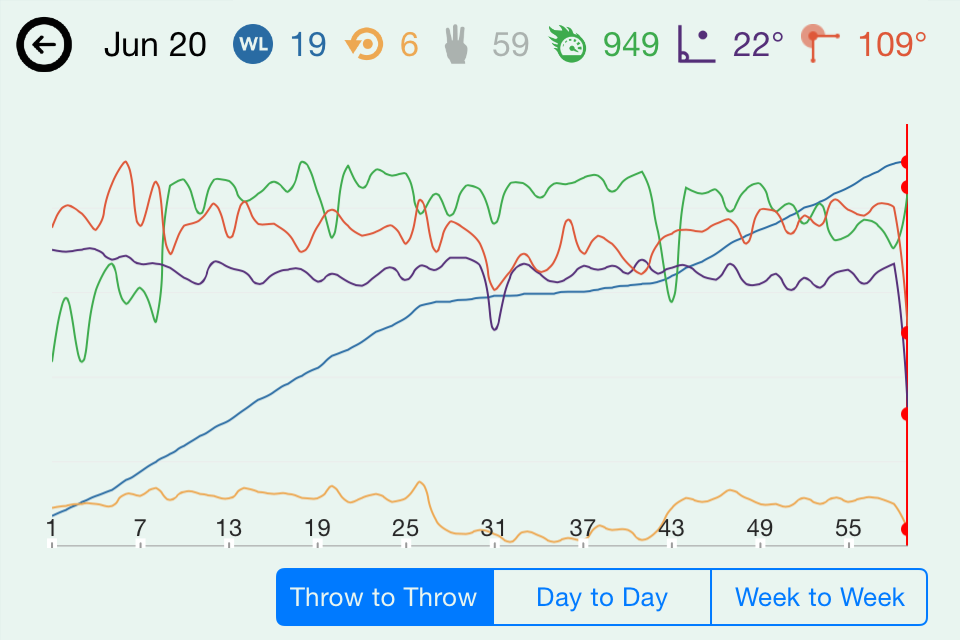
The app is currently available only for the iPhone; an updated version was approved this week. The software now computes five metrics from the sensor data: pitch count; maximum arm speed, a rotational velocity measured in revolutions per minute; arm slot at release; maximum shoulder rotation relative to initial position; and, of course, torque on the UCL. These are then combined into three headline numbers: performance, a measure of mechanical consistency; workload, currently an additive function of elbow torque; and a “throw meter,” an energy bar that drains from blue to orange as the workload increases and consistency decreases.

I ran some preliminary testing of the mThrow, connecting it to an iPhone 4S and throwing 17 fastballs, 17 changeups, and 17 curveballs to the best of my extremely limited ability; all but six throws were recorded. Even if there’s no difference between their speeds and movement, you can still see a difference between my initial warmup tosses (the first dozen, with much lower arm speeds), fastballs (about 13-25), curveballs (26-43, with much lower torque values), and changeups (44 onward, with decreased arm speeds).

image2
This simple relationship was confirmed with a second test using a HitTrax system, which can track speed and late break of pitches as they cross the plate. My subject was a 45-year-old with some collegiate pitching experience who threw ten fastballs and ten curveballs. By comparing the HitTrax velocity report (right) to the mThrow statistics (left), we can see the correlation between the decrease in arm speed and the decrease in velocity as the subject switched from fastball to curves.

donfrancesco
Lastly, I brought the sleeve to a local high school (Blackstone Valley Tech, Upton, MA) to get some insights from active players. Assistant coach John Burke, pitcher Nick Laren, shortstop Joe Corsi, and catcher Jack Lynch took turns throwing an assortment of pitches from a number of release points, seeing how their throwing motions stacked up. The session supported some beliefs — for instance, that the quick motion Lynch uses to throw out would-be base stealers puts more torque on the elbow than a standard pitching delivery. But others were surprisingly contradicted: despite everyone’s belief that sidearm throws put less stress on the elbow than an over-the-top delivery, the app didn’t seem to report a relationship between arm slot and torque.

Chief technology officer Ben Hansen says the mThrow is still in its infancy, and says that the device’s official consumer launch is not scheduled until later this summer. The app currently relies on data compiled from Motus Global’s work with MLB prospects at last fall’s instructional league to generate its workload number, but Hansen and his team are working to produce more meaningful metrics from a more complete data set.

“We’re just capturing as much data as we can to see what’s normal,” Hansen said. “We also have controlled studies going on at every level. We have [NCAA] D1, D3, high school, and Little League players wearing it religiously.”

At this early stage, the app seems to be designed more for Motus’s professional clients than for public users. Maybe the best example of this is the tagging feature, which allows users to tag individual throws as belonging to bullpen sessions, long toss, or game action, and to further break throws down by pitch type. But at the moment, the tags are unavailable to the user after selection, getting passed on to Motus Global with the sensor data but not visible on any of the trend screens. Hansen confirmed that the tags were being used in the company’s research for their MLB clients, however.

“Every week we send reports broken down by tags where we compared each pitcher to the league averages for that pitch type,” Hansen said. “The teams love using the tags and breaking things down into the different pitch types.”

It’s a tantalizing view of an exciting feature that could still be a couple years away. And it’s not just super dorks like me who would find those analytics useful. The key to a good changeup is matching the same arm speed used to throw a fastball, so it’s easy to see coaches like Burke using the arm speed metric to give feedback to young pitchers just learning to throw the pitch. But without any way to divide pitches into different categories, this sort of feedback isn’t possible yet.

“We are looking into a web portal to give users more in-depth analytics,” Hansen said. “But right now we’re focused on getting the analytics right before we move on to other platforms.”

It’s probably still too early to judge the mThrow fairly, and I’m almost definitely not the right person to do it (sabermetrically-inclined tech geeks who can’t pitch are not Motus’s target market). And it’s true that more research could produce findings that actually help young pitchers stay on the field and off the operating table. But as currently constructed, the mThrow raises more questions than it answers, and left me wanting more. Like a top pitching prospect, the technology needs some time to mature before it can make a meaningful contribution.


Hydration Sensor Could Address Wrestlers’ Needs

I can still hear my high school wrestling coach talking to us about the dangers of “cutting weight.” That is to say, dropping large amounts of water weight in a short amount of time in order to make weight and be eligible to wrestle at a particular weight class. Sheer weight used to be the determining factor in how much water one has shed, but no longer. From a study conducted by University of Strathclyde a new wearable device could be able to provide real-time feedback on fluid loss and hydration levels to a computer or smartphone.

Similar to boxing, wrestling is divided up into various weight classes in the name of fairness. Of course, the weight can be very misleading as in just a few hours of intense workouts one can drop multiple pounds of water, allowing athletes to make weight, then rehydrate and technically be above the allowed weight class. Cutting weight is an old story, one that has been around for years despite numerous deaths in the high school and collegiate ranks. The NCAA enacted rules, specifically banning the use of saunas, rubber suits, and pills, but without a way to measure just how dehydrated an athlete is, it’s a fuzzy line between working up a significant sweat and being in real danger.

Dr. Stephen Milne of Strathclyde’s Department of Biomedical Engineering said of the new device:

On an individual level this would allow people to rehydrate during and after exercise. When it comes to team sports, fitness coaches would be able to monitor the data during matches and ensure athletes get what they need to maintain their performance. The sensor is small and wearing it on the skin does not cause any discomfort. During exercise the user would barely be aware of it, allowing them to focus on the activity without distraction.

Given the uniqueness of each person, the need for a personalized game plan for each individual’s workout plan and thus hydration plan is varied. The sensor itself has been designed in part by Professor Patricia Connolly of the Medical Diagnostics Research Group at the university who credited Dr. Milne, saying

Stephen has been able to take our work in medical sensors and transdermal sensing from the healthcare applications into the field of sport.

As someone who managed to stay at the 103 pound weight class all four years of high school, cutting weight was something I was all too familiar with. There were no doubt times I was dehydrated, but our coaches and managers were keen to notice fatigue and sloppiness in me, and would scale back workouts if need be. I would run laps in the pool room where the sweat would just pour out of me, but I never felt in any danger. If I did, I have no doubts the workout would have ceased as I was fortunate enough to have an excellent coaching staff. With this new sensor, the guesswork and “gut-feeling” of coaches is removed. While the context is focused on weight-class athletics, no doubt distance runners, weight trainers and athletes of any caliber should take careful note of their fluid levels. With issues of dehydration to hydrating at the wrong times or even over-hydrating abound, the sports world has been waiting for a wearable device like this for too long.

(Header image courtesy of and features the very dorky author)

Lumoid Lets You Test Drive Wearables

Even before covering CES, it was clear that we as a technology-obsessed culture was headed towards a wearable boon. Between proprietary and universal smartwatches to fitness bands and sleep trackers, the new field of connected devices is a field primed for growth. Like any product, these beginning stages offer a wide variety of options without any clear winner sitting above the competition. Before unloading hundreds of dollars on a piece of technology, why not try it out first? At Lumoid, trying before buying is their sole function.

Though Lumoid has offered photography and video trials before, they have recently expanded their scope to include wearables of all kinds. The company will allow you to try any five connected devices for a week. If you happen to find the perfect wearable you’re able to purchase it at retail price, or failing that, it is just $20 to send all five back. The return label is included with the devices and the $20 is automatically taken off of your credit card upon shipping the unwanted wearables back. Sporting choices such as Samsung’s Gear Fit, the Pebble smartwatch and the Fitbit Charge as well as many others for a total of 36 different options, Lumoid is hitting the ground running with this ambitious product trial.

A recent study conducted by Global Web Index from Q3 2014 showed that while 80% of the 170,000 adults use a smartphone, only a combined 16% utilize some sort of smartwatch (9%) or wristband (7%).

lumoid

If market saturation is the issue — and that is a worthy argument despite the still new wearable field — then perhaps Lumoid will allow users to shed some light on the different products through the week long trials.


CES: GameTraka First Look


The term “knowledge is power” is as important in today’s world of sports as it was when first written down in the Leviathan. Tracking devices are already widely used by professional teams, however never before has a GPS device been open to the public like GameTraka. With the new GameTraka GPS device and accompanying software, any person can arm themselves with a wide assortment of useful on-field analytics. The Australian-made device measures the basics such as distance ran and top speed, as well as giving an intensity rating and acceleration.

The device itself is very small, about the size of a box of matches and measures your position five times per second.

P1076768

Specifically, the dimensions of the GPS unit is 62mm x 38mm x 8mm and comes in at 22 grams. Given the nature of many sports, collisions are inevitable and rather than have wear a device on the hip or wrist, GameTraka is held in place by a lightweight vest with the sensor placed in the back. The vest easily fits under any jersey or uniform and is specifically designed to fit the unit safely and comfortably.

P1076770

The company’s mantra is “wearable, shareable and comparable” and as great as the vest and sensor system is, where GameTraka truly shines is the sharing and comparing department. After the game, the sensor sends the data to the software side of things for the full breakdown. Connecting via Bluetooth to an iOS device or computer, the GameTraka software is where the leg work is done. The previously mentioned intensity rating is an estimation of how hard the wearer worked. For example, on a soccer field, a striker may have ran only two-thirds the distance of a midfielder, but at a higher intensity.

By comparing players to each other as well as well from one game to the next, a coach can clearly see who is running the farthest, the fastest and the hardest. From a training perspective, the system removes any subjectivity and guesswork by allowing coaches to see just how well a player is progressing if coming back from an injury. Individual players can compare data by chronological order and take note of any trends that may present themselves.

The price of knowledge from the GameTraka is $299.99 per unit, though according to the official site there are group discounts available. From a basketball coach seeing who truly hustles on defense to a soccer manager attempting to find the fastest in-game striker or winger to a rec league player who just wants to quantify as much about themselves as possible, GameTraka is the ideal unit for gathering on-field information.


Zebra Technologies Partners with NFL to Track Player Movements

Football coaches at every level have long relied on game film to judge their teams’ performance. But this year, NFL teams have partnered with Zebra Technologies to more accurately track their players’ position and speed on the field.

The real-time location solution (RLTS) used by the NFL relies on radio frequency identification (RFID) tags worn by the players in their shoulder pads. Each RFID tag broadcasts its location 25 times per second to the approximately 20 receivers located around the stadium. From this single sensor, the MotionWorks server can determine a player’s location on the field and speed. By adding a second sensor, Zebra can also track a player’s direction and orientation. The sensors, placed on the player’s shoulder pads, are less than an inch in diameter, and include a battery designed to last an entire season. This improves the usability and scalability of the solution, since teams won’t need to spend time and energy removing, charging, and reinstalling the sensors.

The result is a system that can track all 22 players on a field with an accuracy of a few inches, according to Zebra’s data sheet. According to general manager for sports applications Eric Petrosinelli, this gives Zebra’s solution a clear advantage over other solutions based on technology like global positioning systems (GPS).

“Other solutions aren’t providing anywhere near the accuracy or operational simplicity of our solution,” Petrosinelli said. “They don’t really have scalable solutions.”

The NFL would seem to agree: Zebra won what Petrosinelli called a “bake-off” in 2013 among a number of vendors selling competing systems. Their reward was a multi-year contract with the NFL. As training camp was getting underway, the NFL announced that Zebra receivers would be placed in 17 NFL stadiums (specifically, Atlanta, Baltimore, Carolina, Chicago, Cincinnati, Denver, Detroit, Green Bay, Houston, Jacksonville, Miami, New England, New Orleans, Oakland, San Francisco, St. Louis and Washington) and added RFID tags to every player’s pads. Receivers will be installed in the remaining stadiums, as well as “one-off” stadiums like London’s Wembley Stadium and Pro Bowl site Aloha Stadium, during the offseason.

The data generated by the system is currently controlled by the league to prevent the handful of teams with the solution in place from gaining an unfair advantage from the data. A few teams — the 49ers, Lions, and Saints — will also have Zebra solutions installed at their practice facilities. But for now, teams and fans will have to be content with the samples like these that have been shown in the Thursday night games.

Although the MotionWorks solution may be new to the sports world, Zebra has developed and used similar RFID-based solutions for years in the manufacturing industry. But Petrosinelli said the technology adapted surprisingly well to the new application.

“One thing we’ve been pleasantly surprised by is the operational ease in deploying and operating the solution,” Petrosinelli said.

Zebra’s future plans include expanding vertically to other levels of football, as well as horizontally to other sports. Petrosinelli said his company was in talks with a number of organizations (though he couldn’t give their names) to apply Zebra’s technology to their fields.

“We’ve spoken to people both domestically and globally,” he said. “When you win a contract like [the NFL’s], a lot of people take notice of that.”

And while Petrosinelli said Zebra was considering partnering with other companies to incorporate data from sensors like accelerometers or heart rate monitors, the company currently has no plans to design such sensors internally.

“We’re not a consumer wearables company,” Petrosinelli said. “The way our system is designed, we could be a transporter of that information, but we’re not going to be in that business.”


The Future of Wearables, According to PwC

The professional services network PricewaterhouseCoopers, or more commonly known as PwC, recently had a webcast on the future of wearable technology and its market. All PwC CISs are free to register for and view, with the only requirement being a valid email address. They offer a wide range of webcasts and data ranging from automotive news to technology to health services.

Things kicked off with data from a 1,000-person poll showing 314 of them owned something defined as wearable tech. Thus the question of “what is considered wearable tech” is presented and answered. Ranging from literally the head to the feet, devices from headphones that monitor heart and steps (such as Dash Headphones, warning: auto-playing ad) to chips inserted and paired with shoes, plus smart clothing, wrist bands, watches and of course smart glasses were all considered wearable technology.

pwc

With a clear market for the fitness minded person as well as the tech-savant people, the webcast cites an interested trend. Another study showed one in five (of voting age) Americans own some sort of wearable tech. That 20% ownership rate mirrors the same rate of people who owned a tablet in 2012. Now approaching 2015, American tablet ownership is up to 40% — even when considering the slow sales of tablets for some retailers and particularly Apple iPad sales dropping for the third straight quarter.

pwc1

The same study included a poll, with speculative questions, arguably the most interesting answers were 46% thought obesity rates would drop and 42% believe the average person’s athletic ability will improve dramatically. While there is no data yet back up these figures, it is easy to see why PwC expects the wearable market to double within two years in the same manner as tablets did. In 2013 two million wearable devices were sold in the United States. If estimates for the holiday season prove accurate, that number will jump to 19 million this year.

pwc3

This age group is of particular interest to wearable tech companies. Millennials are defined as ages 18-34 by PwC represent a massive market to cater to. A study by Barkley — who differed and defined a millennial as someone aged 19-37 — claimed the millennial generation are responsible for more than $200 billion in buying power annually. Entertainment is important to them and they are the cord cutting generation. If wearables can help bring them their sports, health information or productivity in a better and more streamlined fashion, then everyone wins.

For a concise breakdown of most of the covered topics, check out PwC’s video.

(Thanks to PwC.com for the screengrabs of slides and TecSplash for the header image.)

The Newest FitBit is a Logical Next Step

Engadget has uncovered an FCC filing outlining what appears to be the newest product from fitness-tracking company FitBit. FitBit offers devices that can go either on the wrist or clip onto a pocket or waistline, and the newest offering, called the Charge, stays within that mold. However, the Charge strays away slightly from the simplistic design and features offered in current FitBit products.

Current FitBit models only do a few basic things. They track your steps throughout the day as well as your dedicated exercise, and converts that info into an estimated calories burned metric. You can pair the device to a smartphone or computer to track your progress, and use FitBit’s app to even log meals to get a good sense of your calories in and calories out. The more adventurous/inquisitive user can even plug into FitBit’s API to log large sets of data for a more macro look at their fitness and activities. Some models also offer sleep tracking, which can also be logged to FitBit’s app.

FitBit’s only wrist-wearable option as of now is the Flex, which is really a small device hidden inside a silicon wristband. The only display is a set of five LEDs that let you know your daily progress compared to your step goals. It’s design is intentionally simplistic, as it’s meant to be worn and ignored throughout the day — to be unobtrusive. According to the US Patent Office filings, however, FitBit is adding some new features to the Charge to help bring it to the level of other wearables offered by other companies.

The Charge will come in two versions, one of which has a heart rate monitor. This data, which can be of interest to more serious exercisers, will most likely also be logged in within FitBit’s ecosystem. The Charge also dabbles in a bit of smartwatch technology, offering navigation information, music controls, and call notifications. These features come as a convenience for people on the streets, trails, or treadmills, as it allows them more interaction with their smartphone while it’s tucked away somewhere. Though the USPTO paperwork doesn’t mention it, photos of some Charge advertising by Twitter user @etownsendwx show a display on the device that could also be capable of displaying the time.

With smartwatches making a push into the mainstream, FitBit seems to be dipping their toes in the shallow end of that pool. By offering a product still focused exclusively on fitness tracking, but with a few smartwatch features thrown in for convenience, it’s clear they are not quite ready to rest on their laurels. For the runners and walkers out there looking for a high-quality performance tracker with just a few necessary bells and whistles thrown in, the Charge might be just what they seek.