Archive for Streaming

TechGraphs News Roundup: 11/20/2015

Greetings, fair readers. We’ve been taking a bit of a mini hiatus here at TechGraphs, but luckily, not a whole lot of news has broken in the world of sports tech. Oh, I mean besides that an entire billion dollar fantasy industry is in complete legal limbo, but, you know … other than that. Anyway, while we all cash out our DFS accounts, here are the stories we found interesting this week.

Let’s get straight to the point, and talk a little daily fantasy:

  • New York state’s attorney general has suspended daily fantasy operations while they investigate the game’s legality.
  • DraftKings and FanDuel are sued said attorney general.
  • That didn’t work, so FanDuel is suspending operations in NY for a while.
  • Oh, it’s also running a bit behind in paying back its players.
  • Meanwhile, Massachusetts has instituted some new regulations regarding DFS.
  • Because of all this, the TV networks might be in trouble as far as ad money goes.
    • DraftKings is trying to suspend its advertising on TV, for example.
  • If you want a British guy to explain everything to you, check here.

OK, now that we’ve sifted through that:

Good news! MLB and Fox have announced that they will offer in-market streaming! Bad news! It doesn’t work for Comcast customers, and only those who already pay to watch the games on TV will have access!

We talked about the controversy circling new styles of curling brooms (because we’re hip like that), and now it looks like the World Curling Federation (yes, that’s a real thing) has put a temporary ban on the brooms while it sorts all this stuff out.

The folks behind Bauer hockey products has unveiled a new collar that they think will help prevent athletes’ brains from bouncing around in their skulls — i.e. concussions.

With the help of Facebook’s 360-degree video technology, GoPro has released a new video to with a panoramic view of what it’s like to carve some waves (is that surfing lingo? I feel like that’s surfing lingo.)

The video game Fallout 4 was released to much fanfare. The game takes place in a post-apocalyptic Boston, so some enterprising fan decided to mod the game to allow the game’s character to look like Red Sox slugger David Ortiz (albeit a right-handed version). It was a fun/lighthearted thing, so naturally MLB got butt-hurt about it.

Speaking of sluggers, Jason Giambi took some time away from not sliding to partner up with a company that uses VR to help train hitters.

If you are a stadium/architecture nerd, Wired ran a couple of stories giving a look into the future of NFL venues.

That’s all for this week. Have a great weekend, and be excellent to each other.


TechGraphs’ Monthly Streaming Device List — October 2015

Much like Futurama’s Lrrr (ruler of the planet Omicron Persei 8) in the episode When Aliens Attack, many are getting upset at their current television situation. At this point it isn’t just the millennial crowd versus traditional TV package customers. Certain companies who have helped bring cord cutting to the forefront of people’s minds are now splintering.

Recently Amazon, creators of the Fire Stick and Fire TV, announced they will no longer sell Google’s Chromecast or Apple’s AppleTV. Via Bloomberg, Amazon has not offered new listings for said devices nor will the online retailer continue sales of the Google or Apple products after October 29th. As the linked article notes, it is curious to see Roku among other stream devices, unaffected by these events. Both Google and Apple still have various options for purchasing in stores or online, but seeing the the streaming options battle each other rather than the likes of Comcast, Charter and AT&T et al is disappointing.

For now, the table below is as up-to-date as possible, though again, any Amazon price listed for Chromecast or AppleTV is a deal with an October 29 expiration date. I’ve also separated the table to separate apps based on cost, determined by whether they are a monthly recurring cost, one-time payment, free, or needing a cable subscription.

Streaming Devices
Box/Dongle Opening Price Point Recuring Cost Apps Notable Free Apps One-time Cost Apps Cable TV Subscription Required
Amazon Fire Stick $39.00 HBO Now, Hulu, Netflix, SlingTV, GaiamTV Twitch.tv, YouTube MLBtv, NBA League Pass, Amazon Video WatchESPN, Fox Sports Go
Amazon Fire TV $99.00 HBO Now, Hulu, Netflix, SlingTV, GaiamTV Twitch.tv, YouTube MLBtv, NBA League Pass, Amazon Prime WatchESPN, Fox Sports Go
AppleTV (Revision A) $73.28* HBO Now, Hulu, Netflix, SlingTV, GaiamTV CBS Sports, 120 Sports, Twitch.tv, YouTube NFL Game Pass, MLBtv, NBA League Pass, NHL Gamecenter, MLS Live, Amazon Prime, Fox Soccer 2Go HBO Go, Watch ESPN, Fox Sports Go, USA Now
Google Chromecast $35.00 HBO Now, Hulu, Netflix, SlingTV, GaiamTV 120 Sports, Twitch.tv, YouTube NFL Game Pass, HBO Go, NBA League Pass, NHL Gamecenter, Fox Sports Go, Fox Soccer 2Go, MLS Live HBO Go, Watch ESPN, Fox Sports Go
Google Nexus Player $49.99 HBO Now, Hulu, Netflix, SlingTV, GaiamTV 120 Sports, Twitch.tv, YouTube NFL Game Pass, HBO Go, NBA League Pass, NHL Gamecenter, Fox Sports Go, Fox Soccer 2Go, MLS Live HBO Go, Watch ESPN, Fox Sports Go
Microsoft Xbox One $349.99 HBO Now, Hulu, Netflix, SlingTV, GaiamTV 120 Sports, Twitch.tv, YouTube MLBtv, NFL Game Pass, NBA League Pass, NHL Gamecenter, ESL, Major League Gaming HBO Go, Watch ESPN, Fox Sports Go
Nvidia Shield $199.99 HBO Now, Hulu, Netflix, SlingTV Twitch.tv, YouTube MLBtv Fox Sports Go, Watch ESPN
Roku Stick $46.99* NFL Now, HBO Now, Hulu, Netflix, SlingTV, UFC TV Twitch.tv, YouTube, Vevo, PBS NFL Game Pass, MLBtv, MLS Live, NBA Game Pass, NHL Gamecenter NBC Sports Live Extra, Watch ESPN
Roku 3 Player $97.95* NFL Now, HBO Now, Hulu, Netflix, SlingTV, UFC TV Twitch.tv, YouTube, Vevo, PBS NFL Game Pass, MLBtv, MLS Live, NBA Game Pass, NHL Gamecenter NBC Sports Live Extra, Watch ESPN
Slingbox M1 $129.99* N/A N/A N/A Steam any currently subscribed channel
Sony Playstation 4 $399.00* HBO Now, Hulu, Netflix, SlingTV, GaiamTV YouTube, PlayStation F.C. MLBtv, NBA League Pass, NFL Sunday Ticket, NHL Gamecenter, Amazon Video HBO Go

*Limited to Amazon Prime members


An Update on Drones in Sports

Drones racing each other at breakneck speeds through an abandoned industrial complex, controlled through VR goggles that broadcast a first-person view simultaneously to the operators and fans alike.

This may seem futuristic, but it was actually one of the most imminent ideas recently discussed in a special panel dedicated to “Drones In Sports”. At last week’s On Deck Sports and Technology Conference, three drone sport experts came together to talk about the potential–and the potential pitfalls–that drones may provide for the future of sports technology.

As one panelist put it, drones in sports are currently “kind of a Wild West opportunity”, and Matt Higgins, CEO of RSE Ventures and vice-chairman of the Miami Dolphins, kicked the panel off with the example of the Drone Racing League. Earlier this year, the DRL started informally as groups of hobbyists flying drones through parking garages and abandoned buildings, but plans are in the works to turn it into a full-fledged sport, pitting sponsored teams of self-taught drone specialists against ex-military UAV pilots.

The DRL held their first two test flights earlier this year in the New York metro area, and plans to release their first official video “in the next few weeks.” When Higgins (an investor in the DRL) was asked how to make this a spectator sport, though, he responded candidly, “I have no clue.” He expects that streaming services like Twitch and Meerkat will be critical in building fan engagement with drone racing — and there certainly aren’t a lack of ideas to spice the sport up, as Bradley Woodrum outlined earlier this year.

Companies are also thinking about how drones can be used to improve the experience for players and fans in more traditional sports. In the eyes of the panelists, the “low-hanging fruit” was using drones to provide new angles for gameplay and practice, but the Amazon “drone-delivery” model was also a clear influence. The possibilities bantered about by the panel seemed limitless. Dispatching drones on golf courses for tee-side food delivery, handing out tickets with drones during games, the drone t-shirt cannon…

…wait a second, “the drone t-shirt cannon”?

It’s an undeniably cool idea, but taking a few seconds to visualize an unmanned aerial vehicle launching anything at fans may remind you that drones still face a number of psychological (and legal) obstacles. Eben Novy-Williams (a reporter for Bloomberg and the panel’s moderator) noted, as one example, that he was at a recent triathlon where a drone filming at the finish line elicited divided reactions–half the audience loved it, but the other half was clearly uncomfortable.

Chris Proudlove (an aerospace insurance expert with Global Aerospace) agreed that “we’re not quite there” when it comes to drones flying over crowds and that we need to “build a public sense that drones will be operated safely”, but that at the same time we don’t want to overstate the risk. The top concern of Proudlove’s clients when discussing drones was “invasion of privacy,” but he predicted this would be “moot” in less than 10 years. We’ve already become accustomed to ubiquitous smartphones that record video; from a certain perspective, drones aren’t terribly novel, just an extension of technology. The rest of the panel was even more bullish about the long-term prospects of us welcoming our new drone overlords.

But there’s still a lot to be done to make drones seem — and be — safer. Chris described geofencing technology to keep drones in and out of certain locations, such as ‘within the stadium, but at least 20 meters from the stands’, and better use of parachutes and other physical features. (Many of us probably remember the recent drone crash during the 2015 tennis U.S. Open, but the panelists were also well-aware of the 1979 mishap where a lawnmower-shaped model plane killed a fan during halftime at a Jets-Patriots game.) Chris also suggested that regulations distinguishing ‘micro-drones’ (of less than 2 pounds) and ‘the big ones’ could make drone safety easier.

In fact, the panel generally agreed that regulatory issues were the primary roadblock currently facing drones in sports. Right now, commercial use of drones (in the US) is illegal except when exemptions are provided by the FAA, and this is expected to remain the status quo until the FAA issues a full ruling on drones sometime in 2017. Until then, companies will need to build their usage of drones on a case-by-case basis. (Late last week, for example, the news broke that the FAA had allowed the NFL an exemption for drone usage — but only in empty stadiums.)

In short, it looks like we haven’t yet reached a drone-filled future of sport, but that day is likely drawing nigh. When Eben asked the panel for a bold “five-year prediction,” panelist Jon Ollwerther suggested that by 2020, we’d see drones being used in “every major American sport”– even down to the high school level.


TechGraphs’ Monthly Streaming Device List — September 2015

With the NFL season kicking off tomorrow, MLB in the middle of the playoff hunt, and of course college football and other sports already going on, it’s time to kick off a monthly series highlighting some of the best cost efficient ways of catching sports broadcasts and more. From set-top boxes to HDMI dongles to consoles, count on seeing an updated list here at TechGraphs every month. As more and more devices and channels are released, count on this list changing, especially as we approach the holiday season. It feels weird saying “holiday season” in September, but some of my local stores are already posting Black Friday store hours.

There is no shortage of options available, but I’ll be limiting the list by two criteria: they have to be available in the United States, and there has to be separate hardware involved (I’m looking at you, SlingTV, Pluto and Plex). I’ve also specifically chosen Google’s Nexus Player, though there are many more other Android TV boxes. Some streaming options such as WatchESPN, HBO Go and NBC Sports Live Extra require a cable subscription, however all devices can be more than adequate for those looking to cut the cord. Given the rising demand of streaming, particularly among Millenials, all of these devices can play in a role in fulfilling your entertainment needs, be it sports or other stream options.

Streaming Devices
Box/Dongle Opening Price Point Notable Channel/App Compatibility
Amazon Fire Stick $39.00 MLBtv, HBO Go/Now, WatchESPN, FOX Sports Go, Twitch
Amazon Fire TV $99.00 MLBtv, HBO Go/Now, WatchESPN, FOX Sports Go, Twitch
AppleTV $62.99* MLBtv, NBA League Pass, NFL Game Pass†, NHL Gamecenter, MLS, HBO Go/Now, WatchESPN, CBS Sports, MLS Live
Google Chromecast $28.99* MLBtv, HBO Go/Now, NFL Game Pass†, WatchESPN, La Liga TV, 120 Sports, MLS Live
Google Nexus Player $69.99** MLBtv, HBO Go/Now, NFL Game Pass†, WatchESPN, La Liga TV, 120 Sports, MLS Live
Microsoft Xbox One $349.99 MLBtv, NFL Game Pass†, NBA League Pass, NHL Gamecenter,ESL, Major League Gaming, HBO Go
Nvidia Shield $199.99 FOX Sports Go, CBS Sports, HBO Go/Now†, Twitch†
Roku Stick $49.99 MLBtv, NBC Sports Live Extra, WatchESPN, MLS Live, NBA Game Pass, NHL Gamecenter, Golf Channel
Roku 3 Player $99.99 MLBtv, NBC Sports Live Extra, WatchESPN, MLS Live, NBA Game Pass, NHL Gamecenter, Golf Channel
Slingbox M1 $139.99* Any currently subscribed TV channel
Sony Playstation 4 $399.99* MLBtv, HBO Go/Now, NBA Game Pass, NFL Sunday Ticket, NHL Gamecenter


*Amazon Prime price
**Best Buy Online price
†Coming soon
Also of note, the Amazon Fire TV is currently off of the market apparently due to selling the entirety of the stock. There is speculation it could be relaunched in a 4K resolution shortly.

With the national mean cable bill at nearly $100 per month according to Leitchman Research Group, up 39 percent from 2010. The soaring recurring costs of TV make one-time payments for top boxes and streaming services such as MLBtv or NBA League Pass more and more enticing. Between my MLBtv and Fox Soccer 2 Go via Chromecast (plus Netflix and Amazon Prime), I’m personally spending less than the near $1,200 per year that I might with cable. I’m admittedly in the minority as a cord cutter, but our numbers are rising, and for good and simple reason. It makes sense.

(Header image screencapped from my season 2 DVD of The Simpsons, specifically episode 13, Homer vs. Lisa and the 8th Commandment)

A La Carte Sports Watching Is En Route

The NBA Finals have been wrapped up for just one week, but already the association is looking to the 2015-16 season. Even before the Golden State Warriors were crowned champions, the NBA announced a major change to their streaming League Pass service. Beginning next season, you’ll be given the option to purchase individual games or team packages, provided you’re out of the team’s local market.

As presently designed, the new League Pass will be compatible with computers — Windows and Mac — as well as Android and iOS devices. For those with Fire, Windows, Blackberry or other operating systems, you may be on the outside looking in. The NBA Game Time app (which is required to view League Pass on mobile devices) does support Amazon Fire devices, but support for Game Time was dropped for Windows devices in July of last year.

The importance of the NBA deciding to offer a more a la carte style cannot be understated, as now more light is cast on other sports leagues, particularly the NFL. As Engadget notes, the NFL is currently fighting a lawsuit from a fan regarding the limits of their Sunday Ticket service, specifically being forced to pay hundreds of dollars to see their favorite team 16 games per year even though they live thousands of miles away from the team’s location.

The murky waters of territorial or cable blackouts has been explored before, just ask a local Dodgers fan, and as Time Warner continues to lose money, it seems possible the 25-year and $8.3 billion dollar deal could get reworked. With sports fans and non-sports fans alike clamoring for an a la carte service, the answer could come not from a cable provider, but rather a group who knows a few things about entertainment in Sony.

During the Electronic Entertainment Expo this year, Sony announced an option purchase specific channels on their Playstation Vue services. It is an ambitious undertaking and perhaps Sony is simply dipping their toes in the water rather than diving right in the streaming market. Right now their Vue service is available in just five cities in the United States: Los Angeles, San Francisco, Chicago, Philadelphia and New York. Playstation 3 and 4 owners in those cities who are tired of the paying a cable bill can pick up a number of individual channels — or a more traditional package — including Fox Soccer, Showtime and Machinima for prices ranging from $3.99 to $14.99.

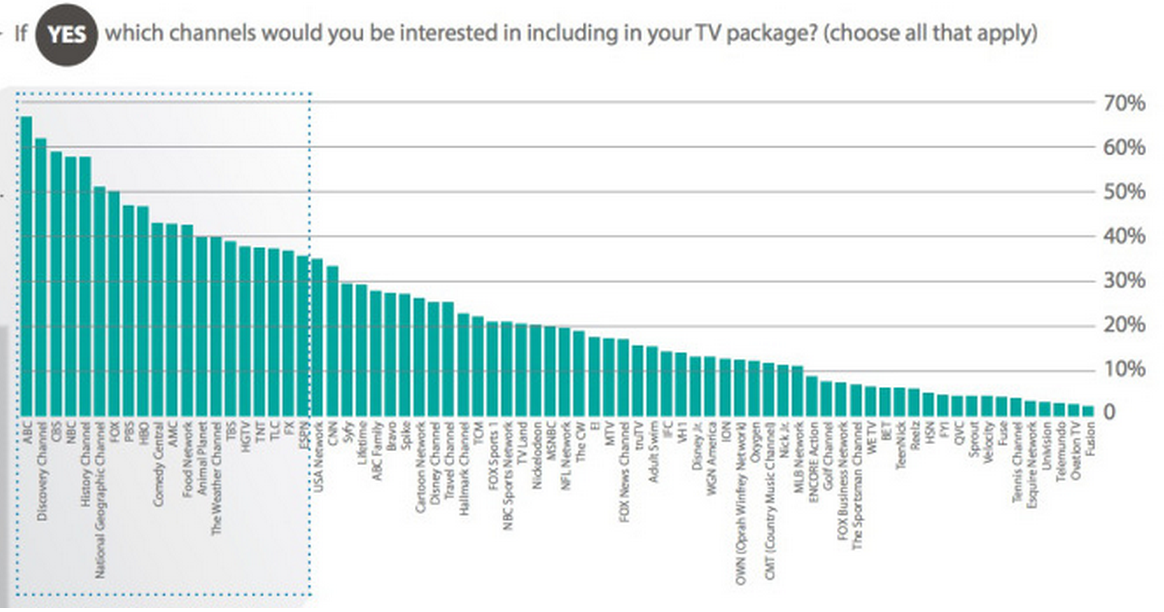
Given the push for a la carte services, a recent poll conducted by DigitalSmiths and posted via DSLReports shows an interesting trend. If sports fans are the driving force of streaming or pay-as-you-go streaming options, the survey had an interesting way of showing it.

alacarte

ESPN ranked 20th among preferred channels, behind non-sports channels such as Animal Planet, Food Network and the History Channel. ABC and CBS ranked first and third respectively, however it would be a stretch to call those sports channels given their diverse programming. The same could be said for NBC (4th), Fox (7th), TBS (15th) and TNT (17th). Where ESPN was the first sports exclusive channel, both Fox Sports 1, NBC Sports, NFL Network, MLB Network plus the Golf Channel and Tennis Channel managed to make the list.

Kudos to the NBA for seizing an opportunity to gain new fans after a strong ratings performance in the finals. Perhaps more professional leagues or streaming service options will follow suit and offer a more personalized option.

(Header image via Wikipedia)

beIN Sports to Offer Streaming of EPL Match to (Some) Cord Cutters

One week from today the final piece of the 2015-16 English Premier League will be decided. A single match between Middlesbrough and Norwich City will kick off at 10 am eastern time on May 25. The winner will advance to arguably the best soccer league in the world, the loser remains in England’s second tier league, the Football League Championship. Unfortunately, despite the high stakes, only a limited number of soccer fans — in particular those with cable subscriptions — outside of the United Kingdom will have access to the game.

Foreign broadcast rights for the Championship here in the United States and Canada fall to beIN Sports. Directly from the beIN website, they offer a free online system called beIN SPORTS CONNECT, allowing users to stream live events to their computers, iOS and Android systems. The downside is there is no standalone option for the service. You have to be in an area with beIN available to you, with a compatible cable provider and then purchase a qualifying cable package.

bein

The good news is Sling TV offers a package for $10.00 per month that includes, among other sports options, beIN Sports. Perhaps this is one of the first times in broadcasting history where cord cutters without a traditional cable package sit in an advantageous position to those with a cable subscription. Despite some channel lineups coming with beIN, the vast majority of cable packages don’t offer beIN until their highest package, or as an add-on at additional cost. In my area in particular, beIN isn’t available for my current provider. A competing cable and internet provider does offer beIN, though it isn’t an included feature — it is available as an add-on for $10.00 with the second and third most expensive packages —  until the highest cost package, coming in at a hefty $91.00 per month. That bill is before taxes and without accounting for internet or installation and activation.

At this point it’s hard to say which is more accurate: that the cord cutting generation is winning or that the old school cable TV model is losing.

(Header image via beIN)

Slingbox Service Heads Across the Pond

For those frustrated in the United Kingdom regarding the Sky TV’s Go and Go Extra no longer being watchable on Google Chrome, help has arrived in the form of Slingbox’s M1 now being available throughout Europe. Via press release, Slingbox announced their set-top box system is now being sold for £129.99 or €199.99 and boasts being compatible with every cable and satellite provider and 100 percent channel availability in their M1 video.

While this still requires a cable subscription, Slingbox does not require any monthly fees to watch sports and shows on the go. That their computer and laptop interface is compatible with Chrome (as well as Safari and Firefox) is a major chip in Slingbox’s favor. Sky Go doesn’t cost anything extra for eligible cable subscriptions, however features such as international viewing, downloading or watching downloaded content are limited to the Sky Go Extra package, costing an additional £5 per month. Currently Sky Go and Extra are limited to iOS and Android whereas the M1 works with iOS, Android, Windows Phone and Kindle devices.

Slingbox is looking to fill what appears to be a self-created void created by Sky for many soccer fans throughout the UK. Given Sky — and to a lesser extent BT Sports — dominate the English Premier League broadcasting rights, it’s surprising to see a company refuse service on a web browser. Fans who can’t be in front their televisions could turn to Slingbox for their on-the-go needs. Senior VP and GM of Sling Media Michael Hawkey is counting on that and said of the latest market expansion:

Given its strong reception in the United States, we are excited to introduce the Slingbox M1 into the European market….With a Slingbox M1 that has been completely localised for customers, we’re delivering the most affordable Slingbox packed with the most robust set of features that we believe will significantly expand the mobile TV and video market.

If the M1 sells well enough and Sky finds many subscribers canceling their Sky Go Extra package, perhaps then the message will be clear: keep up to date with the consumer’s demands or you will lose money.

(Header image via Slingbox)

Even Professional Bull Riding is Getting into the Streaming Game

Last year’s Super Bowl being streamed online was a huge move for the big four — NFL, NBA, MLB and NHL — though the other sports have yet to cater to the streaming population. More fringe or niche leagues may be more willing to embrace the available technology as they attempt to grow their brands, or so it would seem within the ranks of the Professional Bull Riders. Last week PBR announced a partnership with the streaming company Flipps to showcase via pay-per-view their Ring of Honor: Unfinished Business event.

Earlier today via press release, Flipps posted additional details about the Ring of Honor stream. Set to take place on May 30, will consist of a three hour live broadcast of the various competitions with riders aiming to take home up to $160,000 in the winner-take-all formats. In order to view the event, a $29.95 price tag is attached, the same price to watch on Dish Network. Flipps CEO, Kosta Jordanov, said of the partnership with PBR:

PBR is the premiere bull riding organization in the world and we are honored to be able to elevate that content to new audiences through the Flipps platform.

Flipps, a free app available on iOS, Android, most SmartTVs and more, offers both free and PPV options for sports highlights, games and matches ranging from the ACC Digital Network to UFC Sports, the Golf Channel and dozens of others. The entertainment isn’t limited to sports coverage, though. Flipps is dedicated to bringing live coverage to their user base, and includes select programming from Showtime, music videos, plus dedicated genres for children and news. The channel selection also includes industry updates and videos from automotive, health and tech sources. With much of their content readily available for free, Flipps’ revenue comes from in-app ads and video ads, though given their impressive lineup, it is understandable. If you happen to be a bull riding fan who has cut the cord, this is mana from streaming heaven. For those who have dropped their cable packages but are not terrible enthusiastic about the PBR, Flipps has enough other options to be well worth a download.

(Header image via Doug Wertman)

Age Gaps In Preferred Media and Entertainment

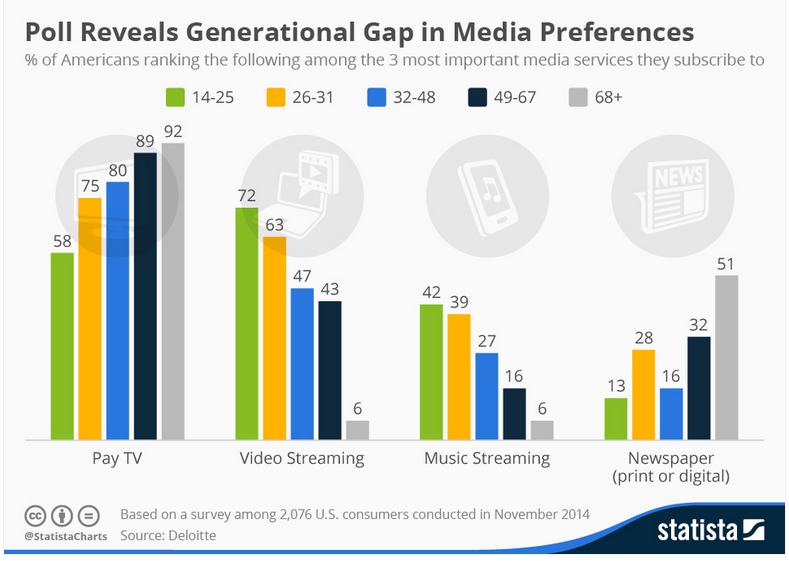
Media consumption, like most things, can be broken down into various age demographics. While the brackets tend to have somewhat arbitrary numbers attached to them  — does turning 26 years old really change the preferred method of watching your favorite TV shows? — they can serve as a platform for observation. With thanks to Statista and Deloitte, the gap between paid cable subscriptions and streaming services, among other things, for those in the United States can be clearly shown.

mediaconsumption

It comes as no real surprise to see the two younger age groups consume the least amount of television while also nabbing the top two spots in video streaming. Somewhat surprising is to see the leading millennials 26-31 age group absorbing more newspaper, be it digital or print, than their older 32-48 counterparts. With large number of online and subscriptions available, plus the Washington Post’s agreement with Kindle customers, perhaps the leading millennial group has come back around in a cyclical trend of newspaper reading.

The percentage of the different aged people who are content with their current cable TV subscription is closely tied with age. The youngest three groups are the least satisfied, reporting at most 55% saying they haven’t at least considered cutting the cord.

mediaconsumption1

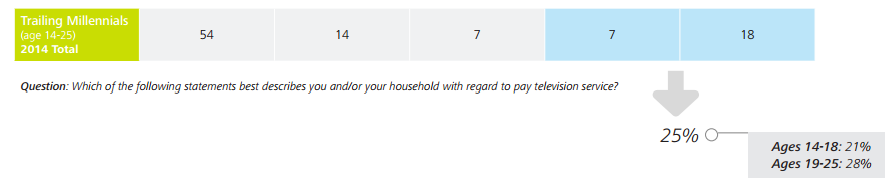
With no shortage of streaming or screencasting options — despite AppleTV’s recent insistence on requiring a cable package for CBS Sports, USA and NBC Sports — the number of current and potential cord cutters has increased over the years, particularly in the younger crowds. Already 25% of the polled age-14 through 25 group hasn’t paid for TV in over a year or have ended their cable subscription within 12 months. Within the age group another trend emerges as 28% of 19-25 year olds versus 21% of 14-18 year olds are calling themselves cord cutters.

mediaconsumption2

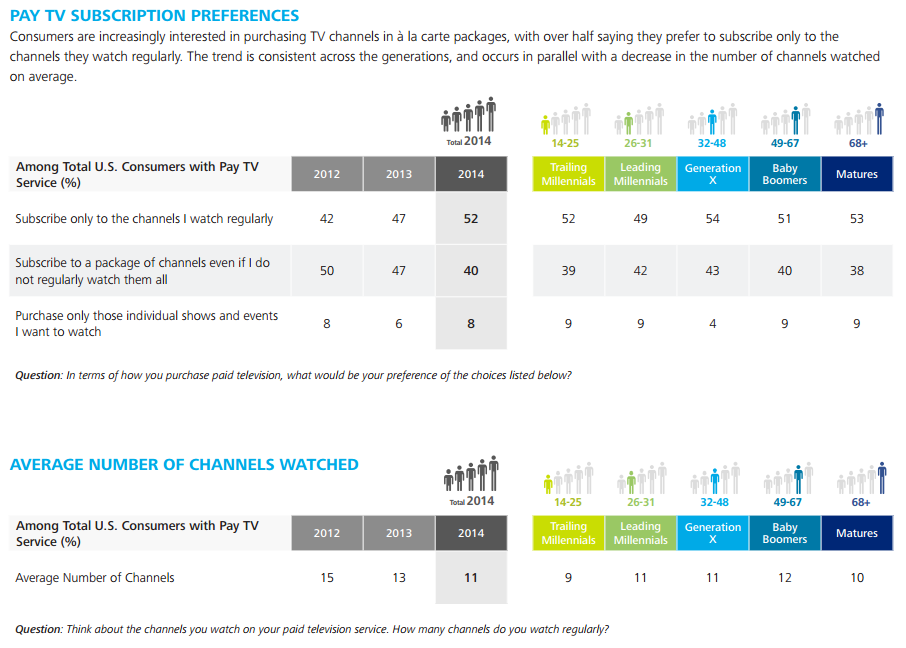
As the overall demand for TV changes, so does the desire for the way TV packages are sold. For the first time in the three year data set, more than 50% of the polled desire the ability to choose individual channels to watch. A three year decrease in the average number of channels watched further highlights the growing calls for an a la carte system. Canada is already developing a government mandate for cable companies to allow customers to choose individual channels after an initial package, though no legislative traction has gained ground in the U.S. yet.

mediaconsumption4

The numbers represent a clear trend in increased subscription based services and a desire to either ditch cable TV altogether or give it a serious overhaul in programming options. The people are applying pressure to big cable with their wallets as companies lose money with every person severing their TV packages. Still, and with apologies to Bon Jovi, at this point it feels like we’re livin’ on a prayer rather than being halfway there.

(Header image via Deloitte)

Microsoft Is Losing the Browser Battle, But the War Isn’t Over

Despite — or in some cases because of — Google’s insistence on pushing forward with new web browsing technologies, the tech giant continues to dominate the browser demographics for desktops as well as mobile phones and tablets. Not only has Chrome been on the rise for people at home, but also on the go. Via numbers from StatCounter Global Stats for mobile and tablets, only Chrome and to a much lesser extent the Android-based UC Browser and IE Mobile have increased their market shares since December 2012, the first month of collected data (click to embiggen).

browsermobile

For fellow computer users, and where many concerns stem from as Google phases out older technology, Chrome is even more dominant than on the mobile market. Again according to StatCounter GC, Chrome holds a remarkable 52.96% of the desktop browser market share. The gap between Chrome and everyone else has been widening since May of 2012, however Microsoft’s newest browser, Edge is looking to change things provided you’re running a Windows 10 machine.

browserdesktop

Edge doesn’t yet have a release date, but it something I’m eager to check out. It is seemingly looking to streamline the web, something I can get behind as separate tabs and locations for things like favorites, recently visited, current downloads and my reading list are all found in different areas in Chrome. Edge’s “Hub” will place them all in one easy to access area, however it isn’t all sunshine and rainbows with Microsoft’s latest browser. While the company is promising support for existing Chrome and Firefox extensions, that support will not be arriving until a later date. No official word on Silverlight being compatible with Edge, though recent history suggests it would be as all Windows 8 devices, including the tablet Surface Pro 3, are. It would be a stunning (though in my opinion welcome) reversal if Windows 10 and by extension Edge, was not Silverlight compatible. An introduction video to Edge can be found on YouTube.

Already some sports fans are finding themselves caught in the crossfire of the browser battles, specifically those looking to watch games on Sky TV, the preeminent broadcast of English Premier League soccer games in the United Kingdom. Sky — working with BT Sports — recently negotiated a new cable deal where Sky holds broadcast rights to 126 EPL matches per season, three times as many games as BT Sports will broadcast. On the Sky Go page there is a message regarding the incompatibility:

skygoUntil Edge is officially released — and probably for some time after — Chrome remains the undisputed browser champion. If Microsoft really does aim to “blur the line between consumption and creation” as the Edge preview video suggests, Windows 10 and Edge will drop Silverlight support and force broadcast companies to update to new and better technologies. What I don’t want to see is Edge allowing massive companies to sit on their hands at the cost of time and frustration for customers.

(Header image via Microsoft)