Archive for soccer

Serie A to Premiere Brand New Soccer Streaming Service

I personally believe the old saying “all roads lead to Rome” tends to embody “different means to the same end” and in the case of online streaming versus traditional cable subscriptions, money as always, is the bottom line. In regards to the streaming cash flow, once again Rome — okay, all of Italy — is front and center in accomplishing the end of collecting revenue, this time by means of streaming. Today the top league of Italian soccer, Serie A, announced a service that beginning on Saturday, will stream three fixtures per weekend.

The price for viewing access is €3.99 for the weekend or €2.00 per individual match. In addition to the games themselves, each will have both pre- and post-game shows for analysis and news for the matches and around the league. It’s a huge move away from the old school television broadcasts, and for here in the United States, where beIN Sports holds the broadcasting rights. Serie A is the first major European league to offer a service of this kind and this could bring about a huge boost to their fandom abroad.

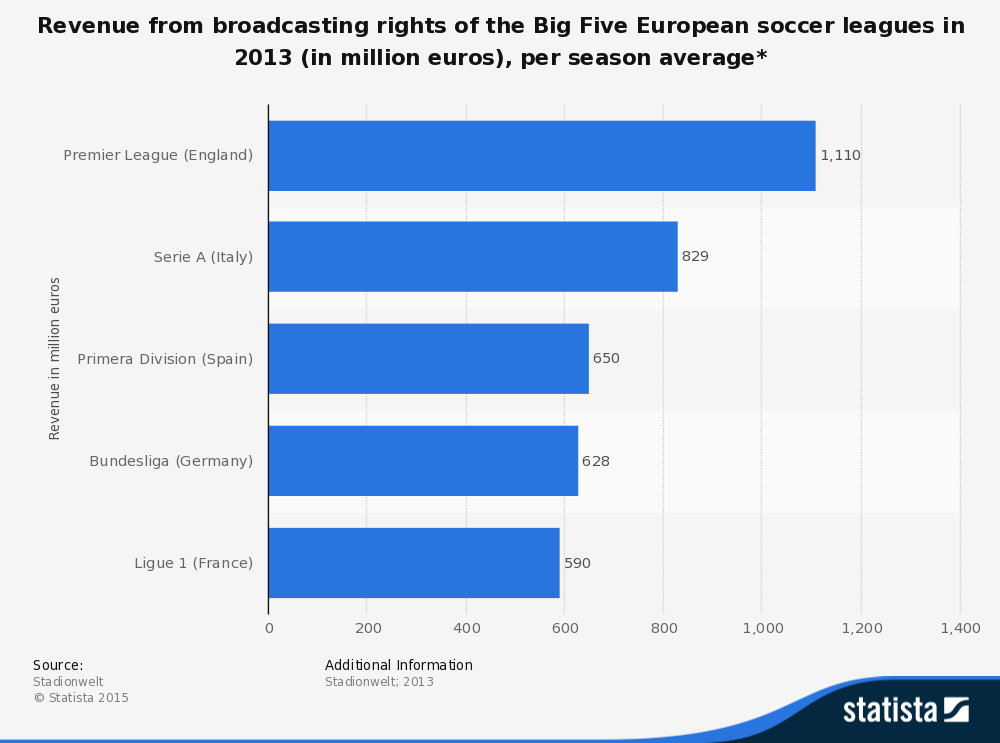
Via Statista, as of 2013, Serie A held the second highest broadcast revenue, trailing only the English Premier League.

statistic_id284787_total-broadcasting-rights-revenue-per-season-european-soccer-leagues--big-five--2013

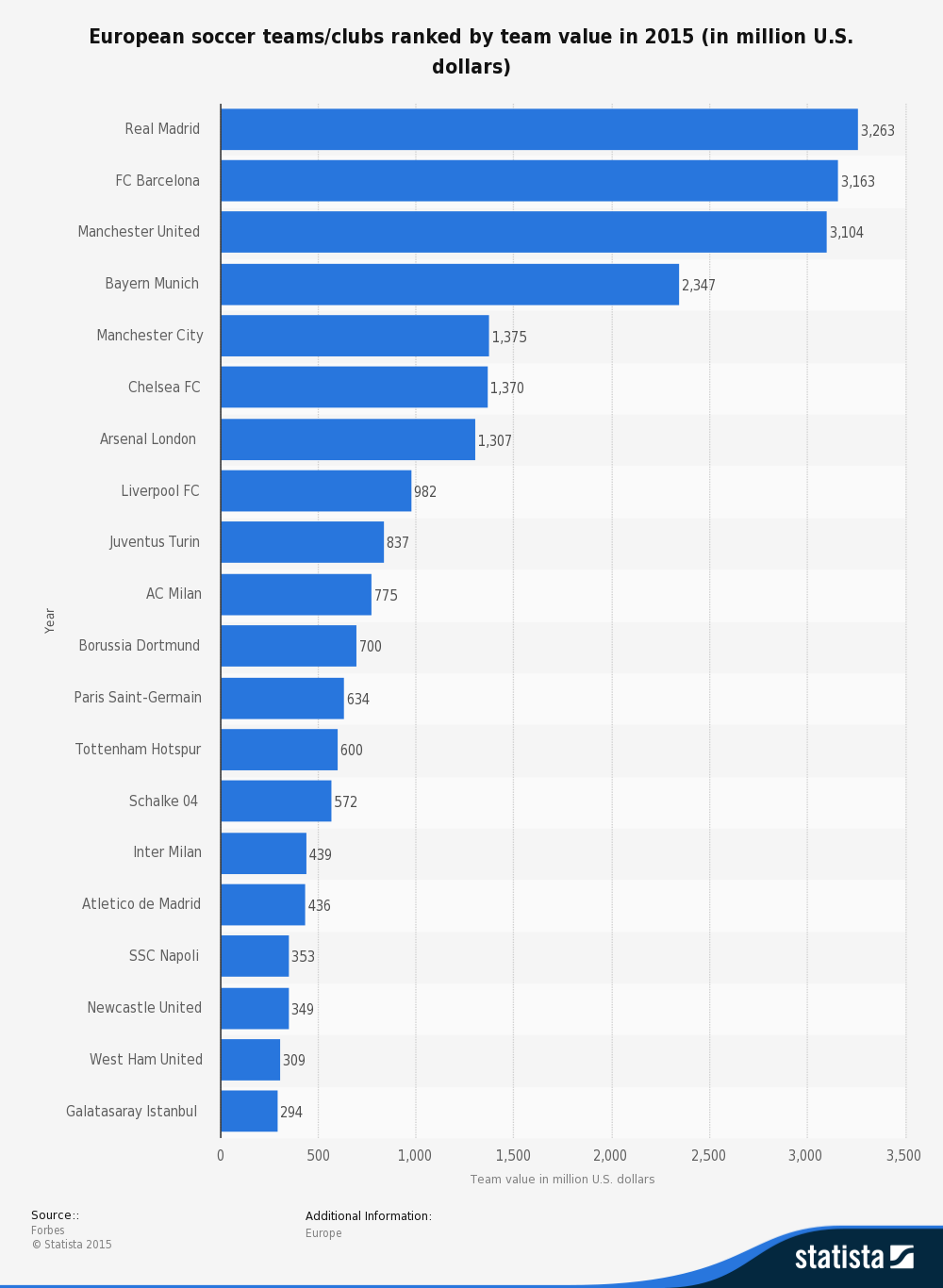
An argument could be made that Italy’s top league isn’t the powerhouse it once was, however the league has posted solid results in UEFA Champions League play, the top continental league in Europe. Even after Serie A lost one of their bids to Germany’s Bundesliga following the 2011-12 season, they’ve posted respectable results. Since being limited to three teams receiving bids to the Champions League, Italian powerhouse Juventus has managed a runner-up finish in the CL last year and both Roma and Milan have made appearances in the Group Stage of the tournament as well. Even with four teams (Juventus, AC Milan, Inter and Napoli) in the top-20 most valuable soccer clubs as of 2015, Serie A has some catching up to do if they’d like to match the brand value of the titans of European soccer.

statistic_id300578_professional-soccer-clubs---teams-ranked-by-value-2015

If this streaming agreement opens up the first of many more casual soccer fans here in the US, all the better. The individual game price is well worth testing the waters of Serie A, but the model of online viewing is the most important part. If other leagues — namely the Premier League, Bundesliga or Ligue One — are able to find a way to offer streamed soccer, it will be another huge win, much like Fox Soccer 2 Go, for cord-cutting soccer fans.


Heart Rate Sensor Assists U.S. Women’s National Team

The United States women’s national team won their third World Cup title this summer in Canada. That same Women’s World Cup, along with this summer’s Under 20 World Cup in New Zealand, marked the first time FIFA allowed players to wear tracking devices during game action. The success of the devices during these events led FIFA to greenlight the use of wearables in future competitions, subject to the approval of individual leagues.

Part of the team’s success was the players’ dedication to the training plans developed by strength and fitness coach Dawn Scott.

“I think it’s a testament to the players that they trusted us and stuck to the program, and did what they needed to even when they had their commitments with their [club] teams,” Scott said in a previous interview.

An earlier Wired article discussed the USWNT’s relationship with Polar Global devices. When reached for comment, Polar Global’s Josh Simonsen confirmed that the players were wearing the H7 heart rate monitor on the pitch, and using M400 GPS watches in training sessions. Simonsen, the company’s national training resource specialist for the U.S., said the Finnish company had worked with Scott and the USWNT since 2010.

“What that gave Dawn was the ability to track speed, distance, and activity of the athlete while they’re away,” Simonsen said. “And they were able to send it her in a much easier environment than the previous models.”

The H7, the heart rate monitor worn during the games, consists of a strap worn across the chest and a small transmitter a few inches wide. The strap contains an electrode that collects the ECG signal from the athlete; after some basic processing, the transmitter then sends out a Bluetooth signal. The system reports heart rate on a per-second basis, using only basic peak-to-peak measurements, which are less susceptible to the kind of movement artifacts you would expect with an athlete wearing the device during competitions.

Polar’s top-of-the-line system, the Team Pro, also includes a GPS and IMU sensor. Switching to Bluetooth Smart also allows the transmitters to communicate directly with a tablet. But Simonsen said the USWNT was still using the older Team2 solution this summer.

“They didn’t want to transition prior to the World Cup,” he said.

The company has a long history with heart rate sensors, having built the first monitor for an athlete in 1977. But it was not until the early 2000s that Polar began developing systems for whole teams, rather than for individuals.

“Essentially the coach would log into the software and each player would have their own page, but they really weren’t able to compare the team as a whole,” Simonsen said. “We couldn’t look at the big picture.”

This functionality would not become available until Polar’s Team2 system was introduced in 2009. Unlike their previous offerings, Team2 allowed coaches to collect and analyze data in much less time. The addition of Bluetooth transmitters also allowed coaches to monitor their players in real time.

“[Team2] was like a 50 percent cut in time that it took to do everything,” Simonsen said. “Everything was exponentially faster.”

The Team2 system is currently used by “about 450 teams” in the U.S., and Simonsen said new coaches are typically surprised by the feedback provided by the data.

“A lot of the time they’re just blown away at how long things were or how hard things truly are,” he said. “Or that their easy day really wasn’t that easy, or that their hard day was a lot harder than they really thought it was.”

Simonsen argues that this experience in the field is what separates Polar Global from the plethora of other companies offering heart rate monitors.

“We created heart rate,” Simonsen said. “And with us using HR from the beginning, accuracy is always our number one thing.”


Bundesliga Gaining Traction in Attendance and Streaming Services

Things are on the rise in the top German soccer league, the Bundesliga. Not just the level of play, but the depth of teams as well as popularity have been trending upwards for several years now. The Union of European Football Association (UEFA) noticed the league’s rising talent as well, increasing their bids to the UEFA Champions League — the highest level of international club play in Europe — to three automatic slots plus one playoff bid.

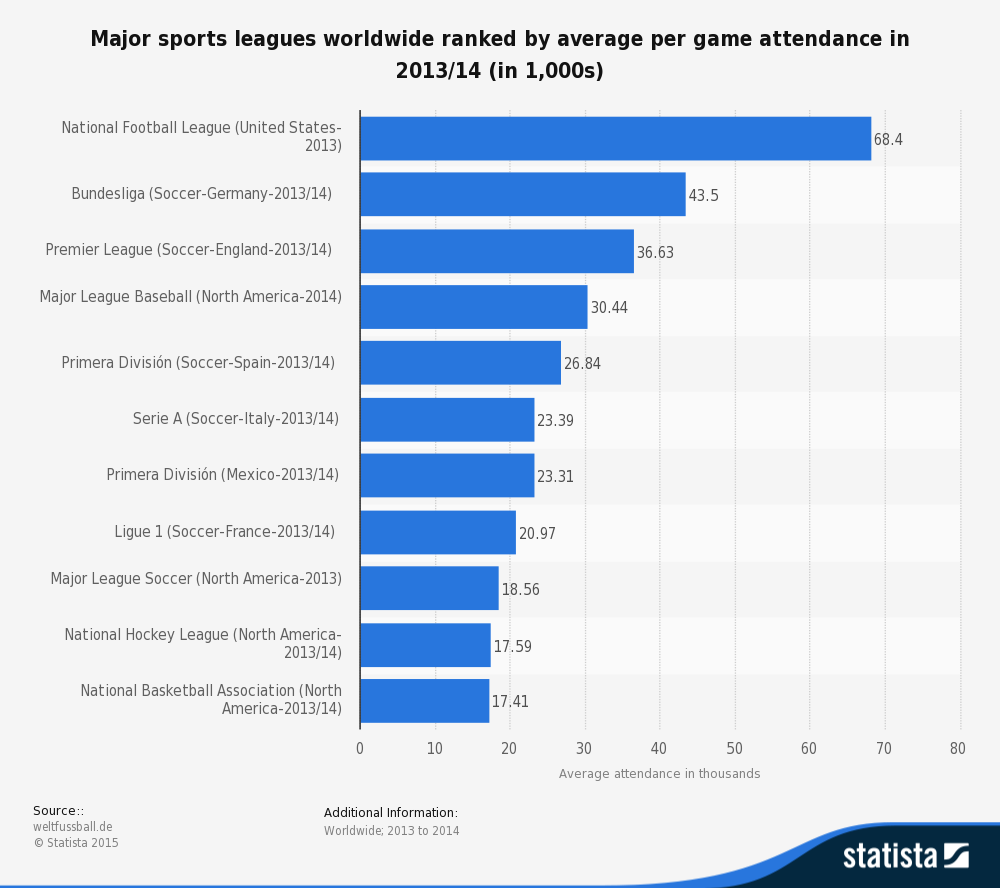
With local fans already showing up to more Bundesliga games in person more than any other sport save for the NFL in the world, it’s hard to understate the league’s current impact and potential growth. Via Statista, the graph below displays the 2013-14 average game attendance for the 11 top ranking leagues.

statistic_id270301_average-attendance-of-major-sports-leagues-around-the-world-2013-14

Not even the English Premier League juggernauts of Manchester United, Arsenal Man City or Liverpool nor Spanish La Liga one-two punch of Barcelona and Real Madrid could draw more fans than the Bundesliga’s top draw in the 2013-14 season. Somewhat surprising, Borussia (there is a typo in the table below) leads all soccer clubs in Europe for attendance.

statistic_id382940_european-football-clubs-average-attendance-2013-14

Beyond local fans and UEFA, Fox Soccer has also taken note of the German league. The broadcasting network already streamed some Bundesliga fixtures on the Fox Soccer 2Go platform, but never all 306 matches. In addition to streaming every single league match, Fox has doubled down on the league by adding televised games as well. A total of 58 matches will be shown on TV on the Fox Sports 1, 60 on Fox Sports 2 and the final 188 games being shown on Fox Sports Plus.

The United States Men’s National Team (USMNT) has also seen an increased presence in Germany as six active members are currently on Bundesliga squads, with three more US players currently on clubs rating in Germany’s second tier. The German league is has the most US players in foreign leagues, barely edging out the Championship, England’s second tier, and trailing only Mexico’s Liga MX that boasts seven US capped players.

According to the Fox Soccer schedule, the opening match will be three time reigning champion Bayern Munich against the near-relegated Hamburg side. The match is set to be broadcasted on Fox Sports 2 at 2:30 pm eastern on Friday, August 14. While up-and-coming 20-year-old USMNT member Julian Green is under contract with Bayern until 2017, it’s possible, albeit unlikely, he could make an appearances and further boost the Bundesliga’s profile in the United States. If you happen to be busy on that Friday, tune in the next day as Werder Bremen just signed USMNT striker Aron Johannssen. Werder is set to kick off at 9:30 eastern on Saturday the 15th. While causation does not determine correlation, the United States has seen the the profile of the national men’s team rise in recent years, possibly due to Tim Howard, Clint Dempsey and Landon Donovan all crossing the ocean to play in the Premier League. Hopefully a similar level of fan interest will happen with the Bundesliga.

(Header image via Wikipedia)

The Technology Behind the U.S. Women’s National Team’s World Cup Victory

The United States women’s national team went into the 2015 FIFA Women’s World Cup with a chip on their shoulder, trying to avenge a heartbreaking finals loss in 2011. But eagle-eyed viewers might have also noticed the chips the women wore under their shirts as well, as Will Carroll pointed out on Twitter.

The objects were Polar Global’s H7 heart rate sensors as suggested by this Wired article and confirmed by Polar Global. The USWNT is also listed as a client of Catapult, an Australian-based company that combines GPS and inertial measurement units (IMU) into a single sensor.

Strength and fitness coach Dawn Scott confirmed that her team uses heart rate sensors and GPS systems to monitor player performance. However, because the team does not have a formal relationship with either company, she could not discuss the specific devices she uses in detail. Nevertheless, she was still happy to answer general questions about how she and the rest of the American coaching staff used the devices.

The GPS system and heart rate monitor produce a wide range of metrics. Head coach Jill Ellis and her staff were mostly interested in measures of intensity, rather than total distance covered. Scott specifically discussed the percentage of high-speed running (running faster than 11 mph) and distance covered during high-speed running.

“For me they’re the main factors that then show how much a player’s involved in the high-intensity activities,” Scott said. “[That means] overlapping for your midfield player, making high-intensity runs into the box. For defenders, [it means] having to recover.”

But not every position calls for such high-intensity bursts. For those players, the coaching staff relies on meterage — a player’s average speed in meters per minute.

“So say a Lauren Holiday, who isn’t necessarily doing a lot of sprints when she’s in a holding midfield position, but she’s one of the ones who does the highest meterage, so for her, that is more of a marker of her work rate,” Scott said. “In one of the games where she was pushed into the attacking midfield role, she suddenly had a lot of max sprints.”

The games presented an additional set of challenges. Although this tournament marked the first time FIFA allowed players to wear monitoring devices on the pitch, FIFA retained the regulations prohibiting the use of technology on the sidelines. This prevented the coaching staff from using these systems to guide their in-game decision making.

“I don’t always see the purpose of real time [monitoring],” Scott said. “Sometimes in training we’ll take out the real time system, but for me that’s only if we want to get a certain physical output from a fitness point of view.”

Making matters more difficult, several of the stadiums in this summer’s World Cup were domed (like Montreal’s Olympic Stadium) or had large roofs overhanging the field (like Vancouver’s BC Place). This meant the team’s GPS-based systems were much less accurate during games.

“The interpretation of that data is crucial, especially when you’re giving that back to players and the coaches who are interested in that feedback,” Scott said.

Scott doesn’t rely on a single number to judge player performance, instead adjusting her expectations and the numbers she looks at based on the game plan for that particular match.

“It’s knowing your team, your opposition, it’s knowing your own players, and what their physical capabilities are as well,” Scott said. “Carli Lloyd’s numbers were very different in the first three games from the final three games when her role was very different.”

But unlike a coach for a club team, who can monitor their players’ workouts year round, Scott had the added challenge of making things as simple as possible for her players after their training session ended. That meant shelving the more complicated GPS monitors and giving each player a wrist-worn heart rate sensor to wear during training. To their credit, though, the players diligently stuck to the team’s training plan — and just as diligently sent the data back to Scott.

“The players were very good at giving us updates in terms of their heart rate loads,” Scott said. “And they also logged into an online training diary or physical monitoring system, where every single day they would log in, answer five questions about how they feel physically, and so I can then log in and see where a player’s physical state is.”

Scott traveled across the country, working with coaches for every National Women’s Soccer League (NWSL) team to come up with a plan that kept the national squad healthy without hindering their club’s chances of winning. Scott was quick to praise her NWSL counterparts for their cooperation.

“The clubs were given guidelines in terms of when we want to train, when we want the players to have a day off, and also ideally how long the training session should be with the player,” Scott said “And to be fair to the clubs, in that crucial period in the leadup to the World Cup, they stuck to the programs we sent.”

Off the field, Scott is working towards a doctorate from the University of Western Sydney. Unsurprisingly, Scott’s research focuses on the physical demands and training loads of elite female athletes, with a focus on soccer players. Scott’s research relies on the hundreds of hours of game data she has collected from USWNT athletes since 2012.

“The main focus is going to be to develop a training model, so looking at what are the physical demands of women’s football,” Scott said. “And then with that, we look at what is the training intervention is to prepare the players physically for those demands,” Scott said.

But not all Scott’s methods are quite so high-tech. During March’s Algarve Cup in Portugal, players complained about stiff necks and poor sleep. So before this summer’s Women’s World Cup, each player was given an allowance to buy their own pillow to take on the road with them. The result, Scott said, the team was better rest and improved performance.

“When I first suggested it, people looked at me like I’d gone mad,” Scott said. “But the players appreciated it, because it just meant something they had at every single hotel.”

(Header image via GoToVan)

Brentford FC’s Stats-Friendly Owner

Brentford FC has been making waves in the ocean of soccer nerds over the past several seasons, most notably due to their owner — Matthew Benham — being a leading advocate for mathematical modeling in soccer. Benham is a nerd after my own heart, a man who studied at Oxford and eventually created his own betting company, Smartodds. Prior to Benham’s purchasing the team after the 2011-12 season, Brentford had been a third tier league, finishing in the middle of the pack of League One, two levels of competition below the English Premier League.

Since taking over ownership duties, Benham has influenced the club’s overall philosophy with his statistical stylings, including publicly acknowledging a head coaching change was partly due to philosophical differences. The coach in question, Mark Warburton, was at the helm as the club ascended from the third tier to the second tier of competition. Despite the success, Warburton found his contract was not to be renewed after the 2014-15 season. With Benham influencing the decision making process and Warburton handling the field level duties of a manager, Brentford managed to escape the third tier after being there for five seasons (2009-10 through 2013-14). The Bees broke through to the Championship, England’s second tier behind the EPL. More success followed in the 2014-15 season as Brentford finished fifth in the Championship and thus found themselves in the playoffs for the right to join the big clubs in arguably the best league in the world. While their playoff run ended earlier than The Bees would have liked, their overall success is not to be discounted.

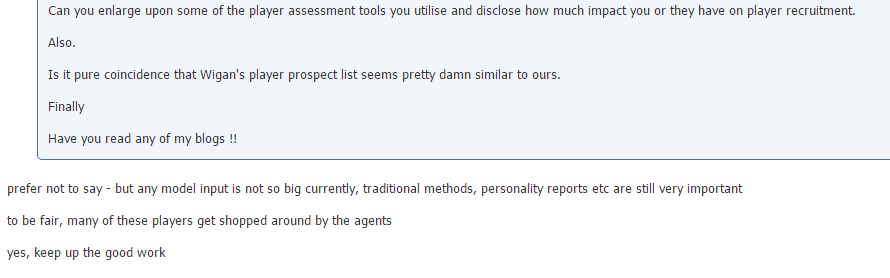
Though the Bees fell short in the playoffs, their rapid ascent has made people take note, including their fans. Benham made time for a Q&A session last year on the Griffin Park Grapevine fan forum, and some of his answers were on point. In order to read the entire session you’ll have to register a free account on GPG, however below are just a few snippets of the Q&A (click to embiggen each picture).

qa1

As one would suspect, Benham is reluctant to give any details about the models and math at work, however his pasta preference is certainly concerning given penne reigns supreme.

qa2

Benham again doesn’t give away anything telling, but he quick to give traditional scouting and reports respect.

qa3

The context behind this answer is quite interesting given the history between Benham and Comolli. Damien Comolli came up as a scout with Arsenal, then worked his way up to director of football for Tottenham, in a similar way a baseball scout would climb the front office ladder. Comolli was dismissed after being at Tottenham for three seasons, landing as sporting director at Saint-Étienne. By the time he was relieved of duties there, Liverpool beckoned and he was appointed director of football strategy in November of 2010. After catching criticism regarding his negotiating abilities more than his scouting talents, Comolli and The Reds parted ways with the club near the end of 2011-12 season. The story, as written in Calvin’s book, is that Benham met with Comolli and was not impressed by any of the numbers Comolli showed him. Benham was also shocked at how Comolli asserted that his numbers and nothing else could be correct. Disagreements among analysts is nothing new, just look at the Red Sox and Mike Gimbel. He served as a specialist and consultant to then general manager Dan Duquette before Gimbel was, in his own words, used as a whipping boy.

Benham has generated his wealth using the best tools available to create the model in order to most accurately project outcomes. The best publicly available stats still leave much to be desired, however given Benham’s background, perhaps he and his team of analysts at Smarodds have broken down some of the walls surrounding statistics in soccer. While not a general manager or coach, as owner of a second-tier English soccer team, he certainly could be a pivotal character in the soccer realm. Just as Billy Beane came under fire for a number of his decisions, Benham has also been a target of the media. As the line near the end of Moneyball states, the first guy through the wall always gets bloodied. Always.

(Header image via Wikipedia)

Kitman Labs’ Profiler Helps Keep Athletes on the Field

Sports analytics has moved on from the days when an ambitious amateur could fire up Excel or a relational database and make earth-shattering discoveries. Modern front offices must incorporate not only on-field performance but also medical histories, training results, biomechanics data, and a host of other sources into their decision making. To help teams better manage and access that mountain of data, Dublin-based Kitman Labs has developed the Profiler, a system that combines disparate data sources into analytics describing player health and injury risk.

Chief product officer Stephen Smith described Kitman Labs’ offering as “the operating system for sports teams.” The strength of the system is in its ability to combine data from multiple areas — including medical, biomechanical, and on-field sources — to produce more holistic analytics that can better inform team decision making regardingl athlete training and injury prevention. Smith said he was first inspired to create the system while working as an athletic trainer for Leinster, an Irish rugby team.

“One of the biggest challenges I had as a practitioner was that all the fitness data was held in one area, all the medical data was held in one area, and all the performance analytics were held in another area,” Smith said. “That just made it very hard to understand what any of the information actually meant.”

An example of the power of Profiler is demonstrated through a software application that allows users to collect markerless, three-dimensional biomechanical data from an off-the-shelf Microsoft Kinect. The software can calculate select joint angles from an athlete a few feet away — even during rapid dynamic movements, such as running, kicking, or throwing a pitch. And although Smith insisted that the Kinect software was “probably five percent of what we actually do,” he was enthusiastic about its ability to make motion-capture based analysis more accessible.

“Biomechanical information that you would garner in a normal professional sports environment would take you hours to actually get because the downtime is huge, and the cost of that is pretty difficult, and you just can’t access that day to day because it takes too long,” Smith said. “The software that we’ve created jumps professional sports teams into the next generation of real-time technology.”

When interviewed, Smith refused to name the specific organizations that have partnered with his companies.

“We definitely don’t like to speak about our clients because a lot of the information we’re housing, as you can imagine, is very sensitive data on very high-profile athletes,” he said.

But some of his clients have been less tight-lipped about their relationship. In March, The Los Angeles Dodgers announced that they would be partnering with Kitman Labs in their farm system, declaring themselves “the first American sports team” to sign with the company. Across the pond, Kitman Labs works with British Premier League squad Everton, along with a number of Irish rugby teams. Other organizations, including the San Francisco Giants, have also tested this system.

When Kitman Labs signs a new client, the two first collaborate to determine which data and which metrics are most important to the organization, and what sources of information the organization already collects. Kitman’s sports scientists then work with the coaches and training staff to demonstrate how to use the system and understand the analytics the system produces.

“We have a very experienced team of sport scientists who all understand the individual nature of each sporting discipline that we work with, and the uniqueness of each club, team, and athlete,” Smith said. “Those sports scientists will actually be on the ground with teams for a number of days actually helping them to get up to speed.”

Smith says he understands that his company offers an appealing solution to clubs looking to maximize the return on their sizable investments in player salaries, not to mention strength and conditioning, coaching, and other aspects.

“I presume that [general managers] want tools to ensure that they can get the best value from their athletes,” Smith said. “I think the clubs just love the idea of being able to try and maximize on that by being sure they can keep the athletes on the field.”

But the growth of biomechanics data has led to rumblings in some quarters. Some have expressed concerns that medical data which suggests an injury risk could be used against athletes during negotiations. (An example can be seen in the controversy surrounding the Houston Astros’ dealings with top overall pick Brady Aiken last summer.) Despite this, Smith said he hasn’t seen any pushback from athletes on teams using this product, and insists that the system was designed primarily with athlete wellbeing in mind.

“One of the largest driving forces for us in doing this is that we want to protect athlete welfare, we want to improve the standard of care that is given to athletes worldwide,” Smith said. “It’s there purely for the team to use that information to empower their decision making, and that way they can ensure the athlete makes it onto the field in the best possible shape.”

Kitman Labs was born out of Smith’s postgraduate research into injury risk factors, as well as his professional experience as an athletic trainer. The company was founded in October 2012, with its first product offering coming online in June 2013. By early 2014, Kitman Labs had signed their first partnerships with soccer and rugby teams, and were looking to expand into the American market.

“We kind of expected that the market over here would be pretty far ahead of what was going on in Europe,” Smith said. “But when we came over, we realized that it didn’t look like there was anybody else trying to do something like what we were doing.”

The company opened its first American office in Menlo Park, California, in September 2014. Since the MLB season was just wrapping up, Kitman Labs initially focused on expanding into baseball to coincide with teams’ buying cycles. Kitman Labs is now looking to expand into other sports, developing new applications in both professional and collegiate sports leagues.

“We’ve had early success with baseball in the U.S., but we’re actively working with NBA teams, NFL teams, and we’re actually now branching into the NHL as well,” Jeff Eckenhoff, a member of the Business Development team, said. “We’re pretty sport agnostic.”

And with the expansion into new sports comes an expansion of staff, as Kitman Labs looks to add sports scientists and engineers that can help them adapt their solutions for new clients. Smith said his company is actively looking to fill eight vacancies.

“We need industry experts from basketball, football, and baseball to come and be part our team, and to help us solve the largest problems for each of these sports so that we can truly help these teams to uncover the sources of injuries,” Smith said.

Still, Smith insisted that his company’s expansion would not come at the expense of Kitman’s current offerings.

“We don’t want to be a company that walks into a market and grabs a huge collection of customers and then walks away with their checks in our back pocket,” Smith said. “We want to change the face of sports science and sports medicine and we’re going to do that by incredible focus and by being extremely diligent.”

beIN Sports to Offer Streaming of EPL Match to (Some) Cord Cutters

One week from today the final piece of the 2015-16 English Premier League will be decided. A single match between Middlesbrough and Norwich City will kick off at 10 am eastern time on May 25. The winner will advance to arguably the best soccer league in the world, the loser remains in England’s second tier league, the Football League Championship. Unfortunately, despite the high stakes, only a limited number of soccer fans — in particular those with cable subscriptions — outside of the United Kingdom will have access to the game.

Foreign broadcast rights for the Championship here in the United States and Canada fall to beIN Sports. Directly from the beIN website, they offer a free online system called beIN SPORTS CONNECT, allowing users to stream live events to their computers, iOS and Android systems. The downside is there is no standalone option for the service. You have to be in an area with beIN available to you, with a compatible cable provider and then purchase a qualifying cable package.

bein

The good news is Sling TV offers a package for $10.00 per month that includes, among other sports options, beIN Sports. Perhaps this is one of the first times in broadcasting history where cord cutters without a traditional cable package sit in an advantageous position to those with a cable subscription. Despite some channel lineups coming with beIN, the vast majority of cable packages don’t offer beIN until their highest package, or as an add-on at additional cost. In my area in particular, beIN isn’t available for my current provider. A competing cable and internet provider does offer beIN, though it isn’t an included feature — it is available as an add-on for $10.00 with the second and third most expensive packages —  until the highest cost package, coming in at a hefty $91.00 per month. That bill is before taxes and without accounting for internet or installation and activation.

At this point it’s hard to say which is more accurate: that the cord cutting generation is winning or that the old school cable TV model is losing.

(Header image via beIN)

When Will UEFA Adopt Goal Line Technology?

The UEFA Champions League final will be set Wednesday as Real Madrid and Juventus square off to determine who will face Barcelona in the finals. Barcelona defeated Bayern Munich en route to their finals bid on a 5-3 aggregate score, but it could have easily been 5-4, and a one goal lead — technically two due to the away goals advantage — as a shot in the 39th minute nearly brought a bit of panic to the Barca side.

Bayern’s Robert Lewandowski received a pass near the penalty spot, turned and sent a strike that beat Barca’s keeper, Marc-Andre ter Stegen. From the game feed, as well as the reactions of the Bayern players, it looked as though it may have been a goal.

A different angle shows the entire ball did not cross the goal line, and thus the no goal call turned out to be correct.

While this second angle is no doubt an improvement over the game feed, it is still off-angle and not parallel with the goal line. The Champions League is one of the few leagues in Europe to not have some sort of goal-line technology (GLT) either planned or already in use. From the Dutch league to Italy’s Serie A to England’s Premier League, GLT is something that absolutely needs to be an industry standard.

Just two days ago GLT was the difference in the EPL as Swansea downed Arsenal 1-0 due to a no-goal call being overturned. Reddit user Poet-Laureate, via Gfycat, clearly showed the use of GLT to determine the game.

Both men’s and women’s World Cups as well as numerous domestic leagues have embraced the usage of GLT, though few international leagues have done so. Aside from the UEFA Champions League which pits clubs against each other, national teams in the 2015 Asian Cup nor the 2015 Africa Cup of Nations did not benefit from any form of goal-line technology. Similarly in North and South America the CONCACAF and CONMEBOL respectively have yet to implement GLT in any capacity. One of the reasons behind the lack of GLT is cost, as UEFA President Michel Platini deemed the technology too expensive in 2013, citing a preference to use the money “on youth programs and infrastructure.”

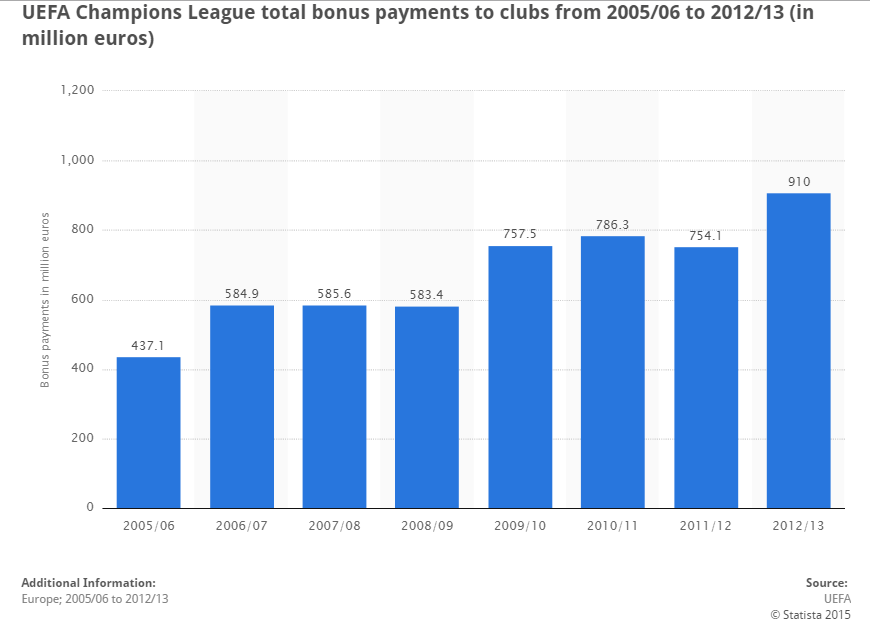
According to Statista, money paid to clubs in the 2012-13 season equated to €910 million.

uefa

Given the UEFA distribution model, 75 percent of the total revenue goes to clubs with the remainder being kept by UEFA. Revenue above the €430 million mark will be split at 82 percent going to teams and 18 percent to the league. It’s hard to cry poor with that amount of money being  publicly disclosed. Soccer leagues are unfortunately notorious for a number of murky and handshake deals — not to mention outright awful human rights — but not utilizing goal-line technology due to something as easily dismissed as cost is absurd. If the finals game is decided by a questionable goal or no-goal call, then maybe UEFA and other international leagues will stop sitting on their hands.


Tech Advances In The Women’s World Cup

This year’s FIFA Women’s World Cup is set to be the grandest Women’s sporting event of all time. Today FIFA boasted a number of major technological advances to be unveiled upon kickoff, such as broadcasting 10 matches — including the final — in 8K Ultra HD format. The press release also announced each game will feature no less than 20 cameras and as many as 22 trained on the field, a step up from the 16 camera setup in 2011’s Women’s Cup.

The use of goal-line technology (GLT) is being revamped as well. Rather than stick with the GoalControl system used in the men’s World Cup in Brazil last year, FIFA has decided to go with the Hawk-eye system in Canada. Both employ seven cameras focused on each goal and will be called upon for a ruling if a goal or no goal situation arrises.

FIFA has noticed the rise in second screening demands as well, and the presser specifically indicates a team of producers with a focus on mobile, tablet and laptop users. In order to view every game you’ll need a television package, as the matches will be split up between Fox and Fox Sports 1 for the English broadcast and NBC-owned Telemundo for Spanish. Nicolas Ericson, FIFA Director of TV, stated:

This is the biggest broadcast production we have invested in so far for a women’s football tournament. This supports FIFA’s commitment to develop and promote women’s football and it reflects the huge momentum and interest in women’s football around the world today.

Via Statista and using previous Women’s World Cups as the bar, nothing has come particularly close as far as live spectators since the 1999 Cup.

fifawomens

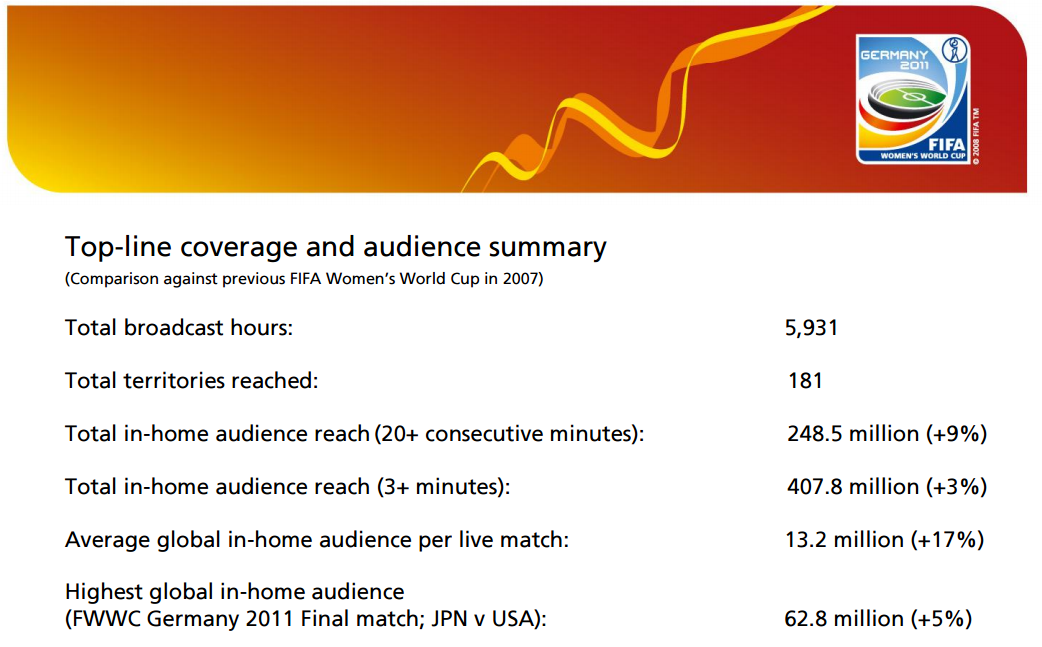
On the other hand, 2011 saw ESPN have its highest rated soccer game of all time in the 2011 final between Japan and the United States. Television audiences were up around the world in 2011 compared the 2007 Women’s World Cup as well.

2011cup

This year offers a good blend time zone friendly starts — the early afternoon games are perfect for Europe — new programming and embracing the fans with second screen options for what is shaping up to be the biggest Women’s World Cup yet.

(Header image via FIFA)

Orlando City Soccer Club Pairs with Bright House Networks for Stadium Ammenities

Orlando City Soccer Club, one of Major League Soccer’s newest expansions, has signed an exclusive deal with internet and communications company Bright House Networks. Set to provide in-house high definition video, phone service and managed Wi-Fi as well as dedicated internet, Orlando City SC joins other MLS stadiums such as Sporting Kansas City and Vancouver Whitecaps FC among others to offer free Wi-Fi.

Phil Rawlins, President and Founder of Orlando City SC, believes this partnership will benefit the fans and club alike, stating

“As a club that is passionate about innovation and prides itself on constantly looking for ways to enhance our supporters’ experience, we are excited to partner with Bright House Networks. Through this partnership, we will offer our supporters a way to stay connected at our stadiums and enjoy interacting with each other during games.”

Fans using an immense amount of data at a sporting event is nothing new, though the usage of phones and tablets while at live game isn’t for everyone. Last year PSV Eindhoven, a perennial powerhouse in the top Dutch league, Eredivisie, had extremely vocal fans come out against the implementation of Wi-Fi in their home stadium (warning: language). As the linked article notes, Manchester United — arguably the most recognized name in soccer — banned iPads and tablets from its home stadium last year.

On this side of the Atlantic, it’s hard to imagine a sports fan base being hostile towards in-stadium Wi-Fi, if anything, the opposite is true: fans are beginning to wish for more connectivity. The difference in opinion could be cultural, or based on the differences in mobile phone billing between here and Europe. Phone and tablet subsidies aren’t a thing in Europe, and thus the monthly bill is much lower than in North America. Regardless of the reasons, Wi-Fi and devices are gaining ground in stadiums here, but not so much abroad.

Home field advantage on the soccer pitch, something that is somewhat quantified in a study for the Premier League, reached a point where a rule was involved across multi-league events back in the 1960s. Since the introduction of the Away goals rule in UEFA, not conceding goals at home is very important, and fans tend to believe they can help their team. Be it through signs, chants and songs or general participation, it isn’t hard to see why certain groups of fans would respond negatively to something they perceive as taking away from their home field advantage.

(Header image via Wikipedia)