Archive for fitness

Strava’s Expanding Role

Strava, makers of the workout app of the same name — available for free on iOS and Android — is venturing further into their client’s lives. On top of their GPS tracking, challenge-a-friend routines and viewable stats, Strava is seeking to join you up with local runners and cyclists as well.

With their Strava Metro system already in place showing where people are running or biking, the next step for the company seems to become a social app as well as a fitness one. With $18.5 million from the latest investor group, Sequoia Capital, and prior groups Sigma West and Madrone Capital Partners, Strava is seeking to bring fitness-minded people together.

In a press release, Michael Moritz, Chairman of Sequoia Capital said:

“Strava is building tomorrow’s sporting network in the manner that Facebook and LinkedIn have developed today’s social and professional networks. Even for the hapless and occasional athletes at Sequoia, Strava has become the essential and amusing way to post and compare our woeful performances and share them with friends and family,”

From using Strava Metro to map out a popular routine, to soon being able to map out a group run with similarly-conditioned strangers, Strava is aiming to becoming a social workout company. Strava already ties in with Instagram so hashtagging, taking morning sunrise pictures or anything that may catch one’s eye is quick and easy. Given the recent investment and the idea on how to use said investment, Strava CEO Mark Gainey was quoted as saying:

“Since day one we have focused on building a network that serves to motivate and entertain the world’s athletes. With Sequoia joining our team, we are better positioned to execute our mission and strengthen Strava’s leadership in digital sports.”

According to the company FAQ, Strava has collected over 300 billion GPS points and boasts over 2.5 million GPS tracked activities being uploaded each week. With funding in hand, a growing user base and a constantly expanding sample size, Strava appears to be the app of choice for many running and cycling enthusiasts.
Potential Breakthrough in ACL Injury Prevention

Most everyone remembers the old “shin bone connected to the knee bone, knee bone connected to the thigh bone” song. While not exactly taught in medical school, everything in the leg is connected one way or another. And according to a recent study, calf muscles, not hamstrings may have more to do with ACL and knee injuries than previously thought.

The study was conducted by The University of Western Australia’s School of Sport Science as well as the University of Tennessee’s Exercise and Health program. The groups observed a series of Australian Rules football players each doing single leg jump landings while attempting to grab a football.

Analysts set up a series of 12-cameras to create a three-dimensional computer model of each football player’s jumping and landing. The findings surprised the researches and Assistant Professor Cyril Donnelly of UWA said:

“This was initially surprising as 30 years of clinical research has suggested the hamstring muscles were key players for supporting the knee during sporting tasks, We are not saying you don’t use your hamstrings, just not as much as we originally thought.”

The previously linked article states over 200,000 ACL injuries occur every year in the United States alone, and these numbers by the University of California, San Francisco claim approximately 70% of these injuries occur playing sports. Soccer, football, skiing and basketball being the primary sports behind ACL injuries.

Be it a figure skater coming off of a double-axel, a defender trying to head a corner kick out of his box or an outfielder leaping at the wall to rob a home run, one-leg jump landings are incredibly common in many sports. From an injury prevention standpoint or even rehabbing post-injury, perhaps we’ll begin to see trainers and medical staff focus more on the calf when dealing with ACL issues.

(Header photo via Becky Stern)

A Workout Worth Your Time

From the “8-minute abs (VHS alert!) ” to even the “7-minute abs” we have seen time become a critical factor in choosing our workouts. From jogging just every other day to maybe twice a week, to perhaps once a week, I’ve seen the ugly side of sitting at a desk firsthand. Things changed for the better last year when The New York Times launched their Scientific 7-Minute Workout app and today they released the advanced version for iOS and Android. Now between the two apps, the combined workout is still probably less than your commute to work.

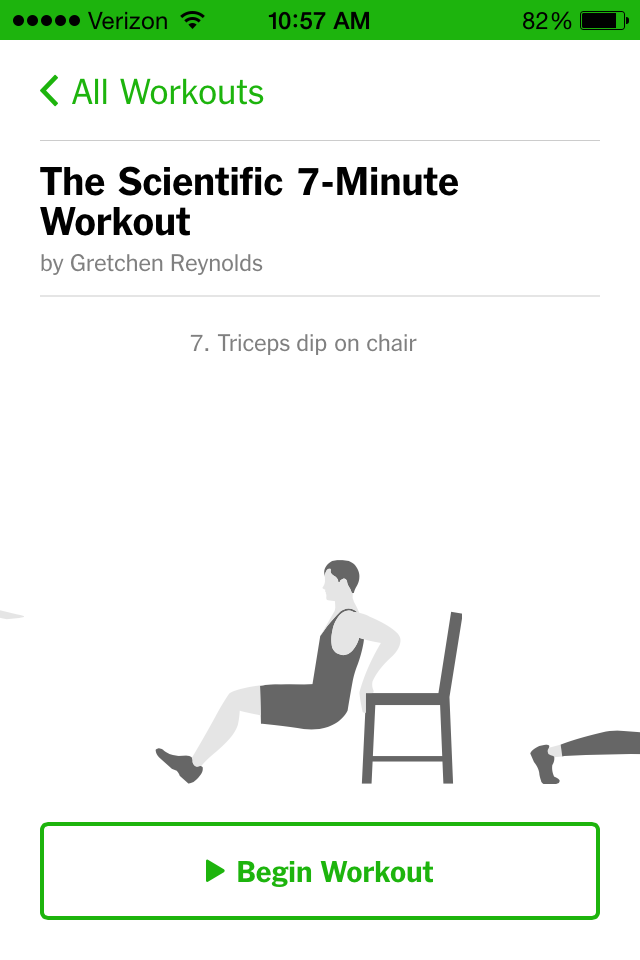
The original 7-Minute Workout required only yourself, a stable chair and the wall isn’t particularly challenging, but still well worth the minimal time investment. A non-rolling chair is best suited for the required tricep dips, but if all you have is a roller then make sure to brace it against the wall.

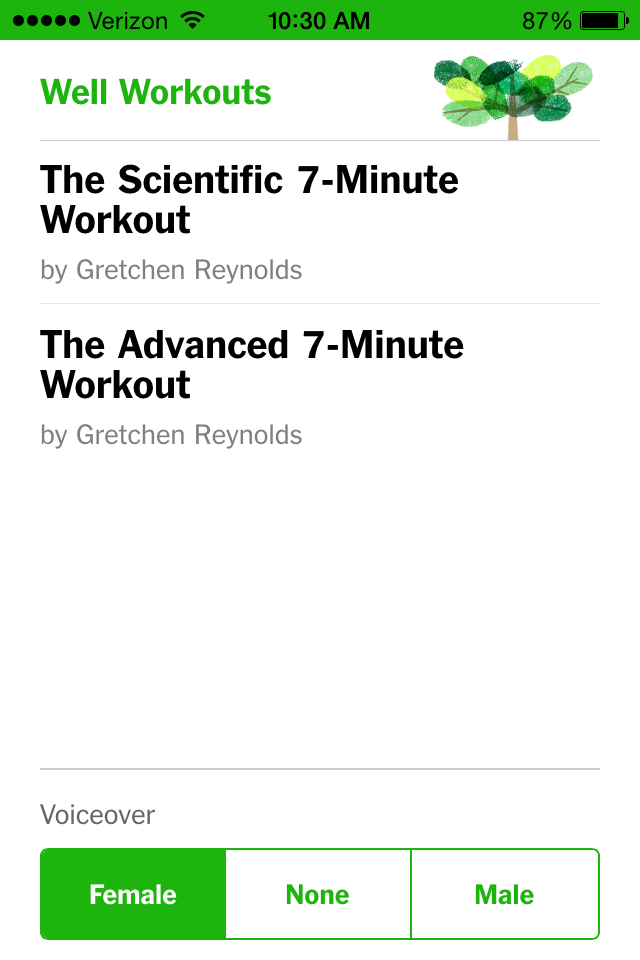
workout3To help guide you on your quest to workout more frequently is a voiced personal trainer. You’re able to pick either male, female or no voiceover whatsoever. Be warned, if you do opt for the trainer, your music — at least on iOS — will stop playing. It isn’t the end of the world, but I can’t remember the last time I worked out without any music to distract me.

workout1The advanced version requires a pair of dumbbells — of whichever weight you feel comfortable to start with, you can always increase the weight as you progress — but those are something that can be found fairly cheap either online or at any sports store. The advanced workout is defined as:

“A more demanding nine-step regimen than the original 7-Minute Workout, one that requires of a couple of dumbbells but still only takes seven minutes.”

After going through both workouts this morning I can already tell I should do these more frequently. Luckily it is basically winter here in midwest, so I can rationalize and consider these extra pounds to be my hibernation weight. Both the standard 7-Minute and the Advanced 7-Minute Workouts are well worth the time. Given the accompanying price of absolutely free, I highly recommend this for anyone else who finds themselves pinned to a desk 40+ hours per week. The app won’t immediately whip you into shape — diet of course comes to play — however for less than a quarter of an hour each day, there is no reason to pass on it.

A full step-by-step workout guide is available at The New York Times link posted in the opening paragraph or by clicking here.