Archive for fanduel

This is the Way Daily Fantasy Ends — Not With a Bang, but With a Whimper

This is the Way Daily Fantasy Ends — Not With a Bang, but With a Whimper

Last night, I was at a fantasy draft party (12-team auction, for those who care). The television was on in the background as people were preparing their spreadsheets and whatnot, when an ad for a daily fantasy sight came on. I’m not being coy be neglecting to mention which one, I honestly don’t remember. Those ads are so ubiquitous, that they rarely seem to grab anyone’s attention, but when it came on the TV at the party, a guest looked up and said “do people still do that?” He was being a bit facetious, of course, as people certainly still do, but we might be honestly getting to the point where scandal and legal hassles the constant state of flux of the industry might be enough to lay daily fantasy — or at least the behemoth it has shown to be not terribly long ago — to rest.

The most recent cut-down of daily fantasy comes in the form of an announcement that DraftKings and FanDuel will cease offering contests that include NCAA games. Reading between the lines, it appears as if the NCAA was giving DraftKings and FanDuel the business, and since college sports were a minor part of the business and the two companies already have enough legal stuff to deal with, they threw in the towel.

It’s those legal troubles that would most likely spell doom for the two companies, should that come to pass. The bottom line is that many states are now looking into whether daily fantasy should be considered gambling. If it is, then it can’t be allowed to occur on the Internet thanks to the Federal Wire Act that, although its reach has been questioned, states that bets cannot be placed over communication channels like phone or Internet lines. As of this writing the commonwealth of Virginia has allowed daily fantasy to take place on its soil, so long as certain restrictions and regulations are in place. New York State originally filed an injunction to stop daily fantasy operations, then was overruled, but in the end FanDuel and Draftkings stood down on the issue, hoping that legislation will be passed allowing their sites to continue operating in the state. Yahoo! Daily Fantasy volunteered to do so as well, seemingly to remind the general public that they exist.

The legal back and forth will be a very interesting one to watch, with many ramifications involved. The things is, if litigation and appeals and everything else involved in the process goes on as long as it looks like they will, none of this might even matter. If daily fantasy doesn’t burn out, it might just fade away.

FanDuel and DraftKings will always have their loyal customers — those who spend lots of time and money on these sites and who will be watching in earnest as the rulings and laws come down state by state. These people aren’t who daily fantasy sites should worry about. They need to worry about the casual player, the person who gets the wild idea to drop $10 or $20 or $50 on a random contest one Sunday to try their luck. The common person. The square. This is who these sites need.

Remember, none of these sites actually care about how any one player does. They don’t lose money if Andrew McCutchen has a better night than Mike Trout. They just let the players duke it out while they take their 10% off the top. The model is pretty much the same for sports betting at casinos. The casinos want an even amount of bets on either side. The losers pay the winners and the house gets the juice. DraftKings and FanDuel acutally have a better model. The casino can still get hosed on a one-in-million bet cashing in. Daily fantasy doesn’t give a crap. It just needs players. It needs bodies that are willing to pay a fee (and forget that the odds are stacked against them) so that it can take its share. But without Joe Sixpack kicking in his money, there is less of a pot to skim from.

The big hitters and the sharps will still have their high-stakes games. If they live in a state where the contests are banned, they’ll find shady workarounds to keep playing. But your coworker or next-door neighbor won’t. If they can’t play, they’ll … just stop playing. And even if the laws are changed or massaged enough where they could theoretically start again, most won’t, or at least not as much. The thrill will be gone. Daily fantasy’s biggest enemy isn’t the law, it’s attrition.

FanDuel and DraftKings aren’t just interested in a positive decision, they need a fast positive decision. Time is of the essence here, as they need to both counter rulings and legislation against them in some states while regaining the right to do business in other states all in a timely enough fashion that the public doesn’t forget about them. So far, it’s not looking good. Layoffs are happening. Funding and partnerships are being pulled. All this effort may end up being just some rearranging of deck chairs.

This is not to say that these companies can’t make a comeback. If they laws fall in their favor, and cloud of doubt is blown away from the industry, the investment money and partnership deals will come rolling in right quick — no hard feelings, right? And maybe they can gain a second wind and intice people into coming back (now 100% legal!) And we may once again be carpet bombed with ad after ad regaling us with stories of average people becoming millionaires overnight. But some serious legal kung fu has to happen first. Luckily for these companies, they have the scratch to spend on top-notch lawyers.



DFS Losers Seek to Recoup Losses in Class Actions Against FanDuel, DraftKings

Last week, a DeKalb County, Georgia resident, Aaron Hodge, filed two proposed class action lawsuits in federal court in Atlanta against daily fantasy sports (DFS) websites FanDuel and DraftKings in an attempt to recover money he lost playing games on both sites, which, he alleges, amount to little more than “illegal gambling.”

As DFS gained popularity and attention this summer and fall, in large part due to broad advertising campaigns by both FanDuel and DraftKings, users may have noticed that residents of a small number of states– including Washington, Louisiana, Arizona, and Iowa– were not allowed to play games for cash prizes.

While these early restrictions did little to slow the momentum of DFS and its two largest sites, the industry recently has come under more substantial public scrutiny following New York Attorney General Eric T. Schneiderman’s initiation of an investigation of and request for an injunction against FanDuel, DraftKings, and Yahoo!, which also hosts DFS games.

Last week’s suits by Hodge are believed to be the first legal challenges to FanDuel and DraftKings brought by a private citizen. (Hodge’s attorneys have since filed a similar lawsuit in Alabama.) Hodge’s complaints (available here and here) are basically identical. The essence of his allegations is that the DFS games offered by FanDuel and DraftKings constitute unlawful gambling under Georgia law and he therefore is entitled to restitution for his losses at both sites. Hodge does not reveal how much money he lost playing DFS, but he does allege that the aggregated losses of the proposed classes — comprised of “All persons in the State of Georgia who participated in Defendant’s DFS, deposited money in a [FanDuel/DraftKings] account, and lost money in any game or contest” —  exceed $5 million in each case.

Hodge’s complaints allege only state law claims, and the legal centerpiece of these cases is O.C.G.A. § 13-8-3, Georgia’s gambling contracts statute. That law provides that all “[g]ambling contracts are void” and that a loser may recover his or her losses from a winner under a gambling contract:

(a) Gambling contracts are void; and all evidences of debt, except negotiable instruments in the hands of holders in due course or encumbrances or liens on property, executed upon a gambling consideration, are void in the hands of any person.

(b) Money paid or property delivered upon a gambling consideration may be recovered from the winner by the loser by institution of an action for the same within six months after the loss and, after the expiration of that time, by institution of an action by any person, at any time within four years, for the joint use of himself and the educational fund of the county.

Hodge argues that DFS contests on FanDuel and DraftKings are not skill games but rather games of chance; that these sites therefore are doing little more than taking bets on sporting events; and therefore he and the sites are parties to gambling contracts for which the user entry fees constitute the gambling consideration that Hodge is entitled to recover under O.C.G.A. § 13-8-3(b).

Among his other claims, Hodge also contends that the sites violate Georgia criminal laws pertaining to commercial gambling and the advertising thereof, and he argues that the sites’ claims that their DFS contests were lawful games fraudulently induced him to participate.

An interesting allegation Hodge sprinkles throughout his complaints is that both FanDuel and DraftKings “failed to disclose the use of ‘bots’ or fake accounts designed to operate as ‘shills'”:

Upon information and belief, [FanDuel/DraftKings] uses “bots” or fake accounts to act as “shills” in the gambling scheme in order that certain winnings go to the “house” ([FanDuel/DraftKings]), and also creating the illusion to the [FanDuel/DraftKings] user of interacting with a gambler on equal footing. The employment of “shills” (or “bots”/fake accounts) employs a similar concept to those “shills” that are permitted by law in states with casinos such as Nevada, but Georgia does not permit any gambling, never mind the use of “shills” in the form of “bots” or otherwise fake accounts. And regardless, in states where such devices are employed, there is no illusion, nor effort to create the illusion, that the “house” is not winning the losing bets (in the form of monies that are attributed to “shills”) and in the case of [FanDuel/DraftKings], there is no disclosure of the use of “shills” nor any legal basis for doing so in Georgia.

One of the first procedural hurdles Hodge will need to clear to proceed with his proposed class actions in federal court are the sites’ terms of use. He wants to avoid the applicability and enforcement of these terms of use because they contain arbitration, jurisdiction, and venue provisions that would neutralize his ability to maintain these class action lawsuits against FanDuel (terms of use) and DraftKings (terms of use) in court. On one hand, Hodge is arguing that a contract — albeit a gambling contract that’s void under Georgia law — existed between him and each DFS site. On the other hand, though, he argues that the sites’ terms of use are not part of any contract or binding agreement between him and each site.

If Hodge is able to keep these lawsuits in the U.S. District Court for the Northern District of Georgia, where he has filed them, his further success will depend upon his ability to convince the court that the DFS contests FanDuel and DraftKings host really are gambling, not skill games. On this point, in addition to the well-publicized New York AG investigation and Nevada’s determination that DFS constitutes gambling, he may find some in-state assistance as well. Georgia Attorney General Sam Olens now has opened his own investigation into the legality of DFS, and the court in Hodge’s cases could find Olens’ conclusions on the matter persuasive.

Another issue possibly lurking in these cases is preemption, a legal concept based on the supremacy of federal law over state law. In general terms, preemption means that if a federal law and a state law conflict, the federal law controls. On the question of whether their sites’ contests constitute gambling, FanDuel and DraftKings may argue that their contests are permissible under the Unlawful Internet Gambling Enforcement Act (UIGEA), a federal law that prohibits certain activities and transactions connected with betting and wagering. Part of that Act provides that “[t]he term ‘bet or wager’ . . . does not include . . . participation in any fantasy or simulation sports game . . . in which (if the game or contest involves a team or teams) no fantasy or simulation sports team is based on the current membership of an actual team that is a member of an amateur or professional sports organization . . . and that meets the following conditions:

(I) All prizes and awards offered to winning participants are established and made known to the participants in advance of the game or contest and their value is not determined by the number of participants or the amount of any fees paid by those participants.
(II) All winning outcomes reflect the relative knowledge and skill of the participants and are determined predominantly by accumulated statistical results of the performance of individuals (athletes in the case of sports events) in multiple real-world sporting or other events.
(III) No winning outcome is based—
(aa) on the score, point-spread, or any performance or performances of any single real-world team or any combination of such teams; or

(bb) solely on any single performance of an individual athlete in any single real-world sporting or other event.”

If FanDuel and DraftKings fit within this exception to the Act, because, for example, their contests involve forming “fantasy” teams of selected individual players, as opposed to simply picking an existing team, like the Detroit Lions, to win, the sites may contend that the federal UIGEA preempts the conflicting state laws Hodge argues make their contests illegal and entitle him to recoup his losses. (For what it’s worth, the congressman who drafted the UIGEA, Jim Leach, doesn’t buy any part of this argument. According to the Associated Press, Leach’s view is that “the carve out for Fantasy sports in the [UIGEA] does not provide them with immunity against other federal and state laws that could limit their activities. . . . ‘Quite precisely, UIGEA does not exempt fantasy sports companies from any other obligation to any other law.'”)

Meanwhile, as legal scrutiny over DFS heats up in the United States, FanDuel and DraftKings are hoping to find friendlier regulatory environs abroad. Some wonder whether their expansion into the United Kingdom may come back to haunt them stateside, however. Calling themselves “gambling software” companies, both sites have applied to U.K. regulators for gambling licenses. DraftKings received a gambling license in August, while FanDuel, which applied this month, still is waiting on a decision. DraftKings’ Chief Internal Officer says he doesn’t see a contradiction between the site’s representations in the U.S. and U.K., but American officials, including the judge or judges handling Hodge’s lawsuits, may see things differently.

(Header image via Karsten Bitter)

TechGraphs Report: On Deck Sports and Technology Conference

Earlier this week, NYC’s Bohemian National Hall played host to hundreds of sports executives, entrepreneurs, and others looking to learn about the very latest in sports technology. Since 2013, the On Deck Sports and Technology Conference (organized and presented by SeatGeek) has provided a forum to showcase what products are “on deck” to help fans follow, analyze, and participate in sports.

On Deck has a slight bent towards sports startups, so a decent amount of the conference was geared more towards raising capital, scaling businesses, etc. Still, there were plenty of fascinating talks, panels and interviews for anyone interested in straight sports tech.

Statcast And Beyond

Possibly the most entertaining talk of the day was Joe Inzerillo’s (CTO, MLBAM) update on MLB’s Statcast, which is finally getting its moment in the sun this season. For those who needed a refresher on how Statcast operates, Inzerillo discussed its missile-technology radar system, its stereoscopically-placed cameras, and how these allow each Major League ballpark to track the movements of every player on the field (plus the ball) at any given time.

Once Statcast has this information, as Inzerillo pointed out, it can then provide real-time data on pitch velocity (actual and perceived), player velocity and reaction time, and a horde of other quantitative metrics, plus more advanced data on a 12-second delay, like fielding route efficiency. This data is just inherently cool (as you likely know if you’ve seen a Statcast-enhanced game or highlight on television), but it’s also already being used to both question and confirm existing baseball strategies.

For an example of the latter, Inzerillo looked at the fallacy of sliding into first using Statcast to plot Eric Hosmer’s 1B slide in Game 7 of the last World Series. Hosmer hit a peak speed of 20.9 MPH before sliding and being out by less than a tenth of a second. If he had just kept running, Statcast found, he would have been safe by nearly a foot. Statcast is already getting noticed by clubs, and even players — batters like to talk smack, apparently, over who has the highest exit velocity.

During questions, Inzerillo was slightly cautious about committing to the future of Statcast, but he did mention that minor league stadiums were a natural next step, and that there was plenty of work being done on developing new metrics. Statcast already tracks ‘defensive range’ for fielders, for example, but since a player doesn’t travel the same speed in every direction, there’s a need to find the more amorphous ‘effective defensive range’ and how it changes–such as during defensive shifts.

On the football side of things, Sportradar’s Tom Masterman talked about the NFL’s NGS (Next Gen Stats) platform, which is collecting data on every single game in 2015 to track, analyze, and visualize how players are moving on the field. NGS is already being distributed to clubs, media, and health and safety personnel; the long-term goal is to have X,Y,Z coordinates for every player and official, plus the ball.

Go Bucks

On Deck’s attendees weren’t just league officials and startup managers–the conference started with a live interview of Wes Edens, who became co-owner of the NBA’s Milwaukee Bucks in 2014. Much of the conversation focused on the new Bucks arena, which was being voted on by the Milwaukee city council literally as the interview was ongoing. As it’s currently planned, the presently-unnamed arena will focus heavily on keeping fans digitally connected — giving attendees plenty of WiFi, for example. At the same time, Edens noted, they want to avoid fans using technology to become distracted from the game going on in front of them. (Edens used the phrase “Instagram culture”, specifically, though he noted that he himself has had these sorts of problems before.)

Edens was similarly balanced when the discussion turned to analytics. One of the first things Edens did after buying the Bucks was to build their analytics program — bringing on employees, consultants and even discussing methodologies with other owners. There’s definitely a “golden age” of analytics in basketball going on.  Edens even thinks the NBA will end up surpassing the MLB as the leader in sports technology. But when he was asked about how the players feel?

“It’s a good question,” Edens replied. “There’s definitely lines that can be crossed” with having too much data being made public, at least when it can affect the privacy of the players (such as rest/injury issues).

Edens also briefly discussed the role of the referees and the potential benefits of replay and “the new center across the river“. Could we see yet more referee technology, even an Oculus Rift-type headset for NBA officials, in the future? “Totally possible.”

Era of Mobility

When it came time to look at how fans themselves were interacting with sports, technologically, it became clear that mobile is “it.” In that panel about growing sports startups I mentioned earlier, representatives from SeatGeek, FanDuel and Krossover all praised the importance of the mobile web for their companies–SeatGeek’s rep described it as a “tale of two companies”, pre- and post-mobile, and Krossover’s founder mentioned they’re considering dumping their web app altogether in lieu of just being on smartphones and tablets. When Yahoo Sports’ VP of engineering presented a chart showing their fantasy football traffic from this season’s Week 1, the fraction of non-mobile data was a pretty small sliver at the top.

Yahoo fantasy data graph
Trust me, it’s there.

Even companies you might never expect to get in the mobile game are joining and succeeding. Jeremy Strauser had 20 years of gaming experience at EA Sports and Zynga before joining one of the most loved and enduring brands in the sports industry, Topps. Yep, they’re digital playing cards.

Topps first got into the digital game 4 years ago and how has three top-selling sports card apps, plus a newly launched Star Wars-themed set. Why should you be interested in buying trading cards on your phone? One starting point is the capabilities the digital platform provides — literally hundreds of thousands of different designs, the ability to create all manner of rare and unique cards, etc.

Topps is also rolling out a daily fantasy sports feature (DFS was a major topic of conversation at On Deck) that allows you to compete using the players in your card deck and swapping them in and out in real time as they go up to pitch or bat. It probably doesn’t hurt, either, that they won’t take up space under your bed or get thrown out by your mom when you’re away at college.

Topps conference talk

Coming To Your Hometown

If you want to look for the next wave of sports technology, though, look to your neighborhood.

Rather than providing new tools or analytics for MLB, the NFL or the NBA, the newest sports apps want to help you participate in sports in your own town. On Deck wrapped up with a “Startup Pitch Contest” a la Shark Tank where teams had four minutes to present their groundbreaking app to a group of judges. The six competitors included:

  • Wooter – a search engine for finding and joining sports and activities like local rec leagues. Wooter provides profiles for leagues looking to form teams, players looking to join them, and the tools to process payment and set up other logistics.
  • NextPlay – helping youth coaches conduct tryouts and league drafts. For $15/month, instead of taking a stopwatch, a bunch of handwritten notes, and an Excel spreadsheet to put together youth rosters, NextPlay handles all the data collection and analytics itself. Their beta has been used by “a couple hundred organizations” and over 10,000 athletes.
  • ScoreStream – filling a gap in local journalism by crowdsourcing reports on high school sports.

With a really impressive presentation, broad coverage (10,300 HS games covered last week alone) and the #1 iOS app for high school sports, I really thought Scorestream would walk away with the prize, but it ended up going to…

  • SidelineSwap, a P2P marketplace for sporting goods. SidelineSwap has over 43,000 registered users who’re interested in trading out sporting gear just collecting dust in their basement or garage. They’re working on building partnerships with youth organizations and promoting used college-branded material, which should play very well with their chief audience of high school students.

On the whole, On Deck was a whirlwind experience for learning about cutting-edge sports tech. This report only covers part of everything I caught there. Watch for further updates and profiles soon!


Is Yahoo! Daily Fantasy the Third Wheel?

The two titans of daily fantasy sports (DFS), DraftKings and FanDuel, have new competition. Recently, Yahoo! has joined the daily fantasy goings on in addition to their traditional fantasy sports leagues. The market growth of DFS sites has taken off on a meteoric rise, and according to Forbes there was an 847 percent rise in participation from September 2013 to September 2014. As the newest option in a popular area, Yahoo!’s approach is slightly different than both DraftKings or FanDuel.

Right off the bat, the aesthetics of Yahoo! appears similar to FanDuel. From left to right, we have the Yahoo!, FanDuel and DrafKings interfaces (click to embiggen).

dfs

Beyond the layout, Yahoo! has seemingly drawn influence from both FanDuel and DraftKings for the gameplay itself. Just like in DK, Yahoo! allows users to draft up to 10 players rather than the nine of FD, the difference being two pitchers in the former and one in the latter. Despite the identical rosters to DK, Yahoo!’s player prices are much different than anything we’ve seen before.

Rather than use the $50,000 or $35,000 salary allotment of DraftKings and FanDuel respectively, Yahoo! has a $200 scaled budget. As a percentage, the prices aren’t terribly different, but I found myself having a surprisingly difficult time adjusting. Of course, the prices are different because the scoring is different as well.

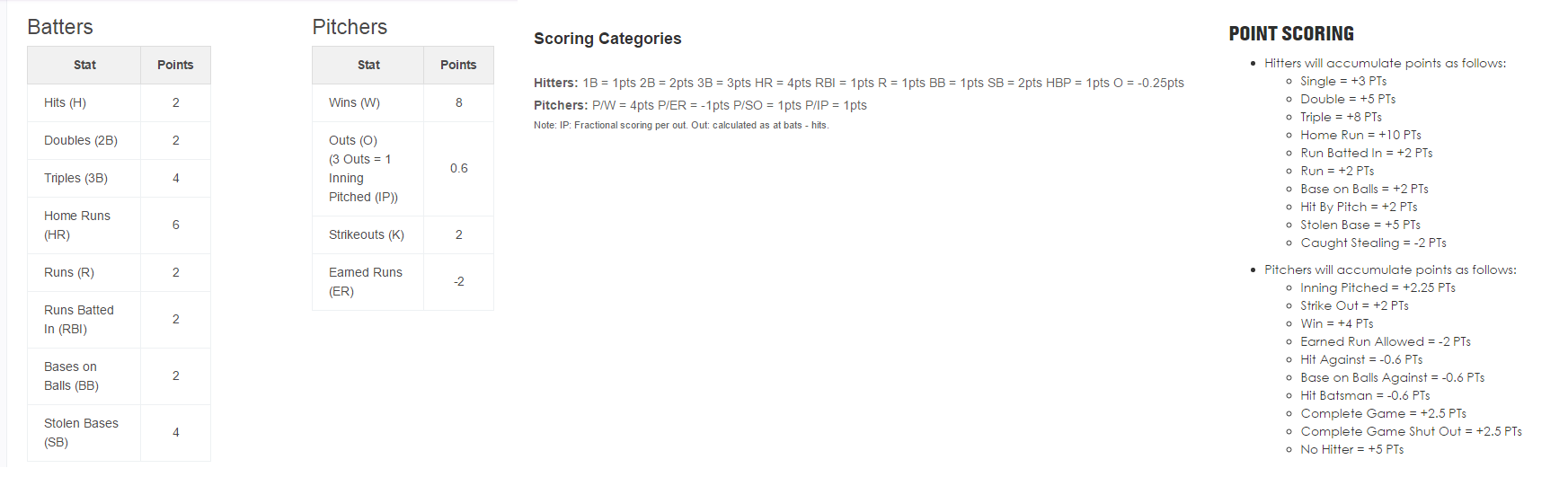
With the same left to right as before, the following picture shows the scoring differences between the three sites.

scoring

Where both FanDuel and DraftKings have negative stats for batters — -0.25 points for any out on FD or -2 points for a caught stealing on DK — Yahoo! doesn’t have a way of punishing poor batting or base running performances. Pitching statistics are even more varied as wins are very heavily valued in Yahoo! at eight points compared to four points for DK and FD. Yahoo!’s only negative pitching category is giving up earned runs, same as FanDuel, to the tune of -1 point per earned run surrendered. For example, let’s say a pitcher costs 20 percent of your budget in any of the three site ($40 in Y!,$ 7,000 in FD and $10,000 in DK) . He records a win after going seven innings, gives up two runs on a pair of solo shots, plus two other hits, two walks and strikes out seven batters, his point totals for each site are:

Yahoo!: 30.6 points
FanDuel: 16 points
DraftKings: 23.35 points

Thanks to the numerous negative pitching stats in DratfKings (hits and walks in this example specifically), you get hands down the least bang for your buck with pitchers compared to FanDuel and Yahoo!. The latter in particular places a massive emphasis on wins at eight points. Such huge upside in pitches in Yahoo! with minimal downside — no negative points for any hitter outcomes and only being penalized on pitcher earned runs — makes stacking your Yahoo! lineup with the best pitchers in line for the win is hands down the best option. This isn’t a flaw, a strength or a weakness on Yahoo!’s behalf, but it is certainly something to exploit.

The biggest issue I have with Yahoo!’s current layout is the lack of weather information for each game. DraftKings at least displays weather info at the top of the screen when you enter a contest.

weatherdk

FanDuel leads the way with a full weather forecast for each game, including chance of rain by percentage and if the game will be played in an open stadium, retractable roof or dome.

weatherfd

I’d always recommend cross checking the weather for the games as in any DFS format it hurts to lose a batter to a rain out and losing a starting pitcher is like throwing money away. Adding in weather seems like something fairly easy, as Yahoo! already has an entire page dedicated to weather around the world.

Beyond the weather related issues, Yahoo! has a bigger concern when it comes to attracting players to its new daily fantasy area. During its launch, Yahoo! promised a $22,000 prize pool, guaranteed even if the contest wasn’t filled. At a $1 minimum entry for the 10,000 player league, it sounded like a good way to gather new DFS players. Unfortunately the wording tripped up many players and saw the $22,000 guaranteed prize pool would be split up if the contest wasn’t filled, and not the way Yahoo! broke it down. The way $22,000 was guaranteed was awarding $2 to the 29th-10,0000 place finishers. So, if it the contest was full, then yes, the full $22,000 would have been handed out. Unfortunately calling a prize pool $22,000 and then not delivering the full amount flies in the face of every other DFS league or entry I’ve ever entered.

For now I’ll stick with DraftKings or to a lesser extend FanDuel to fulfill my DFS cravings. I know they pay out what is advertised, I’m familiar with the scoring, and having to open one less tab for immediate weather reports makes it convenient.


NBA Announces Exclusive FanDuel Deal

The NBA just agreed to a 4-year deal with fantasy website FanDuel according to both TechCrunch and ESPN. For daily fantasy players, this means FanDuel will be the exclusive website to get your hoops fix at. Already on the NBA Fantasy site you can be linked to FanDuel and expect the association to promote it on their apps as well as their streaming ads and commercials.

Currently FanDuel offers both free and pay-to-win leagues. The prizes for these range from cash to game tickets to merchandise. Now with the association in their pockets, FanDuel and the NBA, along with money from venture groups such as Shamrock Capital Advisors and NBC Sports Ventures, will be able to reach and attract even more customers.The growth in the daily fantasy industry is on a massive rise, as FanDuel has increased by 650,000 paying players in the past three months after never before having even a third of that many in a single quarter. FanDuel claims they project to make approximately $600 million in entry fees this calendar year while handing back $540 million in prizes.

While this is new territory for the NBA as a whole, five teams had prior deals with FanDuel; the Brooklyn Nets, New York Knicks, Orlando Magic, Dallas Mavericks and Chicago Bulls. The move also includes NBA league executive Sal La Rocca as a FanDuel board member, further strengthening the ties between the two entities.

With competitor DraftKings snapping up the NHL, this deal makes sense for FanDuel. Given the massive interest and ease of use for daily fantasy leagues, it appears as though both FanDuel and DraftKings will the main entities of daily leagues going forward. With both sides throwing around millions of dollars, the money is driving even more attention to fantasy sports.

(Image credit to NBA.com) 

FanDuel Hits Server Trouble at Critical Time

Daily fantasy sports site FanDuel, fresh off their recent cash influx, ran into a bit of a problem on Sunday. Mainly, a whole host of fantasy players were unable to access the web site or mobile app to enter new contests or update current rosters. About 30 minutes before the 1 pm ET kick-offs, an important window for fantasy as this is usually when teams announce active and inactive players, FanDuel began performing poorly, with slow load times and spotty page loads. Eventually, the site degraded to the point of unusability. With only a few minutes before some teams kicked off — at which point rosters would lock — this left many people high and dry with unentered contests, unwanted rosters, and even injured players destined to gain zero points.

There was, shall we say, a fair deal of unhappiness among fans. A simple search of Twitter can tell you as much. And some of it was, in fact, justified. Many of FanDuel’s games cost money to play, and they run high-stakes tournaments like the World Fantasy Football Championships. When so much is on the line, the ability to change a roster in the final minutes is a necessity.

At the time, FanDuel did not seem to be responding to concerns on Twitter, but did offer one concession about a half hour after the opening kickoffs.

This gave users about 30 minutes to request a refund, assuming said users even saw the singular tweet.

Fantasy sports is becoming an ever-growing business. But, as FanDuel found out, a bigger user base can create bigger problems down the road.