Archive for esports

The US Digital Gaming Market

It’s starting to become less and less crazy to call the United States digital games market a billion dollar industry. Thankfully, according to SuperData Research, it is estimated at $995 million, a 2% increase over last year. That number represents money going to the developers, and does not account for in-game trading and betting.

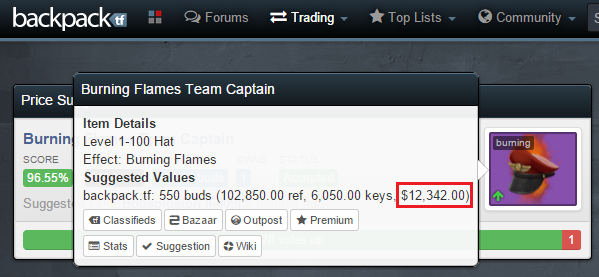
For a taste of how much money trading and in-game economy represents; Yanis Varoufakis, formerly Valve’s chief Team Fortress 2 economist is now the Finance Minister for Greece. Yes, from valuing digital items and pixels to a helping run a country, the economic factor of modern games is not to be understated. A single hat in TF2, the Burning Team Captain, is famous for being a ridiculously priced item, namely about $12,000.
tf2price

Of the $995 million mentioned, some of that is gathered from monthly subscriptions, mostly from massive multiple games. SuperData Research shows five of the most popular MMO subscription games in the US in the table below.

GRAPH-SuperData_EastWestRevenueSplitTopP2PMMOsThese subscription-based numbers are missing free-to-play League of Legends and Dota 2, arguably the two biggest multiplayer games in the esports scene. LoL is known for its massive following and Dota 2 is famous for its huge userbase and even bigger prize pool at the yearly tournament known as The International. Esports have become mainstream when the dollars being thrown around rival that of not only major sports franchises, but entire leagues.
(Header image via Shawn Carpenter Photography)

Competitive Minecraft Has a New Option

Minecraft, the open sandbox style game Microsoft purchased — along with the entire Mojang company —  for a staggering $2.5 billion could be entering a new competitive phase. Given the recent attention towards esports from ESPN, theScore et al, it should be no surprise that Minecraft, the best selling PC game of all time, is getting some love. Over at Kickback.gg (though the site is still just an open Beta) Minecraft players have an option of going against each other either for free or with money on the line.

Between the 34 million player base on computers and consoles plus an additional 30 million mobile users, Minecraft could be on the eve of new multiplayer day. The registration at Kickback is free, though in order to win money you’ll have to deposit some cash in order to wager it. If you’re not quite ready to put your money where your mouth is, there are free games as well. For just $1 per game, any confident player will probably take a crack at it.

The player vs player matches (PvP) will take place on pre-made servers in order to prevent cheating or any suspected tampering. In a world where bets at CSGO Lounge reach millions of dollars per day on Counter-Strike matches, it was only a matter of time before competitive Minecraft cashed in. Unlike other games like ESEA, CEVO and FACEIT, there is no league entry fee  — the the latter two companies do offer free competitive ladders and leagues. It seems as though Kickback is looking to fill the cravings of a competitor on the short-term. Rather than be obligated to compete in official matches, it is a simple as joining the site and jumping in-game.

Think of it in terms of fantasy sports — rather than signing up for six months of a fantasy baseball league, Kickback is a daily sort of thing with minimal commitment. If the success of DraftKings and FanDuel is any indicator in terms of short-term entertainment, Kickback could be something big.

(Image via postapocalyptic)

Gaming Communities Are The New Sports Fans

Earlier today Venture Beat posted an article with polling data on esports fans who have attended live events — not only attended, but as spectators and specifically not as participants. Much like professional sports, the pro scene in esports has a strong following, arguably a stronger (though not necessarily better) social media presence due to the more unfiltered and less politically correct realm of the internet community.

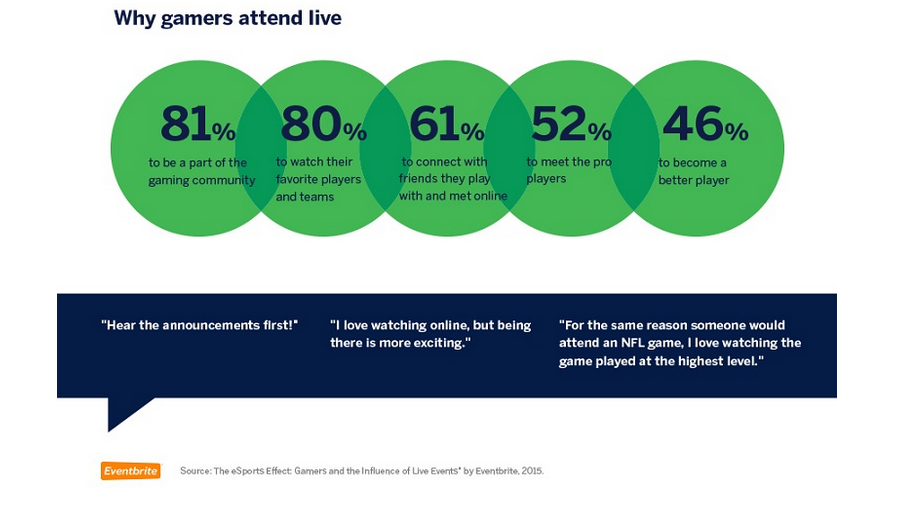
VB (in conjunction with Evenbrite) see over 80% of fans attending live events to be a part of the community and to watch their favorite players and teams live. Many fans, 61%, also go to connect with friends they play with online.

gamerpoll

As a former player — not at the highest level, but relatively close — in both first-person shooters (specifically Counter-Strike 1.5 and 1.6) and real-time strategy games such as StarCraft II, the connecting with friends part is huge. From old LAN centers such as Warfactory in St. Louis, Missouri to CygamZ in Ypsilanti, Michigan, my team(s) and I enjoyed the travel and the live events in a way online couldn’t match.

Back in the day my teams used voice programs such as Ventrilo mostly, though originally we used the even older Roger Wilco to communicate in-game. When we weren’t scrimmaging (aka scrimming) or working on timing strategies, we would often hang out in our mIRC channels and just shoot the breeze. Similar to coaches going over post-game film, our team would often watch demos of ourselves together, take notes, make recommendations and adjustments. We would even scout opposing teams in upcoming matches or swap tactics with other teams in our divisions, and basically have a scouting report. For example, if we knew one particularly member on the opposing team was hyper-aggressive or overly passive, we would adjust our strategies to exploit that.

Living or rooming together to develop strategies and bonds between teammates even has a specific term in the gaming industry: bootcamping. North American CS:GO team Cloud9 often does bootcamps and recorded two last year prior to a major LANs. Other teams live together in literal team houses, mostly in South Korea and throughout Europe.

While my experiences are of course subjective and anecdotal, seeing the vast majority of fellow gamers agree doesn’t surprise. From literally playing games in my parent’s basement to traveling to compete with the best North America had to offer, I wouldn’t change a thing about my gaming career. To see esports take off to such a level that ESPN shows games, media outlets conducting interviews with pro players and the sheer size of prize pools, I may have to get the band back together.

(Header image via ESL)

New Esports Program Debuts in Norway

Norway’s largest commercial television network, TV2, announced a trio of esports leagues to be aired on their programming. The three leagues will consist of League of Legends, StarCraft II and Counter-Strike: Global Offensive. TV2 is partnering with House of Nerds, a large Local Area Network (LAN) center with over 100 computer stations, in order to accommodate the new leagues. The House of Nerds arena is over 1,000 square meters and while the infrastructure is there, no announcements of prize pools, distribution or commentators have yet been made.

Norway isn’t a stranger to the esports scene, particularly with the success of Jens “Snute” Aasgaard, currently ties for #21 in the world according to World Championship Series points. Aasgaard finished 2014 as the #17 ranked player and the highest non-South Korean player in StarCraft II. He just qualified for round of 16, sweeping his group without losing a map and winning 4-0.

The country also owns a solid history of competitive Counter-Strike, going back to the days before CS:GO. In Counter-Strike 1.4/1.5/1.6, Norway boasted a strong collection of talent with multiple world champions in players such as Jørgen ‘XeqtR’ Johannessen and Ola ‘elemeNt’ Moum.

The competitions are set to play a 10 week season, though whether the leagues will be decided by an open qualifier, invites or a mix hasn’t been released yet. Matches will be aired on TV2 Sumo, the entertainment network, though TV2 Sport will also feature the games. Corporate sponsorships are nothing new, but a full partnership to broadcast esports matches — similar to the X Games and Major League Gaming agreement in Aspen — to an entire nation grows the popularity and acceptance of esports.

(Header image via eSports Norway’s Facebook Page)

Sports Site theScore Releases New Esports App

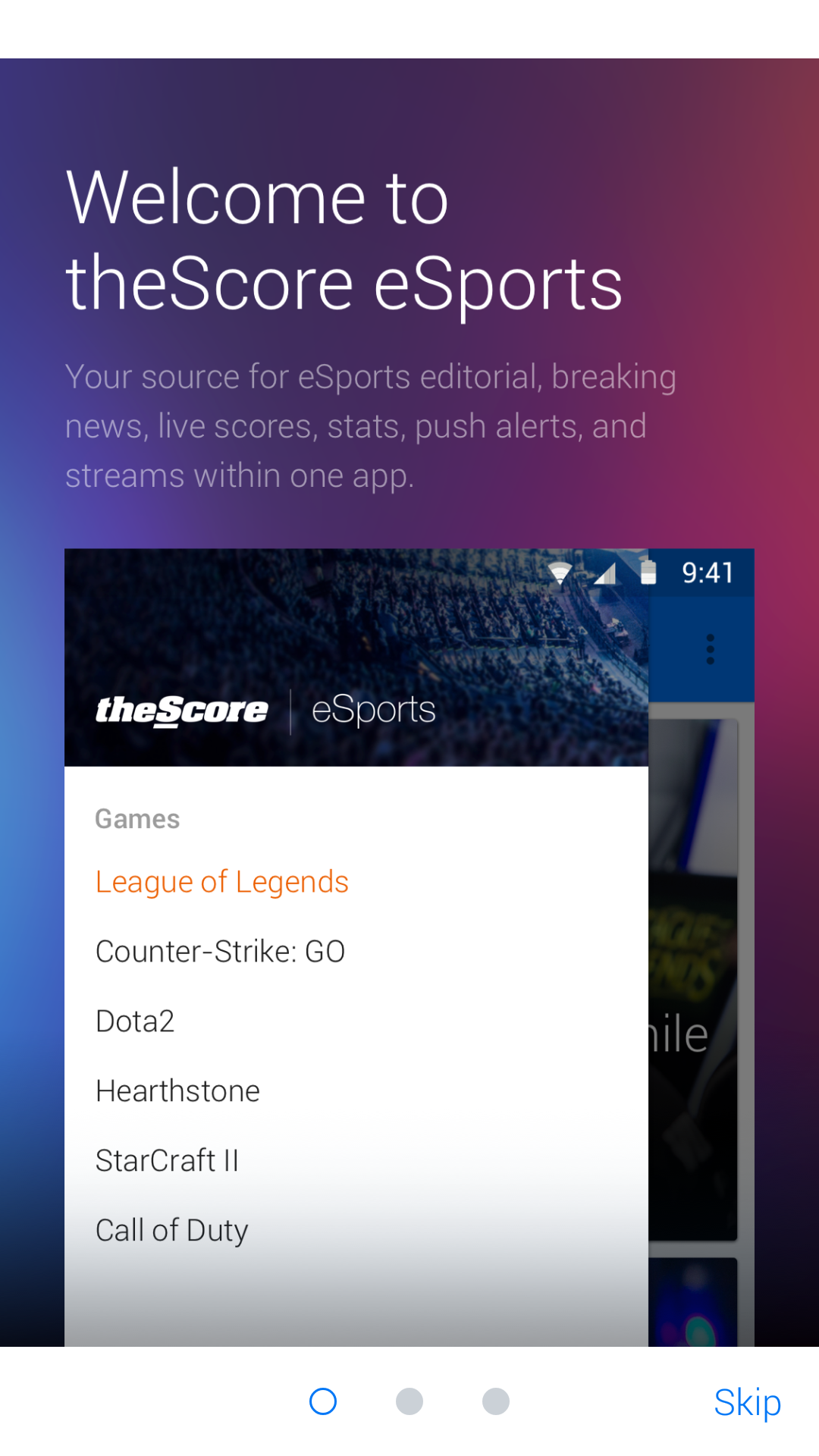
Popular sports website theScore has made the leap into esports with the launch of their “theScore eSports” app for Android today. An iOS version is in the works already. The company, which just set a new record for their site traffic at 10.2 million active monthly users, now features a specific app focused on the happenings in six of the biggest esports titles.

thescore

Featured within the app are options to follow League of Legends, Dota 2, Hearthstone, StarCraft II, Counter-Strike: Global Offensive and Call of Duty. Within those games listed there are specific regions covered as well, currently consisting of North America, Europe, Korea and China. TheScore has promised more games and more regional coverage as the app continues to grow.

Right now some aspects of the app work are fully operational. The North American League of Legends Championship Series currently shows upcoming matches and scores. The StarCraft section isn’t fully complete yet, as neither scores nor regions were available at the time of the app launch.


thescore3

There is a catch-all hub that doubles as the Top News section, where tournament announcements, player acquisitions, sponsorship news and more can all be found. Within the Top News section there is the option to sort by specific game as well, making things very convenient if a person only follows one or two esports scenes.


Bans Handed Down From Valve For Match Fixing

In the wake of the allegations and subsequent investigation formed from The Daily Dot’s Richard Lewis in regards to match fixing, Valve — creators and developers of Counter-Strike: Global Offensive — has acted quickly by banning all parties involved announced in a blog post. Most of the former team iBUYPOWER as well as others involved have received bans from Valve. The ban list which includes professional players and community figures is as follows:

Duc “cud” Pham
Derek “dboorn” Boorn
Casey Foster
Sam “Dazed” Marine
Braxton “swag” Pierce
Keven “AZK” Larivière
Joshua “Steel” Nissan

Of particular note is Braxton Pierce, recently named HLTV’s 18th best CS:GO player of 2014. While there is no sole governing body in esports, let alone CS:GO, Valve did not act alone in their ban of the players from Valve-sponsored events. Competitive leagues ESEA, FACEIT and CEVO have all banned the guilty players for a minimum of one year.

Valve notes they were able to confirm the guilt after tracking the items (or skins) by looking at the historical activity of the accused accounts. Though the players apparently did not wager any money, there was thousands of dollars worth of bets in the form of skins the iBUYPOWER team wagered on the opposing underdog team NetCodeGuides.com. By throwing the match for what equated to a monetary gain, the CS:GO community cried out for justice, and it was served.

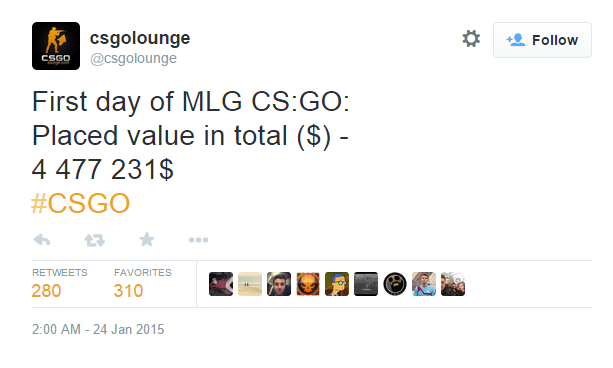
While thousands of dollars worth of in-game items may seem like a lot of money, it pales in comparison to formal bets on the games. Recently the 2015 Aspen X Games hosted a Major League Gaming CS:GO portion and popular betting site CSGO Lounge tweeted out a rather staggering figure for bets they handled on day one:

csgo

If Valve continues to step in and clean up the professional ranks of CS:GO — they and ESEA banned several professional players such as Hovik “KQLY” Tovmassian in November and ESEA more recently banned Andre “flex” Francisty  live on stream — then it betters esports as a whole. With money from sponsorships, advertising revenue and the integrity of the game on the line, Valve acted quickly. It isn’t the first time a governing body has handed down bans for wagering on games, from sAviOr and StarCraft to the much more famous Pete Rose and MLB, gambling on games where you directly affect the outcome hurts the image of the sport.


ESPN and Major League Gaming are Teaming Up for the X Games

The Aspen 2015 X Games have kicked off already — they can be viewed on various ESPN networks, provided you have a cable subscription — however one portion of the X Games can be viewed without any pay access. Partnered with Major League Gaming, X Games is streaming the Counter-Strike: Global Offensive tournament on MLG.tv at no cost. Highlights from the CS:GO tournament will be shown during the television broadcasts of other X Games events.

Some controversy already surrounds the CS:GO playing field. After qualified team Clutch Cats pulled out of the tournament, Torqued (formerly team iBUYPOWER) the second highest in both qualifiers, was overlooked in favor of Team Liquid. Despite going out in the second round of each qualifier, Team Liquid was chosen over the arguably more deserving Torqued. Many reasons had to be a factor in MLG’s decision, however a match fixing scandal involving Torqued and previous team iBUYPOWER members may have been a factor.

The Daily Dot initially broke the news of a potential scandal, citing particularly poor decision making and gameplay from iBP, text messages, as well as suspicious betting. The last part is of particular note, as betting on CS:GO matches yields thousands of dollars of in-game weapon skins (patterns and designs) every tournament. The biggest betting site is CSGO Lounge, where there are active bets for individual matches made nearly every day. With this much real-life money on the line, it isn’t outside the realm of possibility for match-fixing to be a major concern.

Given that this is the first major ESPN and X Games venture into CS:GO, it is no surprise they decided to “play it safe” and invite Team Liquid. While CS:GO tournaments regularly receives over 100,000 unique viewers, the partnership of highlights and cut-ins to the main ESPN broadcast could bring about more growth to the Counter-Strike community. The games begin Friday with a round robin group play where the four teams in each group play a matchup against one another, with the top two teams advancing to the bracket stage. Up for grabs is a $50,000 prize pool split among the top four finishing teams, plus betting wins — and losses — for viewers at home.

(Featured image via Monster Gaming)

Dailymotion Games: A New Streaming Service

As the reach of streaming services continues to grow ever further, the competition to offer streaming options increases — from Amazon-owned Twitch.TV to MLG.TV, YouTube, or even Azubu.TV. Now, Dailymotion is throwing its hat into the ring. With the announcement of Dailymotion Games, the new platform aims to tap into the massive professional and casual stream market.

According to their press release, gaming content already accounts for 180 million video views per month on Dailymotion as well as 11 million unique viewers monthly. The latest addition to the esports streaming scene offers a similar function to existing services including a chat box, user-controlled commercial breaks and an app for both iOS and Android is already available. The official website still says the product is in Beta, however hundreds of channels are already live and ready to be watched.

For doubters questioning if someone can make a living merely streaming a game, Winter, a teamless player who primarily streams StarCraft II, recently answered this on Reddit. He cites a $60,000 income in 2014 — between ad revenue from his stream plus donations — before taxes are accounted for. Given that he does not compete at the professional level and has won a mere $600 in prize money from competitive tournaments in his career, his stream generates more than a livable wage.

Considering the fact StarCraft II is, at best, the fifth most watched game behind League of Legends, Dota 2, Counter-Strike: Global Offensive and Hearthstone, clearly streaming services and those who use it will be constantly searching for the best platform. It remains to be seen if Dailymotion can knock Twitch off of their pedestal as the leader of streaming services, though more competition can only be a good thing.


There are Great Sports Games Available at Steam’s Holiday Sale

Fellow video game enthusiasts, today is a magical day! The annual Steam Holiday Sale went live today, putting hundreds of games on sale. Steam, the game distribution system designed by the Valve Corporation, is free to download, and many games themselves are also free. While these games are limited to PC/Mac/Linux (sorry console gamers), the Holiday Sale is a great time to make bulk purchases to last you all of next year. Most titles are on sale, however two of the three most played games are free to download and play, in Defense of the Ancients 2 — more commonly referred to as DotA 2 — and Team Fortress 2. For sports related titles, Football Manager 2015 is the fourth highest played title thus far today.

steamsale

In Football Manager 2015 you are tasked with building a competitive soccer club and juggling things from scouting and trades to developing a strong youth program. While the 2015 version is not on sale, the full price is $49.99, the 2014 version is discounted to down to $14.99. Rugby Manager 2015 is marked down to just $9.99.

If you prefer to take the pitch yourself rather than run the operations behind the scenes, Pro Evolution Soccer 2015 — winner of the gamescom Best Sports Game 2014 — is 15% off, costing $33.99 right now. For those who would rather take to the court rather than a soccer field, NBA 2K15 is also 17% off sticker price, going for $49.79

Released not even four months ago, The Golf Club is a solid golf experience in lieu of actually stepping onto the fairway. For me, golf is only available about half the year, thanks to the lovely Michigan snowfall. The Golf Club offers tournament and league play, as well as an option to challenge your friends on existing courses or even build your own. Thanks to the Holiday Sale, one can pick up this title for $24.99, 30% off the regular price.

Possibly the best sports simulations games is Out of the Park Baseball 2015, and of course it is being discounted. On sale for $14.99, OOTP was already given a detailed review by the handsome and brilliant Bradley Woodrum. If you’re looking for a game for a baseball enthusiast, do them a favor and grab OOTP while it is on sale.

In addition to the titles highlighted here, Steam also has dozens of racing games from F1 2014 (half off at 24.99) to Nascar 14 (going for $7.99). Given the fact that Steam is free to download, as are 170 different games, if you’re scrambling for a holiday gift, Steam’s free-to-play games, as well as their sale, make for a great option.

(Header image via Steam)


Esports and Caffeine Continue to Grow Together

Soda — or as some call it, “pop” — and video games have a long history of working well together, be it in your friend’s basement, at an arcade or corporate sponsorship. Today at 4pm eastern Coca-Cola will take the next step in their esports interest with a debut Game-A-Thon event in Atlanta. The games will also be streamed via Coke’s Twitch.TV channel, however exactly which games are being played remain a mystery.

Scheduled to last four hours, the Game-A-Thon will pit five esports figures and players against each other in the mystery games in order for the prizes to be donated to various charities. Keeping the players in the dark about what exactly they’ll be playing is all part of the fun. In an interview with GamesBeat, Matt Wolf, head of global gaming for Coca-Cola was quoted saying:

We are interested in gaming. It’s big. We know it. We’re being smart and focused about how we approach it. As we head into the end of the year, this opportunity with our friends at Twitch is a great way for us to cap off the year with a great on-site production. We can give back to the players and to a charity for the holidays.

While Coca-Cola has helped in the League of Legends realm, specifically with their Coke Zero LoL Challenger League, this marks their first major foray into other games. Caffeinated beverages — not to mention energy drinks — have been a part of video games for years. From the Halo “Gamer Fuel” to Mountain Dew and their double experience points for Call of Duty games, to personal sponsorships by Red Bull for StarCraft II players such as Bomber, major beverage labels continue to appeal to gamers and esports fans with both their carbonated drinks as well as their efforts within the gaming communities. Cracking open a can to drink while watching your favorite game or team suddenly doesn’t necessarily equate to beer and baseball anymore.