Archive for esports

Major Changes For Valve’s Major

On Tuesday we will see a major sporting event kick off in Ohio, with hundreds of thousands (if not millions) of people watching online. No, it’s not MLB opening day or the Columbus Crew (but has a soccer fan, I would love to see a crowd of that size for a domestic game). No, I’m talking about the first ever Valve-sponsored Major for Counter-Strike:Global Offensive here in the United States, Major League Gaming’s Championship: Columbus.

While not the first Major, it’s the first one held in the States — all previous Majors have been held in Europe. The location isn’t the only notable change to the Major, as this also represents a record of four teams from the North American region qualifying, though a team from Europe — in particular, Fnatic — seem likely to take the championship. In addition to the solid North American representation in Columbus, Brazil is represented in team Luminosity Gaming, and if any team could challenge the EU region heavyweights, it might be LG. On top of the diverse lineup, the prize pool has been quadrupled from a notable $250,000 in previous Majors to an impressive $1,000,000 up for grabs, with $500,000 going to the first place team. Beyond the massive increase in the cash, Valve has also made changes to the gameplay, specifically the clock, and it is something that could play a role — for better or worse — in the upcoming matches.

While the nature of CS:GO is quite different than any traditional sport, the teams of five simultaneously playing offense and defense lend at least a quick comparison to basketball. Rather than outscoring the enemy team when the game clock reads 0:00, CS:GO instead is a race to be the first side to win 16 rounds. A maximum of 15 rounds per half will be played, so one could consider it a best of 30, in a manner of speaking. The first half consists of the Counter-Terrorists (CT) side defending two bomb sites while the Terrorists (T) attacks and attempts to plant a bomb. CTs can win by

A. Holding both sites for the full 1:55 each round (an uncommon way to win)
B. Eliminating the T’s before they can plant the bomb at one of the sites
C. Defusing the bomb once it has been planted

While that’s the quick and dirty comparison, Valve — developers and sponsors of this Major — have decided to toy with what effectively is the “shot clock” in CS:GO. For years and years, heck, even since I played Counter-Strike 1.5 and 1.6, the universal standard* for each individual round was 1:45, or if the bomb was planted, a 35 second timer would begin. Last December, Valve implemented a significant change, shifting to the longer, previously mentioned 1:55 round and increasing the bomb detonation timer from 35 to 40 seconds. The key thing is that neither planting the bomb nor defusing is instantaneous. It takes approximately three seconds for the T side to plant the bomb, and for the CT side, defusing it varies based on whether or not the CT purchases a defuse kit. Without the kit, it’s a full 10-second defuse but with the kit it’s cut in half to five seconds.

*Valve had a 45-second bomb timer in their official matchmaking until the December change, however this article is aiming to address competitive play.

While leagues such as ESL/ESEA Pro League have adopted the longer round time and 40-second bomb detonation time as have DreamHack tournaments, the change could absolutely affect rounds and thus matches. For example, imagine if the NBA changed a similar 10-percent increase in the shot clock, rather than 24 seconds it would get bumped to 26.4 seconds. Or overall game length from four 12-minute quarters to four 13:15 quarters. It isn’t hard to see just how drastically this would change things like player substitutions, shot selection, timeout usage and team fouls. Just like basketball, CS:GO is heavily reliant on the clock to force action. By changing what forces the action, I would argue the game has been changed as well.

Rather than worry about player substitutions or shot selection like in basketball, the thing being juggled — especially on the CT side of things — in CS:GO is the in-game economy. Instead of needing to purchase a defuse kit, now the CTs can opt to spend that cash elsewhere, be it an upgraded weapon, grenade, body armor etc., and still have what almost equals the same amount of time. By choosing to not purchase a kit, there is no real difference between a full 10-second defuse on the 40-second bomb timer versus buying a kit to cut the time in half to five seconds on a 35-second timer. The kit itself a relatively small price to pay, just $400 in-game dollars, yet that same amount of currency is the same as two flash bangs, one smoke or one high explosive grenade (with $100 left over). As one would suspect, this type of equipment can absolutely have a huge affect on how a round plays out as the longer bomb time opens up the CT arsenal considerably.

On top of the in-game currency falling under scrutiny, the million dollar prize pool is something to cover in detail as well. To be honest, the $1 million is technically correct for the tournament itself, but it fails to account for one thing: stickers. No, not actual, real life stickers, instead these stickers allow the purchaser to place the stickers on weapons if they so desire. The stickers cost just $0.99 with the money being split 50/50, half going to Valve and the other half to the teams.

teamstickers

For a glimpse of an older Cloud9 sticker, here is a screenshot of C9’s Jordan “n0thing” Gilbert in action in the MLG Columbus Qualifiers. The full highlight video can be found on Cloud9’s YouTube page.

nothingstickers

Count on yours truly among those watching the streams as 16 teams representing 18 countries decide who will take home the title.
(Header image via MLG)

An Update on Drones in Sports

Drones racing each other at breakneck speeds through an abandoned industrial complex, controlled through VR goggles that broadcast a first-person view simultaneously to the operators and fans alike.

This may seem futuristic, but it was actually one of the most imminent ideas recently discussed in a special panel dedicated to “Drones In Sports”. At last week’s On Deck Sports and Technology Conference, three drone sport experts came together to talk about the potential–and the potential pitfalls–that drones may provide for the future of sports technology.

As one panelist put it, drones in sports are currently “kind of a Wild West opportunity”, and Matt Higgins, CEO of RSE Ventures and vice-chairman of the Miami Dolphins, kicked the panel off with the example of the Drone Racing League. Earlier this year, the DRL started informally as groups of hobbyists flying drones through parking garages and abandoned buildings, but plans are in the works to turn it into a full-fledged sport, pitting sponsored teams of self-taught drone specialists against ex-military UAV pilots.

The DRL held their first two test flights earlier this year in the New York metro area, and plans to release their first official video “in the next few weeks.” When Higgins (an investor in the DRL) was asked how to make this a spectator sport, though, he responded candidly, “I have no clue.” He expects that streaming services like Twitch and Meerkat will be critical in building fan engagement with drone racing — and there certainly aren’t a lack of ideas to spice the sport up, as Bradley Woodrum outlined earlier this year.

Companies are also thinking about how drones can be used to improve the experience for players and fans in more traditional sports. In the eyes of the panelists, the “low-hanging fruit” was using drones to provide new angles for gameplay and practice, but the Amazon “drone-delivery” model was also a clear influence. The possibilities bantered about by the panel seemed limitless. Dispatching drones on golf courses for tee-side food delivery, handing out tickets with drones during games, the drone t-shirt cannon…

…wait a second, “the drone t-shirt cannon”?

It’s an undeniably cool idea, but taking a few seconds to visualize an unmanned aerial vehicle launching anything at fans may remind you that drones still face a number of psychological (and legal) obstacles. Eben Novy-Williams (a reporter for Bloomberg and the panel’s moderator) noted, as one example, that he was at a recent triathlon where a drone filming at the finish line elicited divided reactions–half the audience loved it, but the other half was clearly uncomfortable.

Chris Proudlove (an aerospace insurance expert with Global Aerospace) agreed that “we’re not quite there” when it comes to drones flying over crowds and that we need to “build a public sense that drones will be operated safely”, but that at the same time we don’t want to overstate the risk. The top concern of Proudlove’s clients when discussing drones was “invasion of privacy,” but he predicted this would be “moot” in less than 10 years. We’ve already become accustomed to ubiquitous smartphones that record video; from a certain perspective, drones aren’t terribly novel, just an extension of technology. The rest of the panel was even more bullish about the long-term prospects of us welcoming our new drone overlords.

But there’s still a lot to be done to make drones seem — and be — safer. Chris described geofencing technology to keep drones in and out of certain locations, such as ‘within the stadium, but at least 20 meters from the stands’, and better use of parachutes and other physical features. (Many of us probably remember the recent drone crash during the 2015 tennis U.S. Open, but the panelists were also well-aware of the 1979 mishap where a lawnmower-shaped model plane killed a fan during halftime at a Jets-Patriots game.) Chris also suggested that regulations distinguishing ‘micro-drones’ (of less than 2 pounds) and ‘the big ones’ could make drone safety easier.

In fact, the panel generally agreed that regulatory issues were the primary roadblock currently facing drones in sports. Right now, commercial use of drones (in the US) is illegal except when exemptions are provided by the FAA, and this is expected to remain the status quo until the FAA issues a full ruling on drones sometime in 2017. Until then, companies will need to build their usage of drones on a case-by-case basis. (Late last week, for example, the news broke that the FAA had allowed the NFL an exemption for drone usage — but only in empty stadiums.)

In short, it looks like we haven’t yet reached a drone-filled future of sport, but that day is likely drawing nigh. When Eben asked the panel for a bold “five-year prediction,” panelist Jon Ollwerther suggested that by 2020, we’d see drones being used in “every major American sport”– even down to the high school level.


DraftKings Joins The Esports Betting Ranks

DraftKings, the daily fantasy site that has saturated the TV airwaves with commercials lately, has just launched their newest wing: esports. As of right now their esports division consists solely of League of Legends matches, however I wouldn’t be surprised to see Counter-Strike: Global Offensive, Dota 2 and more titles added. It should come as no surprise to see those three games be the most watched of August for Twitch.tv.

DraftKings isn’t considered gambling, but more of a skill game  — though Arizona, Iowa, Louisiana, Montana and Washington consider it online gambling and prevent their residents from playing it — and esports, the same as in in the traditional athletic world is unfortunately no stranger to gambling and match fixing. From bans in CS:GO due to match fixing last year to StarCraft banning numerous player in 2010 due to a network of match throwers, sadly once money gets involved, people tend to have their morals become a bit more flexible.

While DK may or may not be considered gambling, they are just the latest website to offer payouts based on investments. Ranging from websites such as CSGO Lounge to CSGO Loot, Gosu Gamers and plenty more, there is money to be made — or lost — by wagering your weapon or player “skins” depending on the game. They’re nothing more than digital pixels, but they carry real world monetary value, sometimes in excess of the tens of thousands of dollars.

In the Counter-Strike realm, the sponsoring of so-called gambling sites — not DraftKings, but the others — has been banned in ESEA, a top competitive league. Citing a conflict of interest, insider knowledge and general professionalism, ESEA is making a stand against gambling. Of all the leagues to take the moral high ground on an issue, it’s interesting that ESEA does it, given their shady history. Regardless of previous transgressions, it is likely for the best to see gambling sites being barred from team sponsorship.

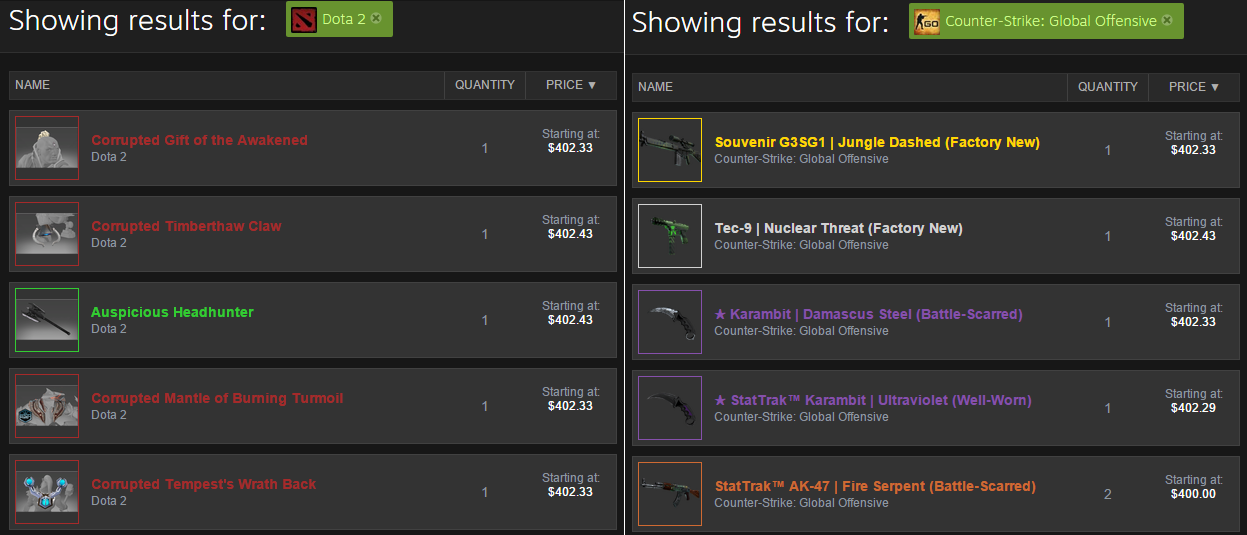
An entirely different issue is when people under age-21 wager their skins. These items are worth lots of money, just look at some screencaps from Steam’s Community Market page. Steam is the software distribution portion of Valve, creators of CS:GO and Dota 2. Some of the items for sale on the Valve Community Market are going for $400 dollars, while other third party marketplaces are trading and betting items worth much more money than that.

dota2
While this is certainly an exciting time to be an esports fan — the prize pools have never been bigger, corporate sponsorships are flowing in and possibly a major television league and broadcast deal in the works — seeing as DraftKings sees League of Legends on par with traditional sports, we can’t get too far ahead of ourselves. We’ve already seen entire organizations get taken down for throwing matches, some for cheating and with yet another website now offering to exchange cash (not just weapon skins with value tied to them) based on esports results, the cynic in me fears the worst.


Player Two Has Entered The Esports Streaming Game

YouTube Gaming launched last Wednesday and after nearly a week of observations, the Google powered streaming service has left several big impressions. Before fully diving into the details, it should be noted that YTG represents the first real challenger (sorry, Major League Gaming TV) to the currently undisputed streaming service of Twitch.TV. Last year Amazon purchased Twitch after Google reportedly backed out despite tentatively agreeing to a price tag upwards of $1 billion. Amazon ended up paying approximately $970 million to acquire Twitch, representing an investment — and presumably a belief — in the continued success of streaming esports and video games.

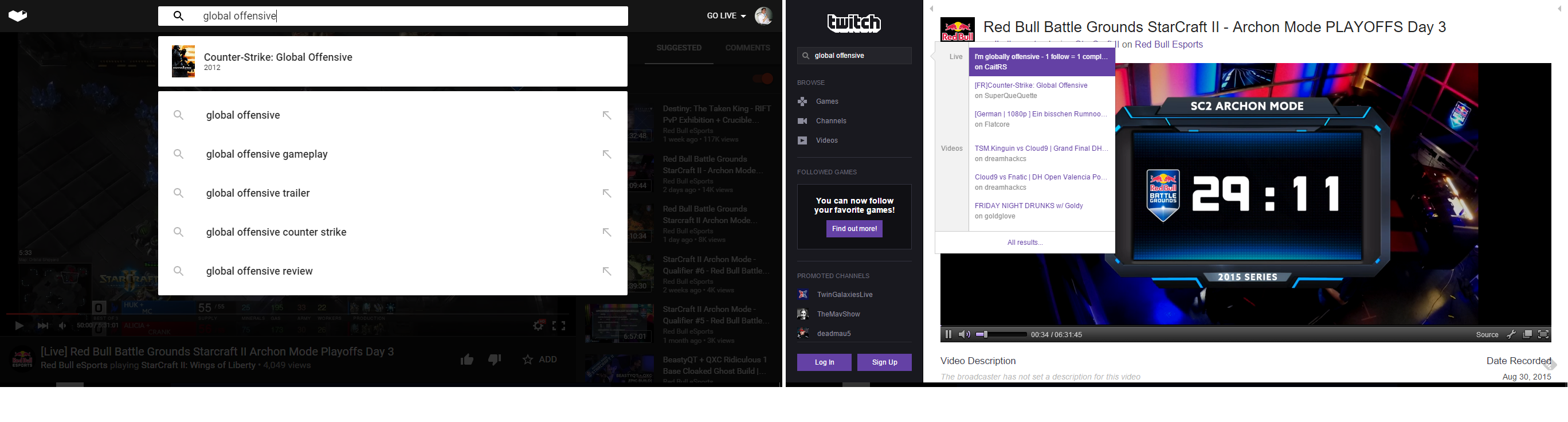
Other than huge difference in viewership numbers, something not particularly unexpected given YTG is still in its infancy, there are some differences in the layout and execution of the two platforms. For the duration of this look-in, YTG will be on the left-hand side with Twitch being on the right. Pictured below is the same moment (as close as I could get) in a StarCraft II: Legacy of the Void beta game between two pairs of professional players that has been paused. The screenshot was a VOD (Video On Demand) rather than live as I couldn’t quite grab the right timing during each live broadcast. The match up took place at Red Bull Battlegrounds, something YTG labels in the upper left whereas Twitch does not during a full screen pause.

comparison1It isn’t a deal making feature for YouTube, however it is a nice feature that normal YouTube videos have that has carried over to the streaming side of things. Another big chip in YTG’s favor is their pausing the VODs. YouTube grants the ability to navigate away from a specific spot in a video and being able to hit the back button and go right to where the video was paused. Twitch on the other will send you back to the beginning of the VOD rather than save a spot. For anyone who’s ever played a video game for more than a few minutes, misclicks or the wrong hotkey being hit are bound to happen, so this pause-and-return feature is another great feature from standard YouTube.

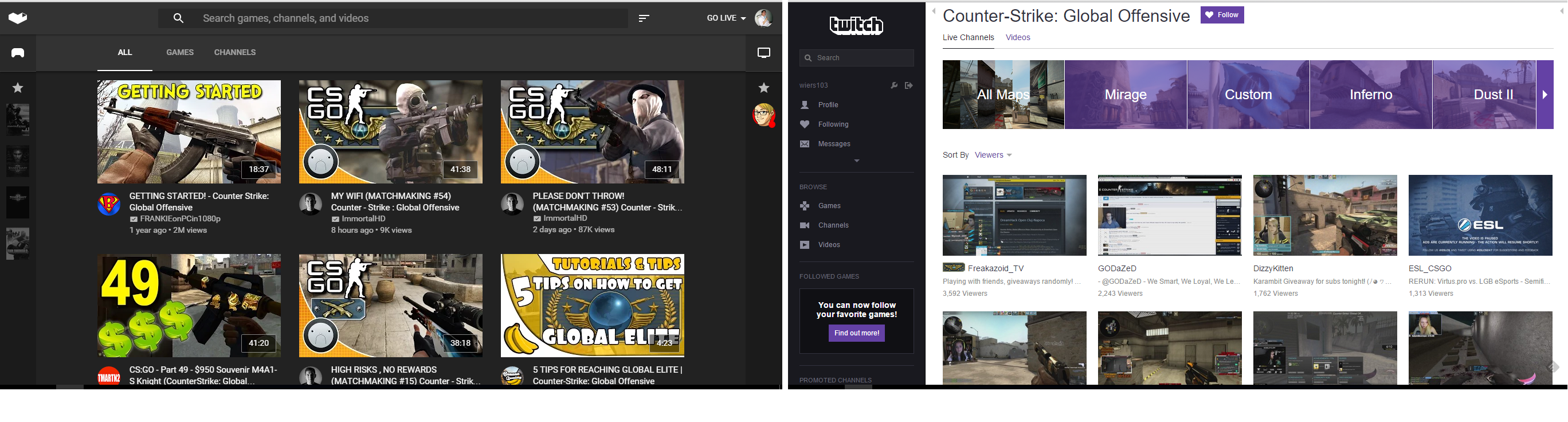
The game search options for both options each leave much to be desired as both sport autocomplete options, but neither are particularly great.

comparison2After clicking the game, in this case Counter-Strike: Global Offensive, Twitch welcomes you to a page featuring the top streams rated by current viewership sortable by specific maps. This is a big contrast from the generic YouTube landing page where it shows a video from a year ago as its top result and zero live streams. After browsing the various YTG videos, most turned out to be previously uploaded videos rather than live stream VODs. As it gains a more extensive VOD library I expect this to change, but it’s somewhat surprising to see two of the top six YTG search results be from more than four months ago.

comparison3Another issue I routinely saw with YouTube that I’m willing to chalk up to it still being new is the lack of moderators for the stream chats. Of the two dozen or so YTG streams I was in, the chat was running rampant with a mix of memes, ASCII characters and the like. Obviously Twitch chat is nothing to brag about, but at least a majority of the ridiculous fluff was removed by mods in the Twitch channels I frequent. To be honest, my friends have nicknamed Twitch chat — and by extension most stream chats — as YouTube comments in real time, something that is not a compliment to anyone who has delved into the depths of said comments.

Despite the flaws, I remain optimistic YouTube Gaming will get up to speed and soon give Twitch a real live streaming threat in the esports realm. As someone who has dealt with streaming issues since Justin.TV and an esports fan who grows weary of Twitch issues — specifically video stuttering or freezing and frame-rate drops despite a strong internet connection and computer — hopefully the competition YTG brings to the table will bring out the best in themselves and in Twitch, resulting in the best possible outcomes for the users. While I remain unimpressed with YouTube Gaming at the moment, I’m eager to see what the coming months brings for their viewer options. I can’t see this becoming Google Glass or Google+; this is one project that seems incredibly likely to succeed if for no other reason than that the market and demand is already in place.


Recent esports Tournaments Show Promising Attendance Numbers

Over the past weekend we saw two titans of esports, League of Legends and Counter-Strike: Global Offensive, hold major tournaments. On Sunday the European and North American League of Legends Championship Series summer finals concluded with the Counter-Logic Gaming team taking first place for North America, $50,000 in prize money, and a ticket directly into the 2015 World Championship, and Fnatic taking home the trophy for Europe. Fans of CS:GO were entertained from Thursday to Sunday with the ESL One: Cologne tournament, a tournament partially sponsored by CS:GO developer Valve, with $100,000 going to the winning team and $250,000 overall up for grabs. The weekend was filled with teams from all over the world aiming to take the top prize.

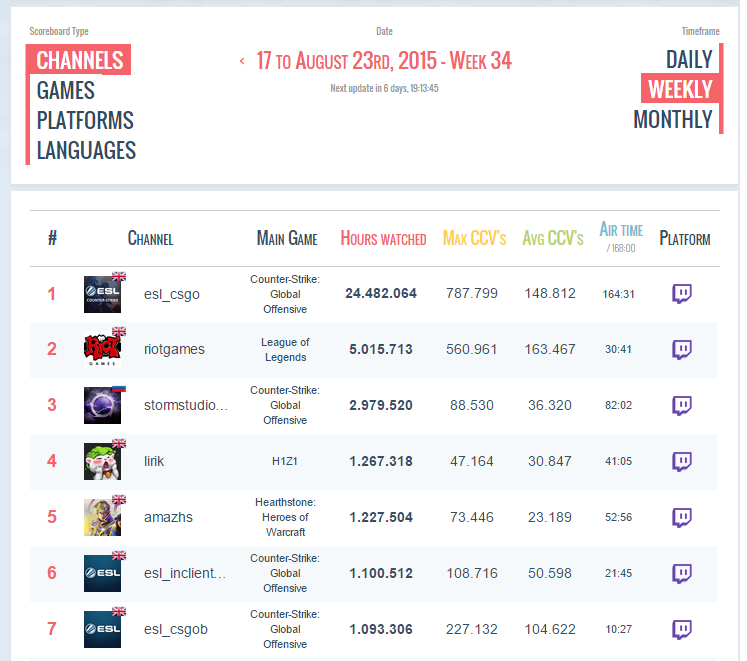
Both esports events captured a huge number of fans, and CS:GO set a sixth month high for Twitch.tv view hours in a single day. Via Gamoloco, CS:GO averaged more than seven million hours per day across the for the four day event, peaking at 8.9 million view hours on Saturday. It should be noted the number of hours is likely skewed by users logging in with multiple CS:GO accounts in order to raise their chances to receive a free in-game item drop, so these numbers should be taken with a grain of salt. The infographic below displays the game itself rather than the specific ESL One Twitch channel, which is to say there were other streams being watched for CS:GO and League of Legends beyond just the official ESL One and LCS streams.

gamoloco

By specific channels with each game, Gamoloco rates ESL One compiling 24.4 million hours (with another one million hours on the official “B Stream”) compared to Riot Games, developer of LoL, totaling just over five million hours over the past week. These numbers represent the English speaking channels only, with the Russian channel covering ESL One accumulating nearly three million hours, plus Polish and German broadcasts for each game.

gamoloco2The crowds at both live venues were impressive as well, with the League of Legends NA Summer tournament filling up Madison Square Garden with a reported 11,000 fans. Europe was no slouch either as ESL looking as though the Lanxess Arena drew a fair crowd as the header image would indicate, along with a large crowd at the EU LCS at Stockholm’s Hovet Arena. While it’s hard to compare a single tournament to the long grind of a sports season, the NA Summer event pulled a crowd comparable to the NHL’s Florida Panthers and more than the MLS’ Chivas USA, though both the Panthers and Chiva rank last in attendance for their respective leagues.

These impressive numbers aren’t even counting Dota 2’s yearly tournament, The International that was held from July 27 to August 8 to decide the world’s champion where we saw the single largest prize pool for an esports tournament. With the growing prize pool, interest level and time commitments being dedicated to esports — not to mention push notifications the ESPN app and score tickers (cap tip to HeyCJay from Reddit) and streams on ESPN 3 — it may be time to pick your favorite esports organization just the same as a football or baseball team. 

(Header image via ESL Twitter)

Esports Players turn to Adderall for Competitive Edge

Over the previous weekend the 2015 Electronic Sports World Cup Counter-Strike: Global Offensive finals took place in Montreal. Multiple countries were represented and competed for the $75,000 prize pool, with $30,000 going the champions. Aside from technical setbacks, other controversy arose due usage of Adderall as well as in-game communication advantages. In a bit of a surprise, North American team Cloud9 won their group and advanced to the finals, though former Cloud9 member Kory “Semphis” Friesen gave a candid interview with Mohan “Launders” Govindasamy where Friesen said how common it is to find Adderall usage. In a separate interview, current Cloud9 member Ryan “fREAKAZOiD” Abadir had strong comments regarding other teams listening in to the Cloud9 in-game strategies.

Transcribing and editing the interview, Friesen said the following:

Friesen: Ha, I don’t even care. We were all on Adderall. Like, I don’t give a [expletive]. Like, it was pretty obvious if you listen to the comms. People can hate it or whatever, but.

Govindasamy: So everyone does Adderall on ESEA LAN, right?

Friesen: Yeah.

Govindasamy: Just throwing that out there, so you’re good.

As someone who has played Counter-Strike (and other games) in a relatively high level for a number of years — as well as someone who has taken their fair share of Adderall, this topic hits pretty close to certain times back in my younger days. While dealing with working part-time or going to school, plus a practice schedule that took up at least two hours per day, it was clear that time was in short supply. A teammate at the time suggested I go for an Adderall subscription. However, living in a college town I soon found out that it wasn’t that easy to get my hands on the pills without my own prescription.

The effects of being on Adderall didn’t seem big like much at first, but then about four hours passed and I hadn’t really noticed. It really did help me focus — almost to the point of tunnel vision — and in the context of esports, managing your tasks and focusing on the matters at hand is critical. For example, at big LAN event or venue, it’s a really loud atmosphere. With your in-game sounds turned up to hear every footstep, your teammates calling strategies, the announcers shouting and the crowd going bonkers, it’s incredibly easy to get distracted. In fact, recent controversy arose over communication. In somewhat recent events, more and more tournaments have been tapping into team’s in-game communications with so called Point-of-View streams, showing gameplay alongside the team’s comms.

Ryan “fREAKAZOiD” Abadir said in an interview how it’s unfair to English speaking teams. To quote Abadir:

Interviewer: What are your thoughts on it [POVs]?

Abadir: I think it’s great honestly. I love POVs, but, if you’re releasing it [live] and we can’t speak their language, then, how can we use it to our advantage when they [opposing teams] can use it [POVs] to their advantage? So release it after we’re done playing.

ESWC had teams from Ukraine, Sweden, Germany, France, China, Brazil, South Africa and Australia, along with Canada and the United States, so a multitude of languages could be found. Abadir’s interview was actually in regards to the previous weekend’s Electronic Sports League tournament, but that also boasted an international lineup where French, Swedish, Polish, Finnish, Portuguese and of course English were spoken. League of Legends releases post-match communication highlights, and tends to be careful to limit the amount of strategy given away at any time.

Is the ability to listen in on other teams’ communications cheating? Is it unfair for players to be taking Adderall? There are some fuzzy lines being skirted by major esports brands. Without pressure from sponsors or an overarching governing body, it doesn’t seem like any significant policy change will be in place for Adderall usage or POV streams. Despite the rapidly rising popularity, esports still have a long way to go when it comes to rules and regulations.

(Header image via ESWC)

Esports Injuries Are Piling Up

A torn knee ligament, shoulder surgery and now wrist injuries can be added to the list of career threatening injuries to those making a living playing video games. In the wake of the sudden retirement of League of Legends pro Hai “Hai” Lam where he specifically cites an ongoing wrist injury, it may be time to re-examine our thoughts on esports competitors as athletes. Repetitive strain injuries from tennis elbow to carpal tunnel effect athletes and esports competitors alike.

The United State government already formally recognizes some esports competitors as athletes by granting multiple P-1A visas, given specifically to athletes. While certainly not a normal athletic workload, esports at the highest level has nonetheless produced a long list of injuries, most notably in the wrist and neck, for years.

In StarCraft II, injuries have forced out arguably the best player in the five year history of the game, Jung “Mvp” Jong Hyun. The four time champion of the Global Star League is the third highest earner in prize money with over $400,000 in the bank for his tournament showings. Mvp’s career was derailed when pains in his neck caused numbness in his shoulders and arms.

Canadian player and at one point arguably the best non-Korean player in the world Sasha “Scarlett” Hostyn was temporarily forced away from the game to allow her wrists to recover.

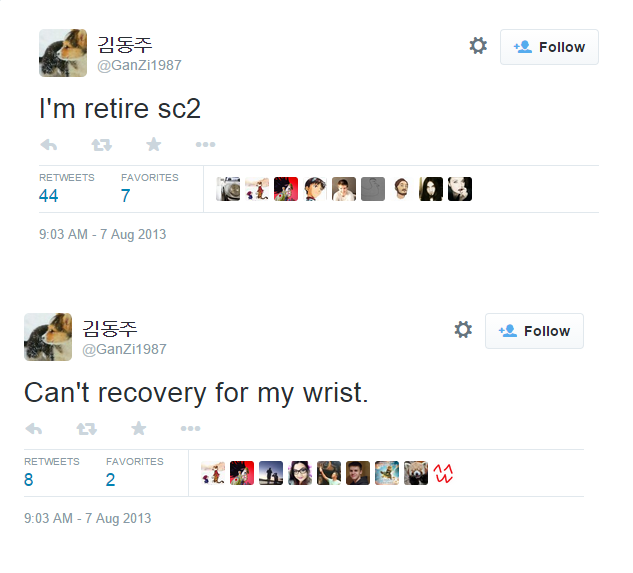
Former competitor Kim “Ganzi” Dong Ju is another victim of wrist injuries, tweeting his retirement announcement and the reason for it.

ganzi

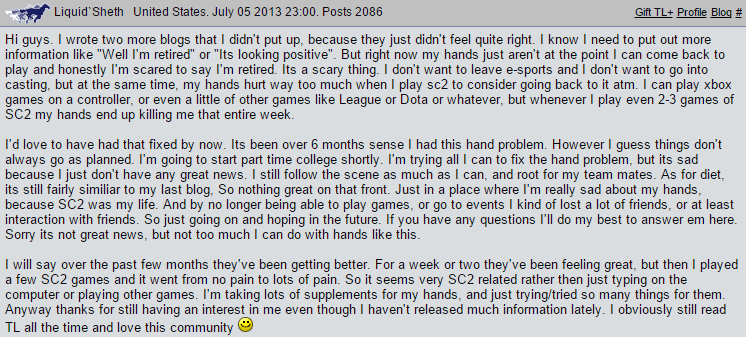
Popular player Shawn “Sheth” Simon was also felled by injuries, citing in a forum post that pain in his hands have prevented him from playing anything more than a handful of matches per week.

sheth

The world of esports is in an awkward position. While getting ESPN2 airtime on a Sunday evening with a Heroes of the Storm collegiate aptly named “Heroes of the Dorm” match is a welcome sight to esports fans as is the emerging scenes across various games, the lack of team infrastructure is alarming. Without any sort of players union or dedicated medical staff, the players lack protection from injuries that have already ended or shortened multiple careers.

(Header image via Wikipedia)

You Probably Play A Computer Game

It is no longer a question of “do you like computer games and esports” but now “which game is your favorite?” The latest Global Web Index report shows 48% of internet users in the United States play a game on their computer (in this context Macs and Linux devices are included with Windows).

pcnumbers
One of the more encouraging signs of growth isn’t in the sheer numbers, but the demographic of the players. It should come as no surprise to see the 25 to 34 and 16 to 24 age groups leading the way at 54% and 52% respectively, however even the more middle aged 35 to 44 bracket plays games at a high frequency of 48%. Across the age boundaries there is a nearly even money chance that both men, 48%, or women, 47%, play a game online or competitively at least once per month as well.

The surveyed group did not need to specify which specific games were played, but Twitch.TV released their January streaming info and serves well as a best-guess proxy on the GWI group. The top three most played — and viewed — games are titans of the esports realm, with League of Legends, Dota 2 and Counter-Strike: Global Offensive standing in order atop the podium. Five of the top 10 highest viewed titles are exclusive to PC’s. When a CS:GO tournament can draw over 1 million simultaneous viewers, big entertainment money follows big entertainment numbers.

csgomillion
(Image credit to Qctopz via r/globaloffensive)


With the biggest prize pools, sponsorship and biggest infrastructure involvement, it isn’t just the nerds taking note. Other entertainment mediums have been sponsoring esports related events. From the StarCraft II Ender’s Game on Blu-Ray tournament last year to the Chappie Challenge tournament playing Evolve this earlier month, to the million dollar perfect game MLB 2k11, the intersection of esports — in particular PC games — and entertainment is at a level never before seen.

(Header image via GWI)

South Korea Announces Esports Investments

The fact that you have to spend money to make money is true for all business models, including esports. South Korea, arguably the world leader in esports, is seeking to build on their strong history of supporting video gaming professionals at the player and developer level. According to The Korea Times, President Park Geun-hye promised 100 billion won — around $90 million — from the government for startup companies in the gaming community, the internet of things and financial technology.

According to Esports Earnings, South Korea has been particularly dominant in StarCraft: Brood War and StarCraft II. Players hailing from South Korea have collected over $5.9 million in tournament winnings from SC:BW compared to China’s second place of almost $87,000.

scbwearnings

The gap in SCII is Korea dominating the scene to the tune of over $11 million versus Sweden’s coming in at a tick above $530,000.

sc2earnings

In addition to being the top earnings in both iterations of StarCraft — so much so the gaming community calls it the “Korean scene” versus the “foreign scene” with foreign meaning every single country that isn’t South Korea — League of Legends has also been largely dominated by Koreans. China is relatively close in winnings, though it is still barely half of what Korean teams and players have raked in.

leaguewinnings

With so much money coming in and going out in Korean esports, it should come as no surprise there is a governing body, the Korean e-Sports Association, better known as KeSPA. From proposing a minimum salary for players, ensuring travel for Korean citizens to foreign events and vice versa, as well as partnering with game developers for feedback, KeSPA’s is an organization looking out for sponsors and players alike. While not perfect, KeSPA — and South Korea as a whole — has inarguably played a major role in bringing esports to its current level of popularity.

(Header image via Blizzard)

Is YouTube Creating a New Rival to Twitch?

For all of the various competitions getting streamed via TwitchTV, it is unfortunate to see the platform itself does not have any major competition. Yes, ESPN3 has shown esports in the past, Major League Gaming TV is making strides, and Azubu is still a thing, but without another titan to battle, TwitchTV holds all the cards as streaming’s primary go-to website. Cue the whispers of YouTube preparing to re-launch a gaming centered live-streaming platform in this Daily Dot piece.

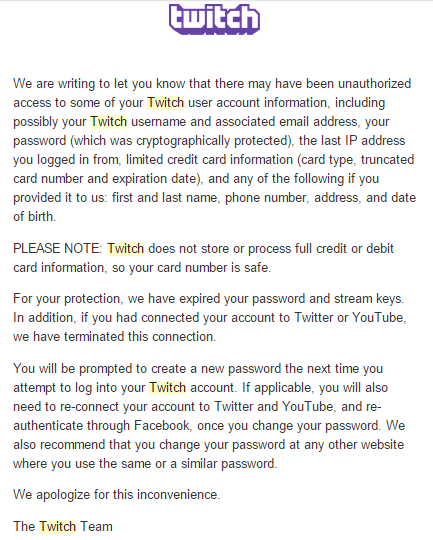
The rumor mill has an acute sense of things given the recent Twitch password issues. While it isn’t on the same scale as Sony storing user passwords in plain text, on Tuesday certain TwitchTV users were hit with the a concerning email. A subject line of “Important Notice about Your Twitch Account” immediately caught the eye of channel owners as the body of the email revealed that unauthorized access within accounts may have taken place:

twitchpolicy

As a relatively long-time Twitch user — my account registration is dated January 1, 2012 and the company officially split from JustinTV in June of 2011 — I can even remember the JustinTV days and the issues that have hampered the streaming platform back then. From out of sync audio and video to levels of lag that turned videos into slideshows, Twitch seems to take one step forward and two steps back in terms of being the best available. Now offering the ability to at least report issues on hand with a few simple clicks, Twitch has nonetheless introduced other problems.

twitchstream

From a sub-par VOD catalogue that lacks a basic search function to their music policy that causes large areas of previous VOD’s getting muted (as indicated by the warning and large red bars), many — myself included — have expressed frustration with the platform.

twitchmusic

Hopes are high that a rival service will end with the companies bringing out the best in each other for the consumers. Google previously showed interest in purchasing the Twitch platform before backing out, but if you can’t join em, beat em.

(Special thanks to the GSL and TakeTV channels)