Archive for ESPN

Imagining a World Without ESPN

Imagine there’s no ESPN.
It’s easy if you try.
No broadcast partner intermediaries to charge us,
above us only direct access to sporting events live.
Imagine all the cord-cutters

living for today[, a day without ESPN].

Today, and for at least the past twenty years, it is difficult to imagine four letters more associated with sports in America than ESPN. Heck, as of 2006, there were at least four kids named ESPN, according to ESPN.com. The network invented the concept of a twenty-four-hour sports television channel at a time when ninety-three percent of the television audience restricted its viewing to ABC, CBS, and NBC, all of which still were signing off entirely each night. Part of the invention included SportsCenter, of course, but the network first established its national reputation when it broadcast the entire 1980 NCAA men’s basketball tournament.

While ESPN is thirty-six years old and living the starkly corporate lifestyle these days, its teenage years were wild, at least by broadcast television standards. In the 1990s, the network’s comparatively brash attitude provided it with a cultural identity that existed almost independent of sports. It may be difficult to remember this now, but it’s true: ESPN used to be cool. A selective timeline:

  • 1992: Keith Olbermann joins SportsCenter to host “the big show” alongside Dan Patrick
  • 1993: ESPN2 launches with Olbermann, Suzy Kolber, Stuart Scott, and, later, Jim Rome and Kenny Mayne, who would also work as a SportsCenter anchor; Craig Kilborn joins ESPN as a SportsCenter anchor; the modern era of College GameDay begins; ESPN.com launches
  • 1994: ESPN Presents: Jock Rock Vol. 1 is released, beginning a series of Jock Rock and Jock Jams audio CD releases that featured popular sports-related pump-up songs interspersed with clips of SportsCenter personalities like Patrick and Chris Berman dishing out their catchphrases
  • 1995: ESPN hosts the first X Games
  • 1996: Rich Eisen joins ESPN to host SportsCenter with Scott
  • 1998: The first ESPN Zone opens, in Baltimore’s Inner Harbor; Norm Macdonald hosts the ESPYs
  • 2000: Page 2 launches on ESPN.com, an alternative site that would feature the bylines of Ralph Wiley, Hunter Thompson, Scoop Jackson, and, of course, Bill Simmons
  • 2001: Pardon the Interruption debuts on ESPN
  • 2003: ESPN debuts Playmakers, the network’s first original drama series, about a fictional professional football team

Playmakers was a blend of Friday Night Lights, Entourage, and Hard Knocks, and, aside from the Sunday night NFL game and Saturday afternoon college football games, it was the most-viewed program on ESPN. Despite its wild popularity, the show was on the air for less than three months. Under pressure from then-NFL Commissioner Paul Taglibue, ESPN first restricted promotion of the show and then cancelled it. The NFL didn’t care for the way Playmakers portrayed NFL players — too realistic, it seems — and wanted the show off the air. Mark Shapiro, then the executive vice president of ESPN, defended the network’s decision to adhere to the NFL’s wishes: ”It’s our opinion that we’re not in the business of antagonizing our partner . . . . To bring it back would be rubbing it in our partner’s face.”

Action speaks louder than words, and the cancellation of Playmakers signaled a turning point for ESPN, which began to purge itself of the people and programs that had built its unique identity in the decade from 1993 to 2003. From the viewers’ perspective, it became clear that ESPN was removing anybody whose name had become bigger than the network’s.

That represents an interesting notion of network cohesion, but there really is one explanation for the shift that ESPN executed in the period beginning with the cancellation of Playmakers and running through the termination of Simmons earlier this year: the prioritization of live-sports broadcast rights. Beginning with the 1980 NCAA tournament (and its early agreements with smaller conferences like the Big East), and running through whichever Monday Night Football or SEC volleyball game you just watched, ESPN’s core programming is live sporting events. The network’s adolescent dalliance with original content and individual personalities a thing of the past (what are they doing with Mayne these days?), that live-sports core is almost all ESPN is in late 2015, the remainder largely consisting of an internal #hottake-generating echo chamber.

Live sports is what national sports networks are supposed to be all about, though, right? So where’s the problem? Yes, ESPN has competition now, but FS1, CBSSN, and NBCSN aren’t serious threats to the Worldwide Leader, at least for the moment. Each rival network has tried different approaches, with Dan O’Toole and Jay Onrait’s Olbermann/Patrick Big Show sendup on FS1, and CBSSN and NBCSN attempting to steal ESPN on-air talent (only to see that talent eventually return to the Mothership). But the organizing principle remains unchanged: for a rival to mount a legitimate challenge to ESPN, the accepted view is that those other national sports networks need more live sporting events, and right now, nobody beats ESPN in that department. By both inventing the medium and controlling the market for so long, ESPN has been able to raise the barriers to entry by gobbling up live sports broadcasting rights, starving its competitors of the programming they need to draw eyes to their channels (or the TV Guide to even find their channels) in the first place.

ESPN spends a boatload to make sure its collection of channels remain the go-to destination for live sports events, which are among the most valuable properties in all of television. That’s long been true, but it’s even more true today with the proliferation of advertisement-avoiding DVR technology. In 2015, it’s not unreasonable to begin binge-watching the entirety of The Good Wife, a drama that debuted in 2009, but nobody’s going to start catching up on all of the Vanderbilt baseball games they saved from back in the spring, championship-caliber MLB feeder program that the Commodores are. People watch games live or not at all. That’s why ESPN has unloaded billions of dollars for the right to broadcast live sporting events on their channels. The estimated numbers from FY 2015 provide an illuminating snapshot:

League
Annual Rights Fee
National Football League
$1.9 billion
Major League Baseball
$700 million
National Basketball Association
$600 million
Major League Soccer
$45 million
Wimbledon
$40 million
U.S. Open (Tennis)
$23.3 million
The Masters (Golf)
$25 million
British Open (Golf)
$25 million
College Football Playoff
$610 million
NCAA Championships
$42 million
ACC Sports
$240 million
Big Ten Sports
$100 million
Big 12 Sports
$110 million
Pac-12 Sports
$110 million
SEC Sports
$227 million*
American Athletic Sports
$18 million
Mountain West Sports
$9 million
Little League World Series
$7.5 million
TOTAL
$4.831 billion

* – ESPN splits SEC Network profits with the conference. The SEC received $150 million from ESPN’s primary rights deal, plus approximately $77 million from SEC Network for the 2014-15 season.

By leveraging its capitalization to corner the market on live-sports broadcasting rights, ESPN has insulated itself against serious competition from FS1 and the other national sports networks, to which are left the scraps. Think bull riding, arena football, and auto racing series you’ve never heard of. (Long live SPEED!) In the course of ensuring a low ceiling for its rival national sports networks, however, ESPN has become exposed to competition from another quarter. Rather than worry about its would-be peers, ESPN’s biggest threat now may be its own broadcast partners.

As we have been noting in our regular news roundups here, ESPN has been losing subscribers as a result of cord-cutting, people ditching traditional cable and satellite television providers, and now we have a number: seven million subscribers lost in the past two years. According to parent company Disney, ESPN now is down to 92 million subscribers. Cord-cutting is an obvious problem for the network because of its cost relative to other channels on viewers’ cable and satellite bills. ESPN relies on cost-spreading– everybody with a cable or satellite subscription pays for ESPN regardless of whether they watch it– to make its price more palatable to its actual users, and it relies on its robust portfolio of live sporting events to make itself so in-demand that everyone continues to pay those costs. The other side of that coin, of course, is that ESPN needs all of those subscriber fees to be able to afford its obligations under its broadcast-rights agreements. So far, it’s a model that’s worked very well for ESPN. But what if they lost those broadcast rights that make them a must-have component of every cable and satellite subscription?

ESPN’s programming portfolio, and those of its fellow national sports networks, is increasingly one-dimensional. Is The Doug Gottlieb Show really appointment viewing? Is Scott Van Pelt’s “midnight” SportsCenter? (what time does it start, exactly?) Nah. We’re all tuning in to watch the games. And without the games, would the remnant husks of networks be able to survive?

Perhaps a better question: why are sports leagues still selling off their broadcast rights? The NFL, MLB, NBA, and NHL all have their own television channels. (Some collegiate athletic conferences also have networks, although these tend to be more akin to partnerships between the conferences and existing television networks like ESPN and Fox, rather than independent media entities.)  They all have well-developed web platforms, and they all exercise control over the use and sharing of their content online, some more stringently than others. Yes, the NFL received a $1.9 billion check from ESPN last year for the right to broadcast Monday Night Football, but ESPN only cut that check because it knew that its broadcast of that event would allow it to make even more money. Why can’t the leagues eliminate these intermediary networks and realize an even greater portion of the value of their own broadcast rights?

This already is occurring to some extent. There are regular-season NFL games that appear only on NFL Network, and some MLB playoff games have appeared only on MLB Network. Cutting ESPN et al. out of the picture completely would require a not-insignificant capital investment, of course, to expand the leagues’ broadcast capabilities, but the issue merely is one of scale. It isn’t as difficult to create and operate MLB2 when MLB Network’s already up and running. The model exists and is replicable, as the national sports networks themselves have demonstrated. Most importantly, the leagues hold the most valuable asset in the equation. Their products essentially market themselves, and distribution follows demand, which, as everyone agrees, follows the games themselves.

That said, there are reasons why each of the leagues might hold differing views of such a large-scale shift.  For example, while NFL football games may be sufficiently popular on a national level to justify a move to NFL Network-exclusive broadcasting, the NHL might find that its 1,230 games per season are only nationally marketable when bundled with other sports and therefore decide to remain with its regional sports network-based broadcast infrastructure. Still, even if leagues like the NHL and MLB, which have long seasons full of many games that draw only regional interest, wouldn’t be good fits to go 100% national, we still could see them bringing marquee matchups, Winter Classics, and All-Star and postseason games exclusively onto the leagues’ own channels.

Are these the End Times for ESPN? Unless the leagues suddenly and rapidly retrench onto their own platforms, probably not. And if the thought of Roger Goodell, Rob Manfred, Adam Silver, and Gary Bettman executing any changes in their respective leagues that might be described as “sudden” or “rapid” made you laugh, it’s probably because you know that these leagues are conservative institutions that change slowly, if at all. In the end, maybe what ESPN & co. offer the leagues is a product-delivery method that, while not necessarily superior to or more profitable on a transaction-by-transaction basis than a league-owned channel, insulates the risk-adverse leagues from the shifting vagaries of the market, politics, and public opinion, all of which affect the sensitivities of the advertisers and corporate and civic sponsors who ultimately fund the leagues. So viva ESPN, the Worldwide Leader in sports-media insurance coverage.
ESPN Sues Verizon Over New Cable Packages that Don’t Include ESPN

Appearances have proven true, with ESPN filing suit against Verizon in New York Supreme Court yesterday. Details of the suit are scarce, as ESPN hasn’t yet filed a complaint, but the summons (shown below via Ars Technica) indicates they will be seeking injunctive relief and damages based on their breach of contract claims.

Without seeing the agreement between ESPN and Verizon or ESPN’s soon-to-be-filed complaint, we can only speculate as to what ESPN’s breach of contract argument will be. What is clear is that ESPN (as well as 21st Century Fox and NBCUniversal) sees Verizon’s new FiOS cable packages that move their programming to optional tiers as a threat to their current business model, which is based on their programming appearing on all basic cable packages, bringing in hefty subscriber fees.

ESPN, in a statement provided to Ars Technica, said, “ESPN is at the forefront of embracing innovative ways to deliver high-quality content and value to consumers on multiple platforms, but that must be done in compliance with our agreements. We simply ask that Verizon abide by the terms of our contracts.”

Deirdre Hart, a spokeswoman for Verizon, responded to ESPN’s statement, saying, “Consumers have spoken loud and clear that they want choice, and the industry should be focused on giving consumers what they want. We are well within our rights under our agreements to offer our customers these choices.”

ESPN’s position in their suit might be that their agreement with Verizon stipulated that their channels would appear on all basic cable packages, thus FiOS’s optional packages are a breach of contract, while Verizon’s defense could  be that Verizon FiOS is a distinct offering featuring new fiber optic technology that isn’t bound by the original agreement.

According to The Washington Post, an ESPN spokesperson added “that the disagreement was not primarily about money, but about sending a message that cable partners can’t ‘unilaterally change deals’ without permission.” Which is of course, nonsense. As Deep Throat said in All The President’s Men, “Follow the money.”

ESPN has over 100 million cable subscribers via the major cable companies who each pay ESPN about $6.10 per subscriber. According to Michael Nathanson of MoffetNathanson Research, if ESPN went fully a la carte, their users would have to pay $36.30 per month. If cable operators are able to shift ESPN to option tiers, their subscriber base would surely fall, hurting their bargaining position when their current agreements expire. In addition, ESPN doesn’t have an opportunity to negotiate higher subscriber fees for these optional tiers, which must have been part of the year long negotiation between ESPN and Dish Network regarding their new streaming service SlingTV.

I would be surprised if this suit went to judgment, as ESPN has already set a precedent with Dish Network for new streaming cable service agreements. It may take a year or so for the lawyers involved in this matter to be satisfied with their billings, but I suspect we’ll see a new agreement between ESPN and Verizon that will account for FiOS and allow ESPN to inflate the sports cable bubble for years to come.


ESPN Feuds with Verizon Over New Cable Bundles That Don’t Include Them

Everyone involved with cable television knows that a la carte programming is coming, but it appears ESPN, the network most responsible for inflating sports cable bubble, isn’t going down without a fight.

Verizon FiOS, a new fiber optic television and internet offering from Verizon, made their cable packages available to the customers yesterday, which included pared down options that makes ESPN’s channels an option, rather than a necessary part of the pay television experience.

Their basic package includes major broadcasters and other basic cable channels like CNN and AMC, but makes ESPN and ESPN 2 part of a separate “sports” tier. The Walt Disney Company, who owns ESPN, made statement last Friday stating:  “Media reports about Verizon’s new contemplated bundles describe packages that would not be authorized by our existing agreements. Among other issues, our contracts clearly provide that neither ESPN nor ESPN2 may be distributed in a separate sports package.”

The reason why Disney is protesting Verizon’s new offering is because ESPN makes $6.5 billion, roughly two-thirds of their revenue, from cable and satellite affiliate fees. If ESPN begins to be relegated to optional tiers by cable companies, those fees would undoubtedly decrease the next time they meet at the negotiating table. This is a position ESPN can ill afford to end up in as they have billions of dollars in rights fees guaranteed to most of the major US pro sports leagues for years to come.

With cord-cutting slowly gaining steam and many Millennials not even buying into cable television at all, cable operators are grudgingly realizing that changing their business model is the only way to retain the next generation of television viewers, hence Dish Networks’s Sling TV and now Verizon FiOS.

However, the deflation of the sports bubble will probably take years to begin deflating, as ESPN has over 100 million subscribers via cable providers and cord-cutting isn’t increasing at the rates initially projected. Most likely, it will come, as Hemingway wrote in The Sun Also Rises, “Two ways, gradually and then suddenly.” Consider these new cable offerings the first shot across the bow.


This Isn’t April Fools, ESPN Launches First Site Redesign Since 2009

Some media companies seemingly redesign their site every year to keep up with the latest technology and best practices in the web content world. But ESPN is an anomaly in this regard, with ESPN’s product SVP Ryan Spoon telling VentureBeat, “Nothing says we need to redesign the site.” ESPN.com is one the highest trafficked websites in the history of the Internet, getting 2.3 million visitors per hour, yet somehow hasn’t redesigned their website for six years!

Again, ESPN.com is a behemoth. The site gets more traffic than CNN, Huffington Post, and BuzzFeed, with 22 million users per day. The staying power of the previous design should be lauded if only for surviving that long, or perhaps it simply shows the power of a media company like ESPN: “You like us so much you’d stare at this ugly site for eternity.”

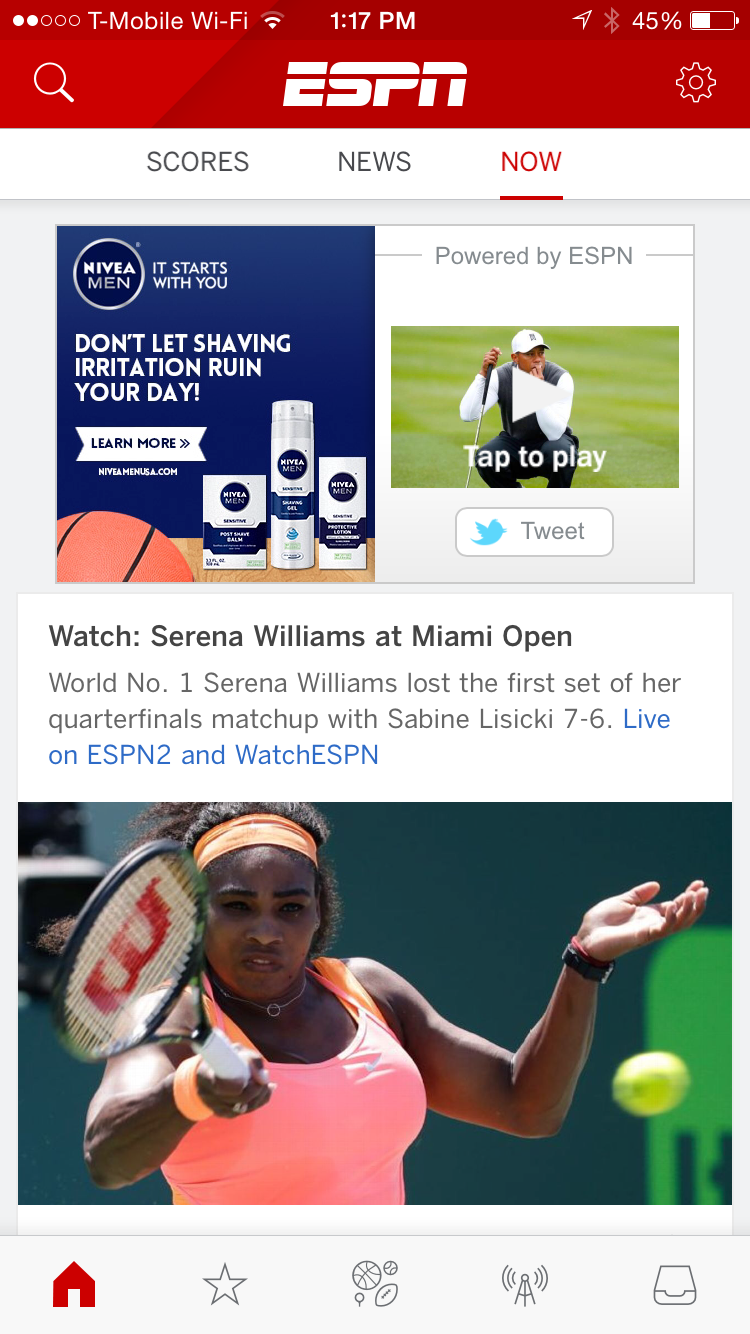
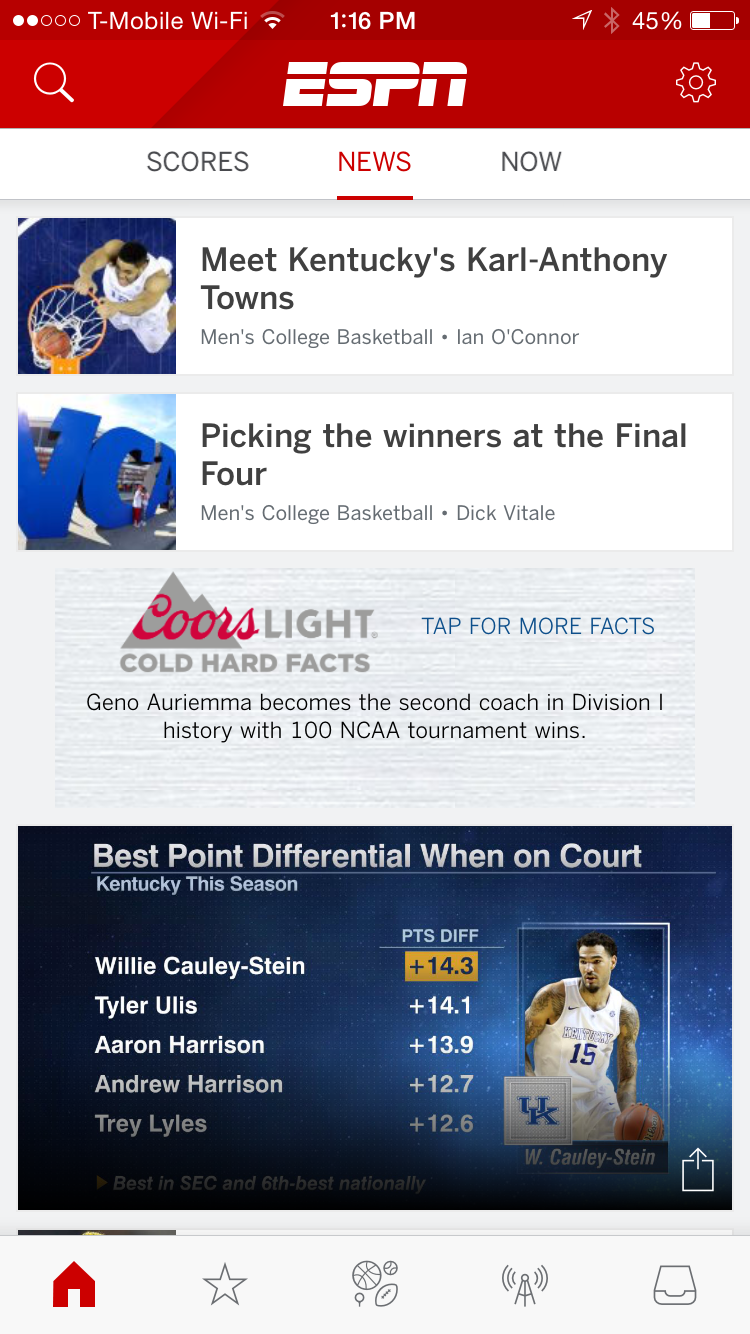
The roll out of their redesign actually started months ago with the redesign of their mobile app, switching from the curiously named “SportsCenter” to simply “ESPN”. The basic navigation for the website, mobile app and iPad app is about the same now that they are responsively designed.

mobile

All three versions come with your favorite teams’ news on the left column (which you can set when you sign in), a news stream in the center, and an “ESPN Now” column on the right, which is a curated Twitter-like feed showing a mix of news, videos, and and Tweets from ESPN personalities that can be easily shared on social media.

So instead  of having a two different versions of the site, one for mobile and one for the web, every version scales to the size of each device providing a pretty uniform experience.

espnmobile3

Sixty-one percent of ESPN’s 94 million users in the US view ESPN exclusively on mobile devices, with a good percentage of those users viewing the mobile web version. From Spoon’s piece about the redesign on Medium, it seems ESPN is hoping the new responsive design will be pull those mobile web users to their newly redesigned ESPN app.

ESPN seems to be doubling down on mobile content cards, which appear in the ” ESPN Now” column and can be distributed to Twitter, Facebook, and other social media sites with one click. This is the latest evolution in mobile content, with creators having less qualms about keeping people on their actual website and instead getting views on whatever platforms are getting eyeballs.

For example, we covered the launch of Snapchat Discover, which ESPN exclusively partnered with to provide content. The partnership has gone better than either side could have imagined, and while neither party would disclose numbers, a recent Winter X Games post logged close to 30 million views. Another new feature with ESPN’s redesign is infinite scroll, with unlimited stories popping up as you scroll down the page — another signal of the shift from the pageview economy mindset.

It is yet to be seen if the new redesign will drive users to ESPN’s new mobile app, but any redesign is welcome at this point, even if it merely draws a “meh” from sports fans. ESPN.com is finally in the 21st century with a responsively designed site, hopefully they won’t wait another six years to update this one.


Check Out MLBAM’s Ridiculous Launch Schedule for 2015

MLB Advanced Media, or the biggest media company you’ve never heard of, is about to embark on a video streaming expedition the likes of which the internet has never seen, supporting five launches in the next month alone, all while providing video streaming infrastructure for CBS Sports, ESPN, and WWE.

Take a look at this list put together by TechCrunch’s Matthew Panzarino:

  • 3/18 – Sony’s PlayStation Vue
  • 3/18 – March Madness streaming for Turner
  • 3/29 – Wrestlemania
  • 4/6 – MLB Opening Day
  • 4/12 – HBO Now debut with Game of Thrones

That launch calendar would be great if it occurred in a year’s time, but MLBAM is doing it in one month. If they nail it, MLBAM will be in prime position to do what has been speculated for months — spin off into their own digital entertainment company. As our esteemed managing editor, David Temple, noted, “Through some forward thinking, some early investments, and a little bit of luck, a sports league has ended up being a giant in one of the biggest tech industries around.”

As was previously reported by TechGraphs, HBO Now is being launched with an exclusive partnership with Apple TV, which created whispers that Apple is looking to start their own over the top streaming service like Sling.

In his interview with TechCrunch, Bowman responded to a question about the possibility of MLBAM supporting Apple in these efforts by saying, “I have no idea. We’d be honored to be part of anything, really… What people forget is how long they’ve been together, and how well they’ve been running the company. I think everybody would do a lot of things to be partners with Apple, but it’s hard to imagine there’s anything technologically we could bring to Apple.”

Continuing with the Apple theme, Bowman gave an update on the At Bat app launch for the Apple Watch, saying, “We obviously built a whole interface, when it launches in April and people sync their phones, [sic] obviously, the interface is different. Every piece of hardware has to look different… Hopefully, it looks cool and neat and — the watch itself, there’s ways to dig deeper. When you move it, you might just get an update, but when you punch it a couple times, it’ll dig a little deeper.”

Right now MLB.com is 85 percent of MLBAM’s business, but obviously that number is likely to fall given all off the business they’re taking on. When asked pick a competitor for MLBAM, Bowman responed, “I think the biggest competitors that we have are inertia.”

(Image via Ming-Yen Hsu)


ESPN Secures Rights to 2016 World Cup of Hockey

Exclusive video broadcasting rights for the World Cup of Hockey 2016 has officially been awarded to ESPN. The Cup is to be held at the Air Canada Centre in Toronto from September 17 through October 1st, 2016 and will pit eight countries against each other in a round-robin format, followed by a semi-final bracket. The finals will be decided by a best-of-three series for the title of best hockey country in the world, at least until the 2018 Winter Olympics.

The press release specifically cites games will be shown on TV via ESPN and ESPN2. It also mentions live access available via the WatchESPN app, though of course that requires a cable subscription. ESPN nailing down major international sporting events is nothing new — see the 2014 World Cup and 2015 Women’s World Cup — but it is curious to them take hockey. The NHL Network and NBC own the US hockey rights as ESPN bowed out of bidding in 2004.

Last month word broke that unofficially ESPN beat out Fox and NBC for the World Cup, though it is doubtful NBC feels threatened. They probably feel secure in their 10-year broadcast deal running through the 2020-21 season. The Worldwide Leader has come under criticism for trending away from hockey, though President of ESPN, John Skipper disagreed:

Look, I don’t think it’s [the criticism] fair,” Skipper said. “I see SportsCenter every day and we cover hockey every day. We do not have a significant differential between highlights of hockey now and when we had it. The only difference is we are not there [as a rights holder]. If we were there for the playoffs, we’d be throwing to the guys calling the game. We can’t do that, but we are at hockey games. We are doing hockey highlights.

Apparently hockey highlights weren’t enough anymore.

(Header image via NHL)

Snapchat Launches Content Platform with ESPN and Bleacher Report

Last week Snapchat announced Snapchat Discover, their new content platform featuring partners like Vice, Comedy Central, and Yahoo! News. For the sports crowd, US users of the ephemeral messaging app will be served content exclusively from ESPN, while international users will get sports content via Snapchat’s partnership with Bleacher Report.

For everyone over the age of 25, what this means is that the Snapchat app, which is primarily used to send pictures to friends that disappear after a set number of seconds, is now a full-fledged media platform.

Regular messages sent on Snapchat disappear after 10 seconds or less. However, stories in Discover will appear for 24 hours before being refreshed with a new batch of content.

The ESPN channel has great visuals and the UX will be familiar to Snapchat users (swipe right for the next story, swipe up for the content of said story). There’s no buffering for video and the content loads immediately—there was never a lag when I was reviewing it. Discover is supported by ads, but you aren’t hit over the head with them. You’re able to swipe them away much like you are the editorial content.

One gripe is there wasn’t any unique content developed for the Snapchat audience, something that may change as content providers become more familiar with the platform. With an estimated 100 million-plus monthly active users, there is great opportunity for providers to attract a young, mobile-friendly audience.

Snapchat insists that this isn’t a social media play, saying in a blog post, “This is not social media. Social media companies tell us what to read based on what’s most recent or most popular. We see it differently. We count on editors and artists, not clicks and shares, to determine what’s important.”

This may be true, but if Snapchat wants to get established in the content game they need to provide a reason to use their app over other native content apps. Right now I can’t see a reason why someone wouldn’t just use the ESPN app.

Additionally, one of the big strengths of social media platforms like Facebook and Twitter is curation — the individual has the power to select the content they see based on their network. Curated editorial content that is essentially cherry picked from what you can find on the web doesn’t provide enough differentiation or value to set it apart from social media platforms

Snapchat’s Discover also signals further fragmentation in the mobile content landscape, with content providers developing their own apps and social media apps like Snapchat developing content platforms. But with mobile video’s strong growth (it currently makes up 22 percent of digital video consumption), combined with the fact that young people aged 14 to 24 are now watching a majority of their video on screens other than their TV, a land rush for a slice of the mobile video market is an obviously play for a growing behemoth like Snapchat.


ESPN Continues esports Experiment

Between esports scholarships and ESPN previously showing the Defense of the Ancients 2 — or DotA 2 — on their ESPN3 stream, the “worldwide leader” is continuing their foray into esports. Yesterday ESPN announced their intent to broadcast the League of Legends — commonly shortened to LoL — World Championship finals on ESPN3 this Sunday, October 19 at 2:30 am Eastern, 11:30 pm Pacific. The finals are being held in South Korea, almost inarguably the esports capital of the world.

lol2

The announcement came as a bit of a surprise given not even a month ago ESPN President John Skipper didn’t mince words on his thoughts on the esports as a sport debate at the Code/Media Series: New York:

“It’s not a sport — it’s a competition. Chess is a competition. Checkers is a competition…Mostly, I’m interested in doing real sports.”

The signals may be getting mixed, as according to some sources, ESPN execs were “delighted” with the viewership numbers from their DotA 2 stream. While there may not be any other DotA 2 events in the near future for ESPN, it is clear the network is interested in esports.

Athletes are getting on the esports hype train too. Gordon Hayward of the Utah Jazz recently tweeted his affection for LoL while simultaneously challenging LeBron James. Hayward, no stranger to esports has previously mentioned StarCraft II and even joined a StarCraft II tournament.

Regardless of whether professional athletes join the ranks of professional gamers, ESPN has clearly found the previously little niche genre of esports is rapidly growing. Between the streams available on Twitch.TV, YouTube and ESPN, plenty of LoL action will be viewable this weekend. While we aren’t at the point of tailgating for esports, we’re getting awfully close. As more and more companies realize the viewership potential, ad revenue and product placement opportunities, expect the contrast between esports and sports continue to fade.
(Header image via Riot Games, makers of League of Legend)