Archive for Review

TechGraphs Report: On Deck Sports and Technology Conference

Earlier this week, NYC’s Bohemian National Hall played host to hundreds of sports executives, entrepreneurs, and others looking to learn about the very latest in sports technology. Since 2013, the On Deck Sports and Technology Conference (organized and presented by SeatGeek) has provided a forum to showcase what products are “on deck” to help fans follow, analyze, and participate in sports.

On Deck has a slight bent towards sports startups, so a decent amount of the conference was geared more towards raising capital, scaling businesses, etc. Still, there were plenty of fascinating talks, panels and interviews for anyone interested in straight sports tech.

Statcast And Beyond

Possibly the most entertaining talk of the day was Joe Inzerillo’s (CTO, MLBAM) update on MLB’s Statcast, which is finally getting its moment in the sun this season. For those who needed a refresher on how Statcast operates, Inzerillo discussed its missile-technology radar system, its stereoscopically-placed cameras, and how these allow each Major League ballpark to track the movements of every player on the field (plus the ball) at any given time.

Once Statcast has this information, as Inzerillo pointed out, it can then provide real-time data on pitch velocity (actual and perceived), player velocity and reaction time, and a horde of other quantitative metrics, plus more advanced data on a 12-second delay, like fielding route efficiency. This data is just inherently cool (as you likely know if you’ve seen a Statcast-enhanced game or highlight on television), but it’s also already being used to both question and confirm existing baseball strategies.

For an example of the latter, Inzerillo looked at the fallacy of sliding into first using Statcast to plot Eric Hosmer’s 1B slide in Game 7 of the last World Series. Hosmer hit a peak speed of 20.9 MPH before sliding and being out by less than a tenth of a second. If he had just kept running, Statcast found, he would have been safe by nearly a foot. Statcast is already getting noticed by clubs, and even players — batters like to talk smack, apparently, over who has the highest exit velocity.

During questions, Inzerillo was slightly cautious about committing to the future of Statcast, but he did mention that minor league stadiums were a natural next step, and that there was plenty of work being done on developing new metrics. Statcast already tracks ‘defensive range’ for fielders, for example, but since a player doesn’t travel the same speed in every direction, there’s a need to find the more amorphous ‘effective defensive range’ and how it changes–such as during defensive shifts.

On the football side of things, Sportradar’s Tom Masterman talked about the NFL’s NGS (Next Gen Stats) platform, which is collecting data on every single game in 2015 to track, analyze, and visualize how players are moving on the field. NGS is already being distributed to clubs, media, and health and safety personnel; the long-term goal is to have X,Y,Z coordinates for every player and official, plus the ball.

Go Bucks

On Deck’s attendees weren’t just league officials and startup managers–the conference started with a live interview of Wes Edens, who became co-owner of the NBA’s Milwaukee Bucks in 2014. Much of the conversation focused on the new Bucks arena, which was being voted on by the Milwaukee city council literally as the interview was ongoing. As it’s currently planned, the presently-unnamed arena will focus heavily on keeping fans digitally connected — giving attendees plenty of WiFi, for example. At the same time, Edens noted, they want to avoid fans using technology to become distracted from the game going on in front of them. (Edens used the phrase “Instagram culture”, specifically, though he noted that he himself has had these sorts of problems before.)

Edens was similarly balanced when the discussion turned to analytics. One of the first things Edens did after buying the Bucks was to build their analytics program — bringing on employees, consultants and even discussing methodologies with other owners. There’s definitely a “golden age” of analytics in basketball going on.  Edens even thinks the NBA will end up surpassing the MLB as the leader in sports technology. But when he was asked about how the players feel?

“It’s a good question,” Edens replied. “There’s definitely lines that can be crossed” with having too much data being made public, at least when it can affect the privacy of the players (such as rest/injury issues).

Edens also briefly discussed the role of the referees and the potential benefits of replay and “the new center across the river“. Could we see yet more referee technology, even an Oculus Rift-type headset for NBA officials, in the future? “Totally possible.”

Era of Mobility

When it came time to look at how fans themselves were interacting with sports, technologically, it became clear that mobile is “it.” In that panel about growing sports startups I mentioned earlier, representatives from SeatGeek, FanDuel and Krossover all praised the importance of the mobile web for their companies–SeatGeek’s rep described it as a “tale of two companies”, pre- and post-mobile, and Krossover’s founder mentioned they’re considering dumping their web app altogether in lieu of just being on smartphones and tablets. When Yahoo Sports’ VP of engineering presented a chart showing their fantasy football traffic from this season’s Week 1, the fraction of non-mobile data was a pretty small sliver at the top.

Yahoo fantasy data graph
Trust me, it’s there.

Even companies you might never expect to get in the mobile game are joining and succeeding. Jeremy Strauser had 20 years of gaming experience at EA Sports and Zynga before joining one of the most loved and enduring brands in the sports industry, Topps. Yep, they’re digital playing cards.

Topps first got into the digital game 4 years ago and how has three top-selling sports card apps, plus a newly launched Star Wars-themed set. Why should you be interested in buying trading cards on your phone? One starting point is the capabilities the digital platform provides — literally hundreds of thousands of different designs, the ability to create all manner of rare and unique cards, etc.

Topps is also rolling out a daily fantasy sports feature (DFS was a major topic of conversation at On Deck) that allows you to compete using the players in your card deck and swapping them in and out in real time as they go up to pitch or bat. It probably doesn’t hurt, either, that they won’t take up space under your bed or get thrown out by your mom when you’re away at college.
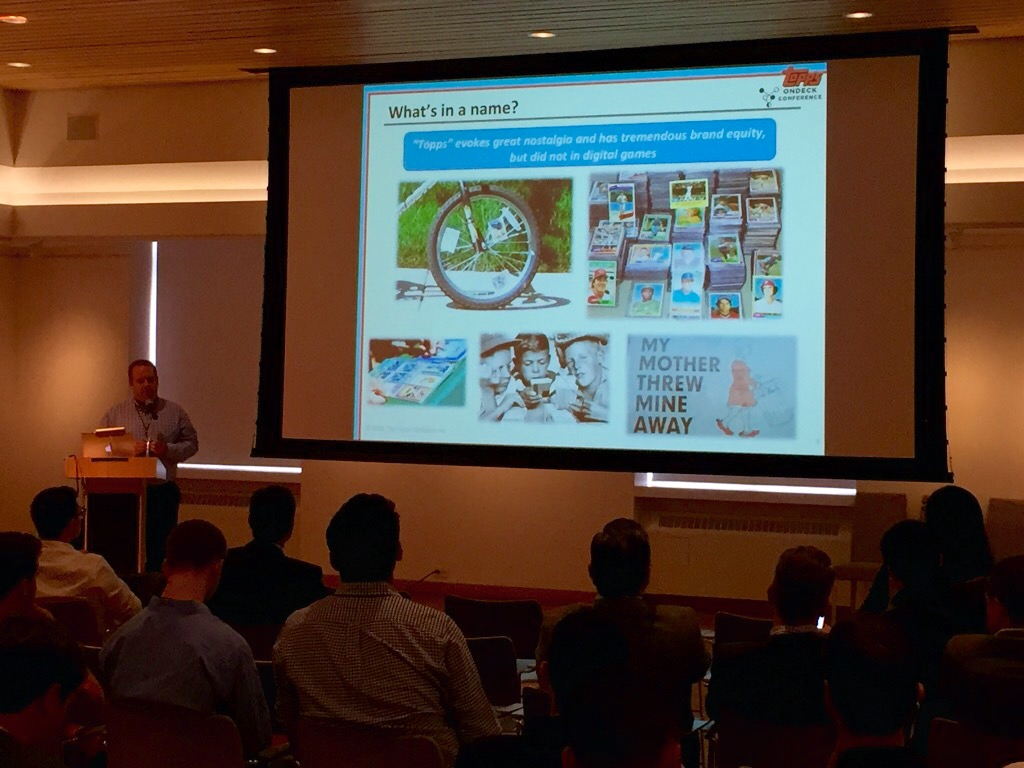
Topps conference talk

Coming To Your Hometown

If you want to look for the next wave of sports technology, though, look to your neighborhood.

Rather than providing new tools or analytics for MLB, the NFL or the NBA, the newest sports apps want to help you participate in sports in your own town. On Deck wrapped up with a “Startup Pitch Contest” a la Shark Tank where teams had four minutes to present their groundbreaking app to a group of judges. The six competitors included:

  • Wooter – a search engine for finding and joining sports and activities like local rec leagues. Wooter provides profiles for leagues looking to form teams, players looking to join them, and the tools to process payment and set up other logistics.
  • NextPlay – helping youth coaches conduct tryouts and league drafts. For $15/month, instead of taking a stopwatch, a bunch of handwritten notes, and an Excel spreadsheet to put together youth rosters, NextPlay handles all the data collection and analytics itself. Their beta has been used by “a couple hundred organizations” and over 10,000 athletes.
  • ScoreStream – filling a gap in local journalism by crowdsourcing reports on high school sports.

With a really impressive presentation, broad coverage (10,300 HS games covered last week alone) and the #1 iOS app for high school sports, I really thought Scorestream would walk away with the prize, but it ended up going to…

  • SidelineSwap, a P2P marketplace for sporting goods. SidelineSwap has over 43,000 registered users who’re interested in trading out sporting gear just collecting dust in their basement or garage. They’re working on building partnerships with youth organizations and promoting used college-branded material, which should play very well with their chief audience of high school students.

On the whole, On Deck was a whirlwind experience for learning about cutting-edge sports tech. This report only covers part of everything I caught there. Watch for further updates and profiles soon!

Review: Motus Global’s mThrow

When Motus Global’s sleeve was announced last spring, it was supposed to save baseball, stemming the flood of Tommy John surgeries plaguing the majors. Now, the device that teams have been using to study their pitchers’ mechanics since last fall is available to the public. The mThrow has been on sale through the Motus website since March, and began shipping in early May. Eager to see what the device had to offer, I plunked down the $150 (plus $20 for an additional compression sleeve) and waited anxiously.

The box that the mThrow comes in is taken up mostly by the compression sleeve. The actual IMU — the sensor that actually tracks the arm’s motion — is a tiny blue thing, about the size and shape of a circus peanut*. The IMU charges by induction, so all the user has to do is plug in the charging station, place the sensor on top of the station, and wait about an hour.

* – But slightly better-tasting.

Pairing the sensor is simple, too, taking just a few taps of the smartphone app. The hardest part of setting the thing up is probably wedging the sensor into its little pocket in the compression sleeve, and then pulling the sleeve on so that the sensor rests over the infamous ulnar collateral ligament. In fact, the design might be overly simplified. In an effort to make the sensor more water-resistant, there are no lights on the sensor to tell the user of the charge level. The only way to check is to pair the sensor with the smartphone app; if the app doesn’t recognize the sensor, it probably needs to be re-charged.

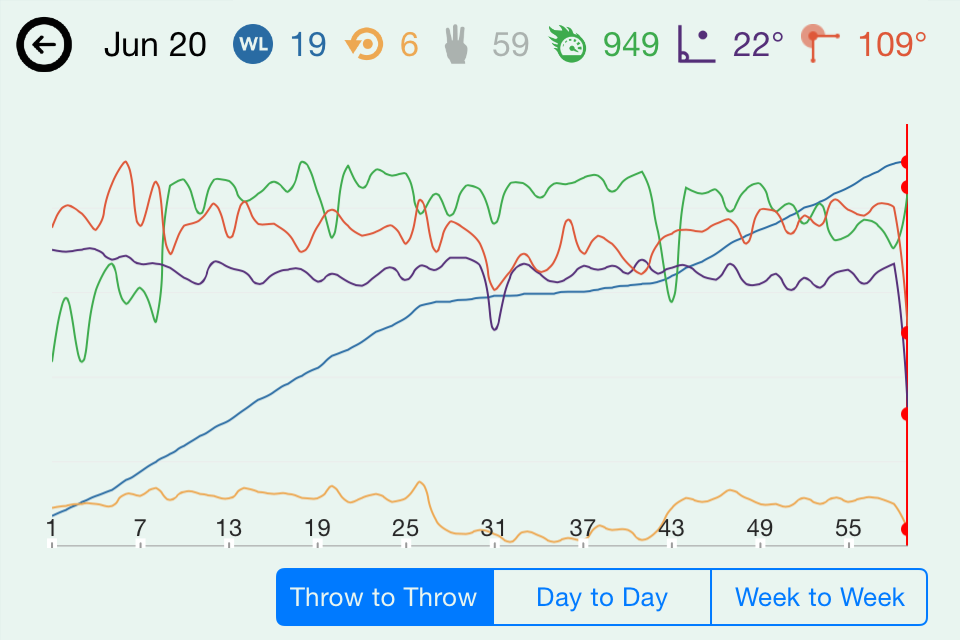
The app is currently available only for the iPhone; an updated version was approved this week. The software now computes five metrics from the sensor data: pitch count; maximum arm speed, a rotational velocity measured in revolutions per minute; arm slot at release; maximum shoulder rotation relative to initial position; and, of course, torque on the UCL. These are then combined into three headline numbers: performance, a measure of mechanical consistency; workload, currently an additive function of elbow torque; and a “throw meter,” an energy bar that drains from blue to orange as the workload increases and consistency decreases.

I ran some preliminary testing of the mThrow, connecting it to an iPhone 4S and throwing 17 fastballs, 17 changeups, and 17 curveballs to the best of my extremely limited ability; all but six throws were recorded. Even if there’s no difference between their speeds and movement, you can still see a difference between my initial warmup tosses (the first dozen, with much lower arm speeds), fastballs (about 13-25), curveballs (26-43, with much lower torque values), and changeups (44 onward, with decreased arm speeds).

image2
This simple relationship was confirmed with a second test using a HitTrax system, which can track speed and late break of pitches as they cross the plate. My subject was a 45-year-old with some collegiate pitching experience who threw ten fastballs and ten curveballs. By comparing the HitTrax velocity report (right) to the mThrow statistics (left), we can see the correlation between the decrease in arm speed and the decrease in velocity as the subject switched from fastball to curves.

donfrancesco
Lastly, I brought the sleeve to a local high school (Blackstone Valley Tech, Upton, MA) to get some insights from active players. Assistant coach John Burke, pitcher Nick Laren, shortstop Joe Corsi, and catcher Jack Lynch took turns throwing an assortment of pitches from a number of release points, seeing how their throwing motions stacked up. The session supported some beliefs — for instance, that the quick motion Lynch uses to throw out would-be base stealers puts more torque on the elbow than a standard pitching delivery. But others were surprisingly contradicted: despite everyone’s belief that sidearm throws put less stress on the elbow than an over-the-top delivery, the app didn’t seem to report a relationship between arm slot and torque.

Chief technology officer Ben Hansen says the mThrow is still in its infancy, and says that the device’s official consumer launch is not scheduled until later this summer. The app currently relies on data compiled from Motus Global’s work with MLB prospects at last fall’s instructional league to generate its workload number, but Hansen and his team are working to produce more meaningful metrics from a more complete data set.

“We’re just capturing as much data as we can to see what’s normal,” Hansen said. “We also have controlled studies going on at every level. We have [NCAA] D1, D3, high school, and Little League players wearing it religiously.”

At this early stage, the app seems to be designed more for Motus’s professional clients than for public users. Maybe the best example of this is the tagging feature, which allows users to tag individual throws as belonging to bullpen sessions, long toss, or game action, and to further break throws down by pitch type. But at the moment, the tags are unavailable to the user after selection, getting passed on to Motus Global with the sensor data but not visible on any of the trend screens. Hansen confirmed that the tags were being used in the company’s research for their MLB clients, however.

“Every week we send reports broken down by tags where we compared each pitcher to the league averages for that pitch type,” Hansen said. “The teams love using the tags and breaking things down into the different pitch types.”

It’s a tantalizing view of an exciting feature that could still be a couple years away. And it’s not just super dorks like me who would find those analytics useful. The key to a good changeup is matching the same arm speed used to throw a fastball, so it’s easy to see coaches like Burke using the arm speed metric to give feedback to young pitchers just learning to throw the pitch. But without any way to divide pitches into different categories, this sort of feedback isn’t possible yet.

“We are looking into a web portal to give users more in-depth analytics,” Hansen said. “But right now we’re focused on getting the analytics right before we move on to other platforms.”

It’s probably still too early to judge the mThrow fairly, and I’m almost definitely not the right person to do it (sabermetrically-inclined tech geeks who can’t pitch are not Motus’s target market). And it’s true that more research could produce findings that actually help young pitchers stay on the field and off the operating table. But as currently constructed, the mThrow raises more questions than it answers, and left me wanting more. Like a top pitching prospect, the technology needs some time to mature before it can make a meaningful contribution.


REVIEW: OOTP 16, Still Very Good

Game: Out of the Park Baseball (OOTP) 2016 (website)
Platform: PC, Mac, Linux, mobile
Release Date: 2015
Metascore: n/a
Techgraphs score: 4.3 or 86 B

General Reaction
OOTP is our most reviewed and highest reviewed game of all time. It takes all the high-level problem solving of a real baseball front office — salary management, roster management, owner expectations, and so on — and somehow condenses them all into a single game. The game is addictive. It’s fantastic.

That said, I’m trying to review this latest edition as critically as possible. And it’s hard to critique something you’re hooked on. But the game does have some flaws, and I will address those. But overall, it’s another excellent submission to the OOTP franchise.

Ratings

Graphics: 4.0 stars
Let’s face it; you’re not going to play OOTP for the graphics. The only 3D component of the game — an optional view for the in-game management — leaves a lot of a room for improvements. It’s not really a problem, per se — more of a “Where’d it go?” The old versions of OOTP had this realistic face generator. It was really impressive. But I can’t find it among the add-ons now. So we end up with this:

I had no idea Brett Gardner looks like a 45-year-old tax accountant from New Jersey!

Concept & Game Modes: 4.5 stars
OOTP does a nice job of not stretching itself thin with game modes. The database and formulas that serve as the foundation for this game would not be at their best in a “Path to the Majors” or a work-your-way-to-the-top game mode. So having a single player GM/coach mode and a multiplayer GM/coach mode is probably sufficient to please 90% of fans.

It would be interesting, however, so see an arcade mode — hear me out! The latest changes to OOTP have created a system where the player (you, sir or madam) are given a salary and contract based upon your reputation and recent success. What if the game took a page from the NBA 2K video game series and made those salaries worth something? Perhaps players could spend their salary on negotiation classes, improving insight and success rates during trade or salary negotiations. Perhaps players could spend on charitable enterprises and improve their reputation — thereby unlocking more prestigious managers and executives. Or perhaps players could spend money on special camps that have a chance to boost a few players’ rating in special areas (“Send [these three players] to the Barry Bonds Hitter Clinic? Grants 10% chance for increase in either Power or Eye rating. Cost is $100K per player.”).

This kind of stuff actually incentivizes earner a higher income. And it’s just kind of fun.

Gameplay & Interface: 5.0 stars
The interface hasn’t changed much in OOTP 16, but there have been a few minor tweaks that I think show the developers’ really care about user feedback. Lots of tiny things like:

This is a nifty little added feature. Saves a few clicks for all the top draft picks.

I’m giving gameplay and interface a perfect score, but a big part of me wishes I could experience it all over with rookie eyes. Of course the interface seems easy to me; I’ve been playing OOTP for a half decade.

Glitches: 3.0 stars
There’s a lot of little things that impede my enjoyment of the game — problems that didn’t exist before. Ratings filters don’t seem to work in the Find a Player section (a great new addition, if it actually worked for me…).

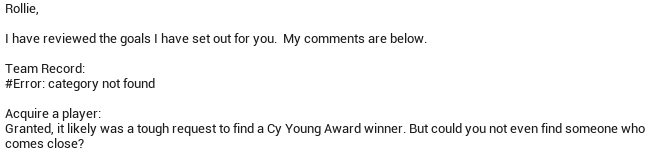
And more than that, the new owner goals feature had serious signs of inconsistency. Several times early in my franchise, the owner could not recognize the fact that I had completed an assigned task:

Um, okay?
One of several glitches. The owner did not like my having acquired Jake Peavy, apparently, nor could it recognize the fact I improved the team record. :/

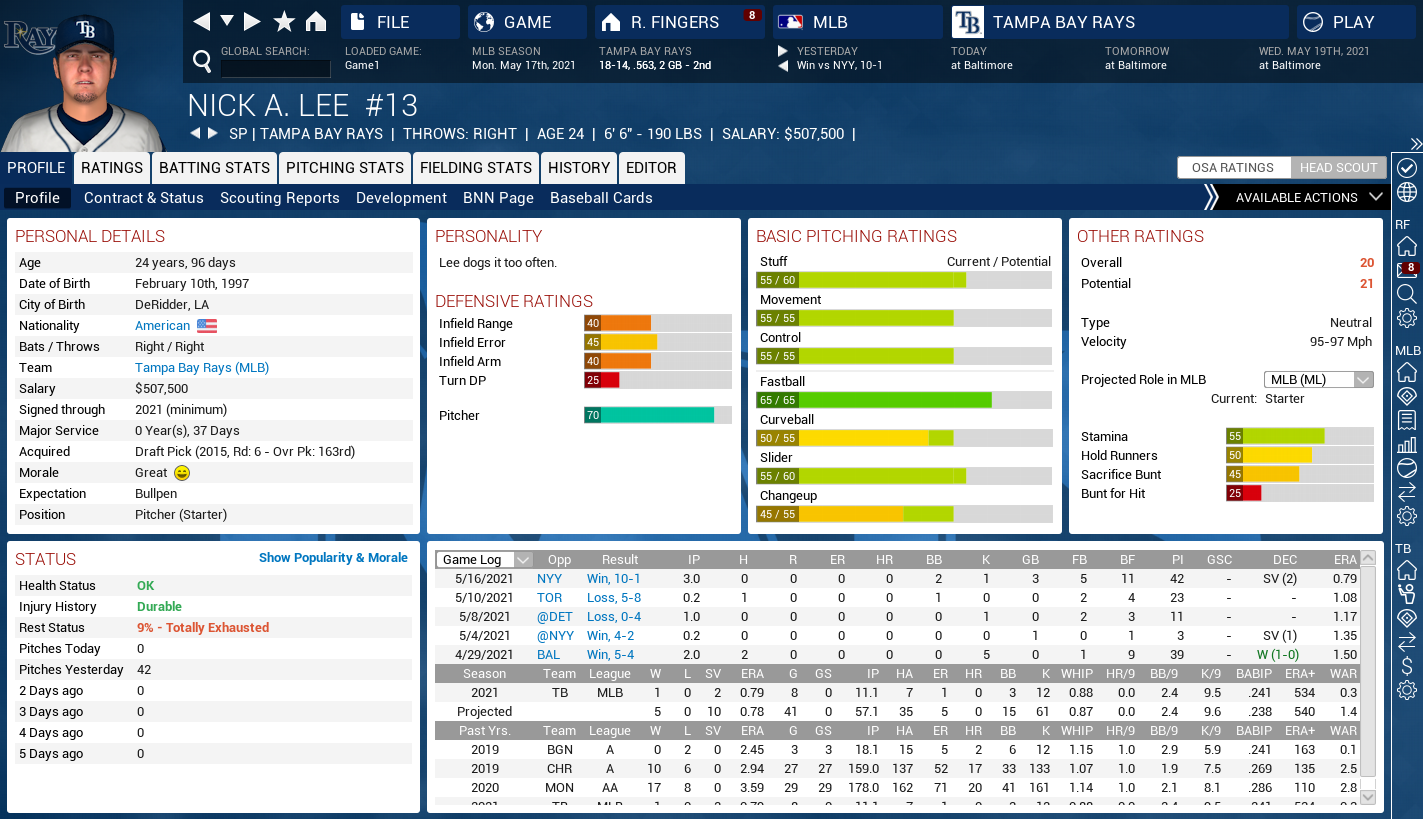
More troubling, though, is that there are numerous issues with player valuation. The AI does not seem to value pitchers correctly (a lot of trades that should go through, don’t), and seems to struggle to identify medium-quality talent. Either everyone is a five-star prospect or not a prospect at all. In general, scouts seem to have a bad grasp on pitcher value (a starting pitcher with three strong pitches and good makeup will still have a 21 potential on the 20-80 scale).

How is this not a good pitcher?

And then, after several years into my franchise, the talent pool disappeared. International free agents stopped being prospects all together (except for a few hidden gem pitchers who had great ratings everywhere except their potential ratings); the draft only had one or two premium prospects at most (normally the first round should land everyone a premium prospect); and since I had a world of difficulty convincing other GM that their pitchers had differentiating between a prospect and Quad-A filler, fair trades were hard to come by.

Say what I will about the relative simplicity of Baseball Mogul, at least the ratings are close (as close as a scouting system with variability should be).

Rosters: 5.0 stars
This is always the strength, nay, the stupid strength — so strong it’s dumb — of the OOTP franchise. You won’t find a more accurate system of minor league players and managers.

See Also:

98 A+ Out of the Park Baseball (OOTP) 2015 (PC)
98 A+ Out of the Park Baseball (OOTP) 2014 (PC)
97 A+ Out of the Park Baseball (OOTP) 2013 (PC)
96 A+ Baseball Mogul ’13 (PC)
96 A+ MLB ’12 The Show (PS3)
82 B- MVP Baseball 2003 (PC)
79 C+ MLB 2K12 (PS3, XBOX 360, Wii, PC, etc.)
74 C MLB Ballpark Empire (Facebook)