Canada is looking to be a world leader in entertainment, and no, it isn’t hockey. Well, it could be hockey, as the beauty of the country’s recently announced cable plansleafs leaves all of the decisions to the customer. The Canadian Radio-Television and Telecommunications Commission (CRTC) claims next year Canadians will have the option of an entry level TV service starting at $20 per month, then an option to purchase individual channels from there. By December of next year, all of Canada is set to have “pick-and-pay” basis or in small packages available.
The vague wording on what “small packages” consists of is yet to be determined, however the CRTC will cap the basic package range from $20 to $25 (plus add-ons) compared to the cheapest current cable package at Rogers Communications goes for $40.48. Of course, much like Big Cable here in the United States, Rogers charges a one time activation fee (49.99), installation fee ($14.95) and renting or purchase fees of the equipment. No word on whether the new plans will have features such as high definition, DVR or any Video-On-Demand services either, which would almost certainly be a major a factor for many.
Take a look at the basic (read: no HD, no premium channels, etc.) packages available in my area for a single TV compared to what we know about Canada’s plans.
Price (Monthly)
Extra Charges
Installation
Activation
Canada
$20-$25
None
N/A
N/A
Charter
$59.99
$6.99
$29.99
N/A
AT&T
$29.99*
None
$99.99**
$49.99**
*This is the price for the initial six months, then the price jumps to $65.00 **After speaking with an online representative, I was able to get both the install and activation fees waived
The mass appeal to an à la carte system is clear, though it could be nothing more than swapping deck chairs on the Titanic. For someone like me, one who roots for favorite sports teams outside of the local coverage, going back to cable doesn’t make sense. I am already paying monthly for Netflix as well as one time payments for MLB.TV, Fox Soccer 2 Go, Amazone Prime and MLS Live (plus various subscriptions to Twitch.TV) as well the soon to be launched HBO Now, do I really want another monthly bill for entertainment?
For years my parents, friends and others have complained and expressed frustration about paying for dozens (f not hundreds) of channels they’ll never watch. Canada is taking a step for people to choose what they want, but many, myself included, already know — and have — what we want. If I lived in Canada, I’m not sure this package would be for me, however I realize I am on the fringe for many things entertainment.
FanAngel is a site that, in a just world, wouldn’t exist. The crowdfunding site enables fans to become patrons of NCAA athletes, donating money to persuade said athletes to stay in school, with the site holding the money in escrow until the athlete’s eligibility expires.
While it is true that NCAA athletes from power conferences have been getting the shaft for decades by not being compensated properly for their increasingly valuable labor, crowdfunded donations from fans do nothing to alleviate the exploitative labor conditions under which NCAA athletes operate.
In the event that a FanAngel crowdfunding campaign is successful and the athlete’s NCAA eligibility expires, 80 percent of the money would go to the athlete, 10 percent would go to the athlete’s teammates (nice touch!), and 10 percent would go to a scholarship fund or charity. FanAngel makes money by taking 9 percent of the total amount raised (more on this later). Of course, if the athlete doesn’t stay in school the money is refunded.
Shawn Fotjik, founder of FanAngel, said in an interview with ESPN sports business reporter Darren Rovell, “If you wanted Marcus Mariota to stay in school for his senior year, you could give $20.” I applaud Fotjik on getting good PR from Darren Rovell, but Marcus Mariota is either going #1 or #2 overall in the 2015 NFL Draft and there is no amount of money FanAngel could raise that could keep him in school.
Contributing to a crowdfunding campaign for teenagers who are exceptionally good at big time NCAA sports, and also strangers to the donor, is something I’d assume would be creepy to most well-mannered adults. As has been proven time and time again in my life, I am wrong about this assumption.
Fans of Jarrell Martin, a sophomore forward for the LSU Tigers who, according to DraftExpress.com, is projected to be drafted at the end of the 1st round in the upcoming NBA Draft, have raised over $700 on FanAngels for him to return to LSU for his junior and senior senior seasons, completing his NCAA eligibility. Understanding that FanAngel is a new venture and will need time to scale both users and donations, it still strains credulity to see this ever happening.
For a glimpse of what might be in Fotjik’s future, FanPay, a crowdfunding site which raises donations as graduation gifts for college athletes, has received over 100 cease-and-desist letters from universities and conferences.
Additionally, FanAngel may want to rethink the 9 percent fee they collect for successful campaigns. Other supposedly altruistic crowdfunding donation sites have been taken to task in the past for collecting high fees. One of the worst offenders is Give Forward, which collects 7.9 percent of every donation plus a $0.50 transaction fee. Nine percent is a laughable amount that puts FanAngels in the same exploitative waters they claim they are trying to drain.
If college sports fans suffering from hero worship want to contribute to an NCAA athlete’s cause, they should skip crowdfunding platforms and donate to the National College Players Association (NCPA), which spearheaded the player union movement at Northwestern. Or do what has been done for time immemorial, put some cash in an envelope and make a handoff.
The long-fought fight to keep the Internet as free (as in speech, not beer) and open as possible gained a very significant victory today, as the FCC ruled in a 3-2 decision to implement strict net neutrality rules and reclassify Internet service offerings as a Title II service. This ostensibly means that Internet services will be classified much like utilities are now, and therefor can’t be subject to the general bandwidth and pricing shenanigans that have begun to crop up. Unless you own an ISP, you can consider this a victory.
The ruling prohibits carriers from strong-arming content providers into ponying up more money to make sure their product reaches consumers. Before today, an ISP — let’s call them Fomfast for the sake of argument — could look at all the traffic that a streaming service like NBA League Pass was carrying across their wires and decide that they were taking up far too many resources to not have to pay a premium. Fomfast would then tell the NBA folks to pay them a fee of some kind, lest they wish their streams to be throttled, creating a poor experience for the customer. This has already happened with Netflix, and could have very well happened to services like League Pass, MLB.tv, FOX Sports GO, WatchESPN, etc. without today’s ruling. What transpired today means less cost for the providers, which means (hopefully) less cost for you.
In an interesting turn, the FCC widened the scope of their ruling to include mobile providers, so while it will still count toward your data cap, you should be able to stream soccer matches on your phone without throttling or slow-down problems.
We talk a lot about streaming sports online on these electronic pages, but in truth, a lot of the services and sites we mention could have looked (and cost) a great deal differently without similar governance in place. There would have been nothing stopping Fomfast or Fime Farner from holding our sports streams hostage in a pixelated prison until the leagues decided to let the providers in on the action.
The Internet has been such a large part of our lives for quite some time. It seems silly that it took this long for this kind of decision to be made. But at least it happened. And in a rare instance, a U.S. governing body made a decision about something before it became a really big problem. It’s a little sad that what seemed like such a no-brainer garnered two “no” votes, but fair-headedness won out in the end.
And just in time for baseball/MLB.tv season. What joy.
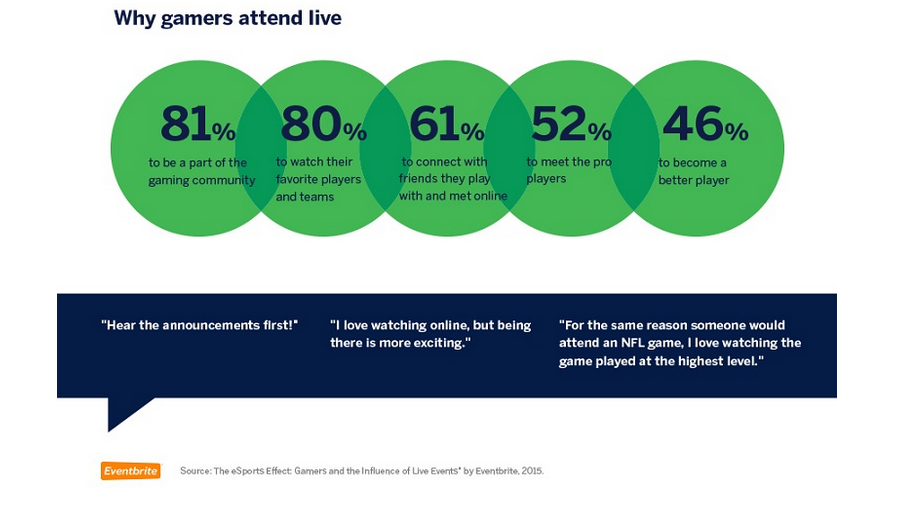
Earlier today Venture Beat posted an article with polling data on esports fans who have attended live events — not only attended, but as spectators and specifically not as participants. Much like professional sports, the pro scene in esports has a strong following, arguably a stronger (though not necessarily better) social media presence due to the more unfiltered and less politically correct realm of the internet community.
VB (in conjunction with Evenbrite) see over 80% of fans attending live events to be a part of the community and to watch their favorite players and teams live. Many fans, 61%, also go to connect with friends they play with online.
As a former player — not at the highest level, but relatively close — in both first-person shooters (specifically Counter-Strike 1.5 and 1.6) and real-time strategy games such as StarCraft II, the connecting with friends part is huge. From old LAN centers such as Warfactory in St. Louis, Missouri to CygamZ in Ypsilanti, Michigan, my team(s) and I enjoyed the travel and the live events in a way online couldn’t match.
Back in the day my teams used voice programs such as Ventrilo mostly, though originally we used the even older Roger Wilco to communicate in-game. When we weren’t scrimmaging (aka scrimming) or working on timing strategies, we would often hang out in our mIRC channels and just shoot the breeze. Similar to coaches going over post-game film, our team would often watch demos of ourselves together, take notes, make recommendations and adjustments. We would even scout opposing teams in upcoming matches or swap tactics with other teams in our divisions, and basically have a scouting report. For example, if we knew one particularly member on the opposing team was hyper-aggressive or overly passive, we would adjust our strategies to exploit that.
Living or rooming together to develop strategies and bonds between teammates even has a specific term in the gaming industry: bootcamping. North American CS:GO team Cloud9 often does bootcamps and recorded two last year prior to a major LANs. Other teams live together in literal team houses, mostly in South Korea and throughout Europe.
While my experiences are of course subjective and anecdotal, seeing the vast majority of fellow gamers agree doesn’t surprise. From literally playing games in my parent’s basement to traveling to compete with the best North America had to offer, I wouldn’t change a thing about my gaming career. To see esports take off to such a level that ESPN shows games, media outlets conducting interviews with pro players and the sheer size of prize pools, I may have to get the band back together.
According to CNBC, YouTube could be on the brink of a major makeover for companies and content creators. The service would offer a subscription price to eliminate advertisements in videos. Google — which bought out YouTube for $1.65 billion in 2006 — has been experimenting with a subscription based revenue model since 2013, though now it seems the service will launch full-scale in a matter of months.
The ad-free experimental model, starting as low as $0.99 per month, currently features partnerships with National Geographic, PGA, UFC and 26 other channels. After two months the service wasn’t quite what some hoped, at least according to National Geographic’s senior vice president of global strategy. On top of the channels and content, YouTube is also launching their Music Key service in order to bring ad-free content specifically to music videos.
As more and more people are finding ways around the pre-roll and in-video ads — the Ad Block Plus Chrome extension claims over 50 million users — it will be curious to see what demographic this new YouTube service is aimed at. As someone who has cut the cord, I rely on streaming services for information, entertainment and the like. While I turn off ABP for certain websites and for Twitch.TV, for the vast majority of my computer based browsing, I leave it on.
The sheer volume of content on YouTube is staggering: over one billion active users upload 300 hours of content is uploaded every minute. Despite sporting an impressive 50% advert revenue going back to the partners on YouTube, this new subscription-based model for generating revenue could be the cure for people like myself who use third-party options to avoid ads. I certainly can’t speak for everyone using ABP or a similar service, but advertisements are a matter of being an inconvenience and for me, just being impatient.
I for one, welcome our new subscription based YouTube overlords.
A few weeks ago, I began to explore the idea of the Soylent Athlete. More specifically, I asked: Can an athlete better meet his or her fitness goals by using powder meal replacements?
The catalyst for this line of thinking, the unforgettably-named Soylent, just raised a whole mess of money in the venture capital world and looks to up their production levels as a result. Which is great. Because I ordered Soylent sometime in mid 2014, and I’m still waiting on my first batch.
But in the meantime, there are many Soylent alternatives available. The recipe for Soylent itself is open source, meaning there are a lot of similar and hopefully great product on the market. Today, I’m going to look at 100% Food from Space Nutrients Station.
I have now tried four variants of 100% Food: The normal vanilla (or “raw”), the normal chocolate, the low carb vanilla, and the low carb chocolate. I have liked all four flavors, and — texture and consistency aside — my favorite flavor might be the Low Carb Raw variety. But the chocolate flavors are excellent, too, and contain Ghirardelli chocolate powder in them. For funsies, you can also add a little chocolate syrup, though that obviously eats away at the health benefits of the meal.
One thing I really wanted, though, was a spicy option. Or perhaps a savory option to which I can add any of my delicious hot sauces. My office neighbor is always dousing his food in Crystals, and it makes eating something mildly sweet almost like torture. I love hot sauces, and I can’t stand by as others eat hot sauces without me.
Overall, are the different flavors of 100% Food suited for everyone? Maybe, maybe not. It really smells better than most of my doubting coworkers expected, and has much more flavor than its gruelish appearance.
Texture
Let me start by saying the texture is difficult. For many people — my wife included — the texture and consistency is a non-starter. There are whole sesame and chia seeds in the mix, and with water, the meal thickens into a kind of paste. Sometimes, especially with the low carb varieties, the powder will clump into thick, tough balls inside the bottle or even leave whole gaps of powder untouched by water (this was never an issue in the normal varieties, just the low carb ones). The remaining combo of water and powder can then create a sort of snotty paste — not fun to look at.
I really don’t throw up much, but after my first 100% Food meal, I nearly did. I ate the majority of the bottle problem free, but then had just a little bit of powder left. I added some extra water and swirled the contents together. I learned from later experiments that the water/powder balance is best when it’s near milkshake consistency, but that first night, I glorged out a mouthful of watery meal as my body said, “Nope! That’s not the consistency we expected!”
That caveat delivered, when I can get the powder whipped into a milkshake or oatmeal consistency — which is about 90% of the time for the normal stuff, 75% of the time with the low carb variety — then the consistency is actually one that I rather like. Sometimes, I’ll make it with hot water and it’s like drinking down some vanilla or chocolate oatmeal of some sort.
Nutrients
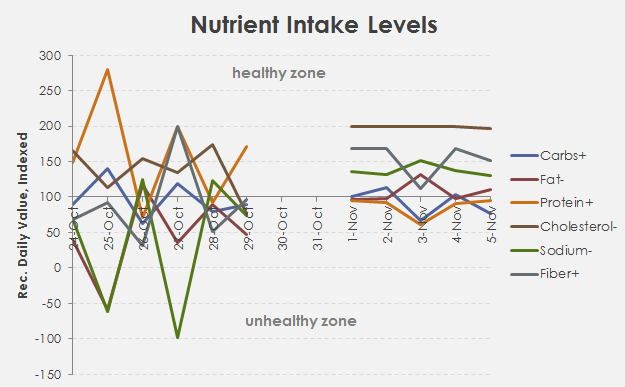
This is the part where I’m most jazzed. Let’s compare my life before and during a wholly Space Nutrients diet:
After switching to a 100% FOOD diet, my nutrient intakes went from erratic to stable — and especially healthy.
Basically: I was getting way too much sodium, not enough fiber, too much fat, and probably an oversized dose of protein (coming specifically in the form of red meat, i.e. burgers). According to the nutrient standards set by the USDA and the NIH, I became a super-prudent eater after I began eating only 100% Food. I was having about 50% more than the recommended daily intake of fiber; I cut my fat intake to appropriate levels; I had sodium under control, probably for the first time in my life; and I consumed almost 0 cholesterol (which corresponds with a 200 Cholesterol-).
I hear it’s important to get some “good cholesterol,” but since the NIH or USDA did not suggest a minimum amount of ol’ cholesty, I guess it’s good I lost it completely from my diet.
I went from typically missing my calorie goals (usually around 2500 on days I run) to landing well under them.
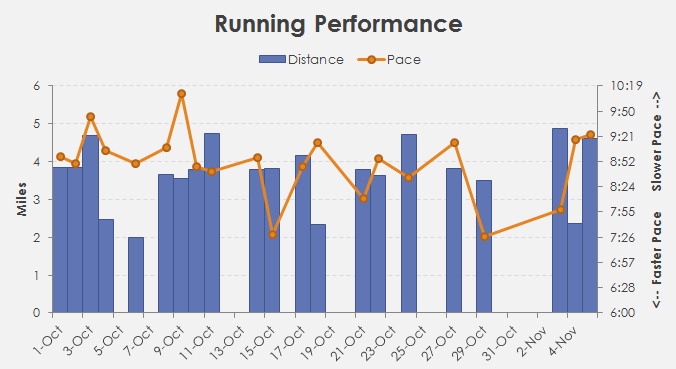
How did this new diet affect my body? Well, first of all, let’s talk about the gap in the middle of my data. On October 30th, at almost precisely 6:00 a.m., my son burst into our lives. He’s a great little fella, but he does not fit neatly into the pocket of my jogging shorts or the nice jogging stroller we have. So the following data I consider very incomplete because I switched from jogging almost every day to jogging occasionally shortly after his birth.
But here is a sample for how my body reacted to 100% Food:
Despite eating nothing but a milkshake-like paste, I managed to maintain my usual running distances and paces.
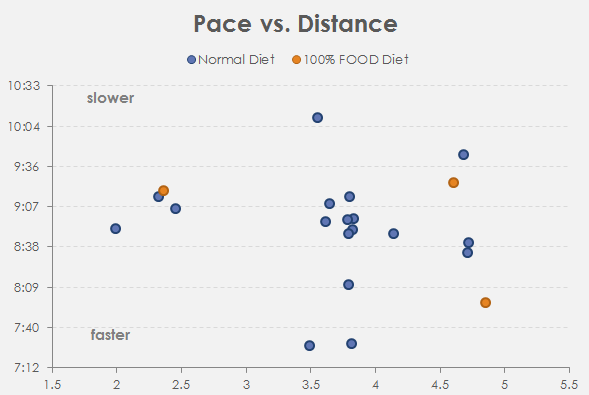
And here is a similar look that show how my runs still clustered with my pre-100% Food performances.
The upper-right orange dots represents one of my best runs in the whole month, but overall, I did not see either a spike or major dip in my running ability.
Did the liquid diet make me a better runner immediately? Did it give me an instant pep in my step? Maybe a bit psychologically, but not in a discernable physical way. Shortly after this period, I tweaked my ankle (not to mention had a kid) and found myself out of commission for a while. I hope to someday revisit this study, though, and track more physical performance data.
AWFUL AND DISGUSTING, BUT HONEST NOTE: Many people complain about the impact 100% Food’s fiber has on their puny digestive systems. But I’m a fiber fanatic. My body has been training for a spotlight like this, so I did not notice a discernable or at least negative difference in flatulence or bowel movements. If anything, I endured less straining and grunting and praying during BMs. Sorry, but I’m just reporting the facts. Back to the non-poo-related part of the article…
Packaging
Because they come in neat, self-contained bottles, I never spent more than 5 minutes preparing a meal. That’s pretty fantastic.
I understand that Soylent and Joylent and some of the other liquid meal groups require users to make a batch beforehand and parcel out bits of food throughout the day, perhaps in sports bottles or used water bottles. I’m not sure, but I do know this current method of delivery for 100% Food works and works well.
I should mention, though, that convenient doesn’t mean great things for the environment. This 10-star rating for the package has to do only with the user’s experience, not the overall impact of the item. That is a calculus the user must complete (as in, what’s worse: garbage dumps filled with plastic bottles, or gallons of water used on washing reusable bottles).
Ego Depletion
Here’s the biggest problem for me. I didn’t mind the texture, but by the end of the day, all I could think about was whatever delicious smells my wife was microwaving. Could I have maintained an all-soylent diet as a college athlete? Maybe if everyone in my apartment and on my team were doing the same. But in a house where real old-fashioned food is being made and consumed, I think it is near impossible.
I wanted to continue to test the different flavors of 100% Food (thus the gap between my data and publish date), and I found a good process that works for me: Eat 100% Food for breakfast and lunch, then share a traditional meal with the wife at dinner. That works pretty well for me, but I still struggle with matters of ego depletion: After eating really healthy throughout the work day, I find myself splurging on chocolate or popcorn at the end of the day. It’s not a great strategy, and I could very much see this as a problem for athletes who already have a lot of stress on the menu.
Price
At around $5 a bottle (even after shipping), it is certainly affordable, but it once was better. When I started in September, I was paying about $3 for bottle. And I believe Soylent wants to get down to $2 a bottle.
Conclusions
Here’s what I think I’ve discovered:
The product tastes good enough for me. I’m going to keep eating it so I can work through lunch and go home early. At least until a better product comes along.
Eventually, a whole bottle of 100% Food became too filling for me, so I would have half the bottle for breakfast (leaving some of the un-mixed powder at the bottom of the bottle) and then eat the rest for lunch. (This was not an issue when I was still running and needing far more calories.)
In order for this to be a viable meal for 90% of my life, instead of the 66% it occupies now, I need a spicy option. Or perhaps more flavors in general. The current flavors work well for me, but I still need just a touch more variety.
Eat well, my friends!
Check out the for some great resources on liquid meal-replacements.
On Wednesday, Wired published an opinion piece written by Federal Communications Commission Chairman Tom Wheeler which unveils proposed rules to “preserve the internet as an open platform for innovation and free expression.” YES to real network neutrality and NO to fast lanes fantasies dreamed up by internet service providers. Can we get an amen? AMEN! Need a refresher on net neutrality? Check out this short video from Stanford Law School professor Barbara Van Schewick in which she explains why this direction is critical to the future of the country’s economy. Van Schewick is also the director of the law school’s Center for Internet and Society.
Over the last 15 years, the internet has been the sporting world’s performance enhancing drug. Twitter has changed the way fans engage socially. The emergence of streaming media has changed the way fans watch live sporting events, thanks to MLB.TV and streaming Super Bowls. Sports web sites and blogs, such as the monster that is SB Nation, have injected fans with focalized news and rumors to cater to their interests while building a community to digest the 24/7 news cycle. There are no more water cooler conversations. Because there’s the internet. Mix in growing mobile device consumption and you have an industry that hangs on a consumer with a fast, affordable connection. It’s why net neutrality, whether you’re for it or against, is so important to sports fans.
Wheeler takes advantage of Title II of the Communications Act to implement and enforce his proposal with the authority to selectively decide not to enforce sections of the act, which were put in to place 80 years ago. He writes that his rules will “ban paid prioritization, and the blocking and throttling of lawful content and services.” And he intends to fully apply these rules to mobile broadband. He promises no rate regulation, which should calm some fears of those that oppose the government’s wrap around our internet. “All of this can be accomplished while encouraging investment in broadband networks,” Wheeler said in the piece. “To preserve incentives for broadband operators to invest in their networks, my proposal will modernize Title II, tailoring it for the 21st century, in order to provide returns necessary to construct competitive networks.”
But that’s not to say Wheeler’s proposal is a perfect one. Gigaom’s Stacey Higginbotham wrote a fantastic summary of a fact sheet the FCC distributed regarding Wheeler’s plans to implement net neutrality. In that piece, Higginbotham sounded off on a loophole which should concern us all:
Finally we have the catch-all rule, which seems to be the agency’s way of future-proofing the open internet as much as it can. The proposal would create a general Open Internet conduct standard stating that ISPs cannot harm consumers or edge providers. It’s likely that things like zero-rating and sponsored data plans such as the one that AT&T offers will be adjudicated under the general conduct rule.
While it sounds nice, a concern is that the more things that fall under this vague general conduct rule, the more flexibility the agency will have in determining what a network neutrality violation is. Flexibility can be a good thing, but in the government, it can also change with each administration and the political climate. I am concerned that this could be a loophole, but a senior FCC official objected to that characterization. “We see this as a safety net to catch any issues that are not covered as a bright line rule and to protect against new practices that may discriminate.”
The five commissioners will vote on Wheeler’s plan on February 26. If it passes, expect the broadband providers to tie this up in court for a long, long time.
Back to Van Schewick’s video. Her key question is who gets to decide what we do on the internet, the consumers or the ISPs? It seems to be a simple answer, right? Not according to some. Republican Senator Ted Cruz of Texas infamously referred to net neutrality as the “Obamacare for the internet” in November. To give the senator, along with those against net neutrality, a fair space, check out Cruz’s speech below.
Cruz fears politicians and the government will over regulate the internet with Title II, and believes that this will stifle innovation. In his #dontmesswiththenet campaign, Cruz warns that regulations will favor the “big guys with armies of lobbyists” and will burden start ups and entrepreneurs. But isn’t that really what the ISPs will do? Their boatloads of cash are already backing an assault against a plan that will protect consumers and maintain the internet that we’ve grown to love. How can anyone be against protecting an open, fast and fair internet, as Wheeler proposes? It’s because they’ll be negatively affected financially. And those are the ISPs. They’ll continue to lose cable customers as the number of cord cutters grow and won’t be able to charge higher fees for faster internet, as many assume they would. They’d get away with it if it wasn’t for that meddling FCC. And really, the only reason Cruz can justify his position and statements, which many have referred to as ignorant, is because those same ISPs must be funding his retirement. Or at least giving him free access the premium movie channels.
“The internet I want my kids to have is like the internet we have today,” Van Schewick says in the video.
And yes, agreed. Ultimately it’s what we all want, right?
We just want this internet that we know today to stay the same. My children should totally grow up with the freedom to stream movies from 20 years ago, watch three-star TV shows instead of doing homework or reading a book, battling friends online with the Xbox Twenty and learning the subtle nuances of the intimate relationships of pizza delivery men, naughty nurses and babysitters with pigtails. Because this is America, am I right?