Archive for Opinion

MLB Network Announces New Streaming Option

Major League Baseball gets a lot things right. Their Advanced Media department, the group in control of MLB.com and MLB.TV, have now updated their At-Bat app. In addition to watching games — which are still subject to local blackouts — the app now allows for constant viewing of the MLB Network’s round the clock channel. Unfortunately unlike Pinocchio, there remain strings attached to this deal.

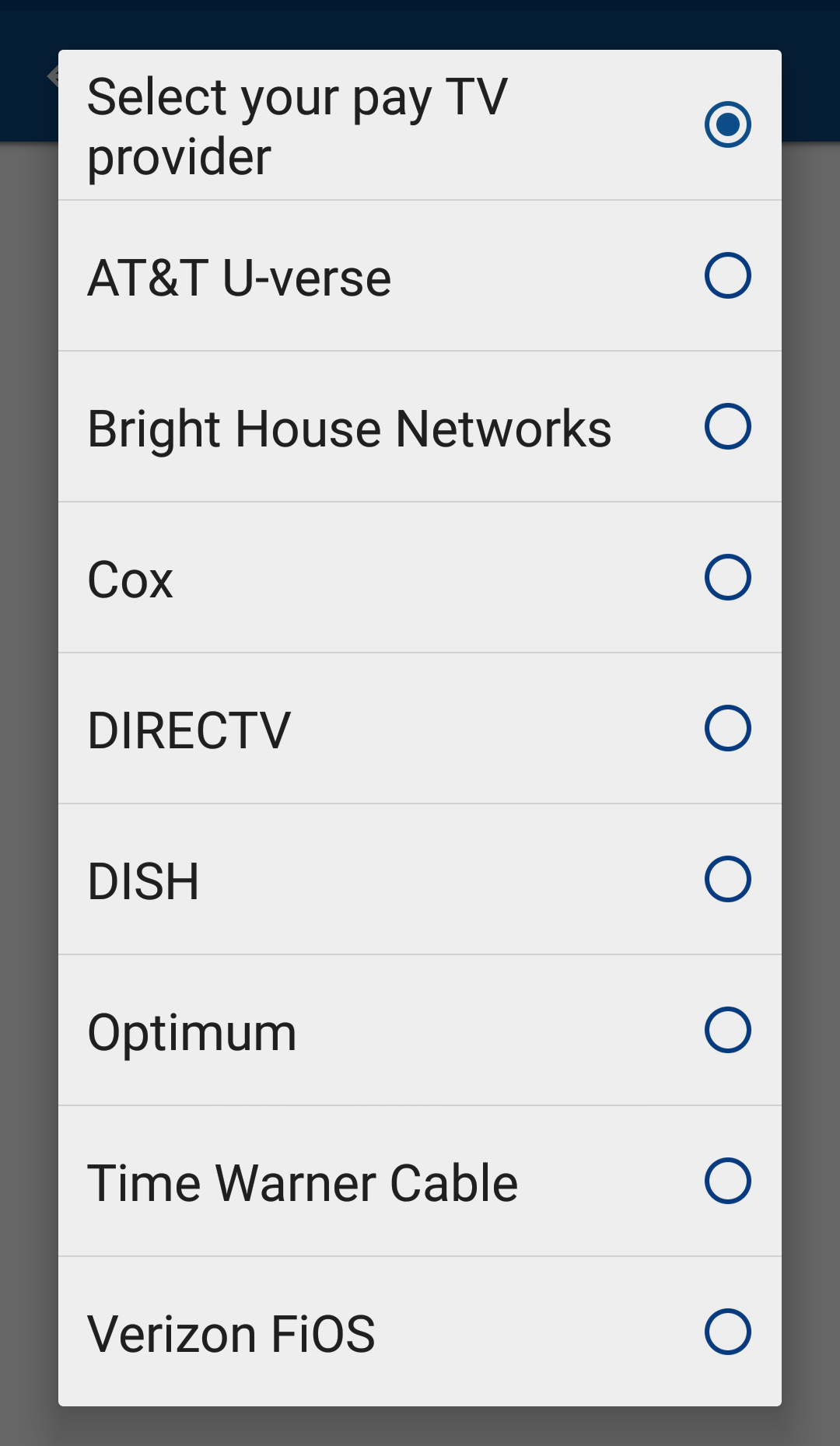
A qualifying cable subscription is required to view the MLB Network live stream. The stream is available on iOS and Android phones or tablets as well as Mac and PCs. As noted by the crew over at Awful Announcing, the initial group of cable providers who have agreed to support the stream does not include Comcast. In addition to missing what Wikipedia calls the number one (by subscriber count) provider in the United States, those who use Charter Communications — number six by subscriber count — such as myself, are also left out.

After logging into my app, I was sad to see I was one of the million of baseball fans left out of the ability to stream the show.
mlbapp

The upshot is this means people on the go (or at work) have the option to view MLB Network shows, interviews and even out-of-market games while away from their televisions. Perhaps even more importantly is the inclusion of playoff and preseason games. Being able to catch a spring training game after a long winter or watching a potential series-defining game when not at home and without paying for any extra add-ons is a great move for baseball.

Last season MLB Network claimed two playoff games, Game 2 of the NLDS between the Dodgers and the Cardinals and Game 3 of the NLDS with the Nationals and Giants. In 2013 there were also two DS games shown, one from the NL and another from the AL. The same format of MLB Network getting two DS games stretches back to 2012. Given that MLB, ESPN, Fox and TBS came to an eight-year, $12.4 billion broadcast agreement that runs through 201, count on continuing to be able to see at least two playoff games per year via MLB Network’s online stream.

Even with the blackouts and the restrictions due to cable companies, this 24/7 streaming of a major sport offering represents a first in the world of sports. Yes, the NBA, NHL and NFL all have their own channels however none are simulcast in the same way MLB Network is. This move seems like a way to meet the old crowd and the new generation in the middle. More traditional TV subscribers may not find a ton of use for it and dedicated cord cutters will likely wish MLB Network didn’t require a cable package. Of course, with such a lukewarm offering, it’s hard to imagine this move generating a lasting effect. Perhaps as the NFL embraces the online streaming realm and as more and more people cut the cord, eventually a non-subscription version may arrive at some point.
The One New iOS Feature That Sports Fans Will Care About

At yesterday’s WWDC Keynote, Apple — per usual — announced changes coming to their products. WWDC is, after all, a developers conference, so the usual announcements have more to do with software then announcing a new physical product. Like many recent renditions of the yearly keynote, changes and updates to the OS X and iOS operating systems were featured. Unlike iOS 8 or OS X Mavericks, these updates focus more on usability and less on a new aesthetic. OS X is getting some minor updates, most notably to the way users see and interact with their screens. With iOS 9, iPhone and iPad users will notice changes to built-in apps including a revamped Notes app, a new News app, as well as overhauls and additions to apps like Maps and Passbook (now Wallet). But beyond that, iPad users will probably see the biggest changes as Apple is finally attempting to tackle true multitasking on the tablet. And if one feature ends up being what it’s said to be, it could be a huge boon for sports fans.

While insanely popular, the iPad has always occupied its own space. It’s bigger and (in some cases) handier than a smartphone, but not as versatile as a laptop. In its infancy, it was purely a content-consumption device. It was made for looking at pictures and watching movies and reading articles, books, and emails. One could create on it, but beyond writing a basic message or drawing with a finger, creation was always a frustrating task. This is because while the actual creative act can be done in one app, the act of creation almost always needs multiple inputs. Writing on the iPad usually requires switching back to an article, photo, or notes. Drawing often needs some sort of source material for reference. Creating music could require downloading a sample or looking to other songs for inspiration. Real work can’t be done on one app alone.

And when people decided that they did want to create and not just consume on their devices, Apple was left scrambling for ways to make that easier. The earliest iterations of iOS had no multitasking capabilities. To use another app, one had to go back to the home screen and open another. Often times, you couldn’t even play audio in the background. Luckily, those days are over, but the process still isn’t totally ironed out. A double-click of the home button will present you with an app switcher, but it’s more cumbersome than a simple Alt/Command+Tab keystroke on a computer. And there was no way to view apps side by side. Now, with iOS 9, Apple has finally come up with a solution.

Apple announced a bevy of improvements with iOS 9 for iPad — a smarter Siri, a Notes app that actually seems robust, and a way to turn the virtual keyboard into a virtual trackpad with just two fingers. But the new multitasking features stole the show, and for good reason. For the first time, iPad users will be able to view (and use) two apps at once.

There are three iterations of multitasking in iOS9. Slide Over allows users to use the right third of their screen to check in on other apps. Apple showcased how this could work with Twitter and Calendar. Suddenly remember an appointment you need to add while reading an article? Slide calendar onto your screen, add the appointment, and slide it back. Apple is providing an API for this feature, so that third-party apps can utilize it as well.

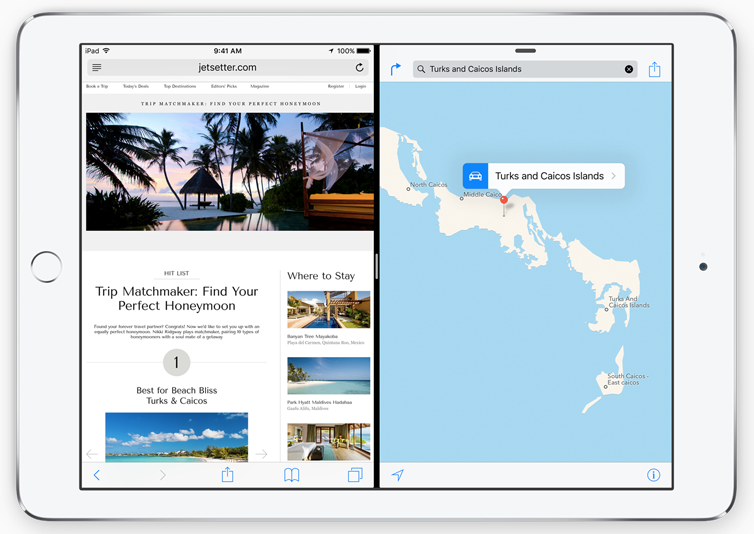
Split View offers the ability to have two simultaneous apps running. The split of the screen can be adjusted (a la a Windows 8 tablet) and essentially any app can run side by side with another.

The iPad's new Split View feature. (Apple.com)
The iPad’s new Split View feature. (Apple.com)

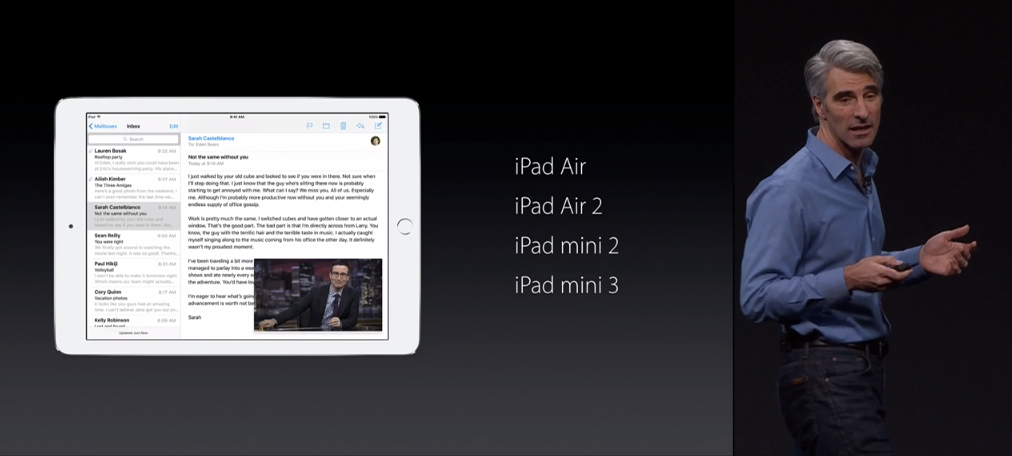
This helps bridge the gap between consumption and creation by allowing the user to do either or both within one view. The catch is that Split View only works on the iPad Air 2, presumably due to the higher processing capabilities needed. But even for those with an iPad Mini or older iPad Air, Slide Over still offers a big upgrade to usability. And luckily, Apple wasn’t so strict as far as supported devices when it comes to the very best feature for sports fans — Picture in Picture.

(via Apple keynote. Muted by default)

This is a pretty big deal. I use my iPad quite a bit for MLB.tv, watchESPN, and NBC/Golf Live Extra. But while using my iPad for those purposes, I was pretty much locked in to that one task. If I wanted to send a Tweet or chat with someone or reply to an email, I either had to quit the app or use another device. When iOS 9 is released this fall, I’ll be able to type to my heart’s content while still watching my event in the floating video window.

This would require MLB, the NBA, DirecTV (for NFL Sunday Ticket) and all the other sports video providers to update their apps to support this function, but I can’t imagine any company worth its salt not having this ready when iOS 9 is released. And, unlike Split View, it will work on all relatively-new iPads.

ipadpipsupport

Proponents of Android and Windows tablets have long used multitasking as a bullet point when lauding the superiority of their favorite ecosystems. And while they still offer some advantages, Apple just cut one of their biggest arguments down at the knees. We’ll have to wait and see how well the feature actually works outside of a meticulously-staged demo, but if I can Tweet about a baseball game I’m watching all within the same screen as well as Apple is saying I can, it will be, for me, the most important feature update by far.

(Header image via John Karakatsanis.)

REVIEW: OOTP 16, Still Very Good

Game: Out of the Park Baseball (OOTP) 2016 (website)
Platform: PC, Mac, Linux, mobile
Release Date: 2015
Metascore: n/a
Techgraphs score: 4.3 or 86 B

General Reaction
OOTP is our most reviewed and highest reviewed game of all time. It takes all the high-level problem solving of a real baseball front office — salary management, roster management, owner expectations, and so on — and somehow condenses them all into a single game. The game is addictive. It’s fantastic.

That said, I’m trying to review this latest edition as critically as possible. And it’s hard to critique something you’re hooked on. But the game does have some flaws, and I will address those. But overall, it’s another excellent submission to the OOTP franchise.

Ratings

Graphics: 4.0 stars
Let’s face it; you’re not going to play OOTP for the graphics. The only 3D component of the game — an optional view for the in-game management — leaves a lot of a room for improvements. It’s not really a problem, per se — more of a “Where’d it go?” The old versions of OOTP had this realistic face generator. It was really impressive. But I can’t find it among the add-ons now. So we end up with this:

I had no idea Brett Gardner looks like a 45-year-old tax accountant from New Jersey!

Concept & Game Modes: 4.5 stars
OOTP does a nice job of not stretching itself thin with game modes. The database and formulas that serve as the foundation for this game would not be at their best in a “Path to the Majors” or a work-your-way-to-the-top game mode. So having a single player GM/coach mode and a multiplayer GM/coach mode is probably sufficient to please 90% of fans.

It would be interesting, however, so see an arcade mode — hear me out! The latest changes to OOTP have created a system where the player (you, sir or madam) are given a salary and contract based upon your reputation and recent success. What if the game took a page from the NBA 2K video game series and made those salaries worth something? Perhaps players could spend their salary on negotiation classes, improving insight and success rates during trade or salary negotiations. Perhaps players could spend on charitable enterprises and improve their reputation — thereby unlocking more prestigious managers and executives. Or perhaps players could spend money on special camps that have a chance to boost a few players’ rating in special areas (“Send [these three players] to the Barry Bonds Hitter Clinic? Grants 10% chance for increase in either Power or Eye rating. Cost is $100K per player.”).

This kind of stuff actually incentivizes earner a higher income. And it’s just kind of fun.

Gameplay & Interface: 5.0 stars
The interface hasn’t changed much in OOTP 16, but there have been a few minor tweaks that I think show the developers’ really care about user feedback. Lots of tiny things like:

This is a nifty little added feature. Saves a few clicks for all the top draft picks.

I’m giving gameplay and interface a perfect score, but a big part of me wishes I could experience it all over with rookie eyes. Of course the interface seems easy to me; I’ve been playing OOTP for a half decade.

Glitches: 3.0 stars
There’s a lot of little things that impede my enjoyment of the game — problems that didn’t exist before. Ratings filters don’t seem to work in the Find a Player section (a great new addition, if it actually worked for me…).

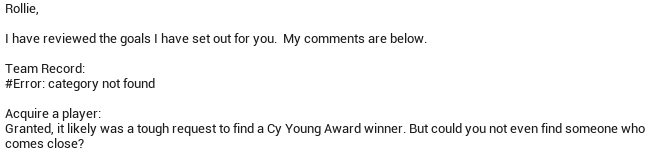
And more than that, the new owner goals feature had serious signs of inconsistency. Several times early in my franchise, the owner could not recognize the fact that I had completed an assigned task:

Um, okay?
One of several glitches. The owner did not like my having acquired Jake Peavy, apparently, nor could it recognize the fact I improved the team record. :/

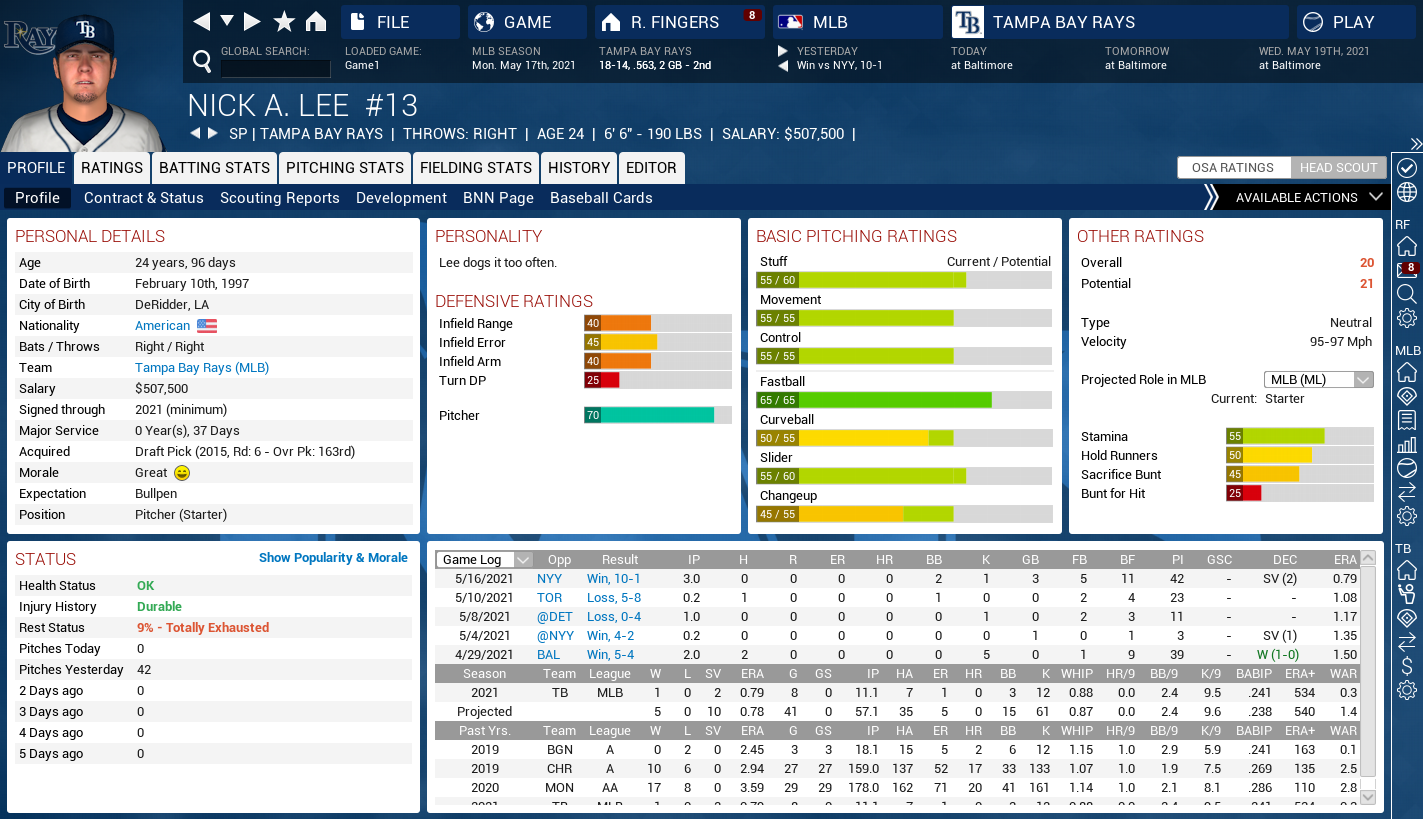
More troubling, though, is that there are numerous issues with player valuation. The AI does not seem to value pitchers correctly (a lot of trades that should go through, don’t), and seems to struggle to identify medium-quality talent. Either everyone is a five-star prospect or not a prospect at all. In general, scouts seem to have a bad grasp on pitcher value (a starting pitcher with three strong pitches and good makeup will still have a 21 potential on the 20-80 scale).

How is this not a good pitcher?

And then, after several years into my franchise, the talent pool disappeared. International free agents stopped being prospects all together (except for a few hidden gem pitchers who had great ratings everywhere except their potential ratings); the draft only had one or two premium prospects at most (normally the first round should land everyone a premium prospect); and since I had a world of difficulty convincing other GM that their pitchers had differentiating between a prospect and Quad-A filler, fair trades were hard to come by.

Say what I will about the relative simplicity of Baseball Mogul, at least the ratings are close (as close as a scouting system with variability should be).

Rosters: 5.0 stars
This is always the strength, nay, the stupid strength — so strong it’s dumb — of the OOTP franchise. You won’t find a more accurate system of minor league players and managers.

See Also:

98 A+ Out of the Park Baseball (OOTP) 2015 (PC)
98 A+ Out of the Park Baseball (OOTP) 2014 (PC)
97 A+ Out of the Park Baseball (OOTP) 2013 (PC)
96 A+ Baseball Mogul ’13 (PC)
96 A+ MLB ’12 The Show (PS3)
82 B- MVP Baseball 2003 (PC)
79 C+ MLB 2K12 (PS3, XBOX 360, Wii, PC, etc.)
74 C MLB Ballpark Empire (Facebook)


Blackout Policies and Their Consequences

Few topics are so regularly discussed among my baseball circle of friends and colleagues as local blackout policies. While I am certainly biased in that I watch and talk baseball more than any other sport, I — among plenty of others — have found numerous flaws in MLB’s way of blocking local fans from their favorite teams. By no means is baseball’s governing body alone in limited television access for regional fans, as the NFL, NHL and MLS have a blackout policy of some sort in place, however given the sheer number of MLB games played each season, more baseball games are blacked out than the other sports combined.

To be fair, the NFL did lift local blackouts for the upcoming 2015 season, however as the linked article notes, zero games were blacked out in 2014. NFL games are only subject to local TV blackouts if the game isn’t sold out 72 hours before kickoff rather than the constantly blocked games in other sports. Professional hockey has seen its share of blackouts in TV, though a recent development for the Tampa Bay Lightning may be expanding the definition of “local blackout.”

Via CSN Chicago (warning: auto-playing video), Tampa is following in the footsteps of St. Louis and Nashville hockey teams in making it difficult for visiting (read: Chicago) fans to see the game in the stadium. The policy also affects actual Lightning fans living in other states. If fans have the time and the means to follow their favorite team from another state, tickets may not be available for them. A screenshot directly from the Lightning Ticketmaster describes the situation:

lightningBuilding a home field advantage or looking for any competitive edge is all well and good, but at what point is a line drawn? How far will fans go to avoid the blackout issues, both on TV and in-person? Going back to baseball, there are massive numbers of people who can’t watch games based on their geographic location. One of my friends was recently accepted to graduate school at Iowa State University, located in Ames, Iowa. The sole downside for him thus far, other than the workload, has been being subjected to blackouts for his favorite team — the St. Louis Cardinals. According to Google Maps, Ames is nearly 370 miles away from Busch Stadium, yet he is still blocked off from their games. Running the Ames 50010 zip code through the MLB blackout finder, the Cardinals aren’t the only team subjected to broadcast issues. Both clubs in Chicago, the Twins, Brewers and Royals are blacked out for him. Even if he were a more broad baseball fan without ties to a specific team, his location alone blocks him off from 20 percent of MLB teams.

The lengths organized sports are going to block off fans from games has only been surpassed by those same fans looking for a way to circumvent the blackouts. Last week a free and popular virtual private network (VPN) came under criticism not from any league or association, but its own userbase. The Chrome and Firefox extension Hola! or Hola! Better Internet was denounced as a potential botnet to be used for malicious attacks on websites, to which they responded to Monday. Danger comes in the form of Hola! using other people’s idle bandwidth — and vice-versa — in order to circumvent geo-blocked content. By granting access to your Internet connection, it can be taken over and re-routed, potentially as part of a DDoS attack on a site or IP address. Be it accessing Canada’s or Australia’s Netflix or someone over there accessing the United States selection of TV and shows, Hola! provided a free and easy way to get around geographically-blocked content. Despite it no longer being available in the Chrome Store, the extension is still downloadable straight from the company’s site. I’d urge caution before a download of Hola! is considered, as the recent allegations have once again shown there is no such thing as a free lunch.

According to the Hola website over 47 million people have downloaded the extension to enhance their web browsing, despite the clear risks involved. That such a number of people would be willing to risk their idle connection in order to open the Internet for their browsing or entertainment needs shows the measure of their resolve. Whether companies like Netflix and HBO or leagues such as MLB or NHL open up their blackout restriction policies on their own accord may not matter. As long as people have a workaround — questionable or not — the market will find a way to access the desired content.

(Header image via BizOfBaseball)

When Will UEFA Adopt Goal Line Technology?

The UEFA Champions League final will be set Wednesday as Real Madrid and Juventus square off to determine who will face Barcelona in the finals. Barcelona defeated Bayern Munich en route to their finals bid on a 5-3 aggregate score, but it could have easily been 5-4, and a one goal lead — technically two due to the away goals advantage — as a shot in the 39th minute nearly brought a bit of panic to the Barca side.

Bayern’s Robert Lewandowski received a pass near the penalty spot, turned and sent a strike that beat Barca’s keeper, Marc-Andre ter Stegen. From the game feed, as well as the reactions of the Bayern players, it looked as though it may have been a goal.

A different angle shows the entire ball did not cross the goal line, and thus the no goal call turned out to be correct.

While this second angle is no doubt an improvement over the game feed, it is still off-angle and not parallel with the goal line. The Champions League is one of the few leagues in Europe to not have some sort of goal-line technology (GLT) either planned or already in use. From the Dutch league to Italy’s Serie A to England’s Premier League, GLT is something that absolutely needs to be an industry standard.

Just two days ago GLT was the difference in the EPL as Swansea downed Arsenal 1-0 due to a no-goal call being overturned. Reddit user Poet-Laureate, via Gfycat, clearly showed the use of GLT to determine the game.

Both men’s and women’s World Cups as well as numerous domestic leagues have embraced the usage of GLT, though few international leagues have done so. Aside from the UEFA Champions League which pits clubs against each other, national teams in the 2015 Asian Cup nor the 2015 Africa Cup of Nations did not benefit from any form of goal-line technology. Similarly in North and South America the CONCACAF and CONMEBOL respectively have yet to implement GLT in any capacity. One of the reasons behind the lack of GLT is cost, as UEFA President Michel Platini deemed the technology too expensive in 2013, citing a preference to use the money “on youth programs and infrastructure.”

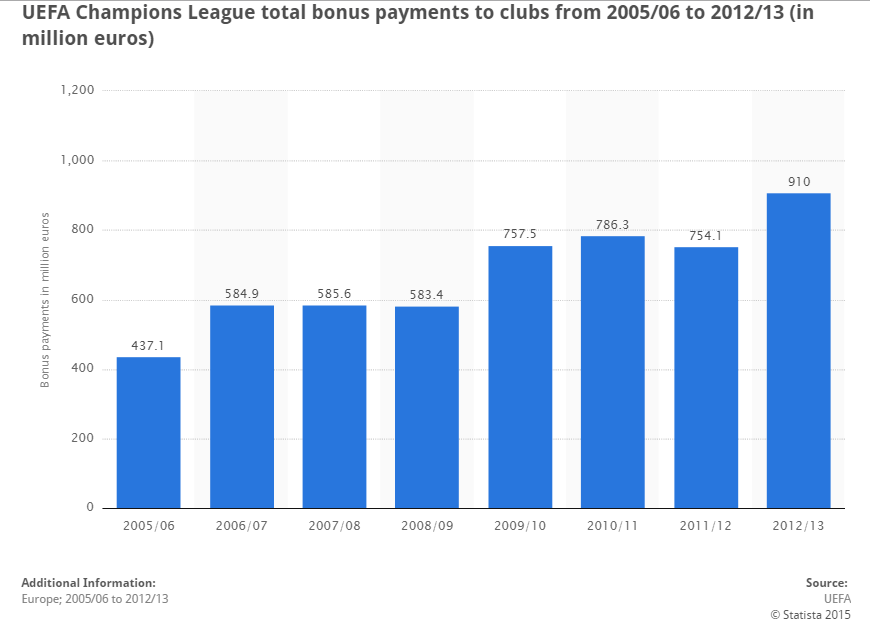
According to Statista, money paid to clubs in the 2012-13 season equated to €910 million.

uefa

Given the UEFA distribution model, 75 percent of the total revenue goes to clubs with the remainder being kept by UEFA. Revenue above the €430 million mark will be split at 82 percent going to teams and 18 percent to the league. It’s hard to cry poor with that amount of money being  publicly disclosed. Soccer leagues are unfortunately notorious for a number of murky and handshake deals — not to mention outright awful human rights — but not utilizing goal-line technology due to something as easily dismissed as cost is absurd. If the finals game is decided by a questionable goal or no-goal call, then maybe UEFA and other international leagues will stop sitting on their hands.


Could the PGA Tour Be the Model for Technology Inclusion in Sports?

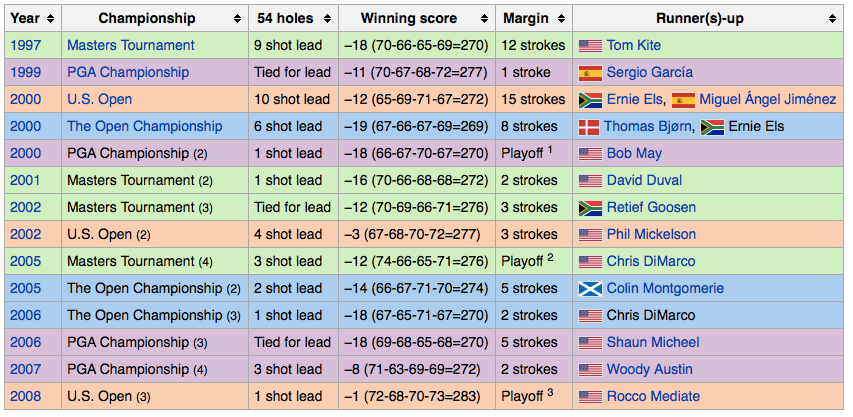
I think it’s safe to say that the Tiger Woods Era is over in golf. Sure, he may find his swing (or swing), again. We may see him in contention at a major tournament here and there. Hell, he may even win a couple. But personal problems, age, and a slew of injuries has put an end to what can and should be considered one of the most dominating runs in sports history. Although it’s actually been a while, it doesn’t seem that long ago that he was basically unstoppable.

Tiger Woods' Major championship wins, per Wikipedia
Tiger Woods’ Major championship wins, per Wikipedia

And with the rise of Tiger Woods, golf as a sport saw a rise in popularity. Woods’ presence created must-see TV for even the most casual of golf fans. Woods inspired droves of kids to pick up the sport. EA jumped on the chance to use his likeness in video games. A rising tide lifts all boats, and as Woods lifted trophy after trophy, the PGA Tour’s boat came with.

But now, golf is in trouble. Or at least people think it is. The crash of the real estate market has lead to countless golf course closings. Concerns over environmental sustainability of courses are being raised. Less people are playing, less people are watching. Golf isn’t dead, it’s just less alive than it used to be. I doubt we’ll ever see a talent like Tiger Woods in our lifetime, so it’s safe to assume that golf won’t see another surge in popularity any time soon. But that doesn’t mean they’re not trying. In fact, the PGA Tour is investing big money in technology in hopes to heighten the fan experience.

One of the biggest pushes being made is in the realm of statistics. Baseball fans may be salivating at the thought of what kind of data StatCast can bring to MLB, but the PGA Tour has been utilizing ShotLink technology for some time now. ShotLink brings everything to golf that StatCast promises for baseball. Using a laser system, ShotLink can track hyper-accurate distance and location data for every shot on the course. After these numbers are crunched, essentially any type of stat can be generated and consumed. And the PGA Tour does a magnificent job of this on their own stats page. With a few clicks, fans can find out which player hits the most greens in regulation from 190-200 yards away, who’s best at avoiding three putts from 40 feet away, and who is best at avoiding or finding the rough on the right or left side of the fairway. Baseball lends itself well to statistics due to its individualistic nature. Well, it doesn’t get much more individualistic than golf, and the PGA Tour and ShotLink are showing that seemingly every aspect of the game can be measured, compared, and analyzed.

Another big tech advancement has come with the inclusion of Protracer in TV broadcasts. Through what I can only assume is some version of witchcraft, Protracer hardware and software is able to track a golf ball throughout its flight and graphically display its trajectory. The PGA doesn’t do this for every event, but bigger tournaments — like this past weekend’s Players Championship — utilize the technology. This not only lets viewers see how the path of Sergio Garcia’s 3-wood,

garciaprotacer

but it can also be combined to show the aggregate of how all players faired on getting their drives to the hair-raising island green of the 17th hole at TPC Sawgrass.

TPCPar17

The use of Protracer is not only cool as hell, it appeals to the majority of the PGA’s fans — recreational golfers. This is where the PGA Tour has a huge advantage.

Professional golf is one of those rare sports where fans actually participate in the same sport themselves. Sure football fans might have a backyard game every now and then, and there is certainly no shortage of beer-league softball, but golf is different. We can play with (pretty much) the same equipment as the pros. We can play a lot of the same courses (if we shell out enough dough). While most golf fans can’t match the pros from the tee, all of us know the feeling of sticking an approach shot two feet from the pin or draining a 20-foot putt. Golf fans can do a lot of the things pros can do, just not nearly as often. We know what the trajectory of a perfect drive should look like, and seeing it on our TV screens time after time only solidifies our ideas of just how good these guys are. Football fans know that Aaron Rodgers is good. Golf fans know first hand just how stupid-hard a good golf swing is to make.

With accurate and in-depth metrics, we can know exactly how much better than us they are. We can see shot trajectories that have us yearning for a better swing of our own. If the PGA Tour has their way, these things will keep us coming back for more and more. No, numbers and shiny graphics won’t bring in the same amount of viewers as Tiger Woods once did. But it might be able to reach fans on a more personal level, which just might rekindle or intensify some viewers’ interest in the game. Until another Tiger comes along, that’s probably the best the PGA Tour can ask for.


The FAA Shifts Their Drone Policies

I’ve criticized various organizations and even the Federal Aviation Administration for failing to embrace drones and their practical applications around sporting events, but I may be lowering my pitchfork now. The FAA posted a trio of press releases that seem to speak of them relaxing their stance on drones.

The first presser was the announcement of an iOS app (with an Android version on the way) called B4UFLY. The app aims to let controllers of unmanned aircraft systems (UAS or more commonly called drones) where it is legal for them to fly. It will have a straightforward “clear” or “not clear” flight availability for current locations as well as the option to search for other areas for future planning. There are preview screenshots of the app in the second press release here. Of note is a pre-flight checklist as well as indicators for special flight rules around specific areas such as Washington D.C. Within the first release, FAA Administrator Michael Huerta spoke on the app and its goal:

We want to make sure hobbyists and modelers know where it is and isn’t okay to fly. While there are other apps that provide model aircraft enthusiast with various types of data, we believe B4UFLY has the most user-friendly interface and the most up-to-date information.

The third item of news from the FAA was an announcement of a joint programs with CNN for news gathering in urban areas, drone manufacturer PrecisionHawk for crop analysis and monitoring and BNSF Railroad to help examine tracks and overall rail infrastructure. None of these partnerships directly affect the average sports fan, but that the government as well as different companies are at least willing to explore new uses for drone technology is worth celebrating. We may not be able to watch a soccer match in the way a polo match could be utilized, but I am just happy to see things shift from mere conversations and potential turn into policy and implementation.

(Header image via Facebook)

Age Gaps In Preferred Media and Entertainment

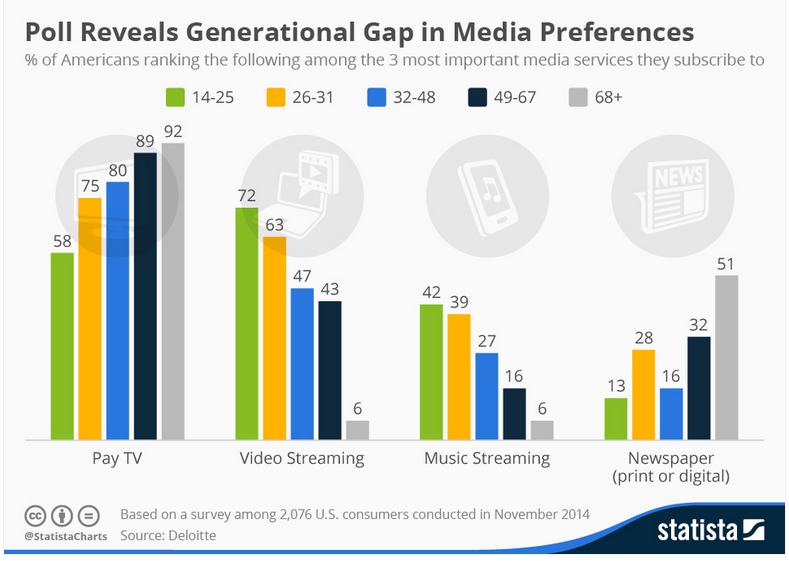
Media consumption, like most things, can be broken down into various age demographics. While the brackets tend to have somewhat arbitrary numbers attached to them  — does turning 26 years old really change the preferred method of watching your favorite TV shows? — they can serve as a platform for observation. With thanks to Statista and Deloitte, the gap between paid cable subscriptions and streaming services, among other things, for those in the United States can be clearly shown.

mediaconsumption

It comes as no real surprise to see the two younger age groups consume the least amount of television while also nabbing the top two spots in video streaming. Somewhat surprising is to see the leading millennials 26-31 age group absorbing more newspaper, be it digital or print, than their older 32-48 counterparts. With large number of online and subscriptions available, plus the Washington Post’s agreement with Kindle customers, perhaps the leading millennial group has come back around in a cyclical trend of newspaper reading.

The percentage of the different aged people who are content with their current cable TV subscription is closely tied with age. The youngest three groups are the least satisfied, reporting at most 55% saying they haven’t at least considered cutting the cord.

mediaconsumption1

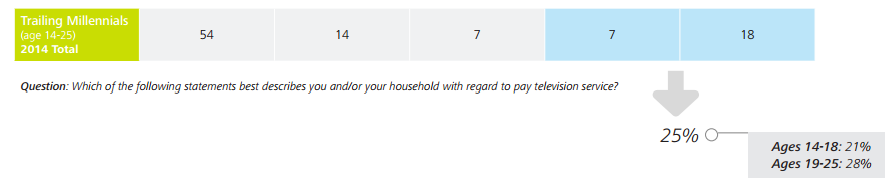
With no shortage of streaming or screencasting options — despite AppleTV’s recent insistence on requiring a cable package for CBS Sports, USA and NBC Sports — the number of current and potential cord cutters has increased over the years, particularly in the younger crowds. Already 25% of the polled age-14 through 25 group hasn’t paid for TV in over a year or have ended their cable subscription within 12 months. Within the age group another trend emerges as 28% of 19-25 year olds versus 21% of 14-18 year olds are calling themselves cord cutters.

mediaconsumption2

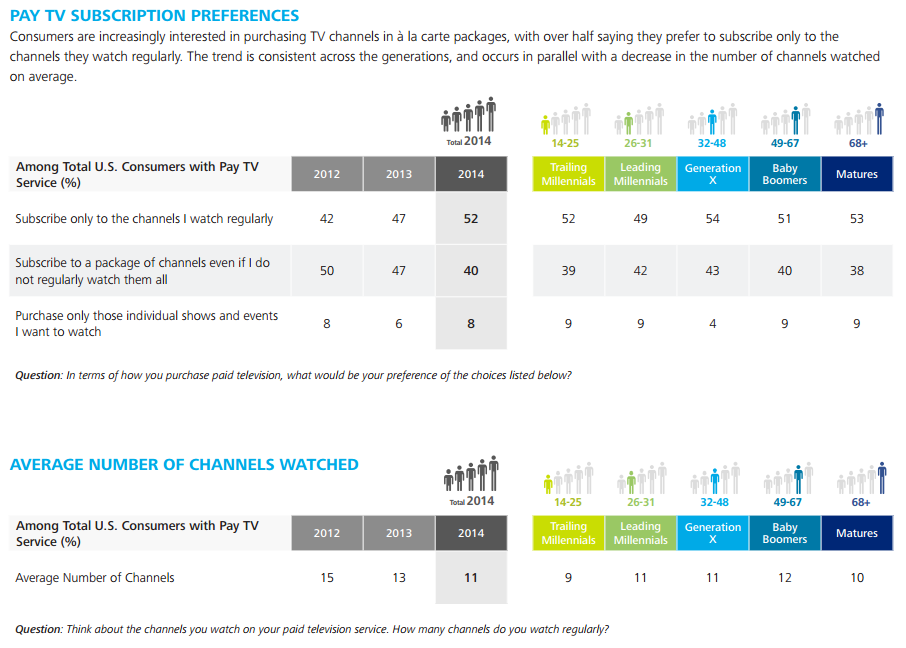
As the overall demand for TV changes, so does the desire for the way TV packages are sold. For the first time in the three year data set, more than 50% of the polled desire the ability to choose individual channels to watch. A three year decrease in the average number of channels watched further highlights the growing calls for an a la carte system. Canada is already developing a government mandate for cable companies to allow customers to choose individual channels after an initial package, though no legislative traction has gained ground in the U.S. yet.

mediaconsumption4

The numbers represent a clear trend in increased subscription based services and a desire to either ditch cable TV altogether or give it a serious overhaul in programming options. The people are applying pressure to big cable with their wallets as companies lose money with every person severing their TV packages. Still, and with apologies to Bon Jovi, at this point it feels like we’re livin’ on a prayer rather than being halfway there.

(Header image via Deloitte)

Microsoft Is Losing the Browser Battle, But the War Isn’t Over

Despite — or in some cases because of — Google’s insistence on pushing forward with new web browsing technologies, the tech giant continues to dominate the browser demographics for desktops as well as mobile phones and tablets. Not only has Chrome been on the rise for people at home, but also on the go. Via numbers from StatCounter Global Stats for mobile and tablets, only Chrome and to a much lesser extent the Android-based UC Browser and IE Mobile have increased their market shares since December 2012, the first month of collected data (click to embiggen).

browsermobile

For fellow computer users, and where many concerns stem from as Google phases out older technology, Chrome is even more dominant than on the mobile market. Again according to StatCounter GC, Chrome holds a remarkable 52.96% of the desktop browser market share. The gap between Chrome and everyone else has been widening since May of 2012, however Microsoft’s newest browser, Edge is looking to change things provided you’re running a Windows 10 machine.

browserdesktop

Edge doesn’t yet have a release date, but it something I’m eager to check out. It is seemingly looking to streamline the web, something I can get behind as separate tabs and locations for things like favorites, recently visited, current downloads and my reading list are all found in different areas in Chrome. Edge’s “Hub” will place them all in one easy to access area, however it isn’t all sunshine and rainbows with Microsoft’s latest browser. While the company is promising support for existing Chrome and Firefox extensions, that support will not be arriving until a later date. No official word on Silverlight being compatible with Edge, though recent history suggests it would be as all Windows 8 devices, including the tablet Surface Pro 3, are. It would be a stunning (though in my opinion welcome) reversal if Windows 10 and by extension Edge, was not Silverlight compatible. An introduction video to Edge can be found on YouTube.

Already some sports fans are finding themselves caught in the crossfire of the browser battles, specifically those looking to watch games on Sky TV, the preeminent broadcast of English Premier League soccer games in the United Kingdom. Sky — working with BT Sports — recently negotiated a new cable deal where Sky holds broadcast rights to 126 EPL matches per season, three times as many games as BT Sports will broadcast. On the Sky Go page there is a message regarding the incompatibility:

skygoUntil Edge is officially released — and probably for some time after — Chrome remains the undisputed browser champion. If Microsoft really does aim to “blur the line between consumption and creation” as the Edge preview video suggests, Windows 10 and Edge will drop Silverlight support and force broadcast companies to update to new and better technologies. What I don’t want to see is Edge allowing massive companies to sit on their hands at the cost of time and frustration for customers.

(Header image via Microsoft)

In the World of Live-Streaming, Some Creators are In, Others are Out

The live-stream app Meerkat went live on the Android market today. It’s still in Beta form, so things may not be perfect just yet, however as TechGraphs overlord David Temple explained over a month ago, Meerkat — and Periscope — both offer a new way to broadcast video.

Meerkat’s rules page doesn’t clearly define what you can or can’t stream as it is more of an outline of features.

meerkat

Once you jump into the legal area of their terms of use one can see the company strictly prohibits broadcasting copyrighted material — as do the content creators. HBO has already sent out takedown notices to people streaming the new Game of Thrones season via Meerkat, though perhaps the company is in the takedown notice mood. Other creative minds have gone the opposite way and are embracing Meerkat. Entertainers such as Jimmy Fallon, Snoop Dogg and Jim Gaffigan are sprinkled among Meerkat’s leader-board in order for them to be easily found. If you are so inclined to follow them on Meerkat, expect a push notification when they begin a new broadcast.

Within each cast there is a chat room for interaction between viewers and the broadcaster. One of the pillars of Meerkat is the ability to cast in the here and now, however the company has also added ability to schedule a future broadcast. The quality of the available casts seems to be dependent on the the strength of the caster’s internet connection. In my brief experiences those doing in an office or home setting have had a quality better than Vines — even with their new 720p broadcasts — however what I assumed to be 4G/LTE connections stuttered and froze from to time. Part of it could be the app is still in Beta or it could be that the heavy bandwidth required to stream is too taxing on user’s non-WiFi networks.

These are urky broadcasting rights waters we’ve waded into. From takedown notices, muted streams on Twitch.tv due to music rights to being wary of narcs taking you down in person for an illegally stream boxing match, the gap between producers and end-users appears to be widening.

(Header image via Meerkat)