Archive for Fitness

Kinduct Sports Offering Featured in Dodgers Accelerator Program

Kinduct Technologies made waves in the sports tech world when they were selected as one of ten companies in the Dodgers Accelerator program. But CEO Travis McDonough admits that his company is more mature than many of his fellow participants.

“We have 40 employees, we’ve got many many different clients, we’re across different industries, we have a mature operating system,” he said. “We have now 50 professional sporting organizations that are using our tool and it changes every day.”

The tool, which is known as the Athlete Management System, aggregates data from wearable, camera-based, and even more subjective systems into a single environment. The system includes visualization tools so teams can search for correlations between the data themselves, and a machine learning component to further guide organization training plans. The system gives vital help to organizations trying to understand the massive amounts of data they collect from games and practices.

“There’s been an explosion of ancillary tracking tools on the market today, everything from camera systems to GPS trackers to heart rate monitors to smart phones,” McDonough said. “And all those data sources, as valuable as they are, reside in siloed pockets.”

In addition to the Athlete Management System, Kinduct offers similar services in the health care, wellness, and human performance market (which covers military and law enforcement applications). Their experience in these other fields informs the algorithms behind their athletic products.

“Because we have had the opportunity to start to figure the machine learning side out on the health side, we’re able to cross-pollinate and apply it to the sports market,” McDonough said.

But the operating system and machine learning tools are only as effective as the data they can handle. McDonough said Kinduct works with their clients to incorporate both new and existing sources of data. Their web page lists relationships with camera-based systems including the NBA’s SportVu system, as well as wearable trackers like Polar Global and Catapult, among others.

“We’re very agnostic, and we love to pull in data from as many sources as possible,” he said. “So we are absolutely delighted at the new technologies that are coming out, and all these emerging data sources are exactly what make us more powerful.”

Kinduct counts dozens of sports organizations among its clients — including “more than half the NBA,” according to McDonough — and is working with a few unnamed leagues to manage data across all teams. The obvious differences are there, of course: basketball teams have different expectations for their relationship with Kinduct than hockey teams or baseball clubs. But the varying levels of sophistication across organizations provides an additional challenge, and Kinduct has to ramp up or scale back their offerings according to the client’s experience and comfort level.

“The NBA teams, they put their arms right around technology so we adopt what they use,” McDonough said. “When it comes to other organizations … they’re looking for recommendations by us to suggest ancillary technologies that can do the best job of tracking their players.

From a researcher’s perspective, the fact that Kinduct works with such a large percentage of the NBA is exciting. Deep in their databases is tracking and data, across games and practices, on dozens of elite athletes. McDonough estimated that the average NBA team spent $10 million on players sidelined with “preventable” injuries, repetitive stress injuries arising from flawed biomechanics that he likened to a stone cutter chipping away at a rock. And while McDonough was more than happy to describe how an individual team could combine their various data sources to find potential injury markers, he also stressed his company’s respect for the “firewall” that protects not only each team’s raw data, but also any metrics they build on top to analyze those data.

“It’s almost like we provide a technological apartment building, but each and every team moves their specific furniture and wallpaper in it, and the keys to the front door are locked down so no one can go in it but that organization,” he said.

Still, he agreed that a league-wide approach would be more effective, allowing coaches and staff to spot trends in a wider sample of data that could keep players off the trainer’s table.

“The right thing in the future is for leagues to be able to analyze the data and intervene to make sure the players are playing at their best and reducing injury as best as they can,” McDonough said.

Nevertheless, Kinduct is still dealing with health care data, which is subject to a wide range of safeguards to protect patient confidentiality. On top of that, athletes and the players associations that represent them remain leery about biomechanical data being used against them during contract negotiations. Players associations also objected to earlier iterations of the system that tracked athlete workouts during the off-season as excessive. As a result, Kinduct has worked to produce a system that provides the data front offices are after while remaining as unobtrusive as possible to players.

“For a player, they just want to win games, they want to win a championship,” McDonough said. “And a level of surveillance [during the season] seems to be acceptable by both the players’ association, the players, and of course management and ownership.”

It was announced in August that Kinduct was one of the ten companies selected for the Dodgers’ first annual accelerator program, which will run through a “demo day” November 15. The Dodgers are running the accelerator in conjunction with advertising agency R/GA, who has successfully run a number of similar programs in the past. Described by McDonough as “almost like a business boot camp,” the program offers Kinduct mentoring from a who’s who of sports executives and a chance to get more exposure.

“What we have is a Ferrari in a garage,” he said. “This allows us to open the garage door and have more people see our Ferrari. And people want to drive it, and it’s exciting.”

For now, McDonough and his staff have moved to Los Angeles to participate in the accelerator, and plan to open an office in the U.S. after the program to expand into the American market, especially in the health care, fitness, and military areas that fall under the same “human performance” umbrella as the company’s Athlete Management System. Still, McDonough said the company would remain true to its Canadian roots regardless of its excursions south of the border.

“We’ll always have a home base in Halifax,” McDonough said. “But we need to have a bigger presence in the United States.”
Jason Pierre-Paul Didn’t Start the Fire: How Athletes Could Lose Control Over Their Health Data

Like many of us, NFL defensive end Jason Pierre-Paul spent last weekend launching fireworks in the course of celebrating America’s birthday. Unlike most of us, hopefully, Pierre-Paul injured himself in the course of his combustible activities. While the extent of his injury, reported to be to one of his hands, initially was unknown, that quickly changed on Wednesday afternoon, when ESPN’s Adam Schefter posted a photograph purporting to be of a Pierre-Paul medical record, which indicated, among other things, that doctors had amputated one of the football player’s fingers.

The news of Pierre-Paul’s digital truncation would have come out before long– it’s difficult for linemen to hide severe hand injuries– even if Schefter’s source didn’t leak it, but in an era of ostensible medical privacy, Schefter’s tweet still was a bit stunning to see. Though laws such as the Health Insurance Portability and Accountability Act do not apply to journalists, Schefter’s actions still cross a line of decency and ethics.

One of the central concepts here is authorization, and as we move away from a time in which the bulk of athlete health information exists in conventional medical records and into a reality in which people, including those involved with sports teams, are embracing wearable athletic technology with the capability of pervasively gathering vast amounts of biometric data, authorization may become a moot issue for the monitored athletes. Seeing Pierre-Paul’s records pop up on Twitter struck some as “creepy” and “invasive,” but we may not be far from a situation in which athletes are indirectly pressured or directly asked to authorize broad disclosure of their health information.

In examining the “explosion of data and data collection” in the NBA for an ESPN The Magazine last fall, Pablo S. Torre and Tom Haberstroh wrote that

The boom officially began during work hours. Before last season, all 30 arenas installed sets of six military-grade cameras, built by a firm called SportVU, to record the x- and y-coordinates of every person on the court at a rate of 25 times a second . . . .

But to follow this logic to its conclusion is to understand why the scope of this monitoring is expanding, and faster than the public knows. Teams have always intuited that on-court productivity could be undermined by off-court choices — how a player exhausts himself after hours, for instance, or what he eats and drinks. Now the race is on to comprehensively surveil and quantify that behavior. NBA executives have discovered how to leverage new, ever-shrinking technologies to supervise a player’s sleeping habits, record his physical movements, appraise his diet and test his blood. . . .

“We need to be able to have impact on these players in their private time,” says Kings general manager Pete D’Alessandro. “It doesn’t have to be us vs. you. It can be a partnership.”

A lovely sentiment, at least in theory. But how long will it be until biometric details impact contract negotiations? How long until graphs of off-court behavior are leaked to other teams or the press? How long until employment hinges on embracing technology that some find invasive?

Baseball fans benefit from the deepening analysis of the sport by writers at places like FanGraphs, who can easily query in-game data troves like PITCH/fx and Statcast to support their work, and recent work on this site highlights the leading edge of wearable technology designed for baseball applications. Will data from players’ heart-rate monitors and FitBits ever be publicly searchable on BaseballSavant? Probably not. Will they be leaked when the player is in the midst of contract negotiations, as Pierre-Paul is, like drug test results and Wonderlic scores already are? The mere existence of the data certainly allows for that possibility.

Reports indicate that Pierre-Paul still plans to play football this season, although it’s unclear whether he will do so as a New York Giant. Even a strong season, wherever he winds up playing, is unlikely to make him the most accomplished nine-fingered performer in recent memory. As we sit on the cusp of the “explosion of data and data collection” in sports, though, we nevertheless may remember the leak of Pierre-Paul’s medical records as marking an important transition point on the path toward the more all-encompassing biometric-data-gathering world. And also the part about blowing off his finger with fireworks.

(Header image via maf04)

REVIEW: Schmoylent, Bags of Powder from the Internet

FUN FACT ALERT: The day I started putting this review into actual writing, I got this letter from the makers of Schmoylent — the very product I had been consuming for the purpose of reviewing.

Here’s the skinny: This is not for everyone. In fact, I’m specifically asking, “Is this right for athletes?” I spent a good many years as a collegiate athlete who struggled with nutrition and calories. For college students tight on money and limited on time, though, this could be a good fit. I was a scholarship athlete who could never get calories under control because I was too exhausted and too poor to eat anywhere but the cafeteria, and too poor to afford healthy, but quick groceries.

Liquid meals, therefore, could offer the necessary solution for the under- and overfed athlete on the budget. And that is the purpose of this investigation. It is to find the possibility of the Soylent Athlete.

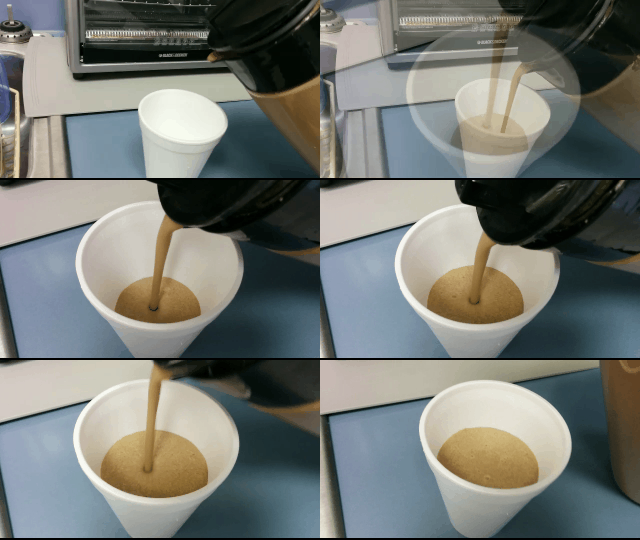
Here's a look at the pouring consistency of Schmoylent.
Here’s a look at the pouring consistency of Schmoylent. NOTE: There’s a loose chunk of unmixed powder in there, but that tends to be user error. I usually can get it mixed well enough.

Grades

Taste: 8
Texture: 7
Nutrients: 10
Packaging: 3
Ego Depletion: 6
Price: 6 ($4.04 per meal)

Rating: 6.7

Taste

I gave name brand Soylent a 5-out-of-10 rating in taste and basically said no thanks. I’m giving Schmoylent an 8-out-of-10 rating and saying I hardly knew thee. The difference in taste? So far as I can tell, the only difference is the inclusion of chocolate powder in Schmoylent. Could that have made the powder-drink that much more likeable? Or maybe it was the fact that Schmoylent is based off an earlier version of Soylent, one which required the user to add a few bits of oil during the mixing process?

Not that I could taste the coconut oil I was adding per se, but I do recall wondering often how my Soylent would taste with some sort of smoothing agent like oil added to it. Was it better tasting than my so-far favorite 100% Food? Boy, it’s hard for me to believe it, but for some reason I just really like the taste of Schmoylent. I looked forward to my Schmoylent meals.

Texture

Much like Soylent, it tastes dusty. Maybe my having tried Soylent first prepared me in ways that 100% Food failed to prepare me for Soylent. But all I know for certain is that the texture, while not enjoyable, was not a deal-breaker this time.

Nutrients

A nice 2100 calorie supply of food with:

Carbohydrate: 252g
Protein: 114g
Fat: 70g
Fiber: 27g

That’s essentially the aim of this whole project — get sufficient nutrients and do so in a sustainable way. The latter half is still pending, but the nutrients of these liquid meals have typically left me feeling as or more awake and ready than ever.

Packaging

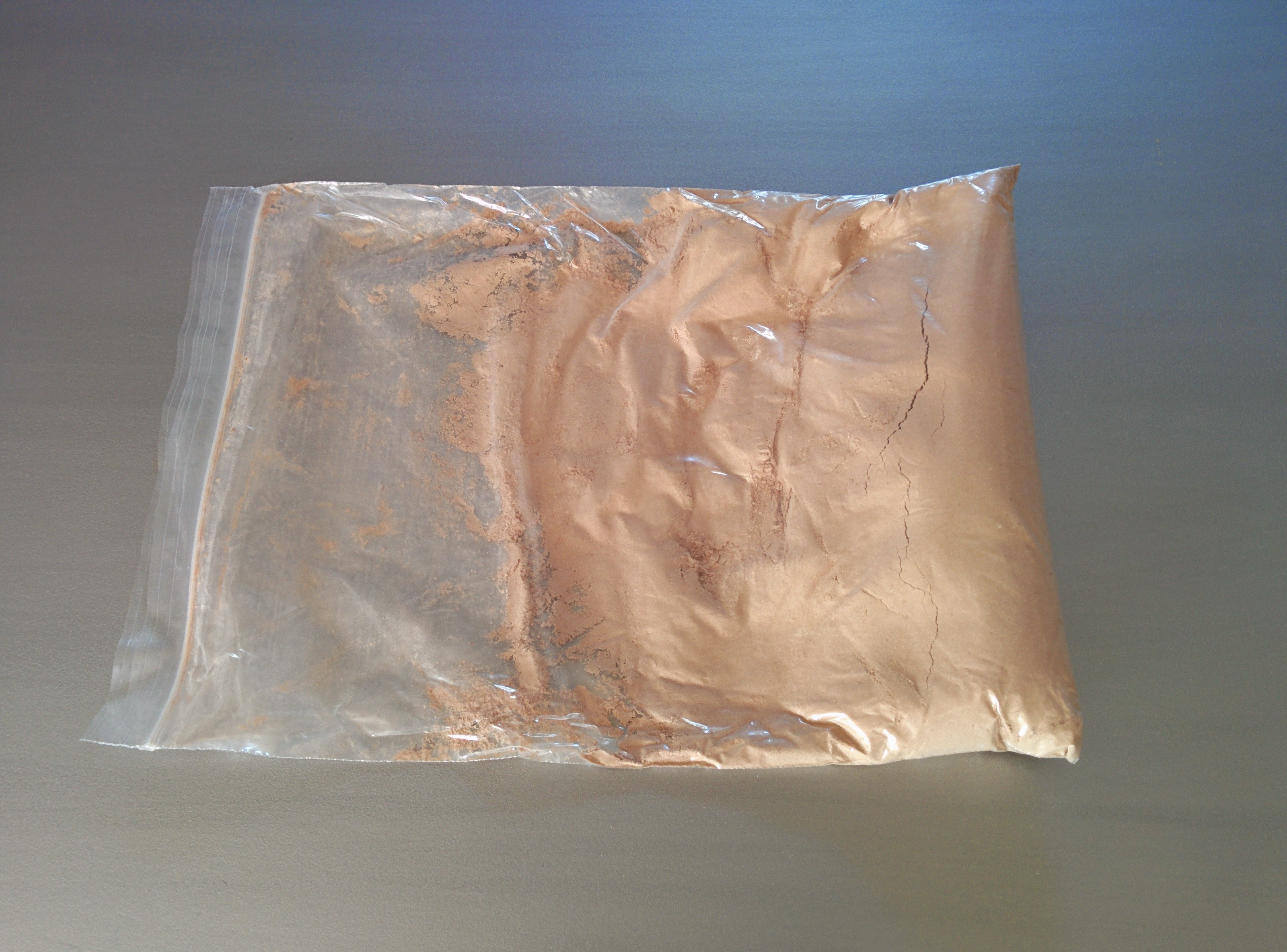
Here’s the problem with Schmoylent: It arrived in unmarked zipper bags.

This isn't at all suspicious.
This isn’t at all suspicious.

Soylent and 100% Food are both clearly young companies, but at least they had unique, professional-looking packaging. Schmoylent felt like some sort of terrifying Internet dare. And while I ultimately loved the product, the packaging would be such a tough sell that I imagine many users would never even taste the product upon seeing it’s floppy, suspicious transmission device.

And besides being a PR problem, the bags also constitute a practicality problem. Whereas 100% Food had self-contained bottles and Soylent had a free pitcher with the first order, Schmoylent lacked any storage accommodations. I was lucky my Soylent order arrived before Schmoylent, otherwise I wouldn’t have had a pitcher appropriate to render my Schmoylent portable (and thereby practical).

Thank goodness for the Soylent pitcher!

Ego Depletion

I honestly think I could eat Schmoylent long term. Had it not ceased its deliveries already. Oh well.

Price

While $4.04 is still better than Taco Bell, but not as good as Soylent’s grocery-level $3.06 price point — especially considering that Soylent also sends a pitcher with the first order.

Conclusions

My final say on Schmoylent:

  1. So far, Schmoylent tasted the best. Still dusty though, so maybe my tastes have begun to change.
  2. That means I should probably give Soylent another go.
  3. I shall miss you Schmoylent, you and your terrifying mystery bags of health powder.

Until the next one, eat well, my friends!

Other Reviews

Check out the Soylent subreddit for some great resources on liquid meal-replacements.


Hydration Sensor Could Address Wrestlers’ Needs

I can still hear my high school wrestling coach talking to us about the dangers of “cutting weight.” That is to say, dropping large amounts of water weight in a short amount of time in order to make weight and be eligible to wrestle at a particular weight class. Sheer weight used to be the determining factor in how much water one has shed, but no longer. From a study conducted by University of Strathclyde a new wearable device could be able to provide real-time feedback on fluid loss and hydration levels to a computer or smartphone.

Similar to boxing, wrestling is divided up into various weight classes in the name of fairness. Of course, the weight can be very misleading as in just a few hours of intense workouts one can drop multiple pounds of water, allowing athletes to make weight, then rehydrate and technically be above the allowed weight class. Cutting weight is an old story, one that has been around for years despite numerous deaths in the high school and collegiate ranks. The NCAA enacted rules, specifically banning the use of saunas, rubber suits, and pills, but without a way to measure just how dehydrated an athlete is, it’s a fuzzy line between working up a significant sweat and being in real danger.

Dr. Stephen Milne of Strathclyde’s Department of Biomedical Engineering said of the new device:

On an individual level this would allow people to rehydrate during and after exercise. When it comes to team sports, fitness coaches would be able to monitor the data during matches and ensure athletes get what they need to maintain their performance. The sensor is small and wearing it on the skin does not cause any discomfort. During exercise the user would barely be aware of it, allowing them to focus on the activity without distraction.

Given the uniqueness of each person, the need for a personalized game plan for each individual’s workout plan and thus hydration plan is varied. The sensor itself has been designed in part by Professor Patricia Connolly of the Medical Diagnostics Research Group at the university who credited Dr. Milne, saying

Stephen has been able to take our work in medical sensors and transdermal sensing from the healthcare applications into the field of sport.

As someone who managed to stay at the 103 pound weight class all four years of high school, cutting weight was something I was all too familiar with. There were no doubt times I was dehydrated, but our coaches and managers were keen to notice fatigue and sloppiness in me, and would scale back workouts if need be. I would run laps in the pool room where the sweat would just pour out of me, but I never felt in any danger. If I did, I have no doubts the workout would have ceased as I was fortunate enough to have an excellent coaching staff. With this new sensor, the guesswork and “gut-feeling” of coaches is removed. While the context is focused on weight-class athletics, no doubt distance runners, weight trainers and athletes of any caliber should take careful note of their fluid levels. With issues of dehydration to hydrating at the wrong times or even over-hydrating abound, the sports world has been waiting for a wearable device like this for too long.

(Header image courtesy of and features the very dorky author)

Pro Athletes Are Turning To Yoga

If I told you Barry Zito did yoga, odds are you wouldn’t be too shocked. You could pick out most interviews with the pitcher and put it together like “Yeah, I can see that.” Not to say the former Cy Young winner isn’t an athlete, but it’d be a stretch to call him a jock. On the other hand, you would most likely be very surprised to hear a slugger such as Giancarlo Stanton utilizes yoga in his workout routines or USMNT midfielder Jermaine Jones regularly incorporates yoga to focus him.

Gaiam, likely the largest yoga focused company in the United States, recently announced both Stanton and Jones as stars of video series aptly named Yoga for Power with Giancarlo Stanton and Yoga for Conditioning with Jermaine Jones. Now available either traditionally via DVD or digitally online (but not through their GaiamTV streaming service just yet) the videos are designed to improve various aspects of one’s game. Where the ties between football and another non-traditional athletic event in ballet are quite established, recent years has seen yoga take off in baseball circles. A number of MLB teams have turned to yoga for various needs including strength, balance, conditioning and focus, and perhaps this latest wave of videos will shed further light on the subject.

Stanton, while speaking on yoga and his videos noted

Yoga has become an integral part of my training regimen. It strengthens my body and mind and pushes me to be more in tune with myself not only physically, but mentally as well. I truly feel that yoga has been a key component in developing a solid foundation on which I can continue to build a healthy athletic career while benefiting my life as a whole.

From casual workouts to more focused goals, yoga has certainly gained traction as a workout option in the United States. Via Statista, the revenue of the Gaiam specifically and yoga and pilates industry in general has been on a sharp rise since 2007 and projects to continue to do so.

yoga1

As the stigma surrounding alternative workout routines drops, potentially more professional athletes will step forward and embrace what yoga offers on both the physical and mental fronts. The mental side of sports while tough to quantify, shouldn’t be overlooked. As Yogi Berra famously once said: “Baseball is 90 percent mental, the other half is physical.”

(Header image via Gaiam)

REVIEW: Soylent Tastes Like Dusty Cardboard

This journey begins with the Soylent Athlete, an article in which I muse about the possibilities of an athlete benefitting from a liquid-meal diet. Specifically, we ask: Can an athlete better meet his or her fitness goals by using powder meal replacements?

After months of waiting, my first shipment of Soylent finally arrived. I have already reviewed 100% Food, which proved rather tasty. In fact, I continued to purchase it well after my review published.

Will Soylent fare as well? I’m guessing you’re one of those “headline reader” types, so I doubt this is a spoiler, but the answer is probably no.

Grades

Taste: 5
Texture: 6
Nutrients: 10
Packaging: 5
Ego Depletion: 5
Price: 7 ($3.06 per meal)

Rating: 6.3

Taste

Woof. I did not like Soylent. Imagine that dusty box on your back porch, the one holding your fake Christmas tree. Imagine ripping that weirdly crispy, tired cardboard into little pieces, adding water, and then blending it into a smooth, pleasing-looking but oddly tacky liquid. Now eat it.

While I complained about 100% Food’s lack of spicy options, I realize now that having great sweet options is a huge accomplishment. In order to eat Soylent — not necessarily enjoy, but just simply eat it — I had to add cocoa powder and sweeteners. Sometimes I just poured a hearty dose of chocolate sauce into the blend. All of this, obviously, eats away at the nutritional value of Soylent — y’know, the core reason for wanting to go on Soylent.

I do think the neutral, cardboardy taste might lend itself to spicy creations, but I was so worried about making a nasty batch, that I never tempted fate and added hot sauce. Why was I worried? Because I already had to throw out one big batch.

I added some fruit as per a suggestion in the neat-looking instruction manual. I took a helping of frozen mixed berries, blended them with some water, and then used the water fruit mix as the base for the Soylent powder. They blended well — which is to say, they chemically combined well — but tasted so awful and turned so ominously gray after 12 hours in the fridge that I couldn’t stomach a second meal of the now-gritty and still-not-sweet-enough Soylent/fruit mix.

I cannot imagine many standard customers, much less food-craving college athletes, satisfying themselves on a batch of Soylent. And that’s just with regards to the taste.

NOTE: Someone on the Soylent reddit page suggested adding powdered fruits to Soylent to help with the flavoring. Because new flavoring ideas are constantly appearing, and because I certainly didn’t try all possibilities, I completely reserve the right to at any time change my opinion and pretend like I always held this new opinion.

Texture

So if 100% Food was like a milkshake in its thickness, Soylent is like chocolate milk. It’s not totally watery, but it’s smooth and thick. Problem is: It’s very tacky. And maybe I’m not using that word correctly, but it’s the closest description I can find for something that feels kind of like how I imagine paint would feel in my mouth.

It’s dry, yet somehow still a liquid. It’s sticks to my mouth, but not in a good way. It’s really not great, but it’s not horrible either.

Nutrients

Fellow redditor Alex Clifford has been on Soylent for some time now. I suggest reading through his Soylent experiences at his beautifully designed blog, Red Dog Tales. He shared some of his data with me, and the results — while much more comprehensive — mirror what I was seeing from my top-down analysis of 100% Food. Basically this: The liquid diet resulted in better health.

Here’s the gist of his changes:

Soylent proved a wise choice for blogger Alex Clifford.

So the only two categories that changed significantly for Alex while on Soylent were Alanine Aminotransferase and Triglyceride, both of which moved from unhealthy to healthy ranges. His Lipemia Index went from 11 to 4, but anything in the 0 to 50 range is okay.

I personally never had any GI issues with soylent, and I hear this latest edition has improved that kind of stuff. So I can’t but give Soylent perfect marks on the nutrition side of things.

Packaging

At first, I thought the big plastic pouring container doodad was pretty awesome. It warned me to not over-tighten it, and I did my best to gently turn it shut. But sure enough, Soylent is everywhere. I got Soylent on my car seats. I go Soylent on my clothes. There’s a Soylent ring on the fridge shelf. I got Soylent all over my hands. I tried tightening the lid more, and I got more Soylent everywhere. And that doesn’t even include the powder form.

Basically, this is how the Powder Problem works: You fill the canister half with water, then add the powder (and good lord, add something with flavor). Shake. Then add more water (to fill the canister), and then shake again. By then of this process, the raw Soylent powder should have arrived at every level location in your immediate area. And no matter how carefully I poured the powder into the canister … poof!, powder everywhere.

I’m betting I’m just super spoiled having started with 100% Food, with its neat, self-contained single meal packaging. By just the process of making Soylent — the whole five minutes necessary to make all three of my day’s meals — felt like a drag.

It’s also worth mentioning here that Soylent took almost a half year to reach me. I believe they are getting more staff and upping production paces, but basically it’s not feasible if you’re looking for an immediate, short-term order.

Ego Depletion

It was very hard to eat Soylent for every meal. But that is almost certainly because the texture was unpleasant and, more importantly, I couldn’t find a flavor (or flavors) that I really liked. Because of it’s neutral base, though, the possibility for more flavor combos exist than with, say, 100% Food. So I’m totally open to changing this section.

Price

Since 100% Food raised its price, Soylent remains among the cheapest tiers. It’s around $3. That’s pretty dang close to grocery prices. A nice midpoint, perhaps, between McDonald’s and homemade — but sans the time cost for either those two alternatives.

Conclusions

Here’s what I think I’ve decided:

  1. It’s not bad enough for me to say no to Soylent forever. I’ll keep trying Soylent.
  2. Generally, I don’t like Soylent.
  3. And I cannot imagine this being the liquid meal that enables healthier, easier student-athlete diets.

Until the next one, eat well, my friends!

Check out the Soylent subreddit for some great resources on liquid meal-replacements.


Sony Looking to Prove Durability with Tough Mudder Partnership

Various devices boast about toughness, water resistance and qualities of similar ilk. As Amazon’s most recent Fire commercial demonstrates, a device’s overall ability to work under circumstances — extreme and every day — remain important bullet points. Sony is willing to put its money where its mouth is, as they partnered up with the Tough Mudder (TM) organization to record and track various events this year. The devices being used will be Sony’s Xperia Z3, Z3 tablet compact and Smartwatch 3.

From the Samsung S4 and S4 Active in 2013 and their S5 last year to the Kyocera Brigadier and HTC Desire Eye, water resistance in mobile devices is nothing new. HTC offers Uh-Oh Protection, where events such as cracked screens and water damage are covered up to one year after purchase. Similarly there is no shortage of water and sweat resistant smartwatches or fitness trackers, though again, few have been put through the paces of an event like the Tough Mudder. In addition to various participants utilizing the Sony gear, a sponsored team will also be running the course while being subject to all manners of dirt, water, dust and any combination of the three.

According to the Tough Mudder website, 1.3 million people have participated in various events over the years and each race averages between 10 and 15 thousand people. The advertising reach for Sony shouldn’t be understated, but that is presuming their devices work as advertised. Sony claims each of the three are IP 68 certified, meaning they can submerged in nearly five feet of fresh — not salt — water for up to 30 minutes without any negative effects. With multiple TM events involving water, such as the Mud Mile and the Underwater Tunnels, Sony is betting that this publicity and their sponsorship paint the company in good light. Samsung faced public backlash when it was discovered in 2013 that the S4 and S4 Active did not have moisture damage covered in the one-year limited warranty despite being so famously advertised by having a camera mode specifically for taking pictures underwater. The next Tough Mudder event is scheduled for this coming weekend in Los Angeles with five more races throughout the year. It’s only a matter of time before Sony’s products get put through the wringer, just like the people who run in the events.

(Header image via Facebook)

The Sports and Fitness Apps We Know Are Coming to Apple Watch

Apple once again took the tech news industry hostage today, as their Spring Forward event promised to bring new insights into a few of their current products as well as the much anticipated Apple Watch. They announced an HBO partnership with the (now cheaper) Apple TV, an incredibly thin new MacBook, and also previewed ResearchKit — a new way for health professionals to crowd source medical research. But the biggest buzz leading up to the event was Apple’s new wearable, and the folks from Cupertino certainly made that a highlight of the presentation. We don’t know all the specifics yet, but sports fans and fitness nerds should have at least a few things to look forward to.

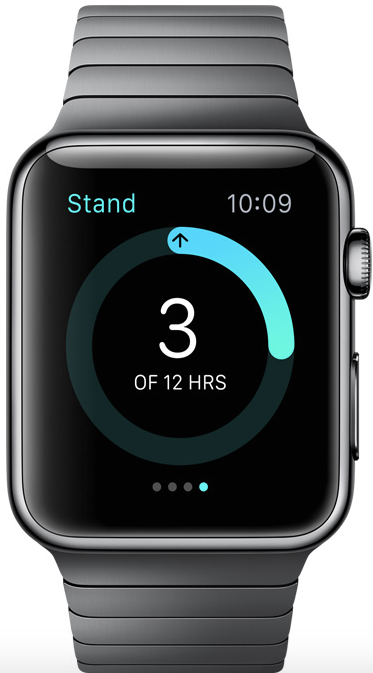
The biggest fitness app really isn’t an app at all, but a built-in feature to the watch. Apple Watch is chock full of fitness and activity tracking options including a workout app, basic step and burned-calorie counters, and will even feature reminders alerting you when it’s time to stand up and walk around a little.

applewatchstand

Third-party apps will also be available for tracking fitness. Offerings from Nike+ Running, Strava, and Runtastic are also being featured on Apple’s web site. Data from Watch will be synced with these services, allowing users more access to and control over their data.

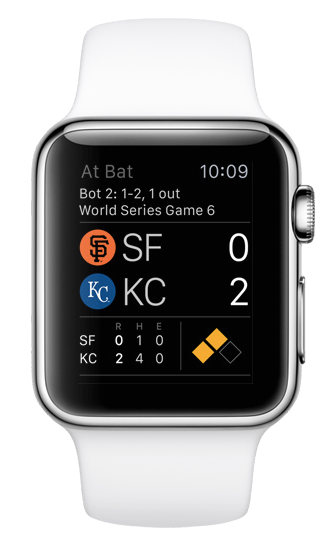
So far, only two apps for sports fans have been announced — MLB At Bat and ESPN. Both will feature team-/game-based notifications and general scoreboard functions, while the At Bat app promises player stats, news, and even highlights. I have to admit, watching highlights on a watch would be pretty cool.

applewatchmlbatbat

Apple has released the iOS update that features the Apple Watch app, but as of this writing access to the Watch App Store was not available. Nevertheless, the Watch API has been out for some time, so it’s easy to assume there will be plenty more offerings above what has been announced today. We’ll keep you updated as soon as we get any more info.

The Apple Watch will be available for preorder on April 10th, with units becoming available on April 24th.


REVIEW: 100% Food, a Liquid Meal-Replacement

A few weeks ago, I began to explore the idea of the Soylent Athlete. More specifically, I asked: Can an athlete better meet his or her fitness goals by using powder meal replacements?

The catalyst for this line of thinking, the unforgettably-named Soylent, just raised a whole mess of money in the venture capital world and looks to up their production levels as a result. Which is great. Because I ordered Soylent sometime in mid 2014, and I’m still waiting on my first batch.

But in the meantime, there are many Soylent alternatives available. The recipe for Soylent itself is open source, meaning there are a lot of similar and hopefully great product on the market. Today, I’m going to look at 100% Food from Space Nutrients Station.

Grades

Taste: 7
Texture: 6
Nutrients: 9
Packaging: 10
Ego Depletion: 6
Price: 8

Rating: 7.7


Taste

I have now tried four variants of 100% Food: The normal vanilla (or “raw”), the normal chocolate, the low carb vanilla, and the low carb chocolate. I have liked all four flavors, and — texture and consistency aside — my favorite flavor might be the Low Carb Raw variety. But the chocolate flavors are excellent, too, and contain Ghirardelli chocolate powder in them. For funsies, you can also add a little chocolate syrup, though that obviously eats away at the health benefits of the meal.

One thing I really wanted, though, was a spicy option. Or perhaps a savory option to which I can add any of my delicious hot sauces. My office neighbor is always dousing his food in Crystals, and it makes eating something mildly sweet almost like torture. I love hot sauces, and I can’t stand by as others eat hot sauces without me.

Overall, are the different flavors of 100% Food suited for everyone? Maybe, maybe not. It really smells better than most of my doubting coworkers expected, and has much more flavor than its gruelish appearance.

Texture

Let me start by saying the texture is difficult. For many people — my wife included — the texture and consistency is a non-starter. There are whole sesame and chia seeds in the mix, and with water, the meal thickens into a kind of paste. Sometimes, especially with the low carb varieties, the powder will clump into thick, tough balls inside the bottle or even leave whole gaps of powder untouched by water (this was never an issue in the normal varieties, just the low carb ones). The remaining combo of water and powder can then create a sort of snotty paste — not fun to look at.

I really don’t throw up much, but after my first 100% Food meal, I nearly did. I ate the majority of the bottle problem free, but then had just a little bit of powder left. I added some extra water and swirled the contents together. I learned from later experiments that the water/powder balance is best when it’s near milkshake consistency, but that first night, I glorged out a mouthful of watery meal as my body said, “Nope! That’s not the consistency we expected!”

That caveat delivered, when I can get the powder whipped into a milkshake or oatmeal consistency — which is about 90% of the time for the normal stuff, 75% of the time with the low carb variety — then the consistency is actually one that I rather like. Sometimes, I’ll make it with hot water and it’s like drinking down some vanilla or chocolate oatmeal of some sort.

Nutrients

This is the part where I’m most jazzed. Let’s compare my life before and during a wholly Space Nutrients diet:

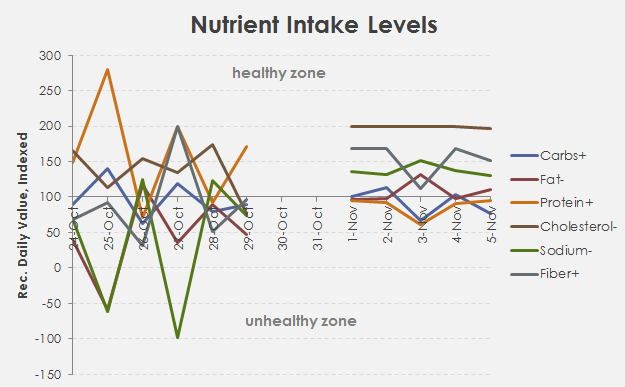
After switching to a 100% FOOD diet, my nutrient intakes went from erratic to stable, if not very healthy.
After switching to a 100% FOOD diet, my nutrient intakes went from erratic to stable — and especially healthy.

Basically: I was getting way too much sodium, not enough fiber, too much fat, and probably an oversized dose of protein (coming specifically in the form of red meat, i.e. burgers). According to the nutrient standards set by the USDA and the NIH, I became a super-prudent eater after I began eating only 100% Food. I was having about 50% more than the recommended daily intake of fiber; I cut my fat intake to appropriate levels; I had sodium under control, probably for the first time in my life; and I consumed almost 0 cholesterol (which corresponds with a 200 Cholesterol-).

I hear it’s important to get some “good cholesterol,” but since the NIH or USDA did not suggest a minimum amount of ol’ cholesty, I guess it’s good I lost it completely from my diet.

I went from typically missing my calorie goals (usually around 2500 on days I run) to landing well under them.

How did this new diet affect my body? Well, first of all, let’s talk about the gap in the middle of my data. On October 30th, at almost precisely 6:00 a.m., my son burst into our lives. He’s a great little fella, but he does not fit neatly into the pocket of my jogging shorts or the nice jogging stroller we have. So the following data I consider very incomplete because I switched from jogging almost every day to jogging occasionally shortly after his birth.

But here is a sample for how my body reacted to 100% Food:

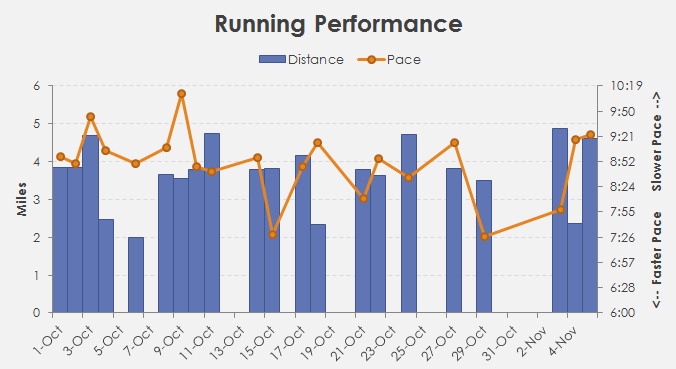
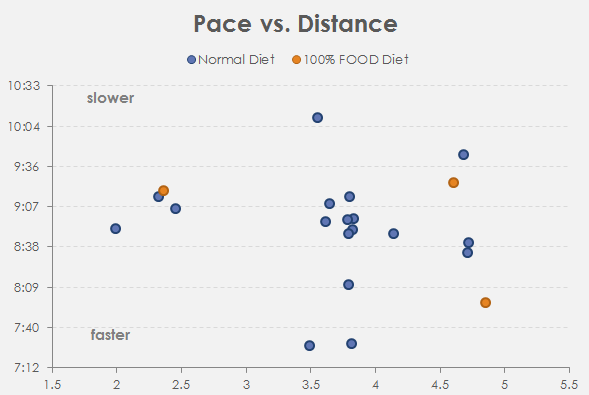
Despite eating nothing but a milkshake-like paste, I managed to maintain my usual running distances and paces.

And here is a similar look that show how my runs still clustered with my pre-100% Food performances.

The upper-right orange dots represents one of my best runs in the whole month, but overall, I did not see either a spike or major dip in my running ability.

Did the liquid diet make me a better runner immediately? Did it give me an instant pep in my step? Maybe a bit psychologically, but not in a discernable physical way. Shortly after this period, I tweaked my ankle (not to mention had a kid) and found myself out of commission for a while. I hope to someday revisit this study, though, and track more physical performance data.

AWFUL AND DISGUSTING, BUT HONEST NOTE: Many people complain about the impact 100% Food’s fiber has on their puny digestive systems. But I’m a fiber fanatic. My body has been training for a spotlight like this, so I did not notice a discernable or at least negative difference in flatulence or bowel movements. If anything, I endured less straining and grunting and praying during BMs. Sorry, but I’m just reporting the facts. Back to the non-poo-related part of the article…

Packaging

Because they come in neat, self-contained bottles, I never spent more than 5 minutes preparing a meal. That’s pretty fantastic.

I understand that Soylent and Joylent and some of the other liquid meal groups require users to make a batch beforehand and parcel out bits of food throughout the day, perhaps in sports bottles or used water bottles. I’m not sure, but I do know this current method of delivery for 100% Food works and works well.

I should mention, though, that convenient doesn’t mean great things for the environment. This 10-star rating for the package has to do only with the user’s experience, not the overall impact of the item. That is a calculus the user must complete (as in, what’s worse: garbage dumps filled with plastic bottles, or gallons of water used on washing reusable bottles).

Ego Depletion

Here’s the biggest problem for me. I didn’t mind the texture, but by the end of the day, all I could think about was whatever delicious smells my wife was microwaving. Could I have maintained an all-soylent diet as a college athlete? Maybe if everyone in my apartment and on my team were doing the same. But in a house where real old-fashioned food is being made and consumed, I think it is near impossible.

I wanted to continue to test the different flavors of 100% Food (thus the gap between my data and publish date), and I found a good process that works for me: Eat 100% Food for breakfast and lunch, then share a traditional meal with the wife at dinner. That works pretty well for me, but I still struggle with matters of ego depletion: After eating really healthy throughout the work day, I find myself splurging on chocolate or popcorn at the end of the day. It’s not a great strategy, and I could very much see this as a problem for athletes who already have a lot of stress on the menu.

Price

At around $5 a bottle (even after shipping), it is certainly affordable, but it once was better. When I started in September, I was paying about $3 for bottle. And I believe Soylent wants to get down to $2 a bottle.

Conclusions

Here’s what I think I’ve discovered:

  1. The product tastes good enough for me. I’m going to keep eating it so I can work through lunch and go home early. At least until a better product comes along.
  2. Eventually, a whole bottle of 100% Food became too filling for me, so I would have half the bottle for breakfast (leaving some of the un-mixed powder at the bottom of the bottle) and then eat the rest for lunch. (This was not an issue when I was still running and needing far more calories.)
  3. In order for this to be a viable meal for 90% of my life, instead of the 66% it occupies now, I need a spicy option. Or perhaps more flavors in general. The current flavors work well for me, but I still need just a touch more variety.

Eat well, my friends!

Check out the for some great resources on liquid meal-replacements.


Review: Pocket Yoga

From 2002 to 2009 the popularity of yoga stagnated. Then in 2010 yoga began a clear rise in popularity and according to projections by Google Trends and Statista, it will continue to grow. The app market has taken note, as there are dozens of yoga apps to choose from in the App Store, Google Play Store and the Amazon Store. Right now through the Amazon Store and for Android devices, the Pocket Yoga app is free to download.

As someone would be classified as an interested novice in yoga, I wouldn’t bother paying the normal $2.99 just to try an app. Free? That is the right price for me to give it a whirl, and Pocket Yoga has impressed me. It features three different practices, each with 27 different preset routines to pick from. Within each routine you can pick the duration — 30, 45 or 60 minutes — as well as choose between beginner, intermediate and expert. There is also the ability to pick a home, studio or office environment, though the only difference is the background setting in which the app runs.

In addition to the preset routines there is also Sun Salutation A and B where instead of a time limit, it is based on how many repetitions you’d like to do, ranging from two to 108 (both A and B also have the option to choose which difficulty and environment).

Throughout each routine the digital instructor gives cues on pose changes as well as helping you regulate breathing, but I found myself struggling to get into the correct form before the next pose. The app does allow you to pause each routine — and pick it up where you left off — or even preview the routine before you get started.

yogaguideA built-in index of the different poses in alphabetical order is incredibly helpful, and if you’re a fellow beginner, I strongly recommend looking at the preview and the list of poses before jumping into a routine.

yogalist

Pocket Yoga tracks your completed practices and routines and once you finish a session you’re given the option to share the accomplishment via Twitter, Facebook and a number of other social networks.

yogaprogress

As even the beginner routine was challenging to me, I’d recommend Pocket Yoga to someone who has more of a working knowledge of yoga. For Android users, make sure to download it through the Amazon Store as it is still $2.99 through the Play Store. The same goes for iOS users. Still, it is hard to fault the app for me not being as flexible as I was in my youth, though after a few weeks of using Pocket Yoga, I should be back in form.