Archive for women’s world cup

Heart Rate Sensor Assists U.S. Women’s National Team

The United States women’s national team won their third World Cup title this summer in Canada. That same Women’s World Cup, along with this summer’s Under 20 World Cup in New Zealand, marked the first time FIFA allowed players to wear tracking devices during game action. The success of the devices during these events led FIFA to greenlight the use of wearables in future competitions, subject to the approval of individual leagues.

Part of the team’s success was the players’ dedication to the training plans developed by strength and fitness coach Dawn Scott.

“I think it’s a testament to the players that they trusted us and stuck to the program, and did what they needed to even when they had their commitments with their [club] teams,” Scott said in a previous interview.

An earlier Wired article discussed the USWNT’s relationship with Polar Global devices. When reached for comment, Polar Global’s Josh Simonsen confirmed that the players were wearing the H7 heart rate monitor on the pitch, and using M400 GPS watches in training sessions. Simonsen, the company’s national training resource specialist for the U.S., said the Finnish company had worked with Scott and the USWNT since 2010.

“What that gave Dawn was the ability to track speed, distance, and activity of the athlete while they’re away,” Simonsen said. “And they were able to send it her in a much easier environment than the previous models.”

The H7, the heart rate monitor worn during the games, consists of a strap worn across the chest and a small transmitter a few inches wide. The strap contains an electrode that collects the ECG signal from the athlete; after some basic processing, the transmitter then sends out a Bluetooth signal. The system reports heart rate on a per-second basis, using only basic peak-to-peak measurements, which are less susceptible to the kind of movement artifacts you would expect with an athlete wearing the device during competitions.

Polar’s top-of-the-line system, the Team Pro, also includes a GPS and IMU sensor. Switching to Bluetooth Smart also allows the transmitters to communicate directly with a tablet. But Simonsen said the USWNT was still using the older Team2 solution this summer.

“They didn’t want to transition prior to the World Cup,” he said.

The company has a long history with heart rate sensors, having built the first monitor for an athlete in 1977. But it was not until the early 2000s that Polar began developing systems for whole teams, rather than for individuals.

“Essentially the coach would log into the software and each player would have their own page, but they really weren’t able to compare the team as a whole,” Simonsen said. “We couldn’t look at the big picture.”

This functionality would not become available until Polar’s Team2 system was introduced in 2009. Unlike their previous offerings, Team2 allowed coaches to collect and analyze data in much less time. The addition of Bluetooth transmitters also allowed coaches to monitor their players in real time.

“[Team2] was like a 50 percent cut in time that it took to do everything,” Simonsen said. “Everything was exponentially faster.”

The Team2 system is currently used by “about 450 teams” in the U.S., and Simonsen said new coaches are typically surprised by the feedback provided by the data.

“A lot of the time they’re just blown away at how long things were or how hard things truly are,” he said. “Or that their easy day really wasn’t that easy, or that their hard day was a lot harder than they really thought it was.”

Simonsen argues that this experience in the field is what separates Polar Global from the plethora of other companies offering heart rate monitors.

“We created heart rate,” Simonsen said. “And with us using HR from the beginning, accuracy is always our number one thing.”

The Technology Behind the U.S. Women’s National Team’s World Cup Victory

The United States women’s national team went into the 2015 FIFA Women’s World Cup with a chip on their shoulder, trying to avenge a heartbreaking finals loss in 2011. But eagle-eyed viewers might have also noticed the chips the women wore under their shirts as well, as Will Carroll pointed out on Twitter.

The objects were Polar Global’s H7 heart rate sensors as suggested by this Wired article and confirmed by Polar Global. The USWNT is also listed as a client of Catapult, an Australian-based company that combines GPS and inertial measurement units (IMU) into a single sensor.

Strength and fitness coach Dawn Scott confirmed that her team uses heart rate sensors and GPS systems to monitor player performance. However, because the team does not have a formal relationship with either company, she could not discuss the specific devices she uses in detail. Nevertheless, she was still happy to answer general questions about how she and the rest of the American coaching staff used the devices.

The GPS system and heart rate monitor produce a wide range of metrics. Head coach Jill Ellis and her staff were mostly interested in measures of intensity, rather than total distance covered. Scott specifically discussed the percentage of high-speed running (running faster than 11 mph) and distance covered during high-speed running.

“For me they’re the main factors that then show how much a player’s involved in the high-intensity activities,” Scott said. “[That means] overlapping for your midfield player, making high-intensity runs into the box. For defenders, [it means] having to recover.”

But not every position calls for such high-intensity bursts. For those players, the coaching staff relies on meterage — a player’s average speed in meters per minute.

“So say a Lauren Holiday, who isn’t necessarily doing a lot of sprints when she’s in a holding midfield position, but she’s one of the ones who does the highest meterage, so for her, that is more of a marker of her work rate,” Scott said. “In one of the games where she was pushed into the attacking midfield role, she suddenly had a lot of max sprints.”

The games presented an additional set of challenges. Although this tournament marked the first time FIFA allowed players to wear monitoring devices on the pitch, FIFA retained the regulations prohibiting the use of technology on the sidelines. This prevented the coaching staff from using these systems to guide their in-game decision making.

“I don’t always see the purpose of real time [monitoring],” Scott said. “Sometimes in training we’ll take out the real time system, but for me that’s only if we want to get a certain physical output from a fitness point of view.”

Making matters more difficult, several of the stadiums in this summer’s World Cup were domed (like Montreal’s Olympic Stadium) or had large roofs overhanging the field (like Vancouver’s BC Place). This meant the team’s GPS-based systems were much less accurate during games.

“The interpretation of that data is crucial, especially when you’re giving that back to players and the coaches who are interested in that feedback,” Scott said.

Scott doesn’t rely on a single number to judge player performance, instead adjusting her expectations and the numbers she looks at based on the game plan for that particular match.

“It’s knowing your team, your opposition, it’s knowing your own players, and what their physical capabilities are as well,” Scott said. “Carli Lloyd’s numbers were very different in the first three games from the final three games when her role was very different.”

But unlike a coach for a club team, who can monitor their players’ workouts year round, Scott had the added challenge of making things as simple as possible for her players after their training session ended. That meant shelving the more complicated GPS monitors and giving each player a wrist-worn heart rate sensor to wear during training. To their credit, though, the players diligently stuck to the team’s training plan — and just as diligently sent the data back to Scott.

“The players were very good at giving us updates in terms of their heart rate loads,” Scott said. “And they also logged into an online training diary or physical monitoring system, where every single day they would log in, answer five questions about how they feel physically, and so I can then log in and see where a player’s physical state is.”

Scott traveled across the country, working with coaches for every National Women’s Soccer League (NWSL) team to come up with a plan that kept the national squad healthy without hindering their club’s chances of winning. Scott was quick to praise her NWSL counterparts for their cooperation.

“The clubs were given guidelines in terms of when we want to train, when we want the players to have a day off, and also ideally how long the training session should be with the player,” Scott said “And to be fair to the clubs, in that crucial period in the leadup to the World Cup, they stuck to the programs we sent.”

Off the field, Scott is working towards a doctorate from the University of Western Sydney. Unsurprisingly, Scott’s research focuses on the physical demands and training loads of elite female athletes, with a focus on soccer players. Scott’s research relies on the hundreds of hours of game data she has collected from USWNT athletes since 2012.

“The main focus is going to be to develop a training model, so looking at what are the physical demands of women’s football,” Scott said. “And then with that, we look at what is the training intervention is to prepare the players physically for those demands,” Scott said.

But not all Scott’s methods are quite so high-tech. During March’s Algarve Cup in Portugal, players complained about stiff necks and poor sleep. So before this summer’s Women’s World Cup, each player was given an allowance to buy their own pillow to take on the road with them. The result, Scott said, the team was better rest and improved performance.

“When I first suggested it, people looked at me like I’d gone mad,” Scott said. “But the players appreciated it, because it just meant something they had at every single hotel.”

(Header image via GoToVan)

Tech Advances In The Women’s World Cup

This year’s FIFA Women’s World Cup is set to be the grandest Women’s sporting event of all time. Today FIFA boasted a number of major technological advances to be unveiled upon kickoff, such as broadcasting 10 matches — including the final — in 8K Ultra HD format. The press release also announced each game will feature no less than 20 cameras and as many as 22 trained on the field, a step up from the 16 camera setup in 2011’s Women’s Cup.

The use of goal-line technology (GLT) is being revamped as well. Rather than stick with the GoalControl system used in the men’s World Cup in Brazil last year, FIFA has decided to go with the Hawk-eye system in Canada. Both employ seven cameras focused on each goal and will be called upon for a ruling if a goal or no goal situation arrises.

FIFA has noticed the rise in second screening demands as well, and the presser specifically indicates a team of producers with a focus on mobile, tablet and laptop users. In order to view every game you’ll need a television package, as the matches will be split up between Fox and Fox Sports 1 for the English broadcast and NBC-owned Telemundo for Spanish. Nicolas Ericson, FIFA Director of TV, stated:

This is the biggest broadcast production we have invested in so far for a women’s football tournament. This supports FIFA’s commitment to develop and promote women’s football and it reflects the huge momentum and interest in women’s football around the world today.

Via Statista and using previous Women’s World Cups as the bar, nothing has come particularly close as far as live spectators since the 1999 Cup.

fifawomens

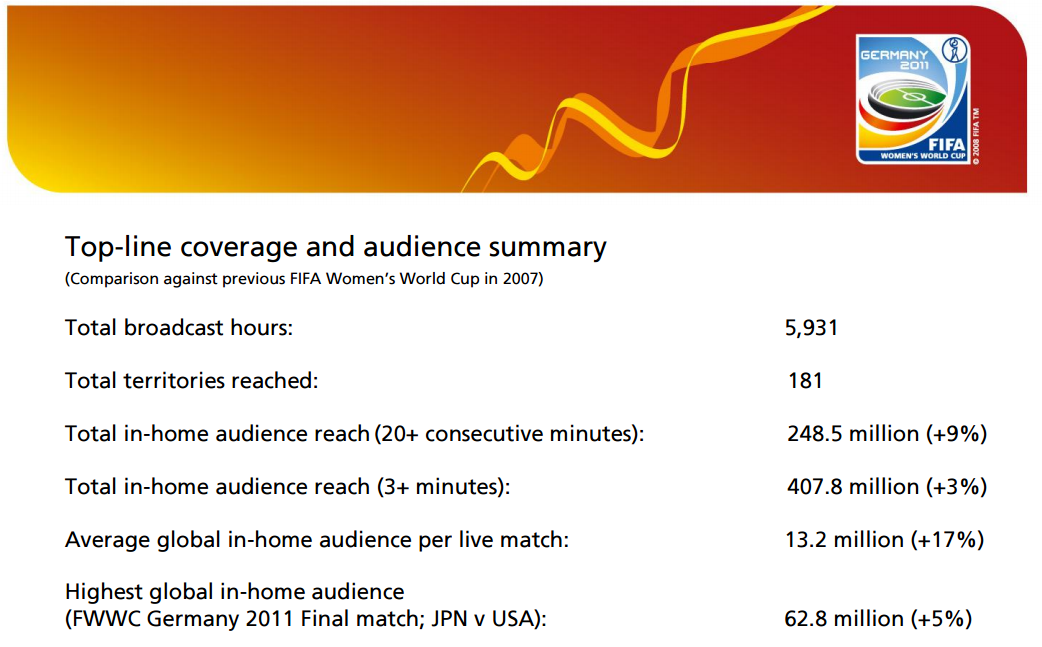
On the other hand, 2011 saw ESPN have its highest rated soccer game of all time in the 2011 final between Japan and the United States. Television audiences were up around the world in 2011 compared the 2007 Women’s World Cup as well.

2011cup

This year offers a good blend time zone friendly starts — the early afternoon games are perfect for Europe — new programming and embracing the fans with second screen options for what is shaping up to be the biggest Women’s World Cup yet.

(Header image via FIFA)

Reminder: You Can (Maybe) Stream the Women’s World Cup Draw Tomorrow

The 2015 FIFA Women’s World Cup groups will be drawn tomorrow at noon eastern on the Fox Sports 1 channel plus a live stream via Fox Sports Go. Joining the host nation of Canada is 23 other nations that qualified to make a run at the title of World Cup champion.

How to view the games themselves on television was decided years ago. FIFA gave all broadcasting rights in the United States from 2015 through 2022 for English TV and radio to Fox and their affiliates. Spanish TV rights went to Telemundo Media, owned by NBCUniversal. The Fox Soccer 2Go stream does not appear to have any streaming rights to the Women’s WC, however with a digital converter box, anyone with a TV — even without a cable subscription — should be able to see a limited number of fixtures. Lou D’Emilio of Fox Sports quoted World Cup Coordinator David Neal saying “Fox or Fox Sports 1 will carry all 52 WWC matches live in 2015.” Without a definite distinction of how the games will be split among the two channels, it remains unclear how many games a cord cutter will be able to see.

A possible option is the Fox Sports Go app is available for Windows, Android and iOS devices. Unfortunately Fox Sports Go currently depends on having a particular cable subscription. Despite producing a strong Fox Soccer 2Go app (where no TV packaged is necessary as it is a standalone price), the Fox Sports Go leaves much to be desired. One of the current issues is that despite having access to a Charter Communications login, complete with Fox Sports 1 and 2 in the channel lineup, Charter is not a selectable option. Given Charter services almost 28 million subscribers across 29 states and is the fourth largest cable provider in the nation based on revenue, one would assume compatibility with Fox Sports Go. Fox Sports Go is also not available to subscribers of either of the two major U.S. satellite providers — DirecTV and Dish. Apparently I am not missing much from not having access to the app, though. Among the three platforms, the highest rating is three stars on the Android version versus two on iOS and a 1.8 stars rating for Windows devices. Not to put faith in internet reviews, after asking around the only worse streaming platform than Fox Sports Go was the NBA’s League Pass, notorious for issues and bugs.

While the games are still over six months away, Canada will play its to-be-determined opponent on June 6, the accessibility of the matches is in doubt. This year’s men’s World Cup broadcasting rights was owned by ESPN and still have matches available to be re-watched via WatchESPN, though that does require a cable package. Whether or not Fox allows streams — both live or after the match — remains to be seen. Trusting major telecoms, let alone FIFA, to make the right decision for viewer accessibility is a nearly impossible dream.

(Header image via FIFA.com)