Archive for vr

VR’s Sports Invasion is Coming: Part 3

This is the third and final installment of Seth’s look at VR’s role in sports. You can find parts one and two here and here.

Branding & Marketing

Whether it’s a leprechaun tattooed on the bicep of a Boston Celtics fan or a white “G” circled in yellow on a green background on a flag that flaps at your neighbor’s next door during the fall, sports fans are fervent brand supporters. For some franchises, such as the Yankees, Cowboys or Lakers, the loyalty is passed down from generation to generation. For others, like the Oklahoma City Thunder or Washington Nationals, fandom is produced by geographical location or a winning product. For the unfortunate franchises, like the Jacksonville Jaguars or Miami Marlins, building a passionate fan base that regularly splurge on game tickets and scoop up team merchandise can be a rougher go.

And for those unfortunate franchises, creativity and a coolness factor is a must for marketing departments that can’t rely just on a winning team or legendary history to meet monthly metrics. Which is where VR could make a difference, as the Jags have already tried.

Last September, 3D-4U teamed up with the Jaguars and invited fans to watch part of the game in VR via an Oculus Rift. Eric Johnson of re/code, viewed a demo of the product.

The company positions between four and six cameras around the field, and depending on where the action is happening, viewers can change their angle on the game. Each camera is slightly zoomed in while recording video, which makes it possible to look around in the video by turning your head. It was also possible, at least in the demo I saw, to rewind the game and see a big play again, sort of like a cable DVR.

Despite a 3-13 record last year and a 4-12 2013, the Jaguars ranked first overall in fan experience, as voted upon by season ticket holders league wide in the NFL’s Voice of the Fan research campaign. And despite a tie for the third worst record in the league, the Jags ranked 21st in home attendance figures, ahead of the San Diego Chargers, and filling a higher percentage of capacity than the Cleveland Browns and Buffalo Bills, which ranked ahead of them. Jacksonville’s focus on fan engagement and immersion is working.

Meanwhile, the Sacramento Kings developed software to pair with Oculus Rifts to help sell premium seating in the yet-to-be-built arena — the Golden 1 Center, expected to open for the 2016-2017 season. The Kings told The Sporting News that they’ve sold all 850 sideline club seats ($200-$300 each) and they expect to sell all remaining courstside seats within the next several weeks. The 16-minute animation allow viewers to see a high-resolution, animated view of the team’s planned arena along with views of sponsorship inventory, suites, club seats, hospitality spaces and seats.

“It is brand new, and we can take it on the road and to someone’s office and bring the new arena to our fans,” Kings President Chris Granger told Sports Business Journal. “Instead of an old-school PowerPoint document, you create an immersive experience. It also allows partners to weigh in to create something with a great sense of understanding.”

Marketing doesn’t only extend to fans. When it comes to big time college athletics, programs need to sell themselves to recruits, too. Syracuse coach Jim Boeheim connected with Next Galaxy to create a tool to wow potential Orange players. While NCCA rules prohibit the coach from many possibilities, the idea is to invite an audience into his home, his gym and showcases his trophy room.

“You’ll be able to wear (them) and feel like you’re in Jim’s house,” Barrett Ehrlich, a financial consultant for Next Galaxy, told Syracuse.com.

Joe Favorito, a sports marketing and public relations consultant and former vice president of public relations for the New York Knicks (2001-2006), holds reservations about VR capturing a live sports audience. However, he said that when it comes to marketing, VR will succeed.

“Virtual reality is more of a secondary experience for those that can’t be there, “Favorito said. “[It] will provide a secondary experience that will be invaluable moving forward that will enhance the brand.”

Experiences such as sitting in a race car with Jeff Gordon, slapping a penalty shot against goaltender Henrik Lundqvist or a Sacramento Kings fan in Mumbai touring the Sleep Train Arena.

IBM gave tennis fans a similar experience last year at the Australian Open. IBM’s ReturnServe captured real-time data of the action on the court which was used to create a virtual serve for fans to try and return, utilizing an Oculus Rift headset and a motion-sensitive racquet.

“You’re used to seeing players that are serving at 80, 90, 150 mph,” Elizabeth O’Brien, sports marketing manager for IBM, told The Atlantic. “Here’s what 100 mph serve would look like to you, let’s see if you can return it.”

Challenges

Those within the VR industry only have to look at 3D TV’s demise for cautionary tales to avoid. While much more limited in scope and capabilities than VR’s likely offerings, 3D TV failed in several common denominators it shares with VR that the latter must focus on as building blocks of success. Nail these issues and VR is on its way to mainstream acceptance.

The Headsets

Virtual reality headsets are silly looking, let’s face it. A tux’d up George Clooney sipping a martini couldn’t look cool with this strapped to his head. Remember earlier in the series, even Peter Moore of EA Sports called them dorky. Others have called them creepy. No doubt they’re unattractive. And there’s no legitimate argument against that description.

“People are going to look back at this thing and laugh,” said Brad Allen, executive chairman of NextVR, comparing current headsets to the brick cell phones of the 80s.

The hardware will shrink and become sleek. It has to. Any wearable piece of tech has to look cool to reach the mainstream. Gizmodo summed it up nicely:

Cool gadgets that look dumb are always a bummer. But looking slick, or at least not extremely goofy, is super important for a VR headset and the future of VR in general. Any wearable gadget has to reach with a higher bar of attractiveness simply because consumers have to wear it. That’s something smartwatches are still struggling with. Not to mention Google Glass.

And while no one (in their right mind) is going to wear a VR headset out in public or all the time, virtual reality is already fighting an uphill battle against looking doofy by involving bulky face-puters. We’ve finally gotten to the point where the tech is cool enough that it’s worth wearing one, so the last thing it needs is a layer of gaudy pseudo-chrome to convince people who haven’t given this new generation of virtual reality a try. “Yeah no. That looks stupid.”

Allen envisions an evolution of the headsets similar to cell phones; headsets will continually reduce in size until it reaches a comfortable balance of functionality and fashion. Likely, they’ll be a tad larger than sunglasses.

And they also need to be comfortable. Consumers didn’t want to wear 3D TV glasses around the house, and don’t want to wear uncomfortable headgear for entertainment. For long-term sustainability, VR will need to develop headsets that can be worn for hours at time. Otherwise, they’ll end up in the tech graveyard with the Zip drives and the RAZR phone while software providers lose their grip on customers.

And then there’s the sound. The initial focus, rightfully so, in VR development was on the visuals. But without sound quality to support the 3D visuals, the immersive experience all VR developers aim for falls short. It’s 360 visuals but with 2D audio. And it’s an issue VR-invested companies know they need to address to keep consumers on board. AltspaceVR and Next Galaxy – both introduced earlier in this series – created solutions to a limiting auditory experience.

Next Galaxy created its own headphones, dubbed Ceekars, which were introduced on Indiegogo earlier this year. Marketed as a VR 4D smart headset, the wireless, battery-powered Ceekars aim to add depth and perspective to a 360 virtual environment and complete the ultimate VR experience. When watching a NFL game from the sideline, that vicious hit on the far side of the field that laid the wide receiver out for a minute will sound a lot less fierce than the tackle in front of the user that knocked the quarterback on his tuckus. The headphones also feature haptic feedback, where an embedded actuator applies motions, pressures and vibrations based on sound intensity and range, for yet another level of immersion. So not only will you hear the hit right in front of you, but you’ll feel it, too.

Business Insider spoke with AltspaceVr’s Bruce Wooden, head of developer and community relations, about their auditory offerings.

As I would later see in my demo — where I was standing in a giant mansion highlighted by an enormous television and a half-moon couch, as well as a balcony off to the side — the sound is what brought everything together.

“If you’re near to that screen, it’s loud, you hear everything,” Wooden said. “But if you’re at the balcony, you can’t hear that screen at all. So it’s just like a real party, where you’ll have two people at the screen, you’ll have French guys over there in a circle talking about whatever French guys talk about, there’s a few people on the balcony doing their thing, and it’s just like a house party. You’ll have these natural social interactions, which is exactly what we’re shooting for.”

The audio is what will tie a nice big bow around the VR package to provide an elegant product.

Health Concerns

One of the biggest issues facing VR today is the perception that it’ll make you sick. It’s not a myth. But hardware companies and software developers continue to design VR experiences to avoid a sickening experience.

“People like the demo, they take it home, and they start throwing up,” John Carmack, the chief technology officer at Oculus, said at the Games Developers Conference in March. “The fear is if a really bad VR product comes out, it could send the industry back to the ’90s,” he said.

Dizziness, nausea, sweating and disorientation – dubbed VR sickness – is caused by the inner ear and the eye sending different messages to the brain at the same time. Valve claims to have cracked the code on eliminating the sickness and to be sure, every hardware designer is focused on delivering an experience that avoids reliving that hangover following that first night of Jägermeister.

Researchers at Stanford claim they’ve developed a headset that reduces eye fatigue, nausea, and VR sickness using light-field stereoscope technology which gives the eye a hologram-like experience for each eye to make the experience more natural. This is compared to “flat” stereoscopic headsets where each eye only sees one image, allowing viewers to freely move focus and experience depth in the virtual scene.

“You have a virtual window which ideally looks the same as the real world, ” Gordon Wetzstein, an assistant professor of electrical engineering at Stanford, told Hacked, “whereas today you basically have a 2D screen in front of your eye.”

Obviously eye strain is a natural concern when a lit up brick is strapped to one’s forehead. But how will this affect one’s brain? Can neurological damage occur following long-term use? Is it safe for children, whose brains are developing? And finally, if hours of Grand Theft Auto V play on my XBox One plants thoughts of driving up a mountain to avoid bumper-to-bumper traffic, what kind of intense impulses will an immersive experience feed my cerebral cortex?

Most of these questions can’t be answered without significant study. However, the preceding 3D experiences users had can lend some insight. Eye strain and dizziness were common symptoms that were not fixed. Warning labels reminded parents that their child’s brain was still developing, and it’s uncertain how 3D would affect that.

Livescience.com spoke with Mayank Mehta, a neuroscientist at UCLA, about virtual reality’s affect on the brain.

“We don’t really know what’s going on,” Mehta said. “I would say this is reason for caution, not business-as-usual.”

Mehta and colleagues put rats on treadmills in a virtual room, then looked at their brains. While the animal’s behavior appeared normal, they found 60 percent of the neurons shut down. And of those that don’t shut down, many showed abnormal patterns of activity and destroyed an individual rat’s map of space. Mehta admitted the consequences of the neural shutdown are unknown, but it’s worth looking in to if VR becomes such a big part of people’s lives.

Content is King

Imagine the snazziest baseball stadium you can imagine. Of course it’s tech friendly with features and amenities bursting from every seat – not just the box level. Supreme WiFi is abound. The bathrooms are sparkling clean and the concession stands lines are never longer than a TV commercial break. Getting in and out of the parking lot is quick and painless. This is VR hardware. Now imagine this same franchise without any on field talent. Like, none. There’s nothing on the field worth coming to see, since it’s filled with a bunch of Jason Tyners. This is VR without content. A snazzy stadium will bring in fans initially, but it won’t keep them coming back.

“Content is king,” Allen told me during our hour-long interview.

These VR headsets and demos will bring users in, but the content is what’s going to keep them coming back.

“We can immerse the players, and now the question is, what are we going to do with that?” said David Votypka, the senior creative director at Ubisoft-owned Red Storm Entertainment. “The way we answer that determines whether VR becomes its own growing, breathing, living gaming sector, or whether it’ll just be a cool way to play games we already know.”

Equally important for users is the ease in which content is found. Spio said for users to have to scour the web to try and find content is a big turn off for most people. Will a Netflix-like platform emerge as the go-to hub of VR content? Or will users split their time, and money, between multiple platforms, depending on which platform has the VR rights to host each sports league and conference.

And then there’s the importance of progression of content. Experiences can’t grow stale, and content-producers will need to continually offer new options for users to spend a buck on. Outside of live sports, of course.

“Constant, constant reinvention is needed,” sports marketing and public relations consultant Joe Favorito said. “How many times are we going to drive around Daytona? Once? Twice? Do we need to show a crash to get people to come back?”

Demand

Even with the coolest, most comfortable glasses which didn’t require Dramamine or result in Visine eye drops every 45 minutes, 3D TV wasn’t going to succeed because it didn’t vastly improve the way people watched television. It’s tough to get consumers to upgrade their current tech for only a marginally improved experience, which 3D TV arguably offered, at best. For VR to grow a market beyond hardcore gamers, tech nerds, and early-adopting rich guys that want the newest toy, it has to move perception from nice-to-have to must-have.

But how does VR create that must-have demand? It needs to provide an exclusive experience that is convenient and affordable that will make some part of a consumer’s life better.

That means affordable VR hardware. A $400 headset will be tough for many to swallow. Upgrade your personal computer to meet minimum standards headsets will require and now you’re up to $1500. The hardware costs will eventually come down. But initially, adoption will be slow because many won’t invest on potential.

It means no hassles. Nausea, eye strain, and any other health-related issues cannot exist. The headset needs to be comfortable and the content must be easily accessible.

And the content needs be be out of this world.

“What’s the drug?” Favorito asked. “How does this become a must-have drug that I have to have around my team, league or favorite player?”

Realistic Reality

Opinions vary substantially on the timeline of mainstream use of VR. Some think it’ll be next year, after the release of consumer headsets Oculus Rift, Project Morpheus and HTC Vive. Chris Ciaccia, a tech editor with the New York-based business and tech publication The Street, is more conservative.

“I think it’ll stay a niche for another five to seven years,” Ciaccia told Stream Daily. “People are still on the fence of ‘Why do I need another device?’”

But sports is niche. A big niche, but it’s niche. So the timeline moves up. VR in training is already here. Conversely, sports video games in VR may not hit the market until 2019, as the big developers wait to see if VR games are profitable. Sports marketing departments, which have started integrating VR in to campaigns, will continue to create and gauge the cost effectiveness of the tech to push brands and drive sales and fan engagement, increasing use VR annually as long as it proves viable. But the holy grail of it all, live broadcasts in VR of games across all leagues, may still be two or three years away.

To quote Yogi Berra, “The future ain’t what it used to be.”

(Header image via Sergey Golyonkin)

VR’s Sports Invasion is Coming: Part 2

This is Part 2 of Seth’s look into VR and sports. If you missed Part 1, you can read it here.

The Gear

Before we dive in too much further, let’s take a quick look at the different rigs in the VR marketplace .

  • Oculus Rift: Arriving 2016, Q1. The Rift plugs in to a computer’s DVI and USB ports. The latest version, the dev kit Crescent Bay, sells for $350. Oculus VR CEO Palmer Luckey estimates a $200-$400 cost. Microsoft and Oculus recently announced the Rift will ship with an Xbox One controller.
  • Samsung Gear VR: Already available, this is a device powered by the Oculus Rift dev kit and uses a Samsung Galaxy phone, either a Note 4 or a Galaxy S6. The mobile device slots in front of the lenses, into a Micro USB dock and uses Super AMOLED display as the screen. It sells for $199, and of course the phone is needed to view content, which can be found on Samsung’s Milk VR service.
  • Project Morpheus: Arriving 2016, Q2. The price is rumored to cost around $400-450, but his is only a rumor.
  • HTC Vive: Arriving 2015, Q4. The Vive plugs into PC and works with Steam’s library of games.
  • Carl Zeiss VR One: Already available and listed for $129, the Zeiss VR One accomodates the iPhone 6, Samsung Galaxy S4, S5, S6, Nexus 5 and LG-G3 smartphones. It also supports apps available from Google Play and the Apple Store.
  • Avegant Glyph: Arriving 2015, Q3. This rig is limited to 45 degrees field of view, but it also is said to reduce motion sickness and eye fatigue. It fits like headphones and the screen pulls down in front of your face. The cost is $499.
  • Google Cardboard: Our own Bradley Woodrum introduced you to this low-cost VR option back in December. Pop a smartphone into the cardboard container and bam, it’s VR time. As Wareable wrote, smartphones contain all the necessary gyroscopic sensors and positioning systems to accurately track head movements.

Broadcast

The most anticipated facet of VR in sports is how it will impact the way we view live sporting events. The NBA is an early adopter in VR broadcasts. The Association launched global marketing efforts years ago to establish new fanbases. While its efforts have succeeded, it’s left international fans, which can only watch games on television, hungry for an in-game experience. Fans in China and India will likely never go to a game. But what if they could in 2016? What if they could hear the squeaky sneakers, scan the jerseys hanging on the rafters and glance up at the scoreboard to see how many fouls Dwight Howard has? This is what the NBA wants to offer.

“When the day comes that 100 million or a billion people from mainland China can feel like they’re attending a Houston Rockets game courtside, that’s the dream. That’s the holy grail,” said Jeff Marsilio, the NBA’s associate vice president of global media distribution, in an interview with Fast Company. “That’s what we’re working toward.”

That work includes a partnership with Samsung’s Milk VR network. Marsilio hypothesized about the possibilities: offering perspectives from courtside during games, mid-court during team practices, in the locker room before a game, and maybe even sitting at the table with on-air commentators.

And while it may sound too good to be true initially, these are ideas that not only the NBA, but the NFL, MLB and NHL are all bouncing around.

In the conference room of an open-spaced, light-filled office in Laguna Beach, Calif., Brad Allen, executive chairman of NextVR, showed me the future. After popping his smartphone in to a Samsung Gear VR headset and helped strap it to my face, he rolled his company’s demo. I hovered above the ice during an Anaheim Ducks game at the Honda Center. I stood behind the pit crew of a Nascar event as they frantically worked to change tires and fuel up as fast as possible. When I turned around I saw the race’s leaderboard. With a 180 degree turn, I went from being on the track to a broadcast studio, and back. A goalie tracked down a ball right in front of me that went out of bounds as I looked up at him from the soccer pitch.

NextVR is a six-year-old company born to broadcast 3D television. Its founders worked with ESPN, TNT and in Hollywood. Co-founders DJ Roller shot the first live 3D sports broadcast at the 2007 NBA All-Star game and David Cole designed the first 3D HD video cameras, which were used in the blockbuster Avatar. They use Hollywood-level cameras that capture in 6K, are based on NextVR’s own compression technology, and can transmit in 4K — allowing live streaming VR on the internet. It all seems sort of Pied Piperish, sans Erlich Bachman’s bong.

In addition to its compression technology, what separates NextVR is its hardware. The cameras. Six RED Epic Dragon cameras operating form a rig to capture with each of three pairs of cameras capturing the stereoscopic image in front of them. The footage is combined with the NextVR software to produce a 360-degree composite video.

nextvr-vr-camera-system

But the killer tech to live VR streaming is light field photography. Light field cameras capture information about the intensity of the light in a scene and the direction the light rays are traveling in space. NextVR announced its voyage into this awesomeness in March, which ideally, would allow the viewer to alter their point of view within the video, in any direction, with six degrees of freedom. It heightens the viewers sense of immersion. Want a better angle on a play happening on the other side from your current view point? You’ve got it. NextVR’s patented approach, which the company has researched and developed for three years, creates a 3D geometric model of the scene. No stitching of images needed, a rarity among VR content producers.

“Live transmission is really the killer app for virtual reality – enabling viewers to witness sporting events as they happen, live in VR and from locations beyond a front row seat ” said DJ Roller, co-founder of NextVR.

nextvr--lightfield-3d-map

Experiencing VR for yourself is a must. While the cool factor is off the charts, what I experienced were just demos. The future Allen showed me – the future that filled me with more excitement than Charlie about to enter Willy Wonka’s factory – is about to become the present.

Allen painted a picture of being at a game. I get to choose my seat, whether it’s front row, behind home plate or behind an end zone. When I look behind me, I have access to my social media feeds. I can enter a team’s store and buy merchandise. My friends list shows me if my buddies are online, and if they’re watching the game. If there’s a few, we can create a luxury box and watch the game together. I can scroll through game stats, player stats and season stats. I really want to listen to Vin Scully call this game, so I include the broadcast overlay. In the bottom of the ninth with the Dodgers down a run and the bases loaded, I can turn off the broadcast and listen to, and become one of, the rabid fans.

It’s the ultimate second screen experience. You just don’t need the actual second screen.

Leagues are preparing how to implement VR into broadcasts, with the goal of enhancing fan engagement, Allen said. And he’d know. NextVR is working with leagues to develop best practices.

According to The Hollywood Reporter, NextVR has already tested its tech with the NBA, NHL and MLB. The company partnered with Fox Sports to deliver a live stream VR experience with multi-camera coverage of golf’s U.S. Open. Earlier in the year NextVR’s cameras grabbed footage in the pit of the Nascar Spring Cup Series in addition to actual racing, which Fox broadcasts. And as Road To VR reported in April, Fox boss Robert Murdoch reviewed NextVR’s content and apparently came away impressed, considering Fox’s progressive partnership with NextVR and testing of VR broadcasting abilities, like the U.S. Open.

“Our ongoing efforts with NextVR are exactly the kind of relationships we are exploring with our new Fox Lab platform,” John Entz, president of production at Fox Sports, in a statement. “Virtual reality is most certainly delivering a new level of excitement to next-generation production possibilities, and it will be great to gauge the reactions of the audiences who get to sample it at the U.S. Open.”

Peter Guber, Mandalay Entertainment CEO and co-owner of the Golden State Warriors and Los Angeles Dodgers, put a few million dollars worth of his chips in to the pot, and is betting on NextVR. A friend of Allen’s, Guber invested an undisclosed amount in to the company and will serve as chair on the advisory board.

“You don’t have a director telling you where to look,” he told Recode.net. “Individual capture devices can be put in separate places, and you can move from courtside to the owner’s suite, looking down.”

NextVR is building a platform through its portal and app to host a large amount of content, which would allow sports fans to view channels of live and on-demand programming. As Sportsvideo.org noted following an interview with David Cramer, senior vice president of corporate strategy, their portal could also be linked to rightsholders’ own apps and websites.

“Some of the content could be accessible to all Fox viewers, or there could be a PPV or subscription model for premium content,” Cramer said. “Then there is also the opportunity for sponsorship or advertising and even e-commerce.”

Pricing would likely be pay-per-view or subscription based through the NextVR app.

Broadcast rights aside, there are other ways to watch live events in the VR realm. In February, for the first time in two decades, AltspaceVR CEO Eric Romo watched the Super Bowl from his Northern California home with his dad and brother, who live in Pennsylvania and New Jersey, respectively.

“I got to hear Dad yell throw the damn ball over and over again,” Romo said.

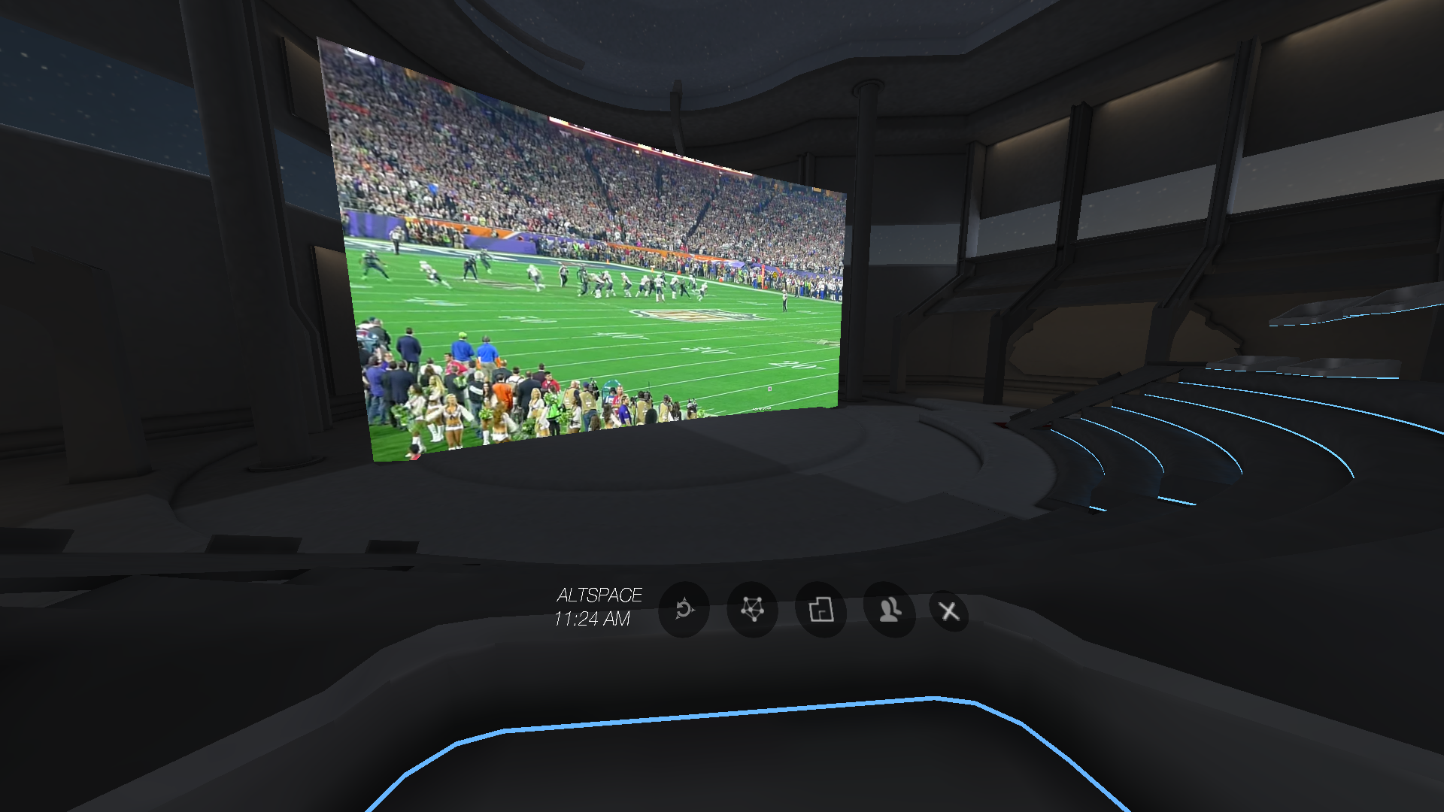
Romo’s AltspaceVR hosted a Super Bowl viewing party for users with an Oculus Rift dev kit and an internet connection. Romo used the game to test his hardware, and beta testers sat in a gigantic virtual theater with the game shown on to a giant screen from NBC’s web stream. The playback of the game was synced so everyone viewed the same thing at the exact same time. For those that think VR is an isolating experience, AltpspaceVR’s vision disproves that notion. The company, which has raised $15.7 million in seed money, including a backing from Google Ventures, is banking on the social side of the technology.

Courtesy of AltspaceVR

“You look around and you’re in a crowded room full of people,” Romo said. If done right, it really feels like it. You’re with real humans and you feel a real connection with those people.”

AltspaceVR continues to hone it’s platform. Its beta access is now open on a continuous basis. Romo said that audio balancing continues to be a challenge. He doesn’t want viewers to have to shout over the audio on the screen.

“There’s a lot to learn about how to make our product a good experience,” Romo said.

On October 25th AltspaceVR will host a viewing party for the Buffalo Bills vs Jacksonville Jaguars in London, as the NFL tests its streaming capabilities. Other focuses for the company include making MLB.tv work and adding international sports for its clamoring global community.

Mary Spio, president of Next Galaxy, which develops content solutions and VR tech, echoed Allen and Romo. The former deep space engineer said she’s talked to a lot of sports teams and they’re most excited about selling tickets globally. It’s an untapped revenue stream. And as Romo highlighted the sociability of sports, Spio noted that there’s a reason Facebook bought Oculus – they saw that it can be a social thing.

“Most people think of games (when it comes to VR), but sports will completely eclipse what’s being done in games in virtual reality,” Spio said.

Next Galaxy put together a nifty promotional video, which I’ll embed, as it illustrates the possibilities of viewing live sports in VR.

Training

Last month the Dallas Cowboys signed a deal to have their quarterbacks use a VR headset for training purposes. Not only will it allow them to improve their decision making, but it allows back ups and injured players, who would not take physical snaps during practice, to speed up learning, all the while complying with strict guidelines prohibiting time with NFL coaches. Not only would the quarterbacks watch film. They’d be doing the drill tape.

StriVR Labs, the company working with the Cowboys, just kicked off its business venture in early January. But as Fox Sports thoroughly profiled earlier this year, it started much earlier. Derek Belch, a former Stanford kicker and special teams grad assistant for the 2014 squad and Jeremy Bailenson, communications professor and founding director of the university’s Virtual Human Interaction Lab, brainstormed how virtual reality could be applied in football, and ultimately, that became Belch’s thesis master’s thesis.

Belch turned Stanford’s practice field in to his personal lab in 2014, thanks to head football coach David Shaw. As Fox Sports reported:

Shaw, who knew Bailenson because the professor’s virtual reality lab was a stop on the tour his staff would show Stanford football recruits, agreed to set aside five minutes of practice each week on Monday nights. Offensive coordinator Mike Bloomgren would scout out eight to 10 blitzes the upcoming opponent favored and scheme up some answers that the Cardinal scout team players would carry out as Belch and his video crew filmed. By Wednesdays, when the quarterbacks came into the football office, the Cardinal’s plan of attack was already loaded into VR and there for them once they strapped on the headsets. But the transition was hardly seamless.

The experiments lasted until November before Belch and his team worked out the kinks. Cardinal quarterback Kevin Hogan played so well in a 31-10 upset of No. 8 UCLA (16-for-19 in pass attempts, with two incomplete passes a result of drops) on November 28 that Bloomgren raved about the results and Shaw mandated all of his quarterbacks work with the StriVR Labs’s trainer weekly. Stanford stomped Maryland 45-21 in its bowl game and Belch turned his thesis in to a company. And ex-NFL quarterback and former Stanford teammate of Belch’s, Trent Edwards, wanted in. After two minutes with the headset, Edwards said he wanted to work with Belch.

Along with the Cowboys, StriVR will work with the Minnesota Vikings, and San Francisco 49’ers. Besides Stanford, StriVR has partnered with Arkansas, Auburn, Clemson, Vanderbilt and Dartmouth. Three college teams decided to work with Belch on the spot. And he said that no one has said no yet.

“Andrew Luck will probably be very interested in this,” Belch told me in April. And he was right. Luck told Indystar.com he thinks VR will have a big impact on football training.

In a space crowded with start-up companies trying to make a buck, Belch emphasized that StriVR Labs’s edge is that it knows football culture. It speaks the language that coaches speak. And that puts coaches at ease.

StriVR is working with its clients to develop customized content for the training programs, which will include more positions than just QB. It also plans to quicken its turnaround time from filming plays to editing the VR content for use, to one day. While Belch wouldn’t divulge the cameras used to film footage, he did say they’re using the Oculus Rift headset.

Ultimately, this is how StriVR Labs can benefit its clients, Belch emphasized. They are very sensitive to keeping the process simple, and not to overwhelm the player. They don’t want to strap bells and whistles to a player.

“If it doesn’t seem like a seamless, transparent experience, that athlete isn’t going to be interested,” Belch said. “We need to keep up with the speed of the athlete.”

Eon Sports VR is the other major player in this space. Current clients include UCLA, Ole Miss, Syracuse and Kansas, and CEO Brendan Reilly told Fortune that he expects to sign two NFL teams before the start of the 2015 season.

Reilly’s goal is to reach the youth with his technology, which can accelerate a player’s knowledge and experience without baking in the August sun at practices, increase repetitions and reduce mental mistakes.

“The VR experience is the same for an NFL player or a 10-year-old kid in Kansas,” Reilly said to Fortune.

Increasing VR abilities will only limit the risk, and likely amount, of injuries in youth and high school sports.

Bailenson agrees with Reilly’s vision. He said VR as a training tool holds unique value in amateur sports as those athletes don’t have fancy workout centers or daily full-team practices. In VR, digital scenes can be replicated for little to no cost. From the top athlete on the planet to a sandlot quarterback.

“Everyone can have access to ‘high end’ virtual training for very little cost,” Bailenson said.

But the virtual training doesn’t stop on the gridiron. Earlier this year, Silver told The Stanford Daily that, in addition to benefiting marketing outreach, VR could help in the training room.

“Players always tell us how they get better by repeating certain situations,” Silver said. “This could be ideal [in helping them elevate their games].”

And baseball? Jesse Wolfersberger shared his vision recently at The Hardball Times:

Imagine this scenario. You are a major league player who will face a pitcher for the first time tomorrow. You head to the batting cage, the team’s VR assistant loads up the program, and you slide on the headset. From your perspective, you are now standing in the batter’s box, in the stadium full of fans, looking at tomorrow’s starting pitcher on the mound. He winds up and throws, and it looks exactly like it will during the game tomorrow. You can virtually face that pitcher dozens of times, seeing every pitch in his arsenal at the exact speed and break that he throws it. Could there be any better preparation other than actually facing the pitcher himself?

Stay tuned for Part 3, discussing branding and marketing, coming soon.

(Header image via Sergey Golyonkin)

VR’s Sports Invasion is Coming: Part 1

Courtside of the NBA finals sits Phil from Cleveland, draped in a stained bath robe with more holes than Pebble Beach. Football practice for New York Jets quarterback Geno Smith, despite his broken face. A Cincinnati Reds fan dug in against Aroldis Chapman and his impending 102 mile-per-hour heater while wearing shorts, sandals and a faded Senor Frogs tank top from spring break ’98. A college recruiting trip inside the coach’s home, arena and practice facility of a top SEC football program – cheerleaders included. With virtual reality, each of these can be an actuality. Some are already possibilities. And others could happen before the next President is sworn in to office.

If there was one take away from the Consumer Electronics Show in January – other than the realization that the wearable market is almost as saturated as homemade craft shops on Etsy – it’s that virtual reality (VR) is coming. That winter in Game of Thrones is like a snowflake compared to the hyped fallout from the Las Vegas trade show. VR is coming hard, it’s coming fast and it will own our souls. That is, if the reality matches the hype.

Oculus, the most recognizable VR hardware, had a booth for the first time at CES. Articles, blogs and videos of the VR experiences flooded the Internet with tales of the unimaginable, the unfathomable and the just plain cool. Scott Stein of CNET.com called VR the eye-catching showstopper and noted Oculus headsets everywhere. Last month the company announced that the Rift will ship to consumers in the first quarter of 2016. As it builds on the Crescent Bay prototype, which many raved about, and is backed by Facebook following the $2 billion acquisition last year, it will be the Rift pressured with bringing VR in to the homes of the masses.

Today, the post-CES buzz has muffled though the anticipation of consumer VR hasn’t ceased. Now, it’s just a matter of when, not if, early adopters will have consistent, quality content to utilize current and future VR rigs. Sports, along with entertainment and pornography, is a leader in technological innovation. Broadcast companies, video game creators, sports leagues and teams all have chips in the proverbial VR pot as they fight for fan engagement, sales and television ratings. While some are calculating their bets, others are all in.

TechGraphs takes a look at what is out, what is coming and potential challenges that face VR’s invasion of sports. Will it be another 3D television? Or will we all wonder how we lived without it in ten years?

Gaming

While VR initially evokes an image of a video game experience for most, its origins are much different. In Pygmalion’s Spectacles, a science fiction short story published in 1935, author Stanley G. Weinbaum detailed a VR system that used goggles with holographic recording of fictional experiences that included smell and touch. In 1957, Morton Heilig, the “father of virtual reality,” invented the Sensorama, which received a patent in 1962. It used 3D motion picture with smell, stereo sound, seat vibrations and wind to create the VR experience. Heilig, a cinematographer, also created a 3D camera for the project. The evolution of the computer harvested an organic relationship between VR and gaming. A relationship that blossomed in to the gaming indstusry as the leader of VR implemenation. A relationship that, according to mobile internet/VR/games and digital client consultant Digi-Capital, could generate $30 billion by 2020.

Except when it comes to sports games.

In January, video game developer Ghost Machine launched the first VR sports game from Steam, the popular online game distributor. Motorsport Revolution is a physics-based PC racing game compatible with the Oculus Rift DK2 headset. The single-player racing game featured multiple 3D tracks tracks, including famed California Speedway, and an action feel filled with an aggressive AI and fantastic crash scenarios. VR Sports Challenge was announced at E3 to launch with the consumer version of the Oculus Rift. Think of it as a Wii Sports-type title. Google search virtual reality sports games and you’ll find little else.

Screens1920_07

Ghost Machine’s CEO Neal Nellans told me earlier this year that big video game developers will sit on the sidelines with a wait-and-see attitude. Today, it seems the big boys moved from the sidelines to the luxury box to munch on appetizers, sip aged scotch and watch a different game on a massive flat screen, all the while checking in on the VR game on the field below to see if it gets interesting.

Peter Moore, chief operating officer at Electronic Arts, told Gamespot that his company will jump in to the VR marketplace “if and when virtual reality becomes a ‘high-demand’ activity.” Moore wants the gear on the heads of consumers first.

Three months ago Owen Good highlighted challenges that face VR in sports games for Polygon. Ignore the writer’s argument that VR can’t give us the superhuman experience we want in games, and Good starts to make some sense.

What keeps sports out of the virtual reality conversation is the size – or lack thereof – of the market. There is no current sports simulation title available on Wii U. I realize people attribute that to some dark deal Electronic Arts demanded and Nintendo refused, but the fact remains there’s still no NBA 2K no WWE 2K — no Pro Evolution Soccer, for God’s sake — on Wii U either.

These are iterative titles with codebases literally stretching back to the Dreamcast days. If they can’t readily adapt that work to make the Wii U controller’s second screen necessary, or even meaningful, it is going to take an even greater overhaul — if not a complete work from scratch — to create virtual reality edition.

And that’s after all of the league licensing costs — which are a huge brake on innovation, — are figured into the discussion.

For Moore, he sees the hardware, rather than software, as an issue. A year ago Gamespot reported that Moore insinuated that the VR headset is dorky.

“It’s an incredibly immersive experience, but it’s you,” Moore said. “You’re inside this world and you’re oblivious and of course, you can’t see. You hope it doesn’t get what I’ll call the Segway effect: incredible technology that kinda looks dorky. Or the Google Glass effect, which is the dork factor that goes with that.”

But that’s not to say that there aren’t big boys moving forward. Last month, Gaming Respawn reported that Ubisoft, the publisher behind uber popular titles Just Dance, Assassin’s Creed and Rainbow Six, is working on multiple games to launch once Oculus and Playstation’s Project Morpheus reach consumers.

“We are working on the different brands we have to see how we can take advantage of those new possibilities,” CEO Yves Guillemot said during an earning’s call last month, “but making sure also we don’t suffer from what comes with it, which is the difficulty to play a long time with those games. We are very bullish about the potential. We think it is going to bring more players to the universe of video games, and we are going to come with our brands.

But again, where are the VR sports games?

Ryan Batcheller is a 3D environment artist for JumpStart, a game designer, and creator of Virtual Screams, which hosts virtual haunt experiences using the Oculus Rift and aims to develop the content to run on the Samsung Gear VR. I first heard about Oculus from Batcheller at a party for a friend two years ago. His stories seized my imagination, flipped it inside out and tied a cherry stem around it. I felt woozy with excitement. It was too good to be true, I thought, as the cost of this tech would be too much for mass distribution. Batcheller’s exposure to VR began when he played a How to Train Your Dragon demo developed by Dreamworks. He tested the Oculus at work and bought both developer kits. He sees different challenges facing developers of VR sports titles.

“Sports games using VR will require a lot of testing with how the game play would work,” Batcheller said. “With the Wii you had people acting out motions in their home and hitting people, knocking over things and hurting themselves. That was with them being able to see and just being absorbed in the game. With VR they can’t see their surroundings. So with sports games I think the real trick is going to be designing game play that is fun and safe for the user who is immersed in the experience.”

In addition to the Oculus Rift launch in early 2016, Sony’s Project Morpheus will be a key to mass VR introduction. The PlayStation product is expected to be available by June of next year. Morpheus simply plugs in to the PS4, which has sold 22.3 million units to date. The marketplace already exists. With a Full HD 1920 x 1080 and 5.7-inch display with 100-degree field of vision and a refresh rate claimed to be higher than the Oculus Rift and HTC Vive (120Hz compared to 60Hz and 90Hz, respectively), Morpheus will contend for the top VR headset.

One rumor prices the Morpheus at $450, which will certainly hinder early adoption, even if it does include a full kit. Among the 21 announced titles, however, only one fits the sports genre. Project CARS, a motorsports game already available for the next gen consoles, is the lone sports title.

And what about Xbox? According to TechRadar, Microsoft’s VR headset development kits are in the hands of some game developers. But this was before the June 11 revelation that Microsoft has partnered with Oculus. Via Windows 10, Xbox One games will stream to the Rift headset as part of the virtual cinema Oculus has created.

The gear is coming.

“The new Oculus is completely mind-blowing, but while I’m bullish on the potential of VR to transform multiple industries, not least entertainment, it won’t be until 2016 that it truly starts becoming a viable consumer success,” said Mind Candy’s creative director Michael Action Smith to Vice.

Consumers just need the content when it comes to sports gaming in VR.

Part Two will discuss the upcoming gear, and how they can infiltrate the broadcast and athletic training spaces.

(Header image via Sergey Golyonkin)