Archive for NCAA

Behind the Code: Ken Pomeroy

Behind the Code is an interview series centered around the sports-related web sites we use every day.

For many college basketball fans, Ken Pomeroy’s kenpom.com is the first–and often the last–word in statistics and analytics.

Pomeroy’s efficiency-based team ratings have received praise from the likes of Nate Silver and have led Pomeroy to consulting opportunities for several college and professional teams. Yet they only scratch the surface of the info “KenPom” provides, including player comparisons, posts on college basketball trends, and preseason game-by-game projections — the latter of which just went live for 2015-16.

TechGraphs writer Brice Russ spoke recently with Pomeroy about what’s new and what’s next for kenpom.com.

Brice Russ: What’s new on KenPom.com for the 2015-16 season? It seems like every fall, there’s another half-dozen features on the site. What should we be looking for this time around?

Ken Pomeroy: The main offseason addition was expanding the player stats to break out performance against different levels of competition.
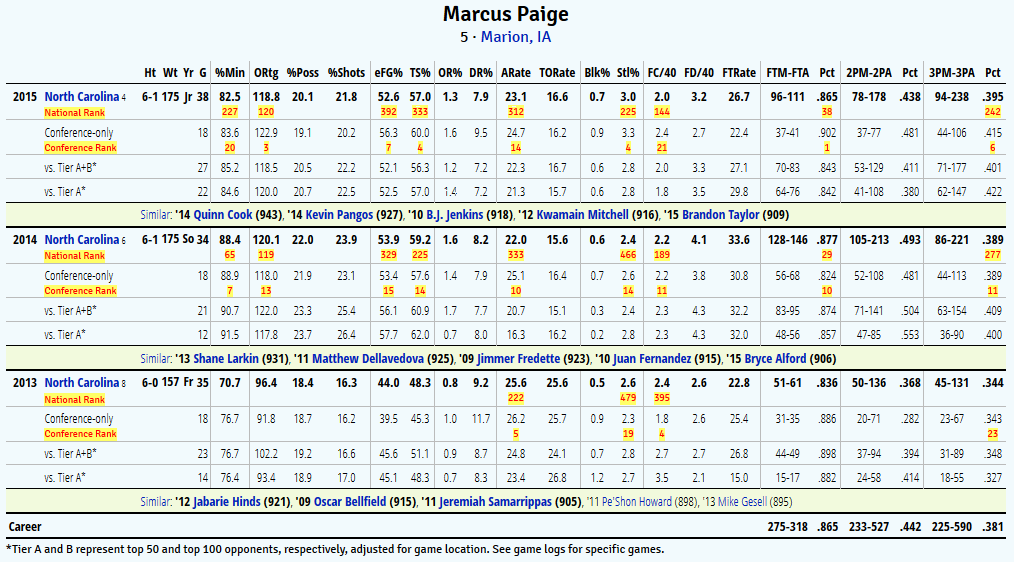
Marcus Paige stats
Marcus Paige career stats breakdown by level of competition

That is an extension of the conference-only player stats and minutes tracker that I added towards the end of last season. I’ve added some search boxes to the navigation bar so people can find teams and coaches a little more quickly.

There are some other things on the burner for this season, but they’ll be surprises for people when they appear. I’m usually reluctant to call my shots because I don’t want to over-promise something.

BR: What’s your motivation when you’re adding new stats to KenPom? Are you looking to incorporate what you think will be most popular? Most useful? Anything you’ve added as a result of your consulting work?

KP: There’s definitely a selfish motive. Usually, I’m thinking of things that I’d like to see, but that’s also consistent with doing something that will be useful to an audience interested in analytics.

I’m not opposed to adding what I’d call trivial stats that have little analytical value. I mean, I have team free throw percentage defense on the site. But I try to avoid adding trivial stats that might be misconstrued as useful. I always get a few requests for home/road splits and largely the differences in home/road performance over the course of the brief college hoops season is noise and not useful from a predictive standpoint, so that’s why they aren’t on the site.

BR: KenPom is unquestionably one of the oldest and most well-established sports analytics sites around, particularly in the basketball arena.

How have you seen the perception and role of analytics change in sports over the years, especially in the public eye? Has the field grown more competitive, or does it feel like there’s still plenty of ground for everyone to cover?

KP: It’s definitely more accepted than it was a decade ago. A lot more people understand the concept and utility of points per possession. But then again, almost every broadcaster and coach still cites regular field goal percentage to measure shooting accuracy, so it’s not like there has been a revolution.

As far as competition, there are certainly more people coming out of college with the goal of working in sports analytics. But it seems like most of the people interested in basketball gravitate to the NBA level, where the data is so much more granular and there are fewer teams to cover.

BR: One of the biggest stories for the upcoming season is the introduction of the new 30-second shot clock. Presumably, this will lead to an increase in tempo, but how else do you expect this to change the game from a metrics standpoint?

You took a brief look at the clock before it was tested in last year’s NIT; have you had a chance to look at the data since then?

KP: I haven’t looked at it any further, although my series of blog posts over the summer was partly inspired by trying to develop a theoretical framework to figure out how we got to this point. And what I found was some evidence that the offense deserves a good chunk of the blame for the slowing of the game.

The cool thing is that with 200+ games during the opening weekend we’ll get a real good idea of the impact of the clock (and the expanded charge circle) fairly quickly.

BR: 2015 will mark the fifth season that team-level KenPom data has gone behind the paywall. Is it fair to say this has been a successful experiment at this point? Any data or trends you can provide about subscriptions?

KP: It’s worked out well. I had a choice between appealing to a mass audience and blasting people with ads, or putting up the paywall and keeping the site clean and limiting the audience to folks who really wanted a source for advanced stats.

BR: What’s next?

KP: Usually the events of the season dictate this, so it’s difficult to say.  But I’m sure it won’t take long for something interesting to happen.

Thanks to Ken for speaking with us! You can follow Ken on Twitter at @kenpomeroy and, of course, at kenpom.com.


Crowdfunding Site Raises Donations For NCAA Athletes, Is A Particularly Bad Idea

FanAngel is a site that, in a just world, wouldn’t exist. The crowdfunding site enables fans to become patrons of NCAA athletes, donating money to persuade said athletes to stay in school, with the site holding the money in escrow until the athlete’s eligibility expires.

While it is true that NCAA athletes from power conferences have been getting the shaft for decades by not being compensated properly for their increasingly valuable labor, crowdfunded donations from fans do nothing to alleviate the exploitative labor conditions under which NCAA athletes operate.

In the event that a FanAngel crowdfunding campaign is successful and the athlete’s NCAA eligibility expires, 80 percent of the money would go to the athlete, 10 percent would go to the athlete’s teammates (nice touch!), and 10 percent would go to a scholarship fund or charity. FanAngel makes money by taking 9 percent of the total amount raised (more on this later). Of course, if the athlete doesn’t stay in school the money is refunded.

Shawn Fotjik, founder of FanAngel, said in an interview with ESPN sports business reporter Darren Rovell, “If you wanted Marcus Mariota to stay in school for his senior year, you could give $20.” I applaud Fotjik on getting good PR from Darren Rovell, but Marcus Mariota is either going #1 or #2 overall in the 2015 NFL Draft and there is no amount of money FanAngel could raise that could keep him in school.

Contributing to a crowdfunding campaign for teenagers who are exceptionally good at big time NCAA sports, and also strangers to the donor, is something I’d assume would be creepy to most well-mannered adults. As has been proven time and time again in my life, I am wrong about this assumption.

Fans of Jarrell Martin, a sophomore forward for the LSU Tigers who, according to DraftExpress.com, is projected to be drafted at the end of the 1st round in the upcoming NBA Draft, have raised over $700 on FanAngels for him to return to LSU for his junior and senior senior seasons, completing his NCAA eligibility. Understanding that FanAngel is a new venture and will need time to scale both users and donations, it still strains credulity to see this ever happening.

For a glimpse of what might be in Fotjik’s future, FanPay, a crowdfunding site which raises donations as graduation gifts for college athletes, has received over 100 cease-and-desist letters from universities and conferences.

Additionally, FanAngel may want to rethink the 9 percent fee they collect for successful campaigns. Other supposedly altruistic crowdfunding donation sites have been taken to task in the past for collecting high fees. One of the worst offenders is Give Forward, which collects 7.9 percent of every donation plus a $0.50 transaction fee. Nine percent is a laughable amount that puts FanAngels in the same exploitative waters they claim they are trying to drain.

If college sports fans suffering from hero worship want to contribute to an NCAA athlete’s cause, they should skip crowdfunding platforms and donate to the National College Players Association (NCPA), which spearheaded the player union movement at Northwestern. Or do what has been done for time immemorial, put some cash in an envelope and make a handoff.

(Image via FanAngel)

Texas A&M Joins Forces with i1 Biometrics

Since we last visited with startup i1 Biometrics, developers of the Vector mouth guard which measures the level and location of each hit on the football field, the demand and the market for their product has grown significantly. Yesterday i1 announced a new partnership with Texas A&M football. Already partnered with the University of Kansas, Louisiana State University as well as the University of South Carolina, i1 Biometrics is making strides to measure potentially concussion inducing levels of impacts.

The Vector mouth guard itself measures rotational and linear impacts and then sends the impact data in real time to to the coaching and training staff where it is stored in their cloud computing for easy access. Notifications can be sent to mobile devices for immediacy or the information gleaned from the mouth guards may be accessed online through a phone or computer.

In a joint study between Harvard University and Boston University last year covering 734 NCAA football players from the 2013 season, the concussion numbers are jarring, and not just the speed of the impacts. The players claimed six potential concussions and 21 “dings” for each confirmed concussion.

Given what is already known about the long-term effects of concussions — and even more alarming is what is unknown — seeing front-line collegiate football teams taking things more seriously is a step in the right direction.


YouTube Announces NCAA March Madness Channel

The network powers that be — CBS, TNT, truTV and TBS — have created an official YouTube channel in preparation for March Madness. By subscribing to the channel you can receive email updates on new content ranging from highlights, best moments and more.

Right now the channel has videos from last year, though according to the press release it will feature highlights and clips from all 67 games this year. Specifically it says real-time highlights and video recaps, though unfortunately the games themselves will not be streamed. The live coverage will only consist of analysis and post-game press conferences and is not related to CBS’ current All Access subscription service.

Vice president of business operations for Turner Sports, Mark Johnson is encouraged by this new foray into the YouTube realm.

“Our new partnership with YouTube gives college basketball fans more ways to discover and watch the plays and storylines that everyone will be talking about during March Madness. Tapping into the power and reach of YouTube’s video platform opens up new opportunities for us to grow interest and consumption of March Madness.”

Given the lucrative TV ad revenue, it is no surprise the governing powers would want to rock the cash boat. Via Statista, in both 2013 and 2014 the revenue surpassed the $1 billion mark.

TVrevenue

No surprise the NCAA and the broadcast partners wouldn’t be eager to ditch that sort of money and go to streaming option where things like Ad Block Plus can remove advertisements. This channel may be a step in the right direction with limited live coverage, but cord cutters will still be forced to look elsewhere for the games.

(Header image via truTV)

Kentucky Hired an Analytics Director, But Not For The Reason You Think

This offseason, Kentucky basketball coach John Calipari told those who approach basketball from a purely analytical standpoint and have never played the game to “beat it.” So it was mildly surprising when the program announced the hiring of Joel Justus as their Director of Analytics this past September.

In a recent profile of Justus by Ben Herald of the Lexington Herald-Leader, Justus said of getting hired, “[Calipari] wanted someone who would be able to talk ball with him. And I think that’s a little bit of the criticism when you talk to folks in the NBA: ‘All right, you’re giving me all of this stuff, but what does it mean?’”

Basketball analytics hirings aren’t new for the NBA, but the coming out party for analytics positions in the college ranks occurred just over a year ago when Drew Cannon emerged as a driving force behind Brad Stevens’ success at Butler. Cannon has since followed Stevens to the Boston Celtics. With the currently undefeated Wildcats hiring Justus, it’s a trend that is sure to continue.

Basketball analysts can provide all sorts of insight to improve team performance, like optimal lineups, tempo-free stats, and video analysis. But this wasn’t why Calipari hired Justus. Ever the salesman, Calipari hired Justus in order to market his players to NBA scouts. This is because Kentucky is so loaded this year that Calipari is playing two platoons of five players, switching them out like hockey lines.

Calipari revealed his motivations for hiring Justus at a pre-season luncheon. “If you’re playing 20 minutes, what will your NCAA stats look like? Terrible for NCAA stats, so we’re going to have big data stats, per-minute and efficiency stats that we can send to NBA teams.” Calipari later said that he’s never coach a team this way and his change in mindset was to make sure “every one of these kids eats.”

It’s unlikely that the platoon system will become a permanent fixture of the Kentucky program, and Justus certainly seems to understand this. As he told the Herald-Leader, “I’ve got to make sure that [Calipari] sees that I’m valuable. So I have to make sure that what I’m giving him is good.”

As the premier huckster in college basketball (NBA players he has coached have made a combined $820 million in salaries), Calipari has made another canny move for his program, ensuring his players will have a seat at the NBA table for years to come.

(Header image via Tennessee Journalist)