Archive for league of legends

DraftKings Joins The Esports Betting Ranks

DraftKings, the daily fantasy site that has saturated the TV airwaves with commercials lately, has just launched their newest wing: esports. As of right now their esports division consists solely of League of Legends matches, however I wouldn’t be surprised to see Counter-Strike: Global Offensive, Dota 2 and more titles added. It should come as no surprise to see those three games be the most watched of August for Twitch.tv.

DraftKings isn’t considered gambling, but more of a skill game  — though Arizona, Iowa, Louisiana, Montana and Washington consider it online gambling and prevent their residents from playing it — and esports, the same as in in the traditional athletic world is unfortunately no stranger to gambling and match fixing. From bans in CS:GO due to match fixing last year to StarCraft banning numerous player in 2010 due to a network of match throwers, sadly once money gets involved, people tend to have their morals become a bit more flexible.

While DK may or may not be considered gambling, they are just the latest website to offer payouts based on investments. Ranging from websites such as CSGO Lounge to CSGO Loot, Gosu Gamers and plenty more, there is money to be made — or lost — by wagering your weapon or player “skins” depending on the game. They’re nothing more than digital pixels, but they carry real world monetary value, sometimes in excess of the tens of thousands of dollars.

In the Counter-Strike realm, the sponsoring of so-called gambling sites — not DraftKings, but the others — has been banned in ESEA, a top competitive league. Citing a conflict of interest, insider knowledge and general professionalism, ESEA is making a stand against gambling. Of all the leagues to take the moral high ground on an issue, it’s interesting that ESEA does it, given their shady history. Regardless of previous transgressions, it is likely for the best to see gambling sites being barred from team sponsorship.

An entirely different issue is when people under age-21 wager their skins. These items are worth lots of money, just look at some screencaps from Steam’s Community Market page. Steam is the software distribution portion of Valve, creators of CS:GO and Dota 2. Some of the items for sale on the Valve Community Market are going for $400 dollars, while other third party marketplaces are trading and betting items worth much more money than that.
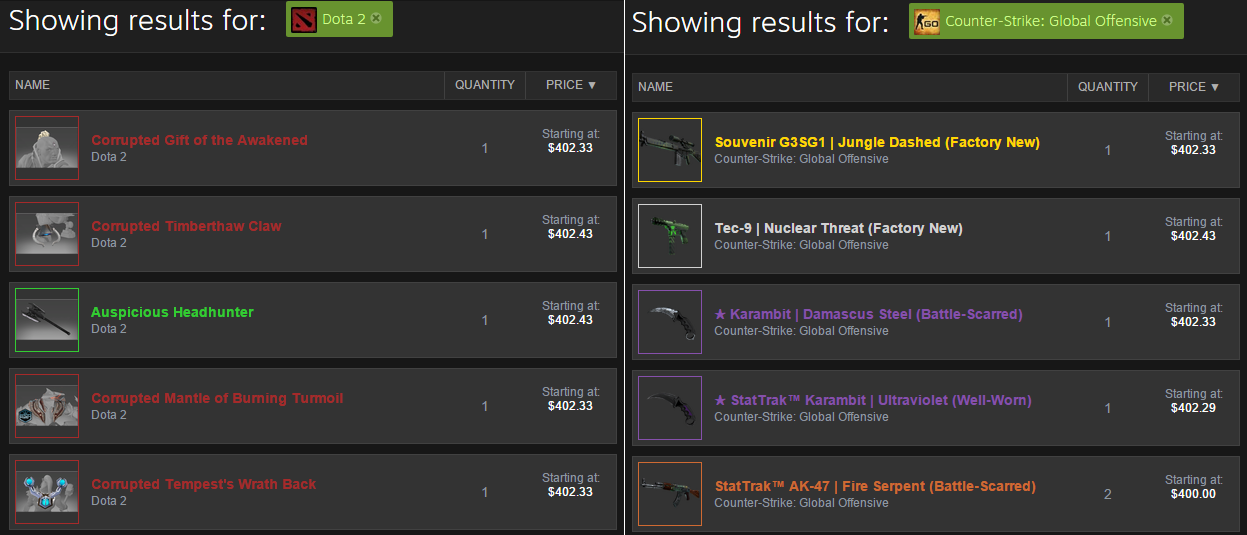
dota2
While this is certainly an exciting time to be an esports fan — the prize pools have never been bigger, corporate sponsorships are flowing in and possibly a major television league and broadcast deal in the works — seeing as DraftKings sees League of Legends on par with traditional sports, we can’t get too far ahead of ourselves. We’ve already seen entire organizations get taken down for throwing matches, some for cheating and with yet another website now offering to exchange cash (not just weapon skins with value tied to them) based on esports results, the cynic in me fears the worst.

Recent esports Tournaments Show Promising Attendance Numbers

Over the past weekend we saw two titans of esports, League of Legends and Counter-Strike: Global Offensive, hold major tournaments. On Sunday the European and North American League of Legends Championship Series summer finals concluded with the Counter-Logic Gaming team taking first place for North America, $50,000 in prize money, and a ticket directly into the 2015 World Championship, and Fnatic taking home the trophy for Europe. Fans of CS:GO were entertained from Thursday to Sunday with the ESL One: Cologne tournament, a tournament partially sponsored by CS:GO developer Valve, with $100,000 going to the winning team and $250,000 overall up for grabs. The weekend was filled with teams from all over the world aiming to take the top prize.

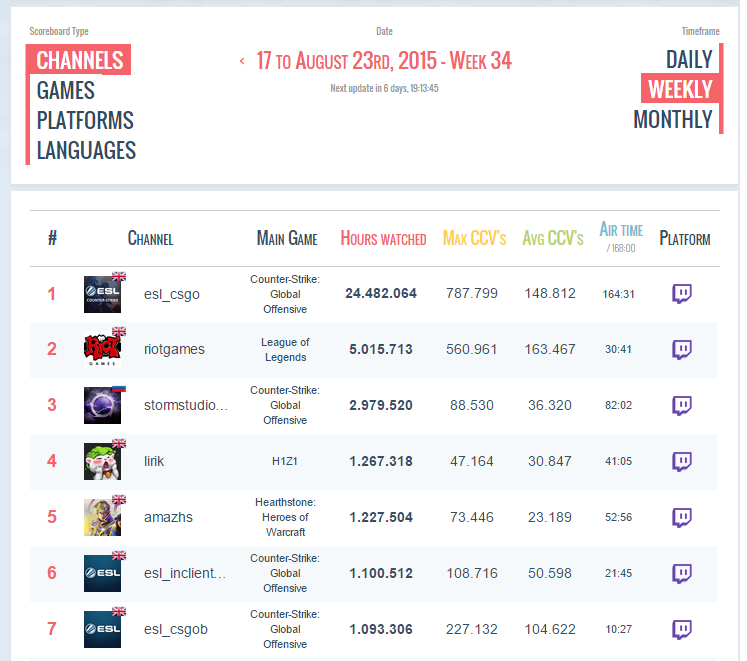
Both esports events captured a huge number of fans, and CS:GO set a sixth month high for Twitch.tv view hours in a single day. Via Gamoloco, CS:GO averaged more than seven million hours per day across the for the four day event, peaking at 8.9 million view hours on Saturday. It should be noted the number of hours is likely skewed by users logging in with multiple CS:GO accounts in order to raise their chances to receive a free in-game item drop, so these numbers should be taken with a grain of salt. The infographic below displays the game itself rather than the specific ESL One Twitch channel, which is to say there were other streams being watched for CS:GO and League of Legends beyond just the official ESL One and LCS streams.

gamoloco

By specific channels with each game, Gamoloco rates ESL One compiling 24.4 million hours (with another one million hours on the official “B Stream”) compared to Riot Games, developer of LoL, totaling just over five million hours over the past week. These numbers represent the English speaking channels only, with the Russian channel covering ESL One accumulating nearly three million hours, plus Polish and German broadcasts for each game.

gamoloco2The crowds at both live venues were impressive as well, with the League of Legends NA Summer tournament filling up Madison Square Garden with a reported 11,000 fans. Europe was no slouch either as ESL looking as though the Lanxess Arena drew a fair crowd as the header image would indicate, along with a large crowd at the EU LCS at Stockholm’s Hovet Arena. While it’s hard to compare a single tournament to the long grind of a sports season, the NA Summer event pulled a crowd comparable to the NHL’s Florida Panthers and more than the MLS’ Chivas USA, though both the Panthers and Chiva rank last in attendance for their respective leagues.

These impressive numbers aren’t even counting Dota 2’s yearly tournament, The International that was held from July 27 to August 8 to decide the world’s champion where we saw the single largest prize pool for an esports tournament. With the growing prize pool, interest level and time commitments being dedicated to esports — not to mention push notifications the ESPN app and score tickers (cap tip to HeyCJay from Reddit) and streams on ESPN 3 — it may be time to pick your favorite esports organization just the same as a football or baseball team. 

(Header image via ESL Twitter)

Esports Injuries Are Piling Up

A torn knee ligament, shoulder surgery and now wrist injuries can be added to the list of career threatening injuries to those making a living playing video games. In the wake of the sudden retirement of League of Legends pro Hai “Hai” Lam where he specifically cites an ongoing wrist injury, it may be time to re-examine our thoughts on esports competitors as athletes. Repetitive strain injuries from tennis elbow to carpal tunnel effect athletes and esports competitors alike.

The United State government already formally recognizes some esports competitors as athletes by granting multiple P-1A visas, given specifically to athletes. While certainly not a normal athletic workload, esports at the highest level has nonetheless produced a long list of injuries, most notably in the wrist and neck, for years.

In StarCraft II, injuries have forced out arguably the best player in the five year history of the game, Jung “Mvp” Jong Hyun. The four time champion of the Global Star League is the third highest earner in prize money with over $400,000 in the bank for his tournament showings. Mvp’s career was derailed when pains in his neck caused numbness in his shoulders and arms.

Canadian player and at one point arguably the best non-Korean player in the world Sasha “Scarlett” Hostyn was temporarily forced away from the game to allow her wrists to recover.

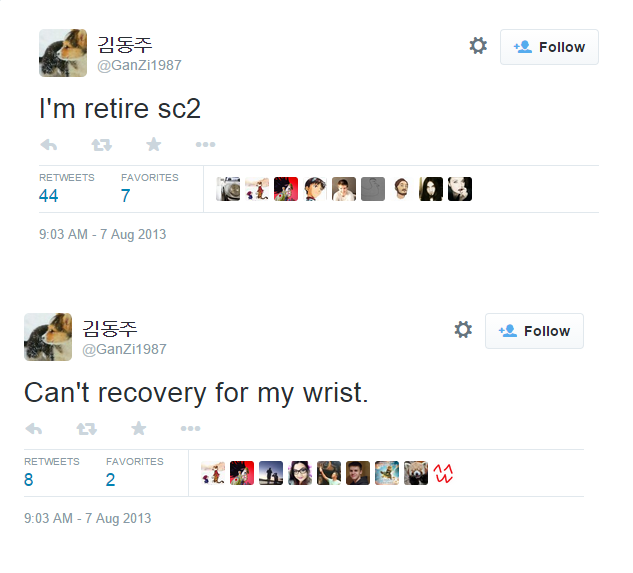
Former competitor Kim “Ganzi” Dong Ju is another victim of wrist injuries, tweeting his retirement announcement and the reason for it.

ganzi

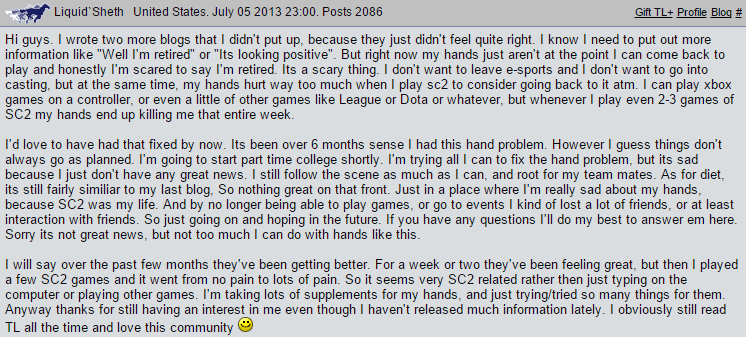
Popular player Shawn “Sheth” Simon was also felled by injuries, citing in a forum post that pain in his hands have prevented him from playing anything more than a handful of matches per week.

sheth

The world of esports is in an awkward position. While getting ESPN2 airtime on a Sunday evening with a Heroes of the Storm collegiate aptly named “Heroes of the Dorm” match is a welcome sight to esports fans as is the emerging scenes across various games, the lack of team infrastructure is alarming. Without any sort of players union or dedicated medical staff, the players lack protection from injuries that have already ended or shortened multiple careers.

(Header image via Wikipedia)

South Korea Announces Esports Investments

The fact that you have to spend money to make money is true for all business models, including esports. South Korea, arguably the world leader in esports, is seeking to build on their strong history of supporting video gaming professionals at the player and developer level. According to The Korea Times, President Park Geun-hye promised 100 billion won — around $90 million — from the government for startup companies in the gaming community, the internet of things and financial technology.

According to Esports Earnings, South Korea has been particularly dominant in StarCraft: Brood War and StarCraft II. Players hailing from South Korea have collected over $5.9 million in tournament winnings from SC:BW compared to China’s second place of almost $87,000.

scbwearnings

The gap in SCII is Korea dominating the scene to the tune of over $11 million versus Sweden’s coming in at a tick above $530,000.

sc2earnings

In addition to being the top earnings in both iterations of StarCraft — so much so the gaming community calls it the “Korean scene” versus the “foreign scene” with foreign meaning every single country that isn’t South Korea — League of Legends has also been largely dominated by Koreans. China is relatively close in winnings, though it is still barely half of what Korean teams and players have raked in.

leaguewinnings

With so much money coming in and going out in Korean esports, it should come as no surprise there is a governing body, the Korean e-Sports Association, better known as KeSPA. From proposing a minimum salary for players, ensuring travel for Korean citizens to foreign events and vice versa, as well as partnering with game developers for feedback, KeSPA’s is an organization looking out for sponsors and players alike. While not perfect, KeSPA — and South Korea as a whole — has inarguably played a major role in bringing esports to its current level of popularity.

(Header image via Blizzard)

New Esports Program Debuts in Norway

Norway’s largest commercial television network, TV2, announced a trio of esports leagues to be aired on their programming. The three leagues will consist of League of Legends, StarCraft II and Counter-Strike: Global Offensive. TV2 is partnering with House of Nerds, a large Local Area Network (LAN) center with over 100 computer stations, in order to accommodate the new leagues. The House of Nerds arena is over 1,000 square meters and while the infrastructure is there, no announcements of prize pools, distribution or commentators have yet been made.

Norway isn’t a stranger to the esports scene, particularly with the success of Jens “Snute” Aasgaard, currently ties for #21 in the world according to World Championship Series points. Aasgaard finished 2014 as the #17 ranked player and the highest non-South Korean player in StarCraft II. He just qualified for round of 16, sweeping his group without losing a map and winning 4-0.

The country also owns a solid history of competitive Counter-Strike, going back to the days before CS:GO. In Counter-Strike 1.4/1.5/1.6, Norway boasted a strong collection of talent with multiple world champions in players such as Jørgen ‘XeqtR’ Johannessen and Ola ‘elemeNt’ Moum.

The competitions are set to play a 10 week season, though whether the leagues will be decided by an open qualifier, invites or a mix hasn’t been released yet. Matches will be aired on TV2 Sumo, the entertainment network, though TV2 Sport will also feature the games. Corporate sponsorships are nothing new, but a full partnership to broadcast esports matches — similar to the X Games and Major League Gaming agreement in Aspen — to an entire nation grows the popularity and acceptance of esports.

(Header image via eSports Norway’s Facebook Page)

Esports and Caffeine Continue to Grow Together

Soda — or as some call it, “pop” — and video games have a long history of working well together, be it in your friend’s basement, at an arcade or corporate sponsorship. Today at 4pm eastern Coca-Cola will take the next step in their esports interest with a debut Game-A-Thon event in Atlanta. The games will also be streamed via Coke’s Twitch.TV channel, however exactly which games are being played remain a mystery.

Scheduled to last four hours, the Game-A-Thon will pit five esports figures and players against each other in the mystery games in order for the prizes to be donated to various charities. Keeping the players in the dark about what exactly they’ll be playing is all part of the fun. In an interview with GamesBeat, Matt Wolf, head of global gaming for Coca-Cola was quoted saying:

We are interested in gaming. It’s big. We know it. We’re being smart and focused about how we approach it. As we head into the end of the year, this opportunity with our friends at Twitch is a great way for us to cap off the year with a great on-site production. We can give back to the players and to a charity for the holidays.

While Coca-Cola has helped in the League of Legends realm, specifically with their Coke Zero LoL Challenger League, this marks their first major foray into other games. Caffeinated beverages — not to mention energy drinks — have been a part of video games for years. From the Halo “Gamer Fuel” to Mountain Dew and their double experience points for Call of Duty games, to personal sponsorships by Red Bull for StarCraft II players such as Bomber, major beverage labels continue to appeal to gamers and esports fans with both their carbonated drinks as well as their efforts within the gaming communities. Cracking open a can to drink while watching your favorite game or team suddenly doesn’t necessarily equate to beer and baseball anymore.


The League of Extraordinary Viewers

The numbers are in for the League of Legends Worlds and they are staggering, and not just the $1 million prize pool. Riot Games, developers of LoL, posted the viewership numbers for their world finals. The event itself was spread out over 15 days of competition and totaled 100 hours of gameplay to decide the champion.

According to Riot, the finals were broadcasted in 19 different languages utilizing 40 different casters and play-by-play partners. The grand finals between Samsung White and  Star Horn Royal Club was watched by a peak of 11.2 million viewers, the equivalent of almost all of the censured population of Ohio. Put a different way, it was as if Oregon, Oklahoma and Connecticut combined to tune in simultaneously.

Throughout the road to the grand finals, LoL Worlds caught 27 million unique viewers and 288 million impressions to see Samsung White win it all. The 179 million hour total of esports watching outpaces the 151ish million hours of the video Gangnam Style by Psy which recently broke YouTube. This year’s fall classic went a full seven games and average 13.9 million viewers, though the final out of game seven was viewed by 27.8 million people. The numbers between esports and baseball are suddenly comparable, not to mention the sold-out 45,000 seat Sangam Stadium venue.

On Riot’s website, dating back to January of this year, they claimed over 67 million users played LoL every month. Of them, 27 million play daily and Riot’s servers carry the load for 7.5 million people at peak hours. The world’s most popular video game is showing no signs of slowing down. Who else ready to tailgate for an esports match? If it’s too cold outside, how about a BarCraft instead?

(Header photo via Riotgames.com)