Archive for injuries

Preventing Concussions in the Next Generation of Football Players

Concussions are bad.

Nobody has ever really disputed this, but over the last decade, it has become increasingly apparent that repetitive head injuries, seen particularly often in football, can lead to significant long-term medical effects.

The “concussion debate” has largely taken place on the professional stage, from the controversies generated by League of Denial to Will Smith’s forthcoming feature film Concussion and beyond. Yet the true impact is being felt across the nation, as schools and innovators work to protect the more than 1,000,000 young adults who play college and high school football each season.

This fall, new devices large and small are being tested to reduce the frequency and effect of football-related concussions.

The Dartmouth Dummy

Five years ago, the Dartmouth Big Green football program eliminated athlete-on-athlete tackling during practices. Cutting out these collisions in favor of tackle sleds and dummies cuts down on injuries and concussions–which makes sense–but made it harder to actually practice tackling against a moving target–which also makes sense.

Enter the MVP–the “Mobile Virtual Player”.

Designed by two Dartmouth engineering students, the MVP is a remote-controlled, human-sized dummy that resembles a cross between the Headless Horseman and a Weeble. Less bone-crushing than an actual human, the MVP allows for relatively realistic tackling simulations while significantly decreasing the risk of head and neck injuries.

Two MVPs were deployed in August, with a third on the way, and the experiment has received the attention of major media, tech blogs–and, reportedly, a few NFL teams.

New Helmets InSite

This doesn’t do much to prevent contact during games–and, as long as there’s tackling in football, there’s only so much you can do–but some new tools are being developed to limit the effects of major hits when they do happen.

The sporting company Riddell is in the process of bringing a new line of helmets to high schools around the country. The SpeedFlex helmets, equipped with Riddell’s InSite Impact Response System, use six built-in accelerometers to measure the individual and combined force of every impact a player receives. This data is sent live to a laptop on the sidelines, where trainers and staff can monitor players for potential danger signs.

As programs continue to adopt the system, one trainer says, this data will itself be useful for better understanding what leads to football brain injuries.

Watch Your Mouth

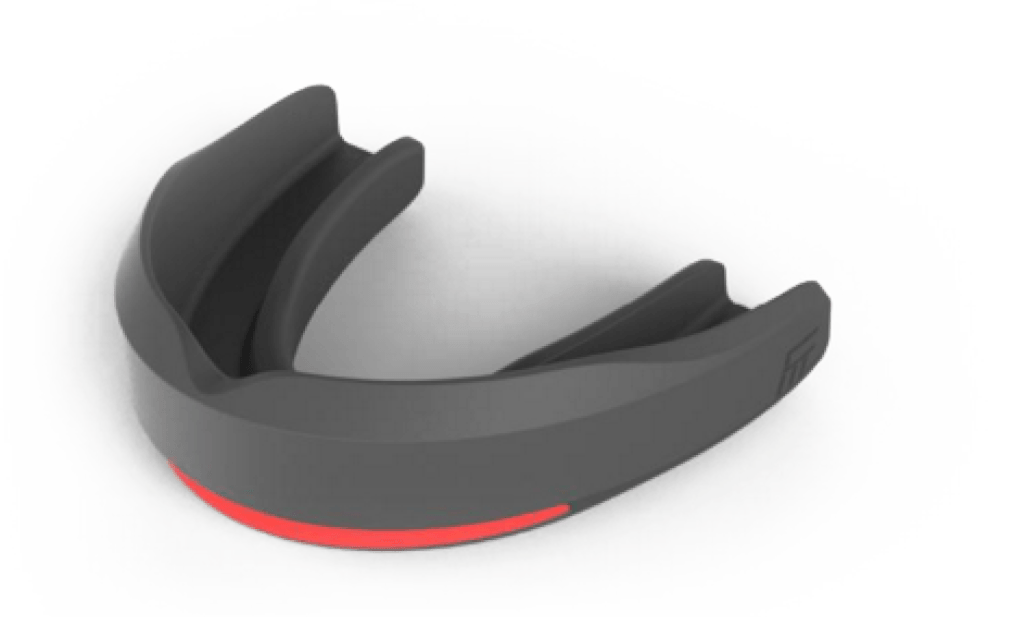
In fact, before long it might not even take a special helmet to easily detect potential concussions. Smithsonian reports on FITGuard, a mouth guard co-created by two Arizona State grads–one a veteran of the rugby team.

Like InSite, FITGuard uses sensors to measure hits to the head and can transfer data to a nearby computer. If FITGuard sees any signs of danger, though, it simply lights up the player’s mouth using LEDs. FITGuard is scheduled for release in early 2016.

Image courtesy of fitguard.me

These tools aren’t without their caveats. A recent Stanford study, for example, found that some currently existing concussion-measuring devices (particularly helmets) can significantly mismeasure the actual force of impact.

Nevertheless, with room for improvement and no end to the concussion crisis in sight, technology like this can still have great potential to help protect our next generation of football players.

(Featured Image via Dartmouth)


Esports Injuries Are Piling Up

A torn knee ligament, shoulder surgery and now wrist injuries can be added to the list of career threatening injuries to those making a living playing video games. In the wake of the sudden retirement of League of Legends pro Hai “Hai” Lam where he specifically cites an ongoing wrist injury, it may be time to re-examine our thoughts on esports competitors as athletes. Repetitive strain injuries from tennis elbow to carpal tunnel effect athletes and esports competitors alike.

The United State government already formally recognizes some esports competitors as athletes by granting multiple P-1A visas, given specifically to athletes. While certainly not a normal athletic workload, esports at the highest level has nonetheless produced a long list of injuries, most notably in the wrist and neck, for years.

In StarCraft II, injuries have forced out arguably the best player in the five year history of the game, Jung “Mvp” Jong Hyun. The four time champion of the Global Star League is the third highest earner in prize money with over $400,000 in the bank for his tournament showings. Mvp’s career was derailed when pains in his neck caused numbness in his shoulders and arms.

Canadian player and at one point arguably the best non-Korean player in the world Sasha “Scarlett” Hostyn was temporarily forced away from the game to allow her wrists to recover.

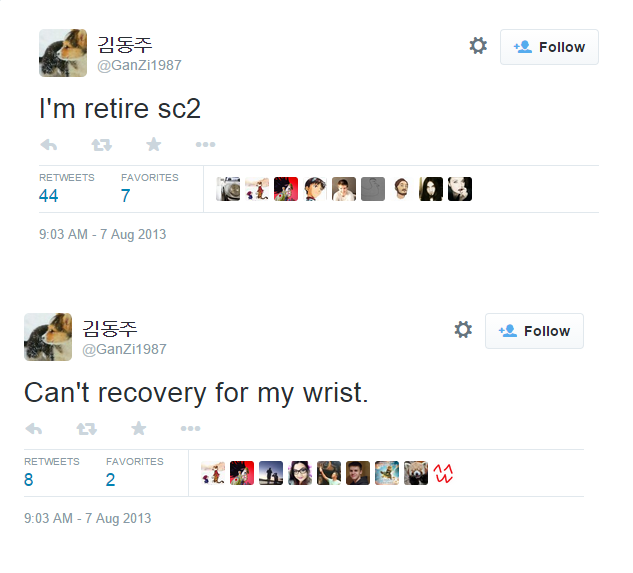
Former competitor Kim “Ganzi” Dong Ju is another victim of wrist injuries, tweeting his retirement announcement and the reason for it.

ganzi

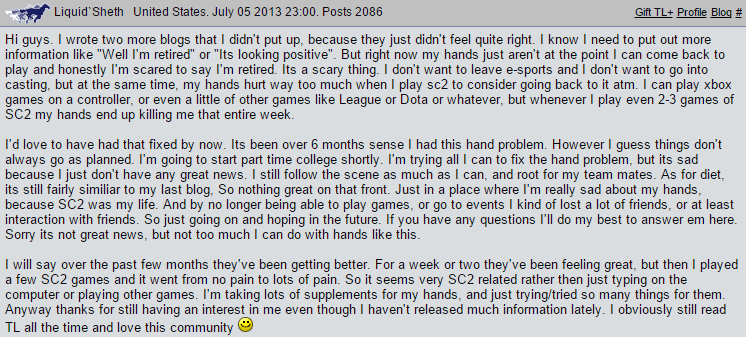
Popular player Shawn “Sheth” Simon was also felled by injuries, citing in a forum post that pain in his hands have prevented him from playing anything more than a handful of matches per week.

sheth

The world of esports is in an awkward position. While getting ESPN2 airtime on a Sunday evening with a Heroes of the Storm collegiate aptly named “Heroes of the Dorm” match is a welcome sight to esports fans as is the emerging scenes across various games, the lack of team infrastructure is alarming. Without any sort of players union or dedicated medical staff, the players lack protection from injuries that have already ended or shortened multiple careers.

(Header image via Wikipedia)

ASMI’s Glenn Fleisig talks about Tommy John Surgeries, Wearable Sensors at Sloan Conference

For such a small piece of tissue, the ulnar collateral ligament can do a lot of damage when it tears. According to Jon Roegele, 90 professional baseball players underwent Tommy John surgery to repair a damaged UCL in the last calendar year, costing teams tens of millions of dollars and months of lost service time. Young prospects, grizzled veterans, pitchers, catchers, outfielders, flamethrowers and junkballers: all went under the knife and emerged with the infamous long, curved scar.

The high stakes go a long way to explain why Glenn Fleisig, Ph.D., research director at the American Sports Medicine Institute, was invited to speak on the epidemic at last weekend’s Sloan Sports Analytics Conference. Fleisig — who also serves as chairman of USA Baseball’s Medical and Safety Committee, an advisor for Little League Baseball, and on Major League Baseball’s Elbow Task Force — presented “Analytics of the Tommy John Injury Epidemic” Saturday morning to discuss the ASMI’s research, dispel some common myths, and talk about the “Pitch Smart” guidelines he helped develop.

Even in the few months since the Pitch Smart guidelines were released, Fleisig said he was “blown away” by the amount of positive feedback he’s received.

“For 20 years, Dr. [James] Andrews and myself have been giving guidelines that have been pretty well received in general by those in medicine,” he said in an interview. “Since the Pitch Smart guidelines came out, we’ve seen the same kind of response from coaches and parents across baseball.”

But Fleisig still devoted a significant amount of time to clearing up misconceptions about the surgery’s success rate (only two-thirds of MLB pitchers who underwent Tommy John surgery made it back to the majors and stayed there) and effect on pitchers (pitchers do not see a bump in performance immediately after the surgery).

The highlight of Fleisig’s talk was a discussion of the risk factors associated with UCL injuries. Fleisig reported the results of a recent study into the biomechanics of 80 minor league pitchers — 40 of whom had returned from Tommy John surgery, and 40 healthy controls. The paper looked at a number of potential risk factors (including amount of arm abduction, stride length, and the infamous “inverted W“), but found no difference between the mechanics of the previously injured and healthy pitchers. Fleisig admitted, however, that the study was not predictive: by looking at the biomechanics of only those pitchers who successfully returned to pitching, the study overlooked any mechanical flaws that had since been corrected, as well as any biomechanical issues in those pitchers who were unable to make a successful comeback.

A better predictor of UCL injuries, Fleisig said, was overuse. A recent ten-year study of 476 adolescent baseball pitchers found that pitchers who threw over 100 innings in a year were three times more likely to be injured; those who regularly threw over 80 pitches in a year more than four times; those who pitched for at least eight consecutive months five times; and those who regularly pitched fatigued 36 times more likely to suffer a UCL injury.

“I hear people say that throwing isn’t a natural motion,” Fleisig said during his presentation. “Throwing is natural. Pitching at max effort, 100 or more times in a game, that’s what’s not natural.”

Fleisig believes overuse of young pitchers is largely responsible for the rise in professional pitchers getting Tommy John surgery, even as organizations are placing increasingly strict limits on prized prospects like Dylan Bundy and Joba Chamberlain.

“A lot of the time, the damage has already been done by the time they get to pro ball,” Fleisig said. “When you pitch, you produce lots of microscopic tears that can heal with rest, but if you pitch too much, then [the UCL] is like a frayed rope, and there’s not much you can do.”

Fleisig’s group has calculated that a 90-mph fastball puts as much as 100 newton meters (N-m) of torque on the elbow. Fortunately, this force is instantaneous or UCLs would be tearing on virtually every pitch. But the ligament still absorbs a significant part of that force; as muscles tire, the amount absorbed by the UCL can increase, leading to the dramatic increase of UCL injuries in pitchers who regularly throw when fatigued. Fleisig said that strength and conditioning can help reduce the risk of injury, but stressed the importance of the entire kinetic chain, from legs to trunk to arm muscles.

“I wish I could say there was one key to avoiding injuries — and that would make a good article — but that’s not reality,” Fleisig said. “The secret isn’t the legs, the secret isn’t the arms, the secret isn’t the trunk, it’s the whole body.”

In addition to his work with ASMI and the sport’s governing bodies, Fleisig also serves as a consultant for Motus Global, a movement analysis company whose mThrow sleeve for pitchers will be available to the public this spring. The headline number produced by the system will be a measurement of workload, derived from the sum of the torque put on the elbow across all throws a player makes, including pitching in game situations, warmups, and drills such as long toss. The sleeve (and the metrics it provides) are still in the early stages, but Fleisig is confident that it represents an improvement in teams’ understanding of workload.

“We don’t know what the right exact formula [for workload] is,” Fleisig said. “For instance, if you throw two throws at 50 N-m, is that the same amount of danger to your elbow as one throw at 100 N-m? Probably not. But before the Motus sleeve, workload was just added up by people counting how many throws someone did.”

Fleisig admits, however, that users will rely too heavily on the system’s workload calculation, especially at the amateur level where coaches, trainers, and players may lack the rapport to establish when a pitcher is truly fatigued.

“The potential customers for the Motus sleeve are not only pro pitchers but also high school kids,” Fleisig said. “I would hope that the pro teams would click through to see the extra data the sleeve produces, whereas I think the summarized information might be the best for many of the amateurs.”

A number of companies aim to improve further on Motus Global’s innovation, and are working on systems that can automatically capture full-body kinematic data without markers. Fleisig does not consult on any of these projects, but has seen some of them in action. Most, including the system Sportvision presented at Saberseminar last summer, require manual digitization, where a human observer annotates the location of the pitcher’s joints at every frame. But despite the demand for automated systems, Fleisig stressed that these technologies are only a tool in the arsenal of coaches, trainers, and pitchers to prevent injuries and improve performance.

“Biomechanics experts and technology are not the keys to optimizing pitcher safety and performance,” he said. “The key will be the expertise of coaches to use this new information.”

Potential Breakthrough in ACL Injury Prevention

Most everyone remembers the old “shin bone connected to the knee bone, knee bone connected to the thigh bone” song. While not exactly taught in medical school, everything in the leg is connected one way or another. And according to a recent study, calf muscles, not hamstrings may have more to do with ACL and knee injuries than previously thought.

The study was conducted by The University of Western Australia’s School of Sport Science as well as the University of Tennessee’s Exercise and Health program. The groups observed a series of Australian Rules football players each doing single leg jump landings while attempting to grab a football.

Analysts set up a series of 12-cameras to create a three-dimensional computer model of each football player’s jumping and landing. The findings surprised the researches and Assistant Professor Cyril Donnelly of UWA said:

“This was initially surprising as 30 years of clinical research has suggested the hamstring muscles were key players for supporting the knee during sporting tasks, We are not saying you don’t use your hamstrings, just not as much as we originally thought.”

The previously linked article states over 200,000 ACL injuries occur every year in the United States alone, and these numbers by the University of California, San Francisco claim approximately 70% of these injuries occur playing sports. Soccer, football, skiing and basketball being the primary sports behind ACL injuries.

Be it a figure skater coming off of a double-axel, a defender trying to head a corner kick out of his box or an outfielder leaping at the wall to rob a home run, one-leg jump landings are incredibly common in many sports. From an injury prevention standpoint or even rehabbing post-injury, perhaps we’ll begin to see trainers and medical staff focus more on the calf when dealing with ACL issues.

(Header photo via Becky Stern)