Archive for health

TechGraphs Report: On Deck Sports and Technology Conference

Earlier this week, NYC’s Bohemian National Hall played host to hundreds of sports executives, entrepreneurs, and others looking to learn about the very latest in sports technology. Since 2013, the On Deck Sports and Technology Conference (organized and presented by SeatGeek) has provided a forum to showcase what products are “on deck” to help fans follow, analyze, and participate in sports.

On Deck has a slight bent towards sports startups, so a decent amount of the conference was geared more towards raising capital, scaling businesses, etc. Still, there were plenty of fascinating talks, panels and interviews for anyone interested in straight sports tech.

Statcast And Beyond

Possibly the most entertaining talk of the day was Joe Inzerillo’s (CTO, MLBAM) update on MLB’s Statcast, which is finally getting its moment in the sun this season. For those who needed a refresher on how Statcast operates, Inzerillo discussed its missile-technology radar system, its stereoscopically-placed cameras, and how these allow each Major League ballpark to track the movements of every player on the field (plus the ball) at any given time.

Once Statcast has this information, as Inzerillo pointed out, it can then provide real-time data on pitch velocity (actual and perceived), player velocity and reaction time, and a horde of other quantitative metrics, plus more advanced data on a 12-second delay, like fielding route efficiency. This data is just inherently cool (as you likely know if you’ve seen a Statcast-enhanced game or highlight on television), but it’s also already being used to both question and confirm existing baseball strategies.

For an example of the latter, Inzerillo looked at the fallacy of sliding into first using Statcast to plot Eric Hosmer’s 1B slide in Game 7 of the last World Series. Hosmer hit a peak speed of 20.9 MPH before sliding and being out by less than a tenth of a second. If he had just kept running, Statcast found, he would have been safe by nearly a foot. Statcast is already getting noticed by clubs, and even players — batters like to talk smack, apparently, over who has the highest exit velocity.

During questions, Inzerillo was slightly cautious about committing to the future of Statcast, but he did mention that minor league stadiums were a natural next step, and that there was plenty of work being done on developing new metrics. Statcast already tracks ‘defensive range’ for fielders, for example, but since a player doesn’t travel the same speed in every direction, there’s a need to find the more amorphous ‘effective defensive range’ and how it changes–such as during defensive shifts.

On the football side of things, Sportradar’s Tom Masterman talked about the NFL’s NGS (Next Gen Stats) platform, which is collecting data on every single game in 2015 to track, analyze, and visualize how players are moving on the field. NGS is already being distributed to clubs, media, and health and safety personnel; the long-term goal is to have X,Y,Z coordinates for every player and official, plus the ball.

Go Bucks

On Deck’s attendees weren’t just league officials and startup managers–the conference started with a live interview of Wes Edens, who became co-owner of the NBA’s Milwaukee Bucks in 2014. Much of the conversation focused on the new Bucks arena, which was being voted on by the Milwaukee city council literally as the interview was ongoing. As it’s currently planned, the presently-unnamed arena will focus heavily on keeping fans digitally connected — giving attendees plenty of WiFi, for example. At the same time, Edens noted, they want to avoid fans using technology to become distracted from the game going on in front of them. (Edens used the phrase “Instagram culture”, specifically, though he noted that he himself has had these sorts of problems before.)

Edens was similarly balanced when the discussion turned to analytics. One of the first things Edens did after buying the Bucks was to build their analytics program — bringing on employees, consultants and even discussing methodologies with other owners. There’s definitely a “golden age” of analytics in basketball going on.  Edens even thinks the NBA will end up surpassing the MLB as the leader in sports technology. But when he was asked about how the players feel?

“It’s a good question,” Edens replied. “There’s definitely lines that can be crossed” with having too much data being made public, at least when it can affect the privacy of the players (such as rest/injury issues).

Edens also briefly discussed the role of the referees and the potential benefits of replay and “the new center across the river“. Could we see yet more referee technology, even an Oculus Rift-type headset for NBA officials, in the future? “Totally possible.”

Era of Mobility

When it came time to look at how fans themselves were interacting with sports, technologically, it became clear that mobile is “it.” In that panel about growing sports startups I mentioned earlier, representatives from SeatGeek, FanDuel and Krossover all praised the importance of the mobile web for their companies–SeatGeek’s rep described it as a “tale of two companies”, pre- and post-mobile, and Krossover’s founder mentioned they’re considering dumping their web app altogether in lieu of just being on smartphones and tablets. When Yahoo Sports’ VP of engineering presented a chart showing their fantasy football traffic from this season’s Week 1, the fraction of non-mobile data was a pretty small sliver at the top.

Yahoo fantasy data graph
Trust me, it’s there.

Even companies you might never expect to get in the mobile game are joining and succeeding. Jeremy Strauser had 20 years of gaming experience at EA Sports and Zynga before joining one of the most loved and enduring brands in the sports industry, Topps. Yep, they’re digital playing cards.

Topps first got into the digital game 4 years ago and how has three top-selling sports card apps, plus a newly launched Star Wars-themed set. Why should you be interested in buying trading cards on your phone? One starting point is the capabilities the digital platform provides — literally hundreds of thousands of different designs, the ability to create all manner of rare and unique cards, etc.

Topps is also rolling out a daily fantasy sports feature (DFS was a major topic of conversation at On Deck) that allows you to compete using the players in your card deck and swapping them in and out in real time as they go up to pitch or bat. It probably doesn’t hurt, either, that they won’t take up space under your bed or get thrown out by your mom when you’re away at college.
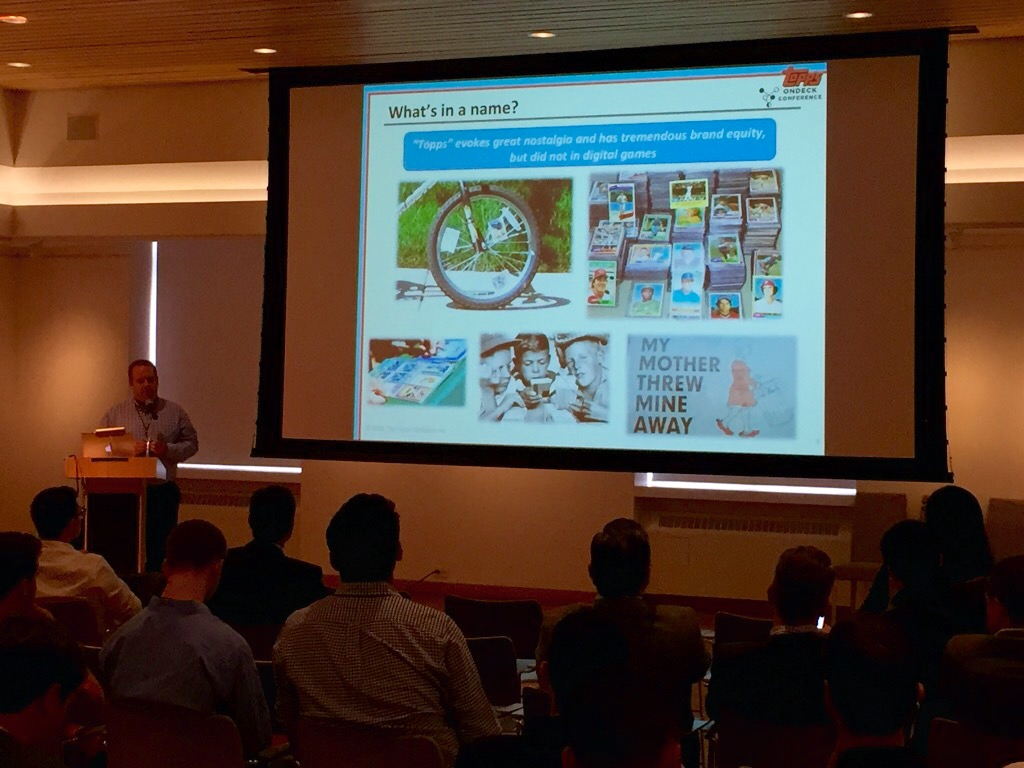
Topps conference talk

Coming To Your Hometown

If you want to look for the next wave of sports technology, though, look to your neighborhood.

Rather than providing new tools or analytics for MLB, the NFL or the NBA, the newest sports apps want to help you participate in sports in your own town. On Deck wrapped up with a “Startup Pitch Contest” a la Shark Tank where teams had four minutes to present their groundbreaking app to a group of judges. The six competitors included:

  • Wooter – a search engine for finding and joining sports and activities like local rec leagues. Wooter provides profiles for leagues looking to form teams, players looking to join them, and the tools to process payment and set up other logistics.
  • NextPlay – helping youth coaches conduct tryouts and league drafts. For $15/month, instead of taking a stopwatch, a bunch of handwritten notes, and an Excel spreadsheet to put together youth rosters, NextPlay handles all the data collection and analytics itself. Their beta has been used by “a couple hundred organizations” and over 10,000 athletes.
  • ScoreStream – filling a gap in local journalism by crowdsourcing reports on high school sports.

With a really impressive presentation, broad coverage (10,300 HS games covered last week alone) and the #1 iOS app for high school sports, I really thought Scorestream would walk away with the prize, but it ended up going to…

  • SidelineSwap, a P2P marketplace for sporting goods. SidelineSwap has over 43,000 registered users who’re interested in trading out sporting gear just collecting dust in their basement or garage. They’re working on building partnerships with youth organizations and promoting used college-branded material, which should play very well with their chief audience of high school students.

On the whole, On Deck was a whirlwind experience for learning about cutting-edge sports tech. This report only covers part of everything I caught there. Watch for further updates and profiles soon!

Kinduct Sports Offering Featured in Dodgers Accelerator Program

Kinduct Technologies made waves in the sports tech world when they were selected as one of ten companies in the Dodgers Accelerator program. But CEO Travis McDonough admits that his company is more mature than many of his fellow participants.

“We have 40 employees, we’ve got many many different clients, we’re across different industries, we have a mature operating system,” he said. “We have now 50 professional sporting organizations that are using our tool and it changes every day.”

The tool, which is known as the Athlete Management System, aggregates data from wearable, camera-based, and even more subjective systems into a single environment. The system includes visualization tools so teams can search for correlations between the data themselves, and a machine learning component to further guide organization training plans. The system gives vital help to organizations trying to understand the massive amounts of data they collect from games and practices.

“There’s been an explosion of ancillary tracking tools on the market today, everything from camera systems to GPS trackers to heart rate monitors to smart phones,” McDonough said. “And all those data sources, as valuable as they are, reside in siloed pockets.”

In addition to the Athlete Management System, Kinduct offers similar services in the health care, wellness, and human performance market (which covers military and law enforcement applications). Their experience in these other fields informs the algorithms behind their athletic products.

“Because we have had the opportunity to start to figure the machine learning side out on the health side, we’re able to cross-pollinate and apply it to the sports market,” McDonough said.

But the operating system and machine learning tools are only as effective as the data they can handle. McDonough said Kinduct works with their clients to incorporate both new and existing sources of data. Their web page lists relationships with camera-based systems including the NBA’s SportVu system, as well as wearable trackers like Polar Global and Catapult, among others.

“We’re very agnostic, and we love to pull in data from as many sources as possible,” he said. “So we are absolutely delighted at the new technologies that are coming out, and all these emerging data sources are exactly what make us more powerful.”

Kinduct counts dozens of sports organizations among its clients — including “more than half the NBA,” according to McDonough — and is working with a few unnamed leagues to manage data across all teams. The obvious differences are there, of course: basketball teams have different expectations for their relationship with Kinduct than hockey teams or baseball clubs. But the varying levels of sophistication across organizations provides an additional challenge, and Kinduct has to ramp up or scale back their offerings according to the client’s experience and comfort level.

“The NBA teams, they put their arms right around technology so we adopt what they use,” McDonough said. “When it comes to other organizations … they’re looking for recommendations by us to suggest ancillary technologies that can do the best job of tracking their players.

From a researcher’s perspective, the fact that Kinduct works with such a large percentage of the NBA is exciting. Deep in their databases is tracking and data, across games and practices, on dozens of elite athletes. McDonough estimated that the average NBA team spent $10 million on players sidelined with “preventable” injuries, repetitive stress injuries arising from flawed biomechanics that he likened to a stone cutter chipping away at a rock. And while McDonough was more than happy to describe how an individual team could combine their various data sources to find potential injury markers, he also stressed his company’s respect for the “firewall” that protects not only each team’s raw data, but also any metrics they build on top to analyze those data.

“It’s almost like we provide a technological apartment building, but each and every team moves their specific furniture and wallpaper in it, and the keys to the front door are locked down so no one can go in it but that organization,” he said.

Still, he agreed that a league-wide approach would be more effective, allowing coaches and staff to spot trends in a wider sample of data that could keep players off the trainer’s table.

“The right thing in the future is for leagues to be able to analyze the data and intervene to make sure the players are playing at their best and reducing injury as best as they can,” McDonough said.

Nevertheless, Kinduct is still dealing with health care data, which is subject to a wide range of safeguards to protect patient confidentiality. On top of that, athletes and the players associations that represent them remain leery about biomechanical data being used against them during contract negotiations. Players associations also objected to earlier iterations of the system that tracked athlete workouts during the off-season as excessive. As a result, Kinduct has worked to produce a system that provides the data front offices are after while remaining as unobtrusive as possible to players.

“For a player, they just want to win games, they want to win a championship,” McDonough said. “And a level of surveillance [during the season] seems to be acceptable by both the players’ association, the players, and of course management and ownership.”

It was announced in August that Kinduct was one of the ten companies selected for the Dodgers’ first annual accelerator program, which will run through a “demo day” November 15. The Dodgers are running the accelerator in conjunction with advertising agency R/GA, who has successfully run a number of similar programs in the past. Described by McDonough as “almost like a business boot camp,” the program offers Kinduct mentoring from a who’s who of sports executives and a chance to get more exposure.

“What we have is a Ferrari in a garage,” he said. “This allows us to open the garage door and have more people see our Ferrari. And people want to drive it, and it’s exciting.”

For now, McDonough and his staff have moved to Los Angeles to participate in the accelerator, and plan to open an office in the U.S. after the program to expand into the American market, especially in the health care, fitness, and military areas that fall under the same “human performance” umbrella as the company’s Athlete Management System. Still, McDonough said the company would remain true to its Canadian roots regardless of its excursions south of the border.

“We’ll always have a home base in Halifax,” McDonough said. “But we need to have a bigger presence in the United States.”


Preventing Concussions in the Next Generation of Football Players

Concussions are bad.

Nobody has ever really disputed this, but over the last decade, it has become increasingly apparent that repetitive head injuries, seen particularly often in football, can lead to significant long-term medical effects.

The “concussion debate” has largely taken place on the professional stage, from the controversies generated by League of Denial to Will Smith’s forthcoming feature film Concussion and beyond. Yet the true impact is being felt across the nation, as schools and innovators work to protect the more than 1,000,000 young adults who play college and high school football each season.

This fall, new devices large and small are being tested to reduce the frequency and effect of football-related concussions.

The Dartmouth Dummy

Five years ago, the Dartmouth Big Green football program eliminated athlete-on-athlete tackling during practices. Cutting out these collisions in favor of tackle sleds and dummies cuts down on injuries and concussions–which makes sense–but made it harder to actually practice tackling against a moving target–which also makes sense.

Enter the MVP–the “Mobile Virtual Player”.

Designed by two Dartmouth engineering students, the MVP is a remote-controlled, human-sized dummy that resembles a cross between the Headless Horseman and a Weeble. Less bone-crushing than an actual human, the MVP allows for relatively realistic tackling simulations while significantly decreasing the risk of head and neck injuries.

Two MVPs were deployed in August, with a third on the way, and the experiment has received the attention of major media, tech blogs–and, reportedly, a few NFL teams.

New Helmets InSite

This doesn’t do much to prevent contact during games–and, as long as there’s tackling in football, there’s only so much you can do–but some new tools are being developed to limit the effects of major hits when they do happen.

The sporting company Riddell is in the process of bringing a new line of helmets to high schools around the country. The SpeedFlex helmets, equipped with Riddell’s InSite Impact Response System, use six built-in accelerometers to measure the individual and combined force of every impact a player receives. This data is sent live to a laptop on the sidelines, where trainers and staff can monitor players for potential danger signs.

As programs continue to adopt the system, one trainer says, this data will itself be useful for better understanding what leads to football brain injuries.

Watch Your Mouth

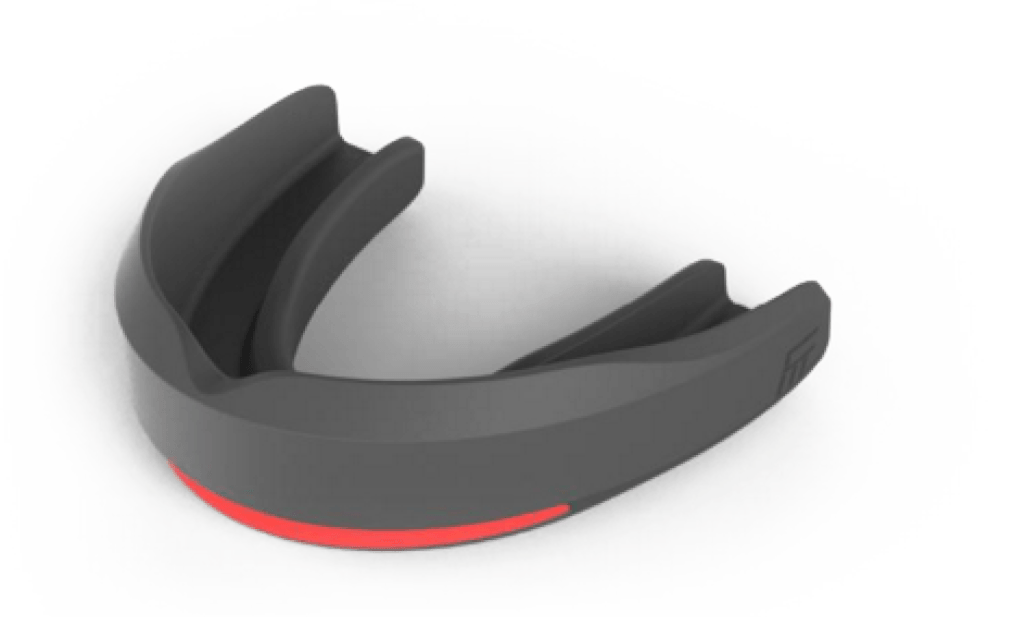
In fact, before long it might not even take a special helmet to easily detect potential concussions. Smithsonian reports on FITGuard, a mouth guard co-created by two Arizona State grads–one a veteran of the rugby team.

Like InSite, FITGuard uses sensors to measure hits to the head and can transfer data to a nearby computer. If FITGuard sees any signs of danger, though, it simply lights up the player’s mouth using LEDs. FITGuard is scheduled for release in early 2016.

Image courtesy of fitguard.me

These tools aren’t without their caveats. A recent Stanford study, for example, found that some currently existing concussion-measuring devices (particularly helmets) can significantly mismeasure the actual force of impact.

Nevertheless, with room for improvement and no end to the concussion crisis in sight, technology like this can still have great potential to help protect our next generation of football players.

(Featured Image via Dartmouth)


Skulpt Aim: A New Workout Measurement Tool

A wrist band there, a smartwatch here, maybe a sensor in your shoe. Connected health devices have an evolving — and growing —  place in our world, and as unique as they are, they tend to measure the same things. Heart rate, distances, sleep and such things are all incredibly helpful, however with the Skulpt Aim device, that is all left behind. Aim is a device that measures muscle quality (MQ) in specific muscle groups, up to 24, and by measuring biceps, triceps, abs and quads it gives a total body fat percentage as well as MQ score.

skulpt1

To quantify the muscle gains, Skulpt Aim utilizes 12 sensors and a technology called Electrical Impedance Myography (EIM), developed by Seth Rutkove, MD, Professor of Neurology at Harvard Medical School. EIM applies a small current of electricity through the muscle to accurately quantify muscle and fat, as each reacts differently when a current is sent through it.

The MQ is measured on an index, the higher the score, the better the muscle quality. With each measurement you can track your fat percentage going down while the MQ goes up, ideal for focusing on specific areas where you think you’re lacking.

skulpt2

With Skulpt, quantifying your training is far beyond simply looking in the mirror or even stepping on a bio-impedance scale. Each measurement with the Aim takes less than one second and the results are displayed on the device itself, no need to pair it with a wireless device for immediate feedback. It is currently compatible with iOS devices (iPhone 5 and later) and will be available for Android (4.3 and later) soon in order to keep a running total of measurements.

Skulpt’s website boasts comparable muscle measurements to hydrostatic weighing, the most accurate and expensive method. The Aim device also claims to be three times more accurate than caliper based measurements. It is available for pre-order at $199 USD and is also available for varying prices in Canada, U.K. and Australia. With a battery that lasts two months a single charge and is splash proof, the Skulpt Aim appears to be a must-have device for any serious trainer, regardless of  the sport. Skulpt’s intro video can be found below and a number of how-to measure videos are available on their website.


NBC’s Radius Fitness Offers Promise and Potential

Working with fitness apparel giant Under Armour, NBCUniversal has launched their new Radius brand, a multi-platform workout regimen. As it stands, Radius is limited to iPhone and iPad users as a $10 monthly service, or the videos will be aired on from 6 am to 9 am Eastern Time each weekday on the NBCSN channel.

The mobile version of Radius will produce content in an on-demand format from the television show. For the workouts themselves, there are levels of fitness ranging from beginner to high intensity. As time for workouts — and free time in general — becomes a premium in our everyday lives, Radius also offers a series called “10acious” designed to give a full body workout in just 10 minutes. A recent study showed the significance of mixing a high intensity spurt into a normal workout, specifically even a short workout with a minute or two of sprint-esque action grants significant dividends.

For now the Radius app is cheaper than just about any local gym membership, however it is limited due to its iOS device restrictions. Undoubtedly, Android users will soon be able to join in the workouts though the idea of paying an additional sum to work out, even one backed by Under Armour and digital personal trainers, seems a bit foreign. With free apps such as the Scientific 7-Minute Workout already available for both Android and iOS users, forcing potential customer into spending more money may not be an ideal way to reach mobile users. For now, Radius offers promise. However, even with the offer of two free months with a purchase of a six month package or four free months with an annual subscription, it may not be enough.

(Image via Wikipedia)

A Potential Anti-Bacterial Implant

“We can rebuild him. We have the technology. We have the capability to make the world’s first bionic man…We can make him better than he was. Better, stronger, faster.”

Classic science fiction aside, there has been a recent announcement by Tufts University regarding the world’s first wireless electronic implant to fight staph infections then automatically dissolve into the body when the job is finished. Working with a collection of talent from Tufts as well as the University of Illinois at Champaign-Urbana, the research group has successfully shown an absorbable chip that eliminated a bacterial infection in mice by applying heat to infected areas after receiving a wireless signal via remote. The devices themselves are made from silk — where the antibiotics are loaded for dispersal — and magnesium, allowing them to be safely absorbed in testing animals after 15 days.

chip

The large scale implications of such a chip in humans is grand, as professor of biomedical engineering at Tufts Fiorenzo Omenetto believes

“This is an important demonstration step forward for the development of  on-demand medical devices that can be turned on remotely to perform a therapeutic function in a patient and then safely disappear after their use, requiring no retrieval.”

Frank C. Doble, a professor at Tufts School of Engineering, believes this could drastically change the aftermath of surgical procedures in hospitals.

“These wireless strategies could help manage post-surgical infection, for example, or pave the way for eventual ‘wi-fi’ drug delivery.”

As per a study conducted by the Center for Disease Control in 2011, as many as 1 in 25 hospital patients were hit with a healthcare-associated infection, or HAI. The same study showed approximately 721,800 and HAIs were responsible for an estimated 75,000 deaths.

With something as simple as a patch the doctor places and remotely monitors, some of the guesswork in post-surgery complications can be removed. While there is no timetable for the implant to begin human trials, the hope would be to cut down on not only HAIs but also infections of any other type. The implant managed to handle staph infections as well as E. coli and S. aureus bacteria. There may come a day where rather than seeing the doctor about a prescription and then driving to the pharmacy, the doctor or nurse could apply something as simple as a patch and then send you on your way.

(Header image via NIAID)