Archive for counter-strike: global offensive

Major Changes For Valve’s Major

On Tuesday we will see a major sporting event kick off in Ohio, with hundreds of thousands (if not millions) of people watching online. No, it’s not MLB opening day or the Columbus Crew (but has a soccer fan, I would love to see a crowd of that size for a domestic game). No, I’m talking about the first ever Valve-sponsored Major for Counter-Strike:Global Offensive here in the United States, Major League Gaming’s Championship: Columbus.

While not the first Major, it’s the first one held in the States — all previous Majors have been held in Europe. The location isn’t the only notable change to the Major, as this also represents a record of four teams from the North American region qualifying, though a team from Europe — in particular, Fnatic — seem likely to take the championship. In addition to the solid North American representation in Columbus, Brazil is represented in team Luminosity Gaming, and if any team could challenge the EU region heavyweights, it might be LG. On top of the diverse lineup, the prize pool has been quadrupled from a notable $250,000 in previous Majors to an impressive $1,000,000 up for grabs, with $500,000 going to the first place team. Beyond the massive increase in the cash, Valve has also made changes to the gameplay, specifically the clock, and it is something that could play a role — for better or worse — in the upcoming matches.

While the nature of CS:GO is quite different than any traditional sport, the teams of five simultaneously playing offense and defense lend at least a quick comparison to basketball. Rather than outscoring the enemy team when the game clock reads 0:00, CS:GO instead is a race to be the first side to win 16 rounds. A maximum of 15 rounds per half will be played, so one could consider it a best of 30, in a manner of speaking. The first half consists of the Counter-Terrorists (CT) side defending two bomb sites while the Terrorists (T) attacks and attempts to plant a bomb. CTs can win by

A. Holding both sites for the full 1:55 each round (an uncommon way to win)
B. Eliminating the T’s before they can plant the bomb at one of the sites
C. Defusing the bomb once it has been planted

While that’s the quick and dirty comparison, Valve — developers and sponsors of this Major — have decided to toy with what effectively is the “shot clock” in CS:GO. For years and years, heck, even since I played Counter-Strike 1.5 and 1.6, the universal standard* for each individual round was 1:45, or if the bomb was planted, a 35 second timer would begin. Last December, Valve implemented a significant change, shifting to the longer, previously mentioned 1:55 round and increasing the bomb detonation timer from 35 to 40 seconds. The key thing is that neither planting the bomb nor defusing is instantaneous. It takes approximately three seconds for the T side to plant the bomb, and for the CT side, defusing it varies based on whether or not the CT purchases a defuse kit. Without the kit, it’s a full 10-second defuse but with the kit it’s cut in half to five seconds.

*Valve had a 45-second bomb timer in their official matchmaking until the December change, however this article is aiming to address competitive play.

While leagues such as ESL/ESEA Pro League have adopted the longer round time and 40-second bomb detonation time as have DreamHack tournaments, the change could absolutely affect rounds and thus matches. For example, imagine if the NBA changed a similar 10-percent increase in the shot clock, rather than 24 seconds it would get bumped to 26.4 seconds. Or overall game length from four 12-minute quarters to four 13:15 quarters. It isn’t hard to see just how drastically this would change things like player substitutions, shot selection, timeout usage and team fouls. Just like basketball, CS:GO is heavily reliant on the clock to force action. By changing what forces the action, I would argue the game has been changed as well.

Rather than worry about player substitutions or shot selection like in basketball, the thing being juggled — especially on the CT side of things — in CS:GO is the in-game economy. Instead of needing to purchase a defuse kit, now the CTs can opt to spend that cash elsewhere, be it an upgraded weapon, grenade, body armor etc., and still have what almost equals the same amount of time. By choosing to not purchase a kit, there is no real difference between a full 10-second defuse on the 40-second bomb timer versus buying a kit to cut the time in half to five seconds on a 35-second timer. The kit itself a relatively small price to pay, just $400 in-game dollars, yet that same amount of currency is the same as two flash bangs, one smoke or one high explosive grenade (with $100 left over). As one would suspect, this type of equipment can absolutely have a huge affect on how a round plays out as the longer bomb time opens up the CT arsenal considerably.

On top of the in-game currency falling under scrutiny, the million dollar prize pool is something to cover in detail as well. To be honest, the $1 million is technically correct for the tournament itself, but it fails to account for one thing: stickers. No, not actual, real life stickers, instead these stickers allow the purchaser to place the stickers on weapons if they so desire. The stickers cost just $0.99 with the money being split 50/50, half going to Valve and the other half to the teams.

teamstickers

For a glimpse of an older Cloud9 sticker, here is a screenshot of C9’s Jordan “n0thing” Gilbert in action in the MLG Columbus Qualifiers. The full highlight video can be found on Cloud9’s YouTube page.

nothingstickers

Count on yours truly among those watching the streams as 16 teams representing 18 countries decide who will take home the title.
(Header image via MLG)

DraftKings Joins The Esports Betting Ranks

DraftKings, the daily fantasy site that has saturated the TV airwaves with commercials lately, has just launched their newest wing: esports. As of right now their esports division consists solely of League of Legends matches, however I wouldn’t be surprised to see Counter-Strike: Global Offensive, Dota 2 and more titles added. It should come as no surprise to see those three games be the most watched of August for Twitch.tv.

DraftKings isn’t considered gambling, but more of a skill game  — though Arizona, Iowa, Louisiana, Montana and Washington consider it online gambling and prevent their residents from playing it — and esports, the same as in in the traditional athletic world is unfortunately no stranger to gambling and match fixing. From bans in CS:GO due to match fixing last year to StarCraft banning numerous player in 2010 due to a network of match throwers, sadly once money gets involved, people tend to have their morals become a bit more flexible.

While DK may or may not be considered gambling, they are just the latest website to offer payouts based on investments. Ranging from websites such as CSGO Lounge to CSGO Loot, Gosu Gamers and plenty more, there is money to be made — or lost — by wagering your weapon or player “skins” depending on the game. They’re nothing more than digital pixels, but they carry real world monetary value, sometimes in excess of the tens of thousands of dollars.

In the Counter-Strike realm, the sponsoring of so-called gambling sites — not DraftKings, but the others — has been banned in ESEA, a top competitive league. Citing a conflict of interest, insider knowledge and general professionalism, ESEA is making a stand against gambling. Of all the leagues to take the moral high ground on an issue, it’s interesting that ESEA does it, given their shady history. Regardless of previous transgressions, it is likely for the best to see gambling sites being barred from team sponsorship.

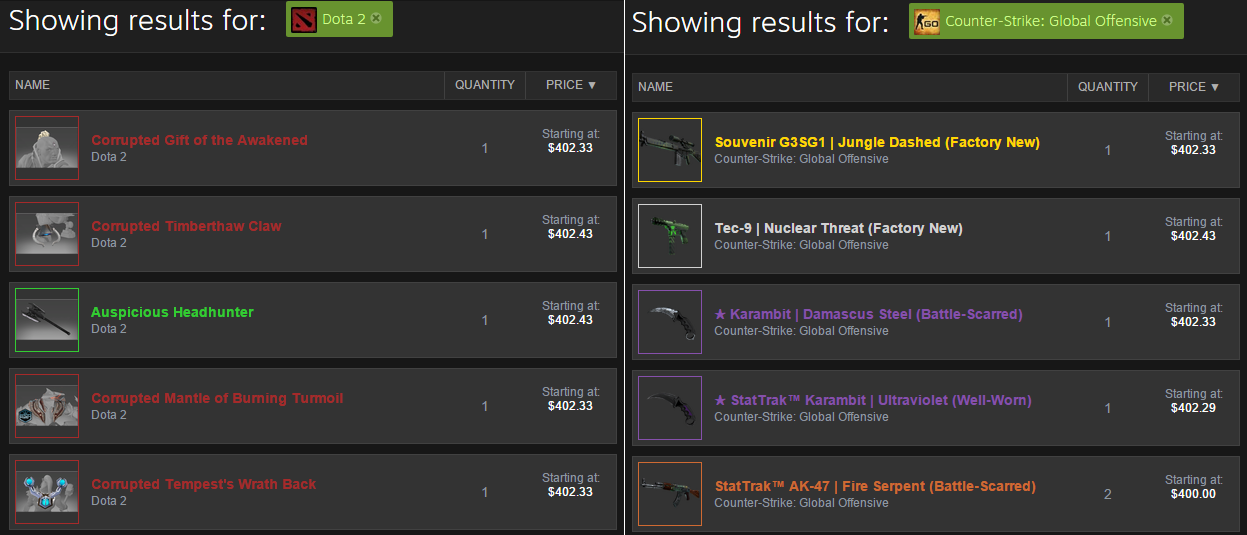
An entirely different issue is when people under age-21 wager their skins. These items are worth lots of money, just look at some screencaps from Steam’s Community Market page. Steam is the software distribution portion of Valve, creators of CS:GO and Dota 2. Some of the items for sale on the Valve Community Market are going for $400 dollars, while other third party marketplaces are trading and betting items worth much more money than that.

dota2
While this is certainly an exciting time to be an esports fan — the prize pools have never been bigger, corporate sponsorships are flowing in and possibly a major television league and broadcast deal in the works — seeing as DraftKings sees League of Legends on par with traditional sports, we can’t get too far ahead of ourselves. We’ve already seen entire organizations get taken down for throwing matches, some for cheating and with yet another website now offering to exchange cash (not just weapon skins with value tied to them) based on esports results, the cynic in me fears the worst.


Recent esports Tournaments Show Promising Attendance Numbers

Over the past weekend we saw two titans of esports, League of Legends and Counter-Strike: Global Offensive, hold major tournaments. On Sunday the European and North American League of Legends Championship Series summer finals concluded with the Counter-Logic Gaming team taking first place for North America, $50,000 in prize money, and a ticket directly into the 2015 World Championship, and Fnatic taking home the trophy for Europe. Fans of CS:GO were entertained from Thursday to Sunday with the ESL One: Cologne tournament, a tournament partially sponsored by CS:GO developer Valve, with $100,000 going to the winning team and $250,000 overall up for grabs. The weekend was filled with teams from all over the world aiming to take the top prize.

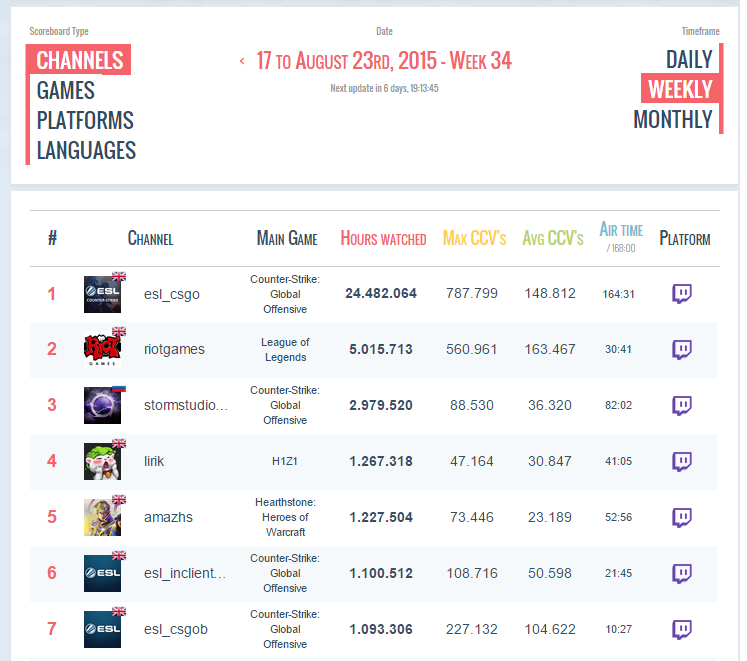
Both esports events captured a huge number of fans, and CS:GO set a sixth month high for Twitch.tv view hours in a single day. Via Gamoloco, CS:GO averaged more than seven million hours per day across the for the four day event, peaking at 8.9 million view hours on Saturday. It should be noted the number of hours is likely skewed by users logging in with multiple CS:GO accounts in order to raise their chances to receive a free in-game item drop, so these numbers should be taken with a grain of salt. The infographic below displays the game itself rather than the specific ESL One Twitch channel, which is to say there were other streams being watched for CS:GO and League of Legends beyond just the official ESL One and LCS streams.

gamoloco

By specific channels with each game, Gamoloco rates ESL One compiling 24.4 million hours (with another one million hours on the official “B Stream”) compared to Riot Games, developer of LoL, totaling just over five million hours over the past week. These numbers represent the English speaking channels only, with the Russian channel covering ESL One accumulating nearly three million hours, plus Polish and German broadcasts for each game.

gamoloco2The crowds at both live venues were impressive as well, with the League of Legends NA Summer tournament filling up Madison Square Garden with a reported 11,000 fans. Europe was no slouch either as ESL looking as though the Lanxess Arena drew a fair crowd as the header image would indicate, along with a large crowd at the EU LCS at Stockholm’s Hovet Arena. While it’s hard to compare a single tournament to the long grind of a sports season, the NA Summer event pulled a crowd comparable to the NHL’s Florida Panthers and more than the MLS’ Chivas USA, though both the Panthers and Chiva rank last in attendance for their respective leagues.

These impressive numbers aren’t even counting Dota 2’s yearly tournament, The International that was held from July 27 to August 8 to decide the world’s champion where we saw the single largest prize pool for an esports tournament. With the growing prize pool, interest level and time commitments being dedicated to esports — not to mention push notifications the ESPN app and score tickers (cap tip to HeyCJay from Reddit) and streams on ESPN 3 — it may be time to pick your favorite esports organization just the same as a football or baseball team. 

(Header image via ESL Twitter)