Archive for Basketball

Behind the Code: Ken Pomeroy

Behind the Code is an interview series centered around the sports-related web sites we use every day.

For many college basketball fans, Ken Pomeroy’s kenpom.com is the first–and often the last–word in statistics and analytics.

Pomeroy’s efficiency-based team ratings have received praise from the likes of Nate Silver and have led Pomeroy to consulting opportunities for several college and professional teams. Yet they only scratch the surface of the info “KenPom” provides, including player comparisons, posts on college basketball trends, and preseason game-by-game projections — the latter of which just went live for 2015-16.

TechGraphs writer Brice Russ spoke recently with Pomeroy about what’s new and what’s next for kenpom.com.

Brice Russ: What’s new on KenPom.com for the 2015-16 season? It seems like every fall, there’s another half-dozen features on the site. What should we be looking for this time around?

Ken Pomeroy: The main offseason addition was expanding the player stats to break out performance against different levels of competition.
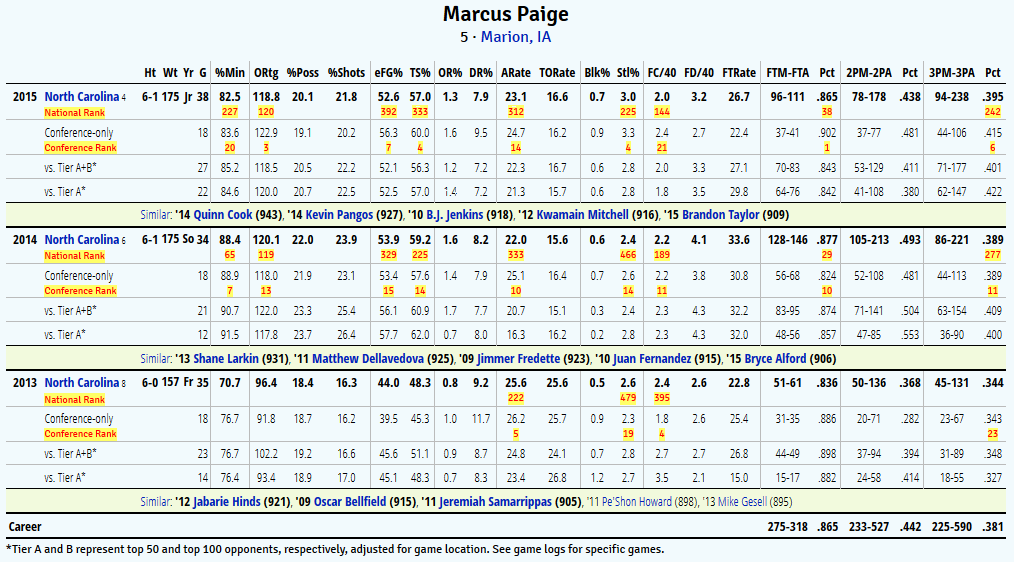
Marcus Paige stats
Marcus Paige career stats breakdown by level of competition

That is an extension of the conference-only player stats and minutes tracker that I added towards the end of last season. I’ve added some search boxes to the navigation bar so people can find teams and coaches a little more quickly.

There are some other things on the burner for this season, but they’ll be surprises for people when they appear. I’m usually reluctant to call my shots because I don’t want to over-promise something.

BR: What’s your motivation when you’re adding new stats to KenPom? Are you looking to incorporate what you think will be most popular? Most useful? Anything you’ve added as a result of your consulting work?

KP: There’s definitely a selfish motive. Usually, I’m thinking of things that I’d like to see, but that’s also consistent with doing something that will be useful to an audience interested in analytics.

I’m not opposed to adding what I’d call trivial stats that have little analytical value. I mean, I have team free throw percentage defense on the site. But I try to avoid adding trivial stats that might be misconstrued as useful. I always get a few requests for home/road splits and largely the differences in home/road performance over the course of the brief college hoops season is noise and not useful from a predictive standpoint, so that’s why they aren’t on the site.

BR: KenPom is unquestionably one of the oldest and most well-established sports analytics sites around, particularly in the basketball arena.

How have you seen the perception and role of analytics change in sports over the years, especially in the public eye? Has the field grown more competitive, or does it feel like there’s still plenty of ground for everyone to cover?

KP: It’s definitely more accepted than it was a decade ago. A lot more people understand the concept and utility of points per possession. But then again, almost every broadcaster and coach still cites regular field goal percentage to measure shooting accuracy, so it’s not like there has been a revolution.

As far as competition, there are certainly more people coming out of college with the goal of working in sports analytics. But it seems like most of the people interested in basketball gravitate to the NBA level, where the data is so much more granular and there are fewer teams to cover.

BR: One of the biggest stories for the upcoming season is the introduction of the new 30-second shot clock. Presumably, this will lead to an increase in tempo, but how else do you expect this to change the game from a metrics standpoint?

You took a brief look at the clock before it was tested in last year’s NIT; have you had a chance to look at the data since then?

KP: I haven’t looked at it any further, although my series of blog posts over the summer was partly inspired by trying to develop a theoretical framework to figure out how we got to this point. And what I found was some evidence that the offense deserves a good chunk of the blame for the slowing of the game.

The cool thing is that with 200+ games during the opening weekend we’ll get a real good idea of the impact of the clock (and the expanded charge circle) fairly quickly.

BR: 2015 will mark the fifth season that team-level KenPom data has gone behind the paywall. Is it fair to say this has been a successful experiment at this point? Any data or trends you can provide about subscriptions?

KP: It’s worked out well. I had a choice between appealing to a mass audience and blasting people with ads, or putting up the paywall and keeping the site clean and limiting the audience to folks who really wanted a source for advanced stats.

BR: What’s next?

KP: Usually the events of the season dictate this, so it’s difficult to say.  But I’m sure it won’t take long for something interesting to happen.

Thanks to Ken for speaking with us! You can follow Ken on Twitter at @kenpomeroy and, of course, at kenpom.com.

TechGraphs Report: On Deck Sports and Technology Conference

Earlier this week, NYC’s Bohemian National Hall played host to hundreds of sports executives, entrepreneurs, and others looking to learn about the very latest in sports technology. Since 2013, the On Deck Sports and Technology Conference (organized and presented by SeatGeek) has provided a forum to showcase what products are “on deck” to help fans follow, analyze, and participate in sports.

On Deck has a slight bent towards sports startups, so a decent amount of the conference was geared more towards raising capital, scaling businesses, etc. Still, there were plenty of fascinating talks, panels and interviews for anyone interested in straight sports tech.

Statcast And Beyond

Possibly the most entertaining talk of the day was Joe Inzerillo’s (CTO, MLBAM) update on MLB’s Statcast, which is finally getting its moment in the sun this season. For those who needed a refresher on how Statcast operates, Inzerillo discussed its missile-technology radar system, its stereoscopically-placed cameras, and how these allow each Major League ballpark to track the movements of every player on the field (plus the ball) at any given time.

Once Statcast has this information, as Inzerillo pointed out, it can then provide real-time data on pitch velocity (actual and perceived), player velocity and reaction time, and a horde of other quantitative metrics, plus more advanced data on a 12-second delay, like fielding route efficiency. This data is just inherently cool (as you likely know if you’ve seen a Statcast-enhanced game or highlight on television), but it’s also already being used to both question and confirm existing baseball strategies.

For an example of the latter, Inzerillo looked at the fallacy of sliding into first using Statcast to plot Eric Hosmer’s 1B slide in Game 7 of the last World Series. Hosmer hit a peak speed of 20.9 MPH before sliding and being out by less than a tenth of a second. If he had just kept running, Statcast found, he would have been safe by nearly a foot. Statcast is already getting noticed by clubs, and even players — batters like to talk smack, apparently, over who has the highest exit velocity.

During questions, Inzerillo was slightly cautious about committing to the future of Statcast, but he did mention that minor league stadiums were a natural next step, and that there was plenty of work being done on developing new metrics. Statcast already tracks ‘defensive range’ for fielders, for example, but since a player doesn’t travel the same speed in every direction, there’s a need to find the more amorphous ‘effective defensive range’ and how it changes–such as during defensive shifts.

On the football side of things, Sportradar’s Tom Masterman talked about the NFL’s NGS (Next Gen Stats) platform, which is collecting data on every single game in 2015 to track, analyze, and visualize how players are moving on the field. NGS is already being distributed to clubs, media, and health and safety personnel; the long-term goal is to have X,Y,Z coordinates for every player and official, plus the ball.

Go Bucks

On Deck’s attendees weren’t just league officials and startup managers–the conference started with a live interview of Wes Edens, who became co-owner of the NBA’s Milwaukee Bucks in 2014. Much of the conversation focused on the new Bucks arena, which was being voted on by the Milwaukee city council literally as the interview was ongoing. As it’s currently planned, the presently-unnamed arena will focus heavily on keeping fans digitally connected — giving attendees plenty of WiFi, for example. At the same time, Edens noted, they want to avoid fans using technology to become distracted from the game going on in front of them. (Edens used the phrase “Instagram culture”, specifically, though he noted that he himself has had these sorts of problems before.)

Edens was similarly balanced when the discussion turned to analytics. One of the first things Edens did after buying the Bucks was to build their analytics program — bringing on employees, consultants and even discussing methodologies with other owners. There’s definitely a “golden age” of analytics in basketball going on.  Edens even thinks the NBA will end up surpassing the MLB as the leader in sports technology. But when he was asked about how the players feel?

“It’s a good question,” Edens replied. “There’s definitely lines that can be crossed” with having too much data being made public, at least when it can affect the privacy of the players (such as rest/injury issues).

Edens also briefly discussed the role of the referees and the potential benefits of replay and “the new center across the river“. Could we see yet more referee technology, even an Oculus Rift-type headset for NBA officials, in the future? “Totally possible.”

Era of Mobility

When it came time to look at how fans themselves were interacting with sports, technologically, it became clear that mobile is “it.” In that panel about growing sports startups I mentioned earlier, representatives from SeatGeek, FanDuel and Krossover all praised the importance of the mobile web for their companies–SeatGeek’s rep described it as a “tale of two companies”, pre- and post-mobile, and Krossover’s founder mentioned they’re considering dumping their web app altogether in lieu of just being on smartphones and tablets. When Yahoo Sports’ VP of engineering presented a chart showing their fantasy football traffic from this season’s Week 1, the fraction of non-mobile data was a pretty small sliver at the top.

Yahoo fantasy data graph
Trust me, it’s there.

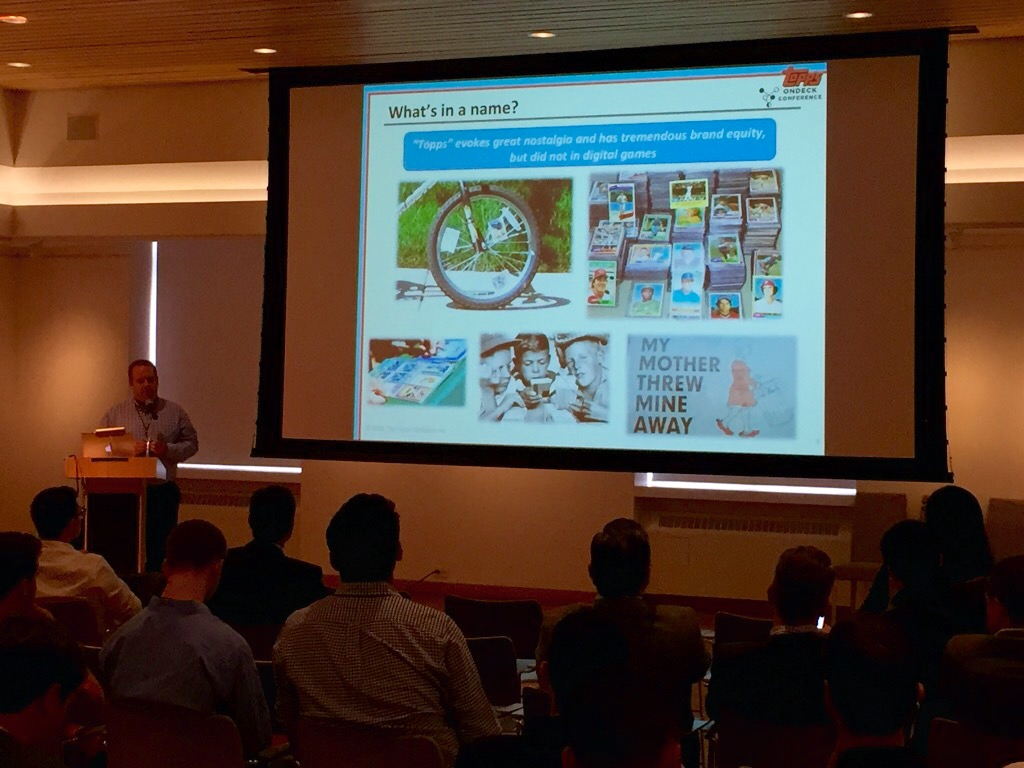
Even companies you might never expect to get in the mobile game are joining and succeeding. Jeremy Strauser had 20 years of gaming experience at EA Sports and Zynga before joining one of the most loved and enduring brands in the sports industry, Topps. Yep, they’re digital playing cards.

Topps first got into the digital game 4 years ago and how has three top-selling sports card apps, plus a newly launched Star Wars-themed set. Why should you be interested in buying trading cards on your phone? One starting point is the capabilities the digital platform provides — literally hundreds of thousands of different designs, the ability to create all manner of rare and unique cards, etc.

Topps is also rolling out a daily fantasy sports feature (DFS was a major topic of conversation at On Deck) that allows you to compete using the players in your card deck and swapping them in and out in real time as they go up to pitch or bat. It probably doesn’t hurt, either, that they won’t take up space under your bed or get thrown out by your mom when you’re away at college.

Topps conference talk

Coming To Your Hometown

If you want to look for the next wave of sports technology, though, look to your neighborhood.

Rather than providing new tools or analytics for MLB, the NFL or the NBA, the newest sports apps want to help you participate in sports in your own town. On Deck wrapped up with a “Startup Pitch Contest” a la Shark Tank where teams had four minutes to present their groundbreaking app to a group of judges. The six competitors included:

  • Wooter – a search engine for finding and joining sports and activities like local rec leagues. Wooter provides profiles for leagues looking to form teams, players looking to join them, and the tools to process payment and set up other logistics.
  • NextPlay – helping youth coaches conduct tryouts and league drafts. For $15/month, instead of taking a stopwatch, a bunch of handwritten notes, and an Excel spreadsheet to put together youth rosters, NextPlay handles all the data collection and analytics itself. Their beta has been used by “a couple hundred organizations” and over 10,000 athletes.
  • ScoreStream – filling a gap in local journalism by crowdsourcing reports on high school sports.

With a really impressive presentation, broad coverage (10,300 HS games covered last week alone) and the #1 iOS app for high school sports, I really thought Scorestream would walk away with the prize, but it ended up going to…

  • SidelineSwap, a P2P marketplace for sporting goods. SidelineSwap has over 43,000 registered users who’re interested in trading out sporting gear just collecting dust in their basement or garage. They’re working on building partnerships with youth organizations and promoting used college-branded material, which should play very well with their chief audience of high school students.

On the whole, On Deck was a whirlwind experience for learning about cutting-edge sports tech. This report only covers part of everything I caught there. Watch for further updates and profiles soon!


A La Carte Sports Watching Is En Route

The NBA Finals have been wrapped up for just one week, but already the association is looking to the 2015-16 season. Even before the Golden State Warriors were crowned champions, the NBA announced a major change to their streaming League Pass service. Beginning next season, you’ll be given the option to purchase individual games or team packages, provided you’re out of the team’s local market.

As presently designed, the new League Pass will be compatible with computers — Windows and Mac — as well as Android and iOS devices. For those with Fire, Windows, Blackberry or other operating systems, you may be on the outside looking in. The NBA Game Time app (which is required to view League Pass on mobile devices) does support Amazon Fire devices, but support for Game Time was dropped for Windows devices in July of last year.

The importance of the NBA deciding to offer a more a la carte style cannot be understated, as now more light is cast on other sports leagues, particularly the NFL. As Engadget notes, the NFL is currently fighting a lawsuit from a fan regarding the limits of their Sunday Ticket service, specifically being forced to pay hundreds of dollars to see their favorite team 16 games per year even though they live thousands of miles away from the team’s location.

The murky waters of territorial or cable blackouts has been explored before, just ask a local Dodgers fan, and as Time Warner continues to lose money, it seems possible the 25-year and $8.3 billion dollar deal could get reworked. With sports fans and non-sports fans alike clamoring for an a la carte service, the answer could come not from a cable provider, but rather a group who knows a few things about entertainment in Sony.

During the Electronic Entertainment Expo this year, Sony announced an option purchase specific channels on their Playstation Vue services. It is an ambitious undertaking and perhaps Sony is simply dipping their toes in the water rather than diving right in the streaming market. Right now their Vue service is available in just five cities in the United States: Los Angeles, San Francisco, Chicago, Philadelphia and New York. Playstation 3 and 4 owners in those cities who are tired of the paying a cable bill can pick up a number of individual channels — or a more traditional package — including Fox Soccer, Showtime and Machinima for prices ranging from $3.99 to $14.99.

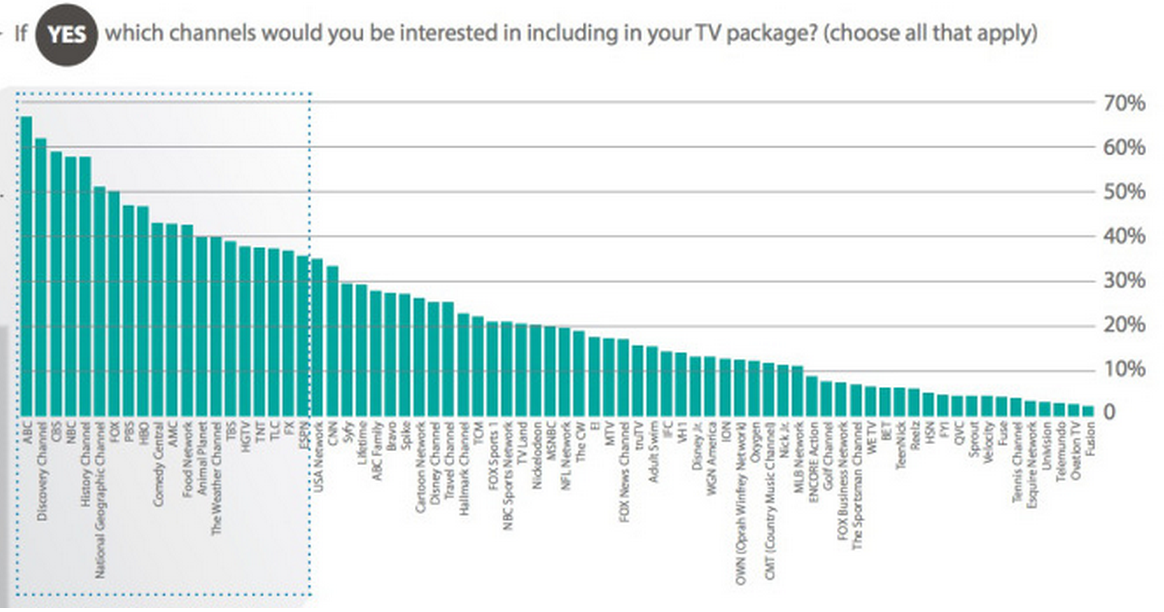
Given the push for a la carte services, a recent poll conducted by DigitalSmiths and posted via DSLReports shows an interesting trend. If sports fans are the driving force of streaming or pay-as-you-go streaming options, the survey had an interesting way of showing it.

alacarte

ESPN ranked 20th among preferred channels, behind non-sports channels such as Animal Planet, Food Network and the History Channel. ABC and CBS ranked first and third respectively, however it would be a stretch to call those sports channels given their diverse programming. The same could be said for NBC (4th), Fox (7th), TBS (15th) and TNT (17th). Where ESPN was the first sports exclusive channel, both Fox Sports 1, NBC Sports, NFL Network, MLB Network plus the Golf Channel and Tennis Channel managed to make the list.

Kudos to the NBA for seizing an opportunity to gain new fans after a strong ratings performance in the finals. Perhaps more professional leagues or streaming service options will follow suit and offer a more personalized option.

(Header image via Wikipedia)

Blast Motion Sensor Augments Metrics with Adaptive Video

The first thing to keep in mind about Blast Motion’s sensor is that it’s not just designed for baseball. Yes, like the Diamond Kinetics SwingTracker, you can attach the sensor to the end of a bat to track swing speed and direction. And like the Zepp sensor, the Blast sensor can also be used to track a golf swing. But Blast’s approach revolved around designing a high-quality, general purpose sensor, and then building specific applications for baseball, basketball, golf, action sports, and athletic performance around it.

“We didn’t approach this as trying to design a swing sensor or a specific sport product,” senior director of marketing Donovan Prostrollo said. “What we designed it to do was to be a natural motion capture product, and then we applied that to different sports, so it doesn’t pigeonhole our product.”

At the heart of the Blast sensor are inertial measurement units (IMUs), the combination of accelerometers, gyroscopes, and magnetometers that have become ubiquitous in devices like smartphones and tablets. But Blast has made two improvements to make the device more accurate. First, Blast Motion uses multiple IMU chips (although they wouldn’t disclose how many) to capture a wider range of movements. Second, the Blast sensor was also designed to use what founder Mike Bentley referred to as “tactical-grade” technology, a combination of more precise sensors, more processing power, and on-the-fly calibration that improves the device’s accuracy and consistency from one movement to the next.

But despite the intense technological focus, both Bentley and Prostrollo stressed the importance of keeping their outputs simple for the end user.

“You’ll find other solutions out there really overwhelm users with numbers, which is both good and bad, because if users don’t know which number to focus on, you’re not really helping them, you’re actually potentially making it worse,” Prostrollo said.

“At the end of the day, [the athletes] would love the technology to just completely disappear,” Bentley added. “And that’s one of the goals of Blast is how do we make the device disappear.”

When compared to other bat sensor apps, Blast lacks the three-dimensional rendering of the swing. Instead, the Blast app revolves around video, typically captured by setting the device on a tripod and automatically clipped so that only the events of interest are included. Prostrollo argued that the focus on video gave Blast an edge in capturing the entire movement, not just key metrics.

“We decided from the beginning to capture video and do it natively as part of the app so it’s really integrated into our DNA,” Prostrollo said. “And the cool thing about that is when you pair video and you compare the level of consistency out of our product it really does an amazing job.”

And Blast recently announced an adaptive slow-motion feature that adjusts the playback speed around the event.

“Basically, we know exactly when the impact occurred, when the swing started, and when the swing ended, and based on that we can speed up and slow down the video,” Prostrollo said. “We can also take the metrics and overlay them on top to get this dynamic fill, so it’s not just a metric in isolation.”

Blast verified the accuracy of its metrics using motion capture systems. As an example, Prostrollo said the system was within 1 mph of the motion capture system “85 percent of the time” and Bentley claimed that the Blast system “outperforms our optical system when you talk about rotational velocity” as verified by higher-end devices more commonly used to test aeronautical and military-grade IMUs.

Bentley and Prostrollo stressed not only the device’s accuracy but also the device’s consistency, so that identical swings or jumps would produce identical sensor readings. They attributed this consistency to improvements in their manufacturing process, and claimed it made a big difference to the professional athletes they collaborated with.

“The challenge is pro athletes absolutely can recognize that day one, the amateur athletes won’t necessarily realize that a product’s not as accurate as they want until it’s too late: they’ve purchased it, they’ve gone out, they’ve tried it, and they wonder why their swing speed varies by 6 mph when it’s all the same,” Prostrollo said.

Despite being a relatively new company, the founders of Blast Motion have been in the inertial sensor business for a quarter of a century. Before entering the sports world, their focus included military and medical products.

“This is not the first sensor we’ve ever manufactured,” Bentley said. “When we originally designed the sensors, it wasn’t for a single application. We wanted to be able to use the sensor and cross-pollinate across all applications.”

As Blast Motion began adapting its offerings for new markets, it worked with coaches, professionals, and other subject matter experts to design useful applications. But Bentley said there was a lot of overlap between the biomechanical elements underlying the different sports. Even more surprising, he said, was the overlap between social circles across different sports.

“What’s pretty unique about when you do get into the inertial world of working with different professional teams, how many baseball players work with professional golfers, and how many golfers play with hockey players,” Bentley said. “So the world is pretty small, and when you get a pretty exciting product, the word travels pretty fast in those worlds.”

The company currently works with a number of action sports ambassadors including Mike “Hucker” Clark and Greg Lutzka, as well as some NBA and MLB players they declined to name, citing confidentiality. And Blast Motion is working closely with bat manufacturer Easton as it gears up to release the Easton Power Sensor this summer. Little information is currently available about the project, but judging from the screenshots in the iTunes App Store, the interface at least will be very similar to Blast’s Baseball Replay app.

Looking to the future, Prostrollo said the biggest change would be not on the technological side but rather on the adoption side, as wearable sensors like Blast become more and more ubiquitous among both amateurs and pros.

“We’re at the point now where the average consumer has access to this technology, it’s no longer the pro athlete,” Prostrollo said. “What you’re going to see is a whole new generation of athletes leveraging the data and the technology, having a history to go back on, and really be able to do something very meaningful and different with that.”


Wilson, SportIQ Team Up to Produce “Pro-Quality” Smart Basketball

Look close at Wilson’s Wx “connected basketball,” and it’s hard to tell what’s so different about it until you spot the Bluetooth logo by the inflation valve.

“That is not something we usually deal with,” Wilson’s Vice President of Innovation Bob Thurman chuckled.

The ball was presented, along with an accompanying mobile app, at last month’s Sloan Sports Analytics Conference in Boston. Wilson developed the basketball in partnership with SportIQ, a Finnish company whose player tracking solution combines wearable sensors with synchronized video to help coaches analyze their teams’ performance.

When asked, SportIQ CEO Harri Hohteri (pictured above) was reluctant to talk about the “secret sauce” behind his company’s basketball. But he was quick to differentiate it from other smart sensor basketballs like 94Fifty’s.

“[The 94Fifty ball] was designed around shooting mechanics as a training tool,” Hohteri said. “But the first thing for us is the consumer side of things. We wanted to develop a professional-quality basketball.”

Hohteri, who played four professional seasons in Finland’s Korisliiga, insisted the feel of the basketball was of the utmost importance to players. “I can’t tell the difference between this and a game ball,” he said.

The quality of the basketball is further underscored by SportIQ’s partnership with the Korisliiga. For the third straight season, Finnish players are wearing the company’s sensors (and using its basketball) in league games. The data is used to automatically tag events in a synchronized video that Hohteri says coaches are using to track the efficiency of their offensive sets. And because it relies on sensors, the system doesn’t need the extensive camera setup used by STATS’ SportVU tracking system.

“It’s about doing things more efficiently,” Hohteri said. “That’s the whole idea. We can do the whole thing in real time with less manpower than teams are using now.”

But for those of us who aren’t running a professional basketball league, Wilson’s connected basketball is launching this year. The demo at the conference included a smartphone app (projected onto a television) that showed players their accuracy from various distances on the floor. A machine learning algorithm in the app detects makes and misses without the need for an additional sensor attached to the net, unique among smart basketball systems. Each distance stripe was color-coded, according to the percentage of shots made from anywhere in that arc.

SportIQ’s partnership with Wilson started in August 2012, when SportIQ first began its relationship with Finnish basketball. Because Wilson is the official basketball of the league, Hohteri approached Wilson’s innovations department about developing a smart basketball.

“At the same time, our business director was asking us for a way to measure makes and misses in the driveway to keep kids in the game,” Thurman said. “So we agreed that we would help engage them on tracking the basketball, and they would help us with this make/miss aspect.”

Thurman hopes the partnership between their companies will combine SportIQ’s intelligence with Wilson’s broad user base to “gamify” practice and inspire the next generation of basketball players.

“We want to activate 12-15 year old kids, to get them off the video games, and get them back in the park, to be more active,” Thurman said.


Simulating the First 36 NCAAM Games with WhatIfSports

With millions of people filling out NCAA brackets and no doubt millions of, let’s say “jelly beans” being wagered, why not try to get the inside track on the opening round games? With thanks to WhatIfSports and their basketball simulation system (as well as Yahoo! for the bracket), we have the four play-in games plus the 32 opening round games predicted.

To participate in the premium features of WhatIfSports — such as creating or joining a sim league or dynasty — there is a fee. However, the NCAA single game matchup sim is free. Though no word on their methodology behind the sim (what stats are weighed, how heavily, is it a Monte Carlo, etc.) I’ll share my methods. I used the neutral court option and ran each team once. Small sample size is an issue, and rather than spend hours running a full simulation, like the tournament, I’m sticking with the one-and-done style. With that out of the way, lets take a look at the play-in games!

Hampton wins a fairly one-sided matchup, keeping Manhattan at arms length in the first and second half.

ncaa1

Our second play-in game is much more competitive, with Boise State narrowly defeating Dayton.

ncaa2Robert Morris couldn’tkeep pace with North Florida, getting doubled up on points in the first half. Though they won the second half, it wasn’t enough to overcome the early hole and UNF advances to the field of 64.


ncaa3Our first power conference team is eliminated in Ole Miss, going down to BYU by doubt digits.

ncaa4

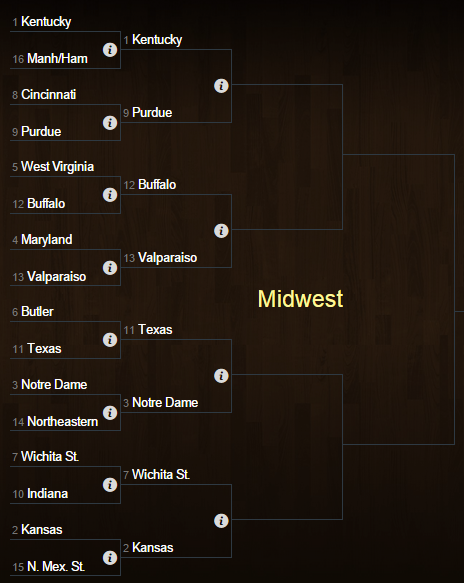
The rest of the results can be found in the brackets below, though note some of opening round upsets. In the Midwest bracket we see Buffalo beating out West Virginia for the classic 5/12 upset and Valparaiso downing Maryland. The upsets continue in the bottom half of the bracket with Butler dropping to Texas.

ncaamidwest

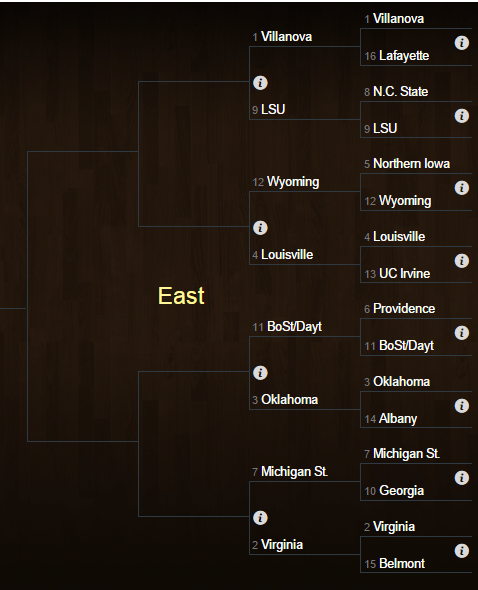
Moving on to the East bracket, a problem arose. Unfortunately the system did not have Northern Iowa’s 2014-15 season on file, so Wyoming got the upset by default. Boise State toppled Providence for their second win of the tournament and while Virginia beat Belmont, it was a five point game.

ncaaeast

History was immediately made in the West bracket, as 16-seed Coastal Carolina shocks the world and beats Wisconsin! BYU defeats Xavier in another upset to finish the surprises for the day.

ncaaupset
ncaawest

Events unfolded without much surprise in the upper half of the South bracket. Suddenly UCLA downed SMU, Iowa State fell to UAB and Davidson defeated Iowa, all upsets.

ncaasouth

Clearly the surprise was for the first time ever a 1-seed, Wisconsin, lost in their opening game. Whether or not this proves to come true remains to be seen, but this bracket will probably do better than the one I filled out.

(Header image via Wikipedia)

YouTube Announces NCAA March Madness Channel

The network powers that be — CBS, TNT, truTV and TBS — have created an official YouTube channel in preparation for March Madness. By subscribing to the channel you can receive email updates on new content ranging from highlights, best moments and more.

Right now the channel has videos from last year, though according to the press release it will feature highlights and clips from all 67 games this year. Specifically it says real-time highlights and video recaps, though unfortunately the games themselves will not be streamed. The live coverage will only consist of analysis and post-game press conferences and is not related to CBS’ current All Access subscription service.

Vice president of business operations for Turner Sports, Mark Johnson is encouraged by this new foray into the YouTube realm.

“Our new partnership with YouTube gives college basketball fans more ways to discover and watch the plays and storylines that everyone will be talking about during March Madness. Tapping into the power and reach of YouTube’s video platform opens up new opportunities for us to grow interest and consumption of March Madness.”

Given the lucrative TV ad revenue, it is no surprise the governing powers would want to rock the cash boat. Via Statista, in both 2013 and 2014 the revenue surpassed the $1 billion mark.

TVrevenue

No surprise the NCAA and the broadcast partners wouldn’t be eager to ditch that sort of money and go to streaming option where things like Ad Block Plus can remove advertisements. This channel may be a step in the right direction with limited live coverage, but cord cutters will still be forced to look elsewhere for the games.

(Header image via truTV)

NBA Announces Exclusive FanDuel Deal

The NBA just agreed to a 4-year deal with fantasy website FanDuel according to both TechCrunch and ESPN. For daily fantasy players, this means FanDuel will be the exclusive website to get your hoops fix at. Already on the NBA Fantasy site you can be linked to FanDuel and expect the association to promote it on their apps as well as their streaming ads and commercials.

Currently FanDuel offers both free and pay-to-win leagues. The prizes for these range from cash to game tickets to merchandise. Now with the association in their pockets, FanDuel and the NBA, along with money from venture groups such as Shamrock Capital Advisors and NBC Sports Ventures, will be able to reach and attract even more customers.The growth in the daily fantasy industry is on a massive rise, as FanDuel has increased by 650,000 paying players in the past three months after never before having even a third of that many in a single quarter. FanDuel claims they project to make approximately $600 million in entry fees this calendar year while handing back $540 million in prizes.

While this is new territory for the NBA as a whole, five teams had prior deals with FanDuel; the Brooklyn Nets, New York Knicks, Orlando Magic, Dallas Mavericks and Chicago Bulls. The move also includes NBA league executive Sal La Rocca as a FanDuel board member, further strengthening the ties between the two entities.

With competitor DraftKings snapping up the NHL, this deal makes sense for FanDuel. Given the massive interest and ease of use for daily fantasy leagues, it appears as though both FanDuel and DraftKings will the main entities of daily leagues going forward. With both sides throwing around millions of dollars, the money is driving even more attention to fantasy sports.

(Image credit to NBA.com) 

A New Way to Stream NBA Games May Be Coming

Given the success of MLB.tv and MLS Live, it was only a matter of time before another major sport followed suit with an all new online streaming service. With a clear shift in how people prefer to receive their sports services — so called cord-cutters are dropping television service in favor of online streaming — the NBA announced a deal yesterday that could see a major change in how fans watch games.

The nine-year TV agreement between the league, ESPN/ABC, TNT and Time Warner won’t officially start with the 2016-17 season, but it could include some good news for those who want to stream games without a cable/satellite package. Per the Wall Street Journal:

As part of its deal, ESPN negotiated a package of games for the online video service. The NBA’s “League Pass” offering already allows users to stream live regular-season games that aren’t televised nationally and aren’t available in their home market.

But ESPN has been cautious about letting its most valuable content—live professional sports games—outside the walls of pay television. Its streaming app WatchESPN is only available to pay-TV customers, so the new online service represents a shift in approach….

It isn’t clear whether the online service will be a subscription offering or a “transactional” one in which people will pay for individual games. The parties are considering licensing the package to wireless carriers such as Verizon that are building online video services, one of the people familiar with the matter said. The number of games that will be made available for the online service is still being decided.

The significance of being able to view games without a cable or satellite plan cannot be understated. The existing NBA League Pass allows one to stream out of market games online for 149.99 for the strictly streaming version — including mobile — or 199.99 for the stream + television package. On the worldwide leader side, WatchESPN requires an existing paid TV subscription to view games, so this new service must be something built from the ground up.

Curiously rather than the NBA buying out its own streaming services, NBA League Pass and NBA TV, the online games continues to be handled by the Turner Broadcasting Company. To outsource something as big as this and still not maintain full, top-down control is a questionable move, especially when considering past criticisms of NBA League Pass.

Assuming ESPN’s streaming service has nothing to do with the previous frustrations with League Pass, this could usher in a new era of free streaming sports for internet-only subscribers. ESPN has a solid history of online services, as ESPN 360/ESPN 3 were stable platforms, and given their renewed partnership with the NBA, ESPN should  invest considerable resources to their NBA centered streaming service.

(Header photo via Keith Allison)