Archive for Opinion

With Twitter/NFL Deal, It’s All About Execution

It was recently announced that Twitter will begin streaming NFL games on Thursday nights. In yet another attempt to bring more users into the fold, Twitter has made a sizable investment in bringing the country’s biggest sport to its platform. The details are fuzzy at this point, so we don’t know the exact way this thing is going to shake out. But the devil is in the details, in this case. What this whole thing will actually look like will have a great deal to do with its success. To ride the rails of a fairly-tired cliche; We know the who, what, where, when, and (mostly) why. The biggest question mark revolves around how.

A while back, I heard Ben Thompson — tech analyst and host of the Exponent podcast — describe Twitter and its problems in a way that stuck with me. I’m paraphrasing, but he essentially said that issue is that Twitter is that its dealing with two groups of people — people who tried their platform and didn’t like it, and people who love it and never want it to change. Somehow, they have to placate both crowds. They have the tech. They certainly have the brand recognition. They just need more people. With the NFL deal, they’re going after new audiences. But trying to solve the problem of gaining new users might run them headfirst into their second problem — those who don’t want it to change.

For people (especially sports fans) who use the platform, Twitter makes and excellent companion to watching something on TV. You hear about companies looking to expand the “second screen experience.” That all started with Twitter. It was a way to share and interact around a centralized event — the Super Bowl, the Oscars, a big news story. You watch on your TV, and you follow along with others’ views (and share your own) on your phone. But Twitter is trying to make your second screen your first screen in this case. Which is all fine and good, but it opens the situation up to a paradox. How can one share their feelings about an event on social media when the social media platform is how they’re watching said event?

Twitter is a large company that employs a whole lot of people smarter than I, so I’m giving them the benefit of the doubt at this point. But if they want to keep the people they’re bringing in with the NFL offering and avoid ridicule from their current user base, they’re going to have to tread lightly. The experience is almost certainly going to have two elements. There will be the actual video stream, of course, and there will need to be a way for people to still read and share on the Twitter service. UI is key here. There are a lot of options for something like a laptop screen.

twitternfl1

twitternfl2

twitternfl3

But how does this work on phones and smaller tablets? Will there be enough real estate for everything?

twitternfl4

Let us not forget the fact that seemingly every time Twitter makes a change, people lose their minds. Most recently it was (probably rightfully so) algorithmic feeds, but there are countless other UI changes and other tweaks that drive the Twitter faithful crazy. Twitter is no doubt going to use its product to advertise the crap out of their NFL offering when the time comes. If that experience is lackluster, there will be noise about it.

If Twitter doesn’t nail this, NFL fans are going to happily return to watching on TV. CBS itself is even offering a stream of the games on their own platform, so it’s not as if Twitter has a monopoly here. There are other avenues fans can travel. Twitter is making a push — taking chances and working hard to bring their product to forefront of social media while trying desperately to take a bite out of Facebook’s current dominance. You can’t fault them for trying. But if history is any indication, they’re really going to need to nail this. They need to impress new customers while trying not to piss off the current ones. It’s an unenviable position. But a ten-year-old company that is still struggling to post profits needs to put themselves in that kind of position every now and again. They’re partnering with a very recognizable brand. If I were a lesser man, I would advise them not to fumble the opportunity.


This is the Way Daily Fantasy Ends — Not With a Bang, but With a Whimper

This is the Way Daily Fantasy Ends — Not With a Bang, but With a Whimper

Last night, I was at a fantasy draft party (12-team auction, for those who care). The television was on in the background as people were preparing their spreadsheets and whatnot, when an ad for a daily fantasy sight came on. I’m not being coy be neglecting to mention which one, I honestly don’t remember. Those ads are so ubiquitous, that they rarely seem to grab anyone’s attention, but when it came on the TV at the party, a guest looked up and said “do people still do that?” He was being a bit facetious, of course, as people certainly still do, but we might be honestly getting to the point where scandal and legal hassles the constant state of flux of the industry might be enough to lay daily fantasy — or at least the behemoth it has shown to be not terribly long ago — to rest.

The most recent cut-down of daily fantasy comes in the form of an announcement that DraftKings and FanDuel will cease offering contests that include NCAA games. Reading between the lines, it appears as if the NCAA was giving DraftKings and FanDuel the business, and since college sports were a minor part of the business and the two companies already have enough legal stuff to deal with, they threw in the towel.

It’s those legal troubles that would most likely spell doom for the two companies, should that come to pass. The bottom line is that many states are now looking into whether daily fantasy should be considered gambling. If it is, then it can’t be allowed to occur on the Internet thanks to the Federal Wire Act that, although its reach has been questioned, states that bets cannot be placed over communication channels like phone or Internet lines. As of this writing the commonwealth of Virginia has allowed daily fantasy to take place on its soil, so long as certain restrictions and regulations are in place. New York State originally filed an injunction to stop daily fantasy operations, then was overruled, but in the end FanDuel and Draftkings stood down on the issue, hoping that legislation will be passed allowing their sites to continue operating in the state. Yahoo! Daily Fantasy volunteered to do so as well, seemingly to remind the general public that they exist.

The legal back and forth will be a very interesting one to watch, with many ramifications involved. The things is, if litigation and appeals and everything else involved in the process goes on as long as it looks like they will, none of this might even matter. If daily fantasy doesn’t burn out, it might just fade away.

FanDuel and DraftKings will always have their loyal customers — those who spend lots of time and money on these sites and who will be watching in earnest as the rulings and laws come down state by state. These people aren’t who daily fantasy sites should worry about. They need to worry about the casual player, the person who gets the wild idea to drop $10 or $20 or $50 on a random contest one Sunday to try their luck. The common person. The square. This is who these sites need.

Remember, none of these sites actually care about how any one player does. They don’t lose money if Andrew McCutchen has a better night than Mike Trout. They just let the players duke it out while they take their 10% off the top. The model is pretty much the same for sports betting at casinos. The casinos want an even amount of bets on either side. The losers pay the winners and the house gets the juice. DraftKings and FanDuel acutally have a better model. The casino can still get hosed on a one-in-million bet cashing in. Daily fantasy doesn’t give a crap. It just needs players. It needs bodies that are willing to pay a fee (and forget that the odds are stacked against them) so that it can take its share. But without Joe Sixpack kicking in his money, there is less of a pot to skim from.

The big hitters and the sharps will still have their high-stakes games. If they live in a state where the contests are banned, they’ll find shady workarounds to keep playing. But your coworker or next-door neighbor won’t. If they can’t play, they’ll … just stop playing. And even if the laws are changed or massaged enough where they could theoretically start again, most won’t, or at least not as much. The thrill will be gone. Daily fantasy’s biggest enemy isn’t the law, it’s attrition.

FanDuel and DraftKings aren’t just interested in a positive decision, they need a fast positive decision. Time is of the essence here, as they need to both counter rulings and legislation against them in some states while regaining the right to do business in other states all in a timely enough fashion that the public doesn’t forget about them. So far, it’s not looking good. Layoffs are happening. Funding and partnerships are being pulled. All this effort may end up being just some rearranging of deck chairs.

This is not to say that these companies can’t make a comeback. If they laws fall in their favor, and cloud of doubt is blown away from the industry, the investment money and partnership deals will come rolling in right quick — no hard feelings, right? And maybe they can gain a second wind and intice people into coming back (now 100% legal!) And we may once again be carpet bombed with ad after ad regaling us with stories of average people becoming millionaires overnight. But some serious legal kung fu has to happen first. Luckily for these companies, they have the scratch to spend on top-notch lawyers.


A Case for Open Source Concussion Research

The Case for Open Source Concussion Research

Not so long ago, the divide between hardware and software was fairly distinct. Certain companies made hardware and others made software. Or, to be more precise, companies made software and others scrambled like hell to make hardware that would run it. This was the time of the 80s and 90s PC market — Microsoft was king and others fought each other to build the machines that would run Microsoft’s software. But as time went by and the silicon got smaller and more diverse, it made sense for the manufacturers to also implement their own software. They knew how the hardware was supposed to function, after all. We see this now with smartphones and tablets. Apple makes their own hardware and software. Samsung makes the phones and and the heavily-modded Android OS that run them. And, of course, we see it with the wearable market. If you want to see the data from your FitBit, you need the FitBit app. The same goes for Misfit and Jawbone and the Microsoft Band. Truth be told, this is usually a perfectly workable system. But the boom of the wearable market has brought with it the proliferation of devices that do more than just track steps. Multiple companies now produce products that measure force and damage done to the head in efforts to try and reduce or at least understand concussions — a now-important issue in sports that we should have paid attention to years ago. But if individual companies are making their own hardware and software to collect this data, the collaboration disappears. Important sharing of knowledge goes by the wayside. Everything gets segmented and compartmentalized. With the threat of head injuries looming so large, should we not strive to pool our collective research? Can we not create products for both good and profit?

The term “open source” brings with it some confusion. Open source was spawned out of the Free Software movement, and in the name lies the first problem. When many people read the term “free software,” they think of those handy programs one can download for free off of SourceForge. It is true that many developers offer their products free of charge, but that’s not what free software or open source is about.

In the 1990s, Linus Torvalds — in either one of the most important acts in the history of computer science or one of the stupidest moves in the world of business, depending on who you ask — created his own variation on the Unix operating system and released it, for free, to anyone who wanted to try it out. It was released under the GNU Public License. The GPL basically* states that anything released under said license is free to be tested, used, and modified. Those who make modifications are even free to sell their product for profit, so long as they pay the GPL forward and release their code for the same testing and modification.

*I know I’m giving a very high overview of this. My apologies to the hardcore free software people out there.

Torvalds’ flavor of Unix was named Linux, and if you haven’t heard of it, your nerdiest friends sure have. It runs almost every web server, ATM, smart tv, and super computer, and can be found on around 50% of the world’s smartphones. This article is being written on a laptop running Linux. Company after company took Torvalds’ work and improved upon it, personalized it, and commoditized it. All they had to do was show their work.

This is how open source works. Google doesn’t technically make money off of Android, which is based on Linux. They do make money off the Android Store and the data the OS collects about users’ habits. Companies like Ubuntu and Red Hat make a killing selling their special flavor of Linux for servers, and/or by selling support for that software. Sure, some organizations do it just to do it — to work toward a common goal of creating something great and exciting — and for the mere challenge of it. But do not be fooled, there’s big money to be found in open source, in one way or another. Device manufacturers need not be afraid, especially when their work goes toward the greater good.

Imagine a company that makes sensors for football helmets. We have covered quite of few of them at this site. The sensors are meant to measure impacts and forces that could lead to brain injuries. The company packages their devices with their special software and sells it to professional, collegiate, and even high school teams. Meanwhile, another company is doing the exact same thing and selling their wares to other such teams. Who’s right? Who has the best data? Each system is self-contained so there’s no opportunity for this type of data to be compared, contrasted, and improved upon.

This is where innovation and collaboration stops. Sure, each company gets their share of the pie, but they’re not necessarily making athletes safer. This data is somewhat useful in the hands of coaches and parents, but imagine if it were open to research groups — if doctors and scientists could pick apart the code to find exactly what was being measured and submit improvements to the software. We might actually have a chance at learning something.

In a recent article about CTE, Deadspin’s Barry Petchesky wrote:

We don’t know a lot. We don’t know the rate at which CTE develops, or the mechanism. We don’t know the correlation with playing football as compared to other contact sports. We don’t know if some people are predisposed to developing it. We don’t know how its symptoms manifest in the living. (We don’t know if it has symptoms—correlation is not causation.) We don’t know if there’s treatment. Each announcement of another CTE-riddled NFL brain amounts to, basically, cataloguing.

Petchesky is exactly right. We’re at a stalemate with this issue. If a company were truly passionate about this, they would release their software under the GPL. They could still make and sell their hardware, but others would be able to sift through the mechanisms for measuring head injuries and submit advancements to make it better. Other companies could edit and enhance this code and implement it into their own sensors. Another company could come along and do the same. Meanwhile, everyone competing in this space would constantly be working to make better systems for tracking these types of things. Researchers, now armed with the code that powers these systems, could implement it into their own experiments and research. The conversation might still take a while, but at least everyone would be speaking the same language.

I understand that the point of all these systems is to make money. They give coaches and parents peace of mind knowing that steps are being taken to protect player safety. But there’s an untapped market here of contributing to the greater good. There’s still money to be made, it just comes with a little extra peace of mind that when a company uses this hypothetical open source system, they are putting their work out there for all to see. They are daring others to create a better system. These dares only lead to other dares, and sooner or later, people might actually learn something definitive about this subject. Players get better and companies still make money — imagine that.


MLB and Match.com Team Up

Listen, I am not — even for a minute — saying that I possess even a modicum of business acumen. In fact, I think it would be safe to say that pretty much everything I know about business comes from 30 Rock’s Jack Donaghy. I do not possess an MBA, and I have a fairly weak handshake. With that all said, the announced partnership between MLB and Match.com could make a lot of sense. However, this does not negate the fact that it all seems very silly.

People give the dating app Tinder a good deal of guff due to the perception that it is a platform merely for people looking to rub against each other in some sort of way. And while that facet of the service certainly exists, Tinder leverages an easily-trackable and simple trait for every user — proximity. When you match up with someone, you know, for a fact, that you already have something in common. This may seem oversimplified — and maybe it is — but it’s part of Tinder’s core appeal.*

*–yes, there are also photos involved, but that is included in nearly all dating services.

Services like Match and OKCupid also leverage common interests, no doubt, but they are not as instantaneous. Match is now looking to tap into that instant-match process by using baseball fandom as a variable. Using the new “Singles” (can you hear my eye rolls through the Internet?) platform, fans can combine their Match.com profiles with their team allegiances. People can search Match for others who have also designated a favorite MLB team, and, 29 team-specific portals will also be available for people to match themselves with others who also root for the same team. I really want to know which MLB team was the holdout.

Is this platform totally pointless? Probably not. Will it make these businesses money? I have no idea — see paragraph one. However, it points to a continuing trend from MLB that shows a disconnect between what MLB thinks women want and, well, reality. Hey guys! Tired of meeting women who *gasp* don’t like baseball?! Do we have the site for you! Ladies! Wanna show all the dudes out there that you are totally down to hang in a ballpark and might even eat a hot dog? Sign up below! From Match’s web site:

With over a quarter of Match members identifying as baseball fans, now’s the time to make a connection with another single fan online. Connecting over a shared passion like America’s favorite pastime is the best way to break the ice, so visit www.match.com/mlb to start your search today!

In the interest of fairness, I haven’t dated in a while. And based on what I hear from single friends, it can indeed be rough out there. But predicating a relationship based on the fact that two people like the same baseball team seems shaky at best. Plus (and I hate writing this as much as you hat reading it), sports are different. There are varying degrees of fandom, to put it lightly. A guy can check a box because he likes going to a game every now and then, where a woman who watches every game and can recite the rosters of every historic team might check that same box. There’s no sliding scale here, it’s a binary response. This can happen with other subjects as well, certainly, but there are no Match.com portals for fans of Hemingway or the movie Top Gun. Match and MLB are trying to pair people together with the help of one variable that can fluctuate immensely. It probably isn’t a recipe for disaster, but it most likely isn’t one for success either.

Who knows? Maybe this will lead to some deep and meaningful relationships. Who am I to tell people how they should look for love? But on the surface, the whole situation seems pretty phony. I mostly am worried about St. Louis fans living in Chicago and vice versa. I don’t see a whole lot of room for romance there, but it might give @BestFansStLouis some good fodder.


Learn from a Nerd: David Wiers Explains esports (Part 2)

Editor’s note: The esports landscape has really expanded over the past year or so, and, for the longest time, we’ve given all the esports stories to David Wiers (an avid gamer and former esports competitor himself) since nobody else here really understands it. Contributor Patrick Dubuque looked to remedy this by digging deep with Wiers to get a better understanding of how this whole world works. Part 1 can be found here. Part 2 is below.)

Patrick: Player movement in itself doesn’t seem like a big deal – it happens in every sport, and it gives fans a metasport to talk about during the offseason. But that’s another point, and one of the reasons I have a hard time getting into, say, soccer, let alone the tourney-based sports: is there even an offseason? Sure, seasons are techinically arbitrary endpoints, but having a standings page that automatically resets gives fans a chance to reset expectations, but also gives new fans a convenient entry point. Do esports have such a thing, or do we all have to just jump into it in media res?

David: This about the perfect time to pick an esport, actually. The Dota 2 Star Ladder Series is just now starting the playoffs, League of Legends North America, European and Korean Spring Split is yet to begin or is only one week in and in CS:GO, a number of leagues and tournaments are set to kick off in the coming weeks. Given the number of titles that have reached or attempting to reach esports status, there really isn’t an offseason if you wanted to follow every single one. Even if you just picked LoL, Dota, or CS:GO (again, arguably the three biggest esports titles) then following all three would still leave you very little time to do watch any other esport or any traditional sport. For me, my level of dedication is pretty split between soccer, baseball and select esports titles.

One thing esports does have going for it is near constant action. As you mentioned earlier from your time in Korea, they had (and now have multiple) channels dedicated to esports. Where I have to wake up early to watch Tottenham play, I can probably tune into Twitch/Azubu/MLB/etc. at anytime and get some solid esports viewing in. In that regard, a lack of a formal, unified season (for titles other than the mostly rigid LoL schedule) is great.

P: Near-constant action is great, but I really feel like there’s something to be said for an offseason, especially after the culmination of a single championship. With different games and different tournaments competing for attention, especially with wildly different gameplay and viewing experiences, it seems like there’s a real danger of fracturing the market, if it hasn’t been fractured already. Other sports like chess (it’s a sport, damn it) and even football during the USFL era suffer when there’s no one real champion to hold up at the end of the day.

Do you think that the future of esports is a general unification, some level of organization above the corporate/tournament level? I envision something where a “season” requires mastery of five or so different games, each requiring different skillsets and thus requiring different skilled team members (almost requiring the specialization of position players) to attain the best overall record. Is this possible? Or will the unique reality of shifting games and cultures prevent anything that codified from ever taking place?

D: I worry about oversaturation and players being exhausted and overstretched, absolutely. I think we saw that this year in CS:GO. There were times where domestic league games were played at a level I think most would call subpar, possibly because both teams just finished traveling to Europe.

As for different cups, leagues, and tournament organizations, I have mixed feelings. On the one hand, I love Dota 2’s main event, The International, which has broken the prize pool records for an esports tournament I think three years running. On the other hand, teams focus almost entirely on qualifying and seeding for that one tournament, with not much else top level competition happening throughout the year. It’s a topic that clearly cuts both ways, and while both LoL and Dota 2 crown World Champions, as does StarCraft II, CS:GO doesn’t. I’d like to see a World Champion of Counter-Strike like back in the days of WCG, but even then the WCG winner had to contend with the summer and winter CPL winters. Personally, I’m all for the leagues uniting to offer a world series of CS:GO, but due to sponsorship needs and contracts, I don’t know if we’ll see that for awhile, at least until the developer steps in.

And my concerns aren’t just about gameplay quality either, but content delivery. With MLG being sold to Activision Blizzard recently and ESL purchasing ESEA late last year, and now the SSL being live casted only on Dingit I’m concerned about esports fans consumption, and no, not just the stereotypical Mountain Dew and Doritos. Twitch.tv is the undisputed king of streaming platforms, but it’s gotten to the point where the numerous flaws in Twitch are being recognized and then quickly forgotten, almost as if esports fan don’t want to give MLG TV, YouTube, or any other competitor a real chance. That said, some Twitch competitors such as Dingit is pretty awful, as is Azubu and Afreeca, but I’ve personally had the exact same problems on Twitch as I have with MLG. Heck, if more people used YouTube to live-stream, I think that could be the best among them given the Google backing it has.

I guess my dream scenario, at least for CS:GO (as they lack a World Champ) would be for a World Series-type event, probably in the form of the top eight teams in terms of tournament and league placings (not fan vote) meet in a December showdown to crown a champ. The event could be broadcasted by CS:GO itself (Spectating in-game rather than in-browser) that way no tournament or league could complain about ad revenue, viewership, sponsors and subscriptions…basically, like almost all things, esports is about the bottom line.

P: So the question that will have to be asked over and over: are esports a sport? What makes a sport a sport?

D: I can’t get there and call it a sport. It can be physically demanding, mentally exhausting and injuries (RSI, carpal tunnel etc.) but I still can’t call it a sport,. To me, and I could be way off base here as I equate professional sports with pro-gamers, a professional athlete has some sort of natural athletic gift. It could be throwing a fastball, running a route, kicking a ball, whatever, but some physical aspect shines through. While there is aiming, reflexes hand-eye coordination and the other physical things a part of esports to be sure, it is not on the same plane as soccer, baseball or even golf.

Again, not to minimize the physical aspects of esports, but they’re light compared to any other sport. I’d liken esports to that of darts or pool There is skill that separates the top from the average Joes, as well as a certain physical demand, but the physical side is secondary to the mental. As for your mention of chess earlier, well, I’m not sure that’s a sport…

P: I’m finding that in my old age, I’m growing increasingly indifferent to the physical aspect of all sports. As a participant, sure, physical exertion and execution if a major part of playing a sport; as an observer, staring at the action on a television screen, the images are already devoid of physicality. Whether those images represent actual people sweating, or are representations of people sweating controlled by people in office chairs with gamepads, has no real effect on my experience.

Execution is great and all, but I don’t watch basketball for the free throws or football for the extra points. It’s the strategy, either on the larger scale or the split-second reactionary one, that makes sports interesting to me, and that translates perfectly to esports, or chess, or even an episode of Jeopardy!. At some point, maybe it’s no longer sports, but I don’t know where that line is and I can’t really make myself care.

Let’s take a hypothetical situation where two people are playing RBI Baseball against each other on Twitch. How is that different, to a viewer, from a recording of a high school baseball game?

D: It probably goes back to reaction times and then level of play. An 16-year-old center fielder might take a bad route or a hitter could be late to a fastball. Sure, those types of issues or errors can be coded into a game as well, but that difference — at least to me — is very huge.  As for the level of play, I wouldn’t want to watch low level baseball just like I wouldn’t want to watch low level esports. Watching a Bronze StarCraft II player or Silver CS:GO player is similar to coach-pitch baseball and softball. It’s the same game as the pros are playing, but the difference in skill is the impressive part.

Maybe that’s one of the things still holding eports back: an inability to convert the level of difficulty to the general public. When someone gets a pentakill in LoL or Dota 2 or a clutch ace in CS:GO, it’s usually an extremely rare and difficult feat to accomplish. Without a basis of comparison, the average non-esports enthusiast might interpret nothing but a bunch of characters, colors and effects on the screen. Just about everyone can recognize the brilliance of a walk-off home run versus very few people recognizing the brilliance and game sense in a 1v5 clutch situation.

P: That’s true. But from the perspective of the person watching on the couch, what’s the difference between watching athletes on a television screen and watching digital representations of athletes on a television screen? What makes one sports and the other not quite sports?

D: As far as spectating goes, it’s an increasingly small difference, but I’d wager the difference is the element of, I guess for lack of a better word, risk. Reaction times are critical in both sports and esports, but when I’m playing MLB 2K16, the fastball aren’t actually humming by me, etc. Not to understate the injuries in esports, but the risk and danger to the players is very different. I highly doubt anyone watches baseball for the beanings or football for the helmet-to-helmet hits, but with physical stakes considerably higher on the field than on the screen, I suppose that would be the difference to the viewer.

P: Is the physical risk to the athlete actually exciting to you? I honestly never even consider it.

D: I don’t think “exciting” is the word, but it’s certainly something I’m aware of. Here’s a video of me facing 50 mph and 70 mph in the batting cage. The highway speed pitches aren’t even close to a major league fastball and I was flailing helplessly. Of course, batting cages aren’t consistent, no seams, etc., but really, I was never going to stand a chance against 70 mph. On the other hand, I’ve played against top tier talent in CS (Hell, Stuard Holden, former Bolton Wanderer and USMNT player and his team steamrolled my team and me several times) back in the 1.5 and 1.6 days, and while we didn’t fare well, my team and I certainly did better against them than I would against an MLB pitcher. Sure, this is just one example and perhaps time has colored my memory a rosy tint — I wish I still had the demos, sadly that computer is long gone — but even semi-pro CS teams can take a map off of pro teams. I can’t see an Indy ball team winning a game against an MLB squad.

To come back to your question, I’m more impressed with the physical ability of pro athletes than I am of the reaction time/aim of esports. The risk involved is secondary, maybe tertiary to what I’m watching, but it is a factor for me. If tension equals compelling story lines (and reality TV would make it seem so), then the physical stakes of sports is much higher than esports, and thus I’m more impressed with sports over esports, and I’m a massive esports fan. I mean, I’m watching DreamHack Leipzig (SCII and CS:GO) as I’m writing this!

P: College baseball teams win occasionally against major league teams! That’s one of the great things about baseball, I think.

Okay, so let’s move on. We’ve talked about how difficult it is to become a sport, all the logistics that go into creating the sport itself and what can make people a fan of it. People quote the viewership and the dollars that go into the industry, and these are all very important things.

But esports have a strange cousin that receives next to no money or attention, except for a couple charities a year. The scene is also nearly completely opposite: individual-focused rather than team, supportive, almost non-competitive. While tournaments take place in giant arenas, speed running takes place in people’s homes, or at most in hotel banquet rooms. And yet the product, the actual gaming, is at least to me as compelling, if not more, to the head-to-head gaming scene.

Is speed running a sport, in your mind, and what makes it fall into such a different realm than the DOTA/LoL sphere?

D: I don’t think speed running is an esport. I adore guys like siglemic et al who do the N64 speed runs of Super Mario 64, but I can’t get there as an esport. The level of competition is certainly there, yet so many speed runs depend on glitches, bugs, etc. that would never fly in a league or organized format. For example, Halo 2 speed running is actually done an older patch of the game, because Bungie opted to remove the sword flying/rocket canceling exploit. It’s a high level of competition, but I can’t get there as an esport.

I guess the counter-point to glitches is things like bunny hopping. It’s used in just about every Half-Life or Half-Life 2 game to speed run, and it is allowed in competitive formats, though the old CAL system did ban bhopping for a spell. Now that I think of it, I think either CEVO or CAL had a limit on crouch-hopping (continuously and rhythmically tapping the crouch button while running to change the sound of the footsteps as well as the player’s hitbox) in CS 1.6 to two consecutive “crouch hops.”

I’m torn now. I don’t see speed running as an esport right now, but I reserve the right to change my answer. If that’s flip flopping, well, so be it.

P:  I just find it compelling as a viewing experience. GDQ just wrapped up their winter charity marathon, and while I missed most of it, there’s just so much spectacle: two players playing Super Metroid on a single controller, a guy getting all the way to Tyson on Punch-Out! while wearing a blindfold, listening to audio cues and timing dodges. It’s really fun to watch, and it’s fun to watch in exactly the way that sports are to a lot of people: seeing the same games played by average people, done to an incredible degree. There’s just so much joy to the experience, a level of sportsmanship and collective pleasure in Beating a Thing, that you don’t see in directly competitive sports that often. It’s Bautista’s bat flip without a pitcher to embarrass. It’s great.

What do you see as the immediate future of the sport? What does it need to do to gain popularity/acceptance with the potential fan?

D: I’m going to sound like a candidate running for office here, but I have a three point plan on how I think it will happen. We’ll soon find out, given the first, big step, is already all but wrapped up.

  1. Television Deal
    1. The Turner Esports League will hopefully bring a boon to CS:GO, and thus esports as a whole. It’s set to kick off this summer and I’m optimistic it will catch enough positive attention to really gain traction in the general population.
  2. Higher accountability
    1. I’m taking for both teams and organizations as well as players. It’s a mix of maturity, penalties, restrictions and binding contracts is something desperately needed. Teams drop rosters, churn or cut players, while different players quit on their teams, leave games while a match is live, etc. I know some organizations do have legal contracts, but other orgs appear shady at best.
  3. Corporate sponsorship
    1. Already various esports related companies sponsor teams. For example. Intel, Hyper X, Razor, Nvidia and many others are involved, but few non-esports related sponsors are involved. There is Samsung, Korea Telecom, CJ Group, but most are in South Korea. I remember Stride Gum had a personal sponsorship with Tyler “Nony” Wasieleski, but those types of deals are far too infrequent. I like to imagine a day where it’s like soccer, with various airline companies or banks sponsoring teams.

P: So this is how the sport will become successful as a business model. But how will it become loved? How will it reach out to people who hate millenials or think blood is a necessary part of entertainment? How will it win my heart, Wiers?

D: I’d argue that it is already loved, haha, but I get your larger point. The on-screen action is still the primary form of entertainment, but to circle back to an earlier point, the interviews, ceremonies, celebrations, basically the *style* in which the esport is played will help capture people’s hearts rather than just their fleeting attention. Without sounding too much like Office Space, it’s about the flair and the drama. I’m generalizing here, but for me, a compelling story in esports is infinitely more interesting than in the traditional sporting world. I didn’t particularly care when Jon Lester pitched against the Red Sox as an Oakland A, but please believe I was glued to my screen when Spencer “Hiko” Martin played his first match for Team Liquid against Cloud9 after he left C9. Esports drama is basically a reality TV show for me: it’s a never ending source of entertainment, though still secondary to the in-game action.

I could be off here, but given how much esports figures interact with the general public (meaning, via Twitter, vlogs, blogs, etc.) versus traditional athletes, the big difference seems to be just how unfiltered the esports competitors are. There is no HR department to screen bad tweets, and few repercussions for them in the first place. I wouldn’t call the esports world transparent in the least bit, but definitely unfiltered. Some esports figures, not just the competitors, but commentators, writers and hosts as well, often jump in with the banter. Sometimes it feels like they’re just baiting the fans to post reactions on Reddit or Twitter, but the interaction, at least to me specifically, is at least refreshing. Imagine David Price jumping into a random thread on r/baseball. Now shrink that down about 1000 times and you’ll have a close comparison to when an esports figure pops up in a thread on r/dota2 or r/globaloffensive and the like.

I feel like fans of anything desire interaction with the stars in their respective fields. The level of interaction in the esports realm far outpaces — for better or worse — that of traditional sports. Get people to pay attention to your esport for a game, have a sharp interview, be personable on social media and bam, you have a likeable (and marketable) esports figure. That’s how people will get drawn in.

P: I hope so. It’s interesting to watch any sport in its relative infancy, creating the foundations for its own future heritage. I’m not sure that this iteration of esports is for me, or even meant to be for me; I prefer a more methodical, chess-match style of battle, one where the audience can scheme along with the participants. I guess what I prefer is actual chess, which is just never going to happen. Or a blend of poker and esport in which two players sit across a table and play Twilight Struggle with their cards exposed to the camera.

D: Instead of Chess or esports, what about streaming a game of Risk or Settlers on Twitch? I think I would watch a streamed Euchre tournament, but that could be my inner Michigander coming out.

As far as watching esports grow from a nerd niche to a wider audience (and hopefully mainstream in the coming years), it is amazing to view the progression. Will I one day say I watched Olof “Olofmeister” Kajbjer in a similar way I’ll talk about Mike Trout? Maybe, maybe not, but we’re certainly closer to that happening than we were even two years ago. And that’s enough progress for me.

P: Me, too. Thanks for answering all these questions, David. It was fun.

D: Thank you, Patrick! Hopefully my rambling words (that may have flirted with a rant from time to time) can help bring a wider audience to the outstanding realm of esports.

Also, I’m not sure exactly where this would fit, but this link (posted today) has some awesome charts/graphics on the rising money in the esports industry, with a projection for it to reach over $1 billion in 2019.


The Astros Hack Won’t Be the Last in Sports

Criminal charges have finally come down in the case regarding an employee of the St. Louis Cardinals illegally accessing computers belonging to the Houston Astros. Chris Correa has plead guilty and could face up to 25 years in prison for his involvement in hacking the Astros’ database. It’s a move that will hopefully deter professional sports teams from participating in this kind of behavior in the future, but one that certainly won’t guarantee it. On the contrary, these kinds of security breaches are now commonplace among corporations, and there doesn’t seem to be any discernible light at the end of the tunnel. Provisions can be made, certainly, but there’s no guaranteeing that any professional sports teams’ internal documents and information will be safe from hackers looking to make a name for themselves, or even from rival teams.

In his (Insider) piece for ESPN, Jim Bowden opines on some possible punishments for the Cardinals in the wake of the scandal. His last idea has good intentions, though the implementation is basically impossible:

New computer requirements: Manfred should put together a task force that would make sure all 30 teams have sufficient security for their baseball operations systems so that hacking is nearly impossible. These systems can either be checked on a regular basis or be monitored from a central location (i.e. the commissioner’s office).

I won’t berate Mr. Bowden on his nativity here. An understanding of cybersecurity doesn’t really fall under his job description. But this suggestion is both impossible and unfruitful. There simply is no way for an organization to absolutely protect itself against network attacks. We’ve seen hacks against the Office of Personnel Management, Patreon, T-Mobile, Ashley Madison, Hilton, and many other companies in 2015 alone. The attack vectors grow bigger and the number of threats gain in numbers every day. Most of what is considered cybersecurity these days is simply addressing known exploits. There are a varying degree of measures that can be taken against unknown exploits, but they are all difficult and the best require big-time money. A league-mandated policy on cybersecurity won’t help that. In fact, if teams are looking to protect themselves against corporate espionage, mandates are the last thing they want.

Let’s play this out a little. Say Team A wants to find out who Team B is planning on drafting. Team B has taken every (hypothetical) precaution laid out for them by the league. The problem is, Team A already knows all of these procedures. They know exactly which exploit methods to avoid and which are still left open. The road map is already drawn up. All they need to do is follow it.

It’s true that something like what Mr. Bowden is suggesting would hopefully ensure that teams act a little smarter. In fact, the exploit used against Houston was a very low-level attack. Correa essentially guessed an Astros employees’ password based on what that employee used as a password when he was previously with St. Louis. This really isn’t hacking, and it’s barely social engineering. Some guidelines from the league (who will hopefully consult with some professional security experts) could help prevent against these kinds of mishaps in the future. But if a team really wanted to get their hands on some classified information (and were willing to take the risk), it wouldn’t be all that difficult.

The FBI charges will most likely ensure that teams won’t try any shenanigans themselves, and certainly not from company computers on company networks. This does not mean, however, that rival teams or any other ne’er-do-wells couldn’t use outside sources to try and dig up secrets.

I don’t want to get too far into the nitty gritty of how the hacking community works, but suffice it to say that there are communities out there that are certainly willing to perform this type of work for a fee. Potential recruits can be found on certain IRC channels or Tor (a pseudo-anonymous network where web traffic is masked) sites and paid in Bitcoin — a cryptographic digital currency that makes transactions hard to trace. There are hackers out there for hire, to be certain, which means that teams wouldn’t even have to get their hands dirty.

And even if teams were to take measures into securing their servers and networks, there are certainly other ways security breaches can happen. An attacker could find an exploit in an employee’s home router and monitor their traffic from a car parked near their house. Man-in-the-middle attacks could be employed from a coffee shop a scout or executive visits.

And let us not forget social engineering, perhaps the most common way breaches happen nowadays. An attacker can call people around the front office posing as Todd from IT, telling people that the mail server failed and that they need their password to recreate their profile. People are still all-too willing to provide passwords and other sensitive data over the phone. Spoofing emails can be sent out with links to legit-looking websites. It usually only takes one person to give up their login information or click a link for an attacker to gain access to a network. People rarely change their passwords — and if they do, it’s often in predictable ways.

These are threats that all corporations face, not just sports teams. But it goes to show that no team is 100% safe, no matter what their respective league does or doesn’t do. In our age of prediction models and player evaluations and biometric sensors that track performance data, there is certainly a lot of juicy information that teams hold dear, and wouldn’t want other teams to see. The problem is that this information is stored on computers, and most computers are on networks that face the public in one way or another.

Is it a little scary? Certainly. Is it avoidable? Not entirely, though a hefty dose of firewall provisions, complex-password requirements, and employee training can go a long way to help prevent most attacks. But there’s no silver bullet that the league or anyone else can provide to ensure that what happened to the Astros won’t happen to anyone else. It’s part of the cost of doing business in our connected world, and probably will be forever.

(Image via Christian Colen)

On the End of the Tyranny of the Local Sports Market

FanGraphs’ Nathaniel Grow recently unearthed an interesting tidbit buried deep in a court filing involving Major League Baseball. Per Grow’s findings, it appears as if MLB is planning on changing up its MLB.tv service.

“beginning next season MLB will make single-team, out-of-market streams available for purchase (alongside the out-of-market package) on MLB.TV.”

It’s a feature that both the NHL and the NBA offer already, but it seems to be a harbinger of a sea change in the world of sports fandom — it’s now easier and cheaper for fans to be region-agnostic when it comes to picking their favorite sports teams.

Not so long ago, and for a very long time, if one found an affinity for a certain sport, their best bet — by far — was to follow the local team. That is, they were best served following the team that held rights to the local TV and radio markets. Those were the teams that kids could watch, listen to, and follow in the local papers (insert “you see, newspapers were these things…” joke here).

Now, fans have a choice, if they want it. It’s probably true that the ensconced fan — those that have been loyal to a team for most of their lives — aren’t budging on this one. But for young fans, or fans of any age that are looking to get into a new sport, it’s a liberating proposition.

The idea behind MLB.tv and NBA League Pass seemed always to revolve around the idea of the misplaced fan — the Cleveland native who was forced to move because of work/love or the offspring of the Yankees fan who moved to the South way back. It was, and certainly still is, a way for one to follow thier favorite team from afar. And these services are great tools for that. But they are also great tools for those looking to play the field — no pun intended. These are also built for the kid in Chicago who loves Giancarlo Stanton or the L.A. native who is a big fan of P.K. Subban. We are no longer tied to our local media markets. We can be free agents.

Again, not too long ago, if people were fans of out-of-market teams, those teams tended to be what’s known in the gambling realm as “public teams.” Think the St. Louis Cardinals or Dallas Cowboys or Chicago Bulls or Boston Bruins. These were the teams that got the most air time of their league’s respective Games of the Week that played on network (and later cable) television. If you didn’t want to follow the local team, your best bet was to latch onto a team that was on TV a lot. No more. Want to follow the Flames in Okalahoma? How about the Padres in upstate New York? No problem. Even college sports are adapting a bit, though only through conference-specific packages.

I won’t get into the specifics, because I already have, but a few years ago I was interested in finding myself a new baseball team. Ten years ago, this wouldn’t really be possible. I would have been stuck with whatever team was playing in my market (i.e. the Twins). But technology allowed me to shake off the shackles of the default.

It’s a microcosm of what technology did to commerce in general. I do believe that the rise of online retailers has been a hindrance to local businesses when it comes to the subjects of scale and wholesale-buying power, but it’s also done wonders for some. I love building PCs, but I could not imagine what I would do if Best Buy were my only option for buying PC parts. I’m lucky enough to have a Microcenter in my town, but if I didn’t I could always turn to Newegg or Tiger Direct to fill my needs. I could shop around.

The same now goes for sports fans. Think your team is dumb for supporting a domestic abuser? Sick of the local baseball team’s refusal to adopt even a modicum of advanced statistics in their daily operations? Go somewhere else. Find a better option.

In the grand scheme of things, we still have little power. TV money rules the kingdom, and blackout rules and other nonsense will still burden us peasants for some time, but there’s some light shining through. Yes, it will cost us money. Yes, the delivery methods aren’t perfect. But we are slowly being allowed to make our own decisions in the realm of fandom. We aren’t tethered to the local club. We might want to be. It’s usually easier and makes for accessible small talk with other locals. But we don’t have to.

My name is David Temple. I live in Minneapolis and I watch the Houston Astros during baseball season and the Edmonton Oilers during hockey season. I am the new face of the sports fan. It’s breaking my bank, but it’s lifting my spirits. Long live team-specific streaming packages.

(Image via Bernard Spragg)

How Playing Hockey Video Games Actually Taught Me How Hockey Works

It’s a bit of an odd dichotomy to be a sports fan living in Minnesota and not know anything about hockey. My excuse is that I grew up in Wisconsin, where football is king, and never even had a chance to play hockey in school. But I moved to Minnesota over 10 years ago. They air high school hockey games on the regional sports network here. I should have learned a little by osmosis at least.

I was too busy going to baseball games in the summer and pretending to care about the NFL in the winter to ever give hockey a try. It’s a shame really, because I found that the more of the sport I caught, the more I enjoyed it. So last year, when the NFL finally pulled enough BS to make me quit it pretty much entirely, I thought I’d give hockey a try. The only problem with that plan revolved around that fact that I didn’t really know anything about hockey. I’m not talking about not remembering what player played on what team. I barely knew the rules. So, like any enterprising 30-something with disposable income would do, I tried to solve my problems with video games.

Let’s preface this by saying, with the exception of simply knowing the name of some of the game’s biggest stars (Ovechkin, Crosby, Kane, etc.) essentially everything I knew about hockey came from whatever I ingested by watching The Mighty Ducks 50 times as a child. As it turns out, regular hockey is WAY LESS exciting than movie hockey, and movie hockey isn’t very good at explaining rules, strategy, or really even giving a general sense of the flow of the game. Needless to say, when I fired up NHL 15 last year, I had a steep hill to climb.

NHL 15 had its flaws, certainly, but the gameplay was always spot on for me. The graphics were great, the controls were responsive, and I had the ability to tailor the game in a myriad of ways. I could make my games easy or hard, fast or slow, and even get granular with how I wanted things like puck handling and passing accuracy to behave. I didn’t play much with these in the beginning, however, because I was too busy getting my butt handed to me.

Playing a video game based on sport you know nothing about is like driving a car in a country where the traffic laws are totally foreign. You have a good understanding of the mechanics of the whole thing, but not quite sure how to put it all together. Here’s how those first few days went:

1. Start game
2. Immediately get scored on
3. Check replay to see why
4. Glean nothing from replay
5. Get back into game
6. Get called for a penalty/violation
7. Pause game
8. Google said penalty/violation on my phone
9. Return to step 2.

I didn’t know what the blue lines were for. I didn’t understand offside or icing or interference of delays of game penalties. I didn’t know that if you shot the puck at the opponent’s net after an offside was called, the other team takes umbrage with it at a fairly aggressive level. I didn’t know that my goalie could be checked if he was out of the crease, because I mostly didn’t know what the crease was.

But soon enough, after enough failings and enough Googling, I understood the basic ins and outs of hockey. The hockey I watched on TV started to make more sense. When I watched the playoffs, I could understand a little more of what Doc Emrick was saying. It was some solid progress.

That was last winter, and I came into this season looking to understand a little more about strategy and basic fundamental gameplay. So instead of a general season playing as one team, I waded into the waters of creating my own player via the Be a Pro feature. I was about to go to school. NHL 15 taught me about how hockey was played. NHL 16 taught me how to play hockey.

OK, that last sentence may have been a bit of an overstatement. I’m not saying I’m ready to lace up and bang against some other out-of-shape dudes in a rec league or anything, but playing a season as a single player helped me better understand what everybody did and where they were supposed to go.

I think I’m on my seventh created player. The first six didn’t last very long. I tried playing as a center, but that didn’t do it for me. I tried a right winger but I made him right handed which isn’t the best idea because of the bad forehand angles (something I learned like three games in). I made some guys too big or too small for their position or juiced all the wrong attributes during creation, but finally I settled on a very solid player.

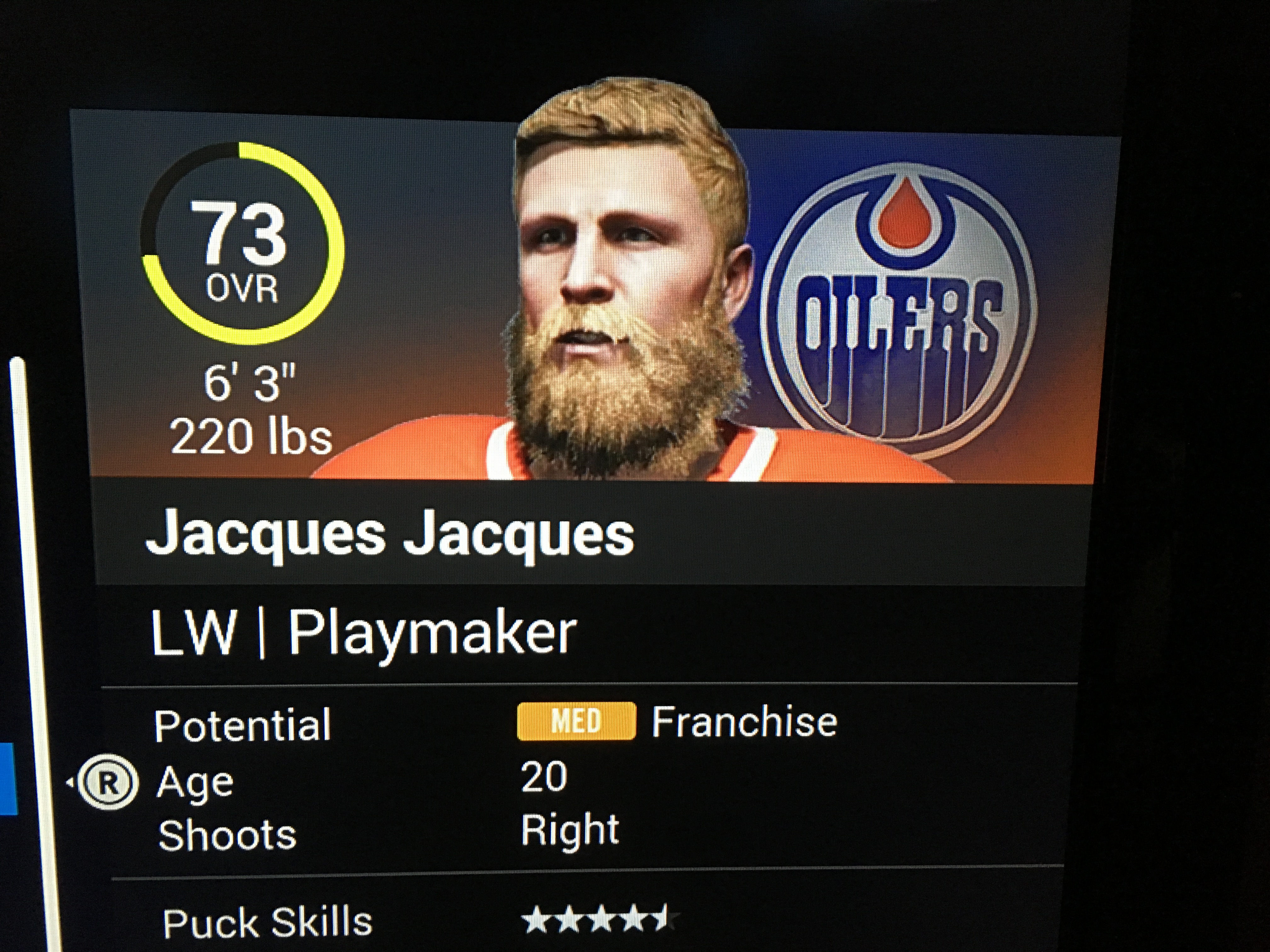
His name is Jacques Jacques. I wanted to make him have just one name like Pele or Cher, but the game wouldn’t let me. Regardless, Jacques was a last name prerecorded by the announcers, so it kind of sounds like they’re just using his one name. I even create a backstory for Jacques. Basically, he’s from somewhere outside Yellowknife, and he was discovered as a 17-year-old competing in unsanctioned MMA fights. He’d never played hockey because he was too busy logging or drilling for oil. But a scout found him and convinced him to learn hockey. It’s basically a mix between the plot of The Air Up There and Wolverine’s backstory from the first X-Men movie.

Jacques grows his playoff beard in November. That's how confident he is.
Jacques grows his playoff beard in November. That’s how confident he is.

Anyway, I played a whole minor league season with Jacques and ended up being the first overall pick. I was an Edmonton Oiler. The game, however, did not adjust the rest of the draft after that, so the Oilers still ended up with Connor McDavid. Needless to say, the Oilers are doing pretty well.

It’s kind of hard to explain everything I learned while trying to make my way through a digital hockey career, but the progress has been substantial.

I now understand things like general positioning — where the left winger should be in a given offensive formation. In the past, line changes always seemed so random to me, but now that I actually skate to the bench to rest, I’m starting to pick the best times to do so given where the puck, my teammates, and the opposing players are. I’m starting to decipher the fine lines surrounding what is and isn’t boarding and what is and isn’t interference. Whenever a goal is scored, I go to the replay to try and find out how. Where were the weaknesses in the defense? Who made a good play to get open? Was the goalie beat or was it a fluke deflection?

I see articles all the time about how schools are using games like Minecraft to teach kids things about teamwork and geometry and even basic computer programming. Educators have long used games as a teaching tool. And a silly as it sounds, NHL 15 and 16 honestly helped me learn about hockey. I now have a GameCenter subscription. I watch the Oilers and my hometown Wild or any other game that I find interesting. I’m understanding more and more why certain players or teams are really good.

I still have a lot of learning to do, but I can at least hold my own in a conversation with a hockey fan. I can detect a good play or a misstep when watching on live TV. I now have opinions that I yell at the TV.

Anyone can mindlessly play Madden or FIFA for hours on end. I’m not saying there isn’t value in that. But if one wants to really dig into the specifics and the minutiae of the sport, video games can actually be great for that too. I now know some stuff about hockey, which isn’t something I could have said two years ago. Now I just need to acquire a taste for lutefisk, and I’ll be a true Minnesotan.


Imagining a World Without ESPN

Imagine there’s no ESPN.
It’s easy if you try.
No broadcast partner intermediaries to charge us,
above us only direct access to sporting events live.
Imagine all the cord-cutters

living for today[, a day without ESPN].

Today, and for at least the past twenty years, it is difficult to imagine four letters more associated with sports in America than ESPN. Heck, as of 2006, there were at least four kids named ESPN, according to ESPN.com. The network invented the concept of a twenty-four-hour sports television channel at a time when ninety-three percent of the television audience restricted its viewing to ABC, CBS, and NBC, all of which still were signing off entirely each night. Part of the invention included SportsCenter, of course, but the network first established its national reputation when it broadcast the entire 1980 NCAA men’s basketball tournament.

While ESPN is thirty-six years old and living the starkly corporate lifestyle these days, its teenage years were wild, at least by broadcast television standards. In the 1990s, the network’s comparatively brash attitude provided it with a cultural identity that existed almost independent of sports. It may be difficult to remember this now, but it’s true: ESPN used to be cool. A selective timeline:

  • 1992: Keith Olbermann joins SportsCenter to host “the big show” alongside Dan Patrick
  • 1993: ESPN2 launches with Olbermann, Suzy Kolber, Stuart Scott, and, later, Jim Rome and Kenny Mayne, who would also work as a SportsCenter anchor; Craig Kilborn joins ESPN as a SportsCenter anchor; the modern era of College GameDay begins; ESPN.com launches
  • 1994: ESPN Presents: Jock Rock Vol. 1 is released, beginning a series of Jock Rock and Jock Jams audio CD releases that featured popular sports-related pump-up songs interspersed with clips of SportsCenter personalities like Patrick and Chris Berman dishing out their catchphrases
  • 1995: ESPN hosts the first X Games
  • 1996: Rich Eisen joins ESPN to host SportsCenter with Scott
  • 1998: The first ESPN Zone opens, in Baltimore’s Inner Harbor; Norm Macdonald hosts the ESPYs
  • 2000: Page 2 launches on ESPN.com, an alternative site that would feature the bylines of Ralph Wiley, Hunter Thompson, Scoop Jackson, and, of course, Bill Simmons
  • 2001: Pardon the Interruption debuts on ESPN
  • 2003: ESPN debuts Playmakers, the network’s first original drama series, about a fictional professional football team

Playmakers was a blend of Friday Night Lights, Entourage, and Hard Knocks, and, aside from the Sunday night NFL game and Saturday afternoon college football games, it was the most-viewed program on ESPN. Despite its wild popularity, the show was on the air for less than three months. Under pressure from then-NFL Commissioner Paul Taglibue, ESPN first restricted promotion of the show and then cancelled it. The NFL didn’t care for the way Playmakers portrayed NFL players — too realistic, it seems — and wanted the show off the air. Mark Shapiro, then the executive vice president of ESPN, defended the network’s decision to adhere to the NFL’s wishes: ”It’s our opinion that we’re not in the business of antagonizing our partner . . . . To bring it back would be rubbing it in our partner’s face.”

Action speaks louder than words, and the cancellation of Playmakers signaled a turning point for ESPN, which began to purge itself of the people and programs that had built its unique identity in the decade from 1993 to 2003. From the viewers’ perspective, it became clear that ESPN was removing anybody whose name had become bigger than the network’s.

That represents an interesting notion of network cohesion, but there really is one explanation for the shift that ESPN executed in the period beginning with the cancellation of Playmakers and running through the termination of Simmons earlier this year: the prioritization of live-sports broadcast rights. Beginning with the 1980 NCAA tournament (and its early agreements with smaller conferences like the Big East), and running through whichever Monday Night Football or SEC volleyball game you just watched, ESPN’s core programming is live sporting events. The network’s adolescent dalliance with original content and individual personalities a thing of the past (what are they doing with Mayne these days?), that live-sports core is almost all ESPN is in late 2015, the remainder largely consisting of an internal #hottake-generating echo chamber.

Live sports is what national sports networks are supposed to be all about, though, right? So where’s the problem? Yes, ESPN has competition now, but FS1, CBSSN, and NBCSN aren’t serious threats to the Worldwide Leader, at least for the moment. Each rival network has tried different approaches, with Dan O’Toole and Jay Onrait’s Olbermann/Patrick Big Show sendup on FS1, and CBSSN and NBCSN attempting to steal ESPN on-air talent (only to see that talent eventually return to the Mothership). But the organizing principle remains unchanged: for a rival to mount a legitimate challenge to ESPN, the accepted view is that those other national sports networks need more live sporting events, and right now, nobody beats ESPN in that department. By both inventing the medium and controlling the market for so long, ESPN has been able to raise the barriers to entry by gobbling up live sports broadcasting rights, starving its competitors of the programming they need to draw eyes to their channels (or the TV Guide to even find their channels) in the first place.

ESPN spends a boatload to make sure its collection of channels remain the go-to destination for live sports events, which are among the most valuable properties in all of television. That’s long been true, but it’s even more true today with the proliferation of advertisement-avoiding DVR technology. In 2015, it’s not unreasonable to begin binge-watching the entirety of The Good Wife, a drama that debuted in 2009, but nobody’s going to start catching up on all of the Vanderbilt baseball games they saved from back in the spring, championship-caliber MLB feeder program that the Commodores are. People watch games live or not at all. That’s why ESPN has unloaded billions of dollars for the right to broadcast live sporting events on their channels. The estimated numbers from FY 2015 provide an illuminating snapshot:

League
Annual Rights Fee
National Football League
$1.9 billion
Major League Baseball
$700 million
National Basketball Association
$600 million
Major League Soccer
$45 million
Wimbledon
$40 million
U.S. Open (Tennis)
$23.3 million
The Masters (Golf)
$25 million
British Open (Golf)
$25 million
College Football Playoff
$610 million
NCAA Championships
$42 million
ACC Sports
$240 million
Big Ten Sports
$100 million
Big 12 Sports
$110 million
Pac-12 Sports
$110 million
SEC Sports
$227 million*
American Athletic Sports
$18 million
Mountain West Sports
$9 million
Little League World Series
$7.5 million
TOTAL
$4.831 billion

* – ESPN splits SEC Network profits with the conference. The SEC received $150 million from ESPN’s primary rights deal, plus approximately $77 million from SEC Network for the 2014-15 season.

By leveraging its capitalization to corner the market on live-sports broadcasting rights, ESPN has insulated itself against serious competition from FS1 and the other national sports networks, to which are left the scraps. Think bull riding, arena football, and auto racing series you’ve never heard of. (Long live SPEED!) In the course of ensuring a low ceiling for its rival national sports networks, however, ESPN has become exposed to competition from another quarter. Rather than worry about its would-be peers, ESPN’s biggest threat now may be its own broadcast partners.

As we have been noting in our regular news roundups here, ESPN has been losing subscribers as a result of cord-cutting, people ditching traditional cable and satellite television providers, and now we have a number: seven million subscribers lost in the past two years. According to parent company Disney, ESPN now is down to 92 million subscribers. Cord-cutting is an obvious problem for the network because of its cost relative to other channels on viewers’ cable and satellite bills. ESPN relies on cost-spreading– everybody with a cable or satellite subscription pays for ESPN regardless of whether they watch it– to make its price more palatable to its actual users, and it relies on its robust portfolio of live sporting events to make itself so in-demand that everyone continues to pay those costs. The other side of that coin, of course, is that ESPN needs all of those subscriber fees to be able to afford its obligations under its broadcast-rights agreements. So far, it’s a model that’s worked very well for ESPN. But what if they lost those broadcast rights that make them a must-have component of every cable and satellite subscription?

ESPN’s programming portfolio, and those of its fellow national sports networks, is increasingly one-dimensional. Is The Doug Gottlieb Show really appointment viewing? Is Scott Van Pelt’s “midnight” SportsCenter? (what time does it start, exactly?) Nah. We’re all tuning in to watch the games. And without the games, would the remnant husks of networks be able to survive?

Perhaps a better question: why are sports leagues still selling off their broadcast rights? The NFL, MLB, NBA, and NHL all have their own television channels. (Some collegiate athletic conferences also have networks, although these tend to be more akin to partnerships between the conferences and existing television networks like ESPN and Fox, rather than independent media entities.)  They all have well-developed web platforms, and they all exercise control over the use and sharing of their content online, some more stringently than others. Yes, the NFL received a $1.9 billion check from ESPN last year for the right to broadcast Monday Night Football, but ESPN only cut that check because it knew that its broadcast of that event would allow it to make even more money. Why can’t the leagues eliminate these intermediary networks and realize an even greater portion of the value of their own broadcast rights?

This already is occurring to some extent. There are regular-season NFL games that appear only on NFL Network, and some MLB playoff games have appeared only on MLB Network. Cutting ESPN et al. out of the picture completely would require a not-insignificant capital investment, of course, to expand the leagues’ broadcast capabilities, but the issue merely is one of scale. It isn’t as difficult to create and operate MLB2 when MLB Network’s already up and running. The model exists and is replicable, as the national sports networks themselves have demonstrated. Most importantly, the leagues hold the most valuable asset in the equation. Their products essentially market themselves, and distribution follows demand, which, as everyone agrees, follows the games themselves.

That said, there are reasons why each of the leagues might hold differing views of such a large-scale shift.  For example, while NFL football games may be sufficiently popular on a national level to justify a move to NFL Network-exclusive broadcasting, the NHL might find that its 1,230 games per season are only nationally marketable when bundled with other sports and therefore decide to remain with its regional sports network-based broadcast infrastructure. Still, even if leagues like the NHL and MLB, which have long seasons full of many games that draw only regional interest, wouldn’t be good fits to go 100% national, we still could see them bringing marquee matchups, Winter Classics, and All-Star and postseason games exclusively onto the leagues’ own channels.

Are these the End Times for ESPN? Unless the leagues suddenly and rapidly retrench onto their own platforms, probably not. And if the thought of Roger Goodell, Rob Manfred, Adam Silver, and Gary Bettman executing any changes in their respective leagues that might be described as “sudden” or “rapid” made you laugh, it’s probably because you know that these leagues are conservative institutions that change slowly, if at all. In the end, maybe what ESPN & co. offer the leagues is a product-delivery method that, while not necessarily superior to or more profitable on a transaction-by-transaction basis than a league-owned channel, insulates the risk-adverse leagues from the shifting vagaries of the market, politics, and public opinion, all of which affect the sensitivities of the advertisers and corporate and civic sponsors who ultimately fund the leagues. So viva ESPN, the Worldwide Leader in sports-media insurance coverage.


Who Will Save GoPro?

Hey, remember GoPros? You might have one sitting in a closet or a drawer somewhere. Perhaps some well-meaning friend or family member got you one as a gift thanks to a great Black Friday deal, or you did the same for someone on your gift list. I have one. I can see it right now from where I’m sitting. It has footage of golf and curling and probably my dogs on it, but I wouldn’t know. To know, I’d have to unload the video files off the SD card onto my computer. And then what would I do with it? Shove it onto a hard drive somewhere? Back it up to the cloud where it will live a sad and lonely existence? Put it on YouTube? Much like the footage I’ve shot with my camera, GoPro is being left for dead.

Herein lies the problem with GoPro. It’s a great piece of hardware that provides output of limited value. It’s like if Gutenberg invented the printing press, but it was only capable of producing copies of Fifty Shades of Grey. A GoPro is one of things that seems like a good idea when you get it, like a wok or a pair of snowshoes. Any maybe you do use it for a time, but the novelty eventually wears off. It’s not GoPro’s fault. Its draw is the same as a wok or some snowshoes — GoPro isn’t just selling a product, it’s selling the idea of what your life could be like with that product. I’m gonna get my snowboard out of the garage and hook this thing up to it! I’m gonna strap this to my bike helmet and finally try navigating those trails! This is some Don Draper-level stuff. And then, like so many things in life, our hobbies of fantasy are put on the shelf. And the sales drop off. And that’s where GoPro sits. On your shelf, and on the sales lists of investors.

Sure, some people use GoPros for legitimate and genuinely great stuff. Some use them in very creative and engaging ways. And those people are really the core market of GoPro. But that market is niche and limited. The rest of use schlubs barely use the things. Even if we do, the cameras are so durable that we hardly have a need to replace or upgrade the models we currently own. GoPro has become a victim of its own success, it seems. And this is why the market is so bearish on them. GoPro might have hit its maximum saturation already. Throw in a new lawsuit and things start to get even more dicey.

But we should not mourn GoPro just yet. They have one very important thing going for them right now — they make really solid products. Startups are a dime a dozen these days, but one thing remains true; hardware is hard. With all due respect to software developers — seriously, many of them do amazing things — an app or a website can be set up with, all things considered, somewhat-minimal investment. A few laptops and a server instance can lead to great things in software. Hardware, on the other hand, takes a good deal more capital. There’s R&D. There’s prototyping. There’s contracts to be hashed out with manufacturers overseas and quality control and component sourcing. So when a company can break through all those barriers and produce a quality product, it’s a big deal. GoPro has already done that. They’re just having a hard time convincing the market to buy more of them. All the legit and wannabe thrill seekers have already procured GoPro cameras. GoPro needs a new gig, a new way to inject themselves into our lives. That’s where another company with deep pockets can come in and utilize the superior hardware into a new application.

So, who has the resources and possible need for such a thing? Here are a few ideas.

It should go without saying, but this is pure speculation on the author’s part and does not constitute advanced knowledge of the situation nor investment advice.

Google

This one seems like cheating since Google has enough money to acquire almost any company, but there could be a fit. Since Google spun off into a subsidiary of Alphabet, it’s clear that they’re not just in the search/advertising game any more. They are branching out. They already have a hardware company under their umbrella in Nest, and they own the biggest platform for GoPro content in the form of YouTube. Perhaps Google can package the cameras with a free software suite that allows GoPro footage uploads to be faster and easier. Maybe footage shot with GoPros can hit higher in the search ranks or be featured in promoted content. Could Google figure out a good solution to actually use a GoPro as a webcam? They have the engineering talent. Maybe selling these cameras as the all-in-one solution to create user content is how it comes into the hands of consumers again. And don’t forget that Google and GoPro have already collaborated on a new rig that will allow 360-degree filming for VR purposes.

Facebook/Oculus

Facebook made a big and somewhat unexpected splash when it entered the hardware market by acquiring Oculus. Oculus may be best known for making VR gaming hardware and software, but there is no reason it can’t get into the content-producing game. Much like the Google offering, Oculus could concoct a filming rig to produce content for their upcoming headsets, making it easier (and perhaps cheaper) for creators to create a VR environment. Why stop at gaming when the future of news and entertainment could hinge on the VR world?

Some other camera company

The analog company Fossil just got into the wearables game when it acquired Misfit. What’s to say an old-school camera company can’t make a similar push into the video field with GoPro? Canon and Nikon already are neck deep in the digital photography and video world. There are good reasons for bringing GoPro into the fold, either to bring the durable cameras into their product line or integrate GoPro tech to make SLR cameras more feature-rich. A hyper-durable SLR that can shoot HD video with the push of a button? Not a bad market to get into.

Samsung

Samsung has been trying to introduce their own ecosystem to rival Apple’s with limited success. They have their own VR division, of course, and everything they make seems to tie into the Galaxy family of products. If they could offer a piece of dedicated hardware that paired with both the consumption and production of VR content and have it specifically tie into the Galaxy line of products, they could bring another bargaining chip to the table when trying to covert iPhone users. Yeah, the iPhone camera might be good, but check out what you can make when you pair a Galaxy GoPro with a a Galaxy phone! Samsung has the capital and engineering chops to make a partnership like this work, if they chose to.

I don’t see the GoPro going extinct any time soon. I do see it becoming a product offering for another company, however. GoPro did all the heavy lifting here. It made the rock-solid product that’s easy and fun to use. They just need a little help from another entity to make a better use case for their cameras. It may be one of the companies mentioned above, it could be another entirely. But hardware is still hard. When an outlier like GoPro comes along, it doesn’t die a quick death. Like their cameras, GoPro can take a beating and still end up in great shape. Exactly who ends up with the final say in that shape they will take remains to be seen.