
A Short History of Video Game Baseball: Tornado Baseball
Four years have passed since Ralph Baer brought the thrill and excitement of baseball to your television via the Magnavox Odyssey and its three omnipresent white squares. The year is now 1976, and everyone is playing Pong, listening to Afternoon Delight and mourning the deaths of renowned Japanese electrical engineers Hidetsugu Yagi and Shintaro Uda. Magnavox has released two more home consoles, the 100 and 200, but it’s becoming clear that for the latest games, the burgeoning arcade scene is where, proverbially, it’s at.
We have the first ultra-violent video game, Death Race, based on the movie and rewarding players for running over stick-figure “gremlins” with their cars. Atari, with the help of Steve Jobs and Steve Wozniak, release the iconic Breakout. Meanwhile, Midway Games returned to the grand old game, releasing the two-player arcade Tornado Baseball.
Baseball grew up a lot in those four years. Players are no longer represented by squares, or even one of the more intricate quadrilaterals. Instead they are honest-to-God stick figures with arms and legs and saddle-sore thighs, sometimes locked in rigid half-wave, as though shielding themselves from an unmoving and broiling sun. Also, there are eight of them, the catcher deemed unnecessary for the cause.
Tornado Baseball is still black and white – color arcade games were known by this time, but still expensive and rare – but instead of projecting directly out of a screen, it is cleverly projected upwards onto a mirrored panel that adds grassy green and dirty brown. The game is two-player only still, and certain actions are still automated: runners travel a predestined number of bases per hit, and throws and catches are made by the fielders without waiting for advice from the player. (In the event of a double play, the second out is called before the throw reaches first, in pleasant Frank Drebin-style umpiring). Outfielders, in what will become a common refrain, move with synchronized precision.
Mechanically, Tornado Baseball looks far more like the modern arcade baseball game than the Odyssey’s version: the batter is at the bottom, the fielders spread out above him. I say batter, but we’re not ready for that yet: instead we see a floating bat that swings through the plate at the push of a button. The pitcher selects one of eight different types of pitches and then steers it, in that wonderfully odd Mario-jump way, left and right and slow and fast to deceive the hated bat. After contact, it’s 1972 again: the ball flies off the screen in a given direction, the bat transforms into a runner and gets 0-4 bases depending on where the ball disappears. Quoted from the manual: “The infielders automatically move to make the plays, which adds to the excitement of the game.” Sure.
It’s not a game that aged well. The timing aspect of hitting remains the same as the Odyssey version, but the aiming mechanic on the part of the hitter has been eliminated; now it’s just wait and click. Also, the advanced graphics actually only succeed in underscoring how limited the game is in other aspects. In an interesting bit of flavor, the players run on and off the field between innings, and defenders run to cover bases – the pitcher in particular loves to cover first, even when the first baseman is still standing there – but there’s no animation for throwing a ball, which makes the game look as if it’s being played by little puppets.
Tornado Baseball grew in several directions. On the arcade side, it saw three sequels, each with a new name and a handful of slight improvements. Double Play (1977) added a computer AI but removed four of the eight pitch-types. Extra Inning (1978, not pluralized) restores the lost four pitches and adds a extra-game prize for hitting six letters in the outfield. Extra Bases (1980) finally included a graphical overhaul, including color and rudimentary bleep-blorp sound.
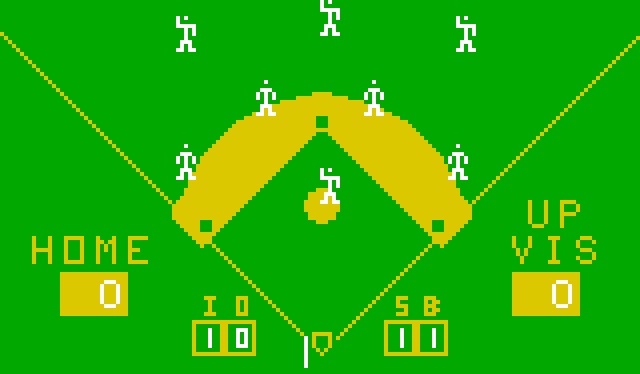
It was also a launch title for the now-forgotten Bally Astrocade, a home console from 1978. The Astrocade sold for a staggering $299 ($1,168.05 in 2014 dollars) and employed advanced technology for its era: the ability to display four of 256 colors onscreen at a time, 4k of RAM, 8k of ROM, and a glorious 160×102 resolution. Compare that to the Atari 2600 (128 colors, 128 bytes RAM, 4k ROM), released in the same year, and you can see why it paid to be rich in the late seventies, as in all other times.
It’s a rare case of the concurrent home port being far superior to the arcade original. Of the Midway baseball family, Tornado Baseball most resembles Extra Bases, released a full three years later. The limited resolution wreaks havoc on the font, and the stick-limbs of the players are a little more stick. It’s perhaps a bit of a disappointment, still feeling more like pachinko than sport. But if you loved baseball enough in 1977 to sink 1,196 quarters into it, the Astrocade was a cost-effective solution.
Patrick Dubuque is a wastrel and a general layabout. Many of the sites he has written for are now dead. Follow him on Twitter @euqubud.